


26 Sep UPSC Alert: Telangana Launches Sheep & Goat Insurance Scheme for Shepherds
✎ Sheep and goat insurance schemes reduce mortality risks for pastoralists by subsidising premiums, aligning with the National Livestock Mission’s goal of enhancing small ruminant productivity and resilience in dryland regions.
Subject Relevance — Where This Topic Fits
- GS Paper III — Agriculture, Animal Husbandry and Dairying | GS Paper III — Government Schemes and Policies | GS Paper III — Inclusive Growth and Rural Development
- Prelims: Livestock insurance, Animal Husbandry Infrastructure Development Fund (AHIDF), National Livestock Mission (NLM), Pradhan Mantri Kisan Samman Nidhi (PM-KISAN), Golla Kuruma community, Indiramma Bima Scheme
- Essay: Agrarian distress and the role of insurance in rural resilience, Sustainable livelihoods for pastoral communities: challenges and policy responses
Quick Revision: Sheep and goat insurance schemes reduce mortality risks for pastoralists by subsidising premiums, aligning with the National Livestock Mission’s goal of enhancing small ruminant productivity and resilience in dryland regions.
Why is this in the news?
The Government of Telangana launched a state-specific sheep and goat insurance scheme in Karimnagar district on 26 September 2026, with a subsidised premium of ₹13 per animal per year, aiming to mitigate mortality risks faced by pastoralists. This initiative underscores the intersection of livestock insurance as a climate-resilient livelihood strategy and the broader policy thrust on animal husbandry sector development in India.
Background
- Livestock rearing, particularly of small ruminants such as sheep and goats, constitutes a critical livelihood for marginal and small farmers in semi-arid and dryland regions of India, including Telangana.
- Small ruminant mortality due to diseases, drought, and predation remains a persistent challenge, leading to significant economic losses for pastoral communities.
- The National Livestock Mission (NLM), launched in 2014, seeks to enhance productivity and mitigate risks through insurance, breed improvement, and veterinary services.
- The Animal Husbandry Infrastructure Development Fund (AHIDF), operationalised under the Atmanirbhar Bharat stimulus package, provides financial support for infrastructure projects in the livestock sector.
- Telangana has a significant pastoralist population, including the Golla Kuruma community, which relies on sheep and goat rearing for income and nutritional security.
- The state’s Indiramma Bima Scheme provides life insurance coverage to vulnerable households, reflecting a broader social security architecture.
What is the Sheep and Goat Insurance Scheme in Telangana?
- The scheme is a state-funded livestock insurance programme designed to protect sheep and goat rearers against mortality losses due to diseases, natural calamities, or predation.
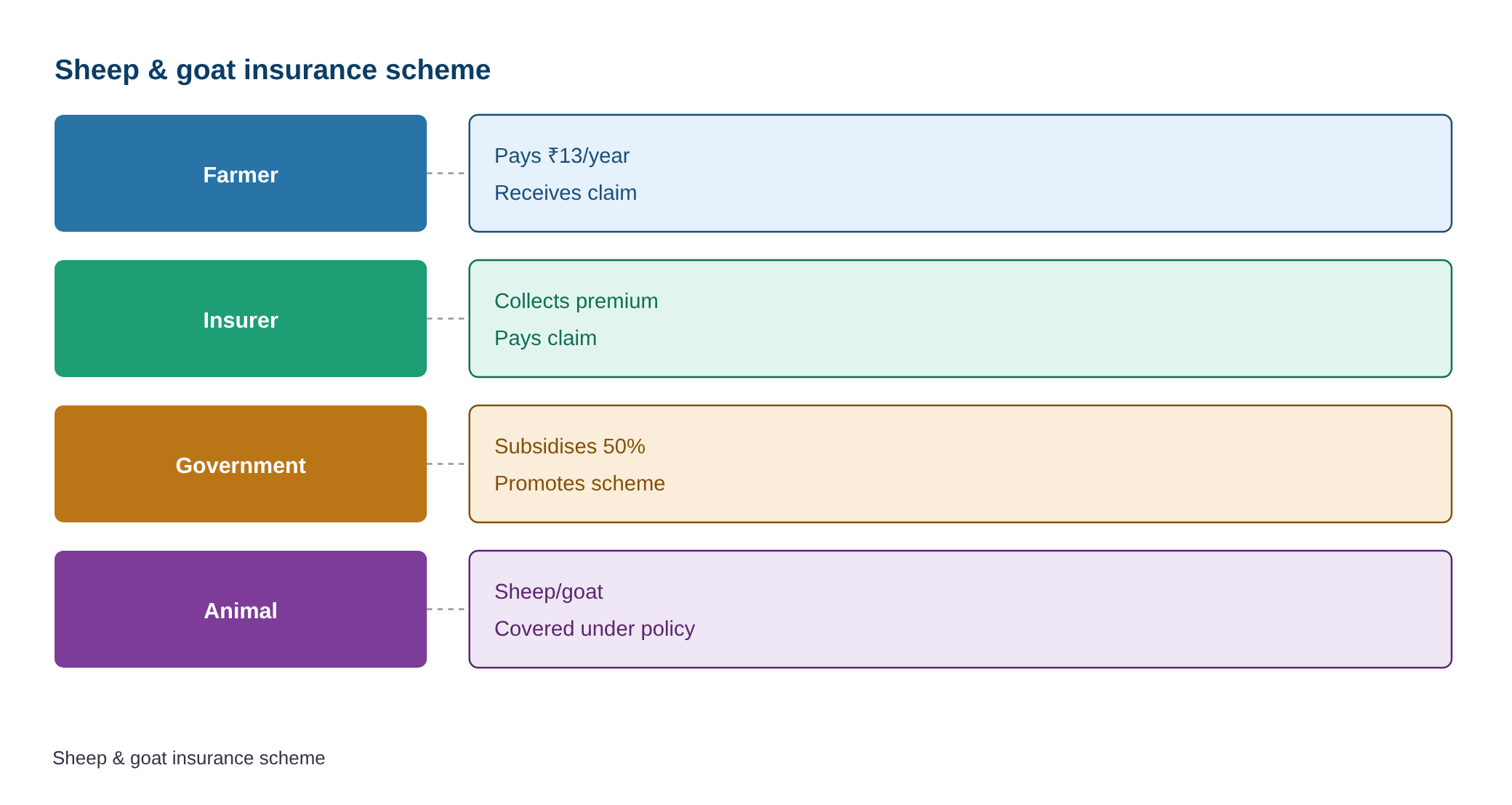
- The annual premium per animal is set at ₹13, with the state government bearing the remaining premium cost, making it highly affordable for small and marginal farmers.
- The scheme is implemented through cooperative societies, such as the Golla Kuruma societies in Karimnagar, which facilitate enrolment and claims processing.
- The scheme aligns with the National Livestock Mission’s objective of reducing mortality rates and improving productivity in small ruminant farming.
- It complements existing social security measures, such as the Indiramma Bima Scheme, by addressing livelihood risks specific to pastoral communities.
UPSC Value Addition
Keywords for Mains Answer-Writing
Livestock insurance schemes · Animal Husbandry sector reforms · Cooperative societies in agriculture · Risk mitigation in pastoralism · Subsidised insurance premiums · Government land allocation for livestock · Indiramma Bima scheme · Kisan Credit Card for small ruminants · Pastoralist welfare measures · Agricultural cooperative governance
Prelims Practice Questions
Q1. Consider the following statements regarding livestock insurance schemes in India:
1. The Government of India provides subsidised premiums for sheep and goat insurance under the National Livestock Mission.
2. The Indiramma Bima scheme offers life insurance coverage to members of cooperative societies.
3. The Kisan Credit Card scheme exclusively covers large ruminants like cattle and buffaloes.
How many of the above statements are correct?
- Only one
- Only two
- Only three
- None
Answer: Only two — Statement 1 is correct: The National Livestock Mission provides subsidised insurance for small ruminants. Statement 2 is correct: Indiramma Bima offers life insurance to cooperative society members. Statement 3 is incorrect: Kisan Credit Card covers both large and small ruminants.
Q2. Assertion (A): Livestock insurance schemes primarily aim to mitigate financial losses for farmers due to animal mortality.
Reason (R): The Government of India bears a significant portion of the insurance premium under these schemes to enhance adoption.
Options:
A. Both A and R are true, and R is the correct explanation of A.
B. Both A and R are true, but R is not the correct explanation of A.
C. A is true, but R is false.
D. A is false, but R is true.
- A
- B
- C
- D
Answer: A — Assertion (A) is true: Livestock insurance schemes aim to mitigate financial losses from animal mortality. Reason (R) is also true: The government bears a significant portion of the premium to promote adoption. R correctly explains A.
Q3. Match the following schemes with their primary objectives:
Column I (Scheme)
A. Indiramma Bima
B. Kisan Credit Card
C. National Livestock Mission
D. PM-KISAN
Column II (Objective)
1. Providing credit support to farmers
2. Income support to landholding farmers
3. Life insurance coverage to vulnerable groups
4. Risk mitigation for livestock rearing
Options:
A. A-3, B-1, C-4, D-2
B. A-1, B-2, C-3, D-4
C. A-4, B-3, C-2, D-1
D. A-2, B-4, C-1, D-3
- A
- B
- C
- D
Answer: A — A-3: Indiramma Bima provides life insurance. B-1: Kisan Credit Card offers credit support. C-4: National Livestock Mission mitigates livestock risks. D-2: PM-KISAN provides income support.
Mains Practice Question
✍ Critically examine the role of livestock insurance schemes in enhancing the welfare of pastoralist communities in India. Also, discuss the challenges in their implementation and suggest measures to improve their efficacy. (15 Marks)
Approach: MODEL-ANSWER SKELETON:
1. **Introduction (2 Marks)**
– Define pastoralism and its socio-economic significance in India (e.g., 20% of rural population dependent on livestock).
– Role of livestock in income security, employment, and food security.
2. **Livestock Insurance Schemes: Framework and Objectives (3 Marks)**
– National Livestock Mission (NLM) and state-level initiatives (e.g., Karimnagar scheme).
– Subsidised premiums (e.g., ₹13 per animal with government bearing the rest).
– Target beneficiaries: small and marginal farmers, cooperative societies.
– Link to Indiramma Bima for life insurance coverage.
3. **Impact on Pastoralist Welfare (4 Marks)**
– Risk mitigation: financial protection against mortality, disease, and natural disasters.
– Income stabilisation: reduced vulnerability to livestock losses.
– Empowerment of women: increased participation in cooperative societies (e.g., 3,200 members in 750 societies).
– Data: Cite any available statistics on reduction in livestock mortality or increase in adoption rates.
4. **Challenges in Implementation (3 Marks)**
– Low awareness and outreach in remote areas.
– High administrative costs and delays in claim settlements.
– Fragmented land holdings and lack of grazing rights.
– Climate change impacts (e.g., droughts, fodder scarcity).
– Cooperative governance issues: transparency, accountability, and member participation.
5. **Measures for Improvement (3 Marks)**
– Strengthening cooperative societies: capacity building, digitalisation, and financial literacy.
– Integration with Kisan Credit Card for credit access.
– Government land allocation for grazing and rearing infrastructure.
– Leveraging technology: AI/ML for early disease detection and claim processing.
– Public-private partnerships for reinsurance and risk pooling.
6. **Conclusion (2 Marks)**
– Summarise the transformative potential of livestock insurance.
– Emphasise the need for a multi-dimensional approach combining insurance, credit, and infrastructure.
Source: The Hindu
Telangana PCS (TGPSC (TSPSC)) — State PCS Practice
Prelims: Which of the following schemes was recently launched by the Telangana government in Karimnagar district to provide insurance coverage for sheep and goats?
- A. Ksheera Bharosa Scheme
- B. Sheep and Goat Insurance Scheme
- C. Rythu Bandhu Scheme
- D. Kalyana Lakshmi Scheme
Answer: B. Sheep and Goat Insurance Scheme — The scheme aims to protect livestock farmers from financial losses due to the death of sheep and goats by providing insurance coverage.
Mains: Discuss the significance of the recently launched Sheep and Goat Insurance Scheme in Karimnagar district for the agricultural economy of Telangana. Highlight its potential impact on livestock farmers and the state’s rural development.
Generated by AanyaAi for educational purpose.
Related guides on our sites
- Current affairs for upsc 2026
- Best PSIR optional coaching for upsc
- Best PSIR optional teacher for upsc
- Best teacher of PSIR optional for upsc

- यूक्रेन का रोबोट सेना अभियान: युद्ध में मानव हानि कम करने की रणनीति - September 27, 2026
- Ukraine’s ‘Army of Robots’: A Game-Changer for UPSC Mains 2026 Polity & Governance - September 27, 2026
- रूस ने भारत-ब्राजील को दिया UNSC स्थायी सदस्यता का समर्थन, जर्मनी-जापान विरोध में - September 27, 2026

No Comments