


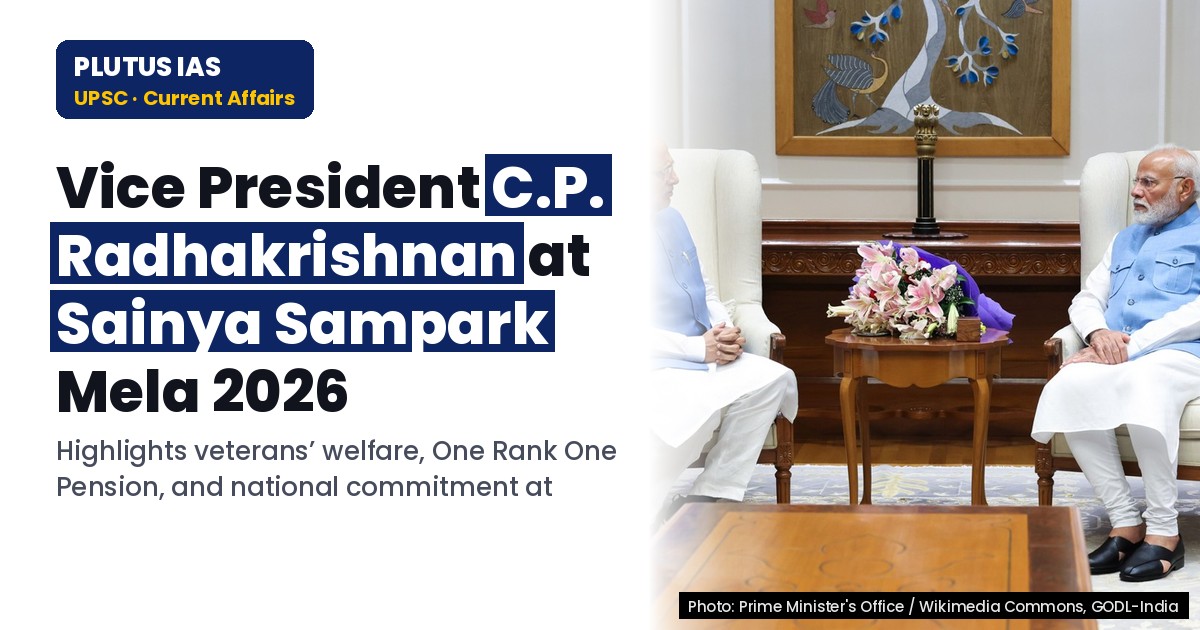
10 Oct UPSC Alert: Vice President at Jharkhand’s Sainya Sampark Mela 2026
✎ The Sainya Sampark Mela exemplifies the principle of ‘integrated governance’ in veterans’ welfare, where the Army, civil administration, and civil society converge to ensure that those who served the nation receive dignified…
Subject Relevance — Where This Topic Fits
- GS Paper II — Governance, Administration and Challenges — Welfare Schemes for Defence Personnel | GS Paper III — Security — Role of Armed Forces and Veterans’ Welfare
- Prelims: One Rank One Pension (OROP), Ex-Servicemen Contributory Health Scheme (ECHS), Sainya Sampark Mela, Veer Naris, Param Vir Chakra
- Essay: Sacrifice and Service: The Unseen Pillars of National Security, From Battlefield to Boardroom: Harnessing the Experience of Veterans
Quick Revision: The Sainya Sampark Mela exemplifies the principle of ‘integrated governance’ in veterans’ welfare, where the Army, civil administration, and civil society converge to ensure that those who served the nation receive dignified, timely, and comprehensive support.
Why is this in the news?
The Vice-President of India, Shri C. P. Radhakrishnan, visited the ‘Sainya Sampark Mela – Sadaiv Aapke Saath’ in Deoghar, Jharkhand, on 10 October 2026. The event, organised by the Indian Army in collaboration with the district administration, focused on delivering welfare services and grievance redressal to veterans, ‘Veer Naris’ (war widows), and their dependents. The visit underscored the constitutional and institutional imperative to honour the sacrifices of defence personnel and ensure their sustained welfare through integrated public service delivery.
Background
- The One Rank One Pension (OROP) scheme, implemented in 2015, ensures uniform pension for defence personnel retiring at the same rank with the same length of service, addressing long-standing demands for parity.
- The Ex-Servicemen Contributory Health Scheme (ECHS) was launched in 2003 to provide comprehensive healthcare to veterans and their dependents through a network of polyclinics and empanelled hospitals.
- Jharkhand has a rich legacy of military service and sacrifice, exemplified by the contributions of tribal freedom fighters such as Birsa Munda, Tilka Manjhi, Sidhu and Kanhu, and the martyrdom of Param Vir Chakra awardee Lance Naik Albert Ekka during the 1971 Indo-Pak War.
- The Sainya Sampark initiative is part of the Indian Army’s outreach programmes aimed at bridging the gap between the armed forces and civil society through welfare, awareness, and grievance redressal mechanisms.
Sainya Sampark Mela: Institutional Framework and Objectives
- The Sainya Sampark Mela is a flagship outreach programme of the Indian Army designed to provide a single-window platform for the delivery of welfare services to veterans, ‘Veer Naris’, and their families, ensuring timely redressal of grievances and access to entitlements.
- The event integrates multiple stakeholders including the Army, district administration, financial institutions, healthcare providers, and welfare agencies to deliver services such as pension disbursement, medical facilities, documentation support, and legal assistance under one roof.
- The ‘Sadaiv Aapke Saath’ (Always by Your Side) theme encapsulates the Army’s commitment to lifelong support for its personnel, recognising that their service extends beyond active duty into civilian life.
- Key services offered include the Ex-Servicemen Contributory Health Scheme (ECHS), pension-related assistance, disaster relief support, and awareness campaigns on health, education, and employment opportunities for dependents.
- The programme also serves as a platform for recognising the sacrifices of ‘Veer Naris’, who bear the emotional and social costs of military service, and highlights the need for societal recognition of their contributions.
- By fostering direct interaction between veterans, beneficiaries, and service providers, the Mela enhances transparency, trust, and efficiency in the delivery of welfare schemes.
Key Features
| Feature of the Sainya Sampark Mela | Significance |
|---|---|
| Single-window mechanism for welfare services | Ensures seamless delivery of pensions, medical facilities, documentation, and grievance redressal under one platform, reducing bureaucratic delays for veterans and Veer Naris. |
| Ex-servicemen Contributory Health Scheme (ECHS) services | Provides subsidised healthcare access to veterans and their families, addressing long-term medical needs post-service. |
| Disaster relief and emergency response displays | Demonstrates the integration of military expertise in national disaster management frameworks, highlighting dual-use capabilities. |
| Blood donation and health awareness camps | Promotes public health engagement and community service, fostering societal recognition of military contributions. |
| Interactive stalls on military equipment and NCC activities | Enhances public awareness of defence preparedness and youth engagement in national service through paramilitary and cadet programmes. |
Why it Matters
Institutional and Governance
- Demonstrates the Indian Army’s outreach programme to integrate veterans into civilian welfare ecosystems, reinforcing the principle of ‘One Rank, One Pension’ (OROP) through administrative coordination.
- Showcases the role of district administrations in implementing central welfare schemes at the grassroots level, exemplifying cooperative federalism.
- Highlights the synergy between the armed forces, civil administration, financial institutions, and healthcare providers in delivering targeted welfare services.
Social and Cultural
- Reaffirms societal gratitude towards veterans and Veer Naris, fostering national cohesion and remembrance of military sacrifices.
- Celebrates Jharkhand’s historical contributions to India’s freedom struggle, including tribal heroes like Birsa Munda and Tilka Manjhi, linking past and present service narratives.
- Promotes intergenerational dialogue by positioning veterans as mentors for youth, leveraging their experience for nation-building.
Strategic and Security
- Underscores the importance of ex-servicemen as a strategic resource for disaster management and national resilience, given their training in high-stress environments.
- Reinforces the message of ‘Nation First’ by aligning military welfare with broader national security paradigms, ensuring a motivated and supported defence ecosystem.
Challenges
1. Grievance Redressal and Pension Disbursement Delays
- Despite single-window systems, legacy issues in pension disbursement and documentation persist due to inter-departmental coordination gaps.
- Digital divide and lack of awareness among rural veterans may hinder effective utilisation of welfare services.
UPSC Link: GS II: Welfare schemes for vulnerable sections
2. Healthcare Access in Remote Areas
- Limited ECHS coverage in geographically challenging regions like Santhal Pargana necessitates mobile healthcare units and telemedicine solutions.
- Shortage of specialised medical facilities for veterans with service-related disabilities.
UPSC Link: GS II: Health infrastructure and services
3. Integration of Ex-Servicemen in Civilian Economy
- Skill mismatches between military training and civilian job markets require targeted vocational training and placement programmes.
- Stigma associated with post-retirement reintegration in certain sectors.
UPSC Link: GS III: Employment and skill development
4. Sustainability of Welfare Initiatives
- Long-term funding and resource allocation for veteran welfare programmes depend on fiscal priorities and economic conditions.
- Ensuring continuity across political transitions to prevent policy discontinuity.
UPSC Link: GS III: Government budgets and policies
Challenges — UPSC Perspective
| Challenge | Concern |
|---|---|
| Pension disbursement delays | Affects financial security of veterans, leading to hardship and administrative inefficiencies. |
| Limited ECHS coverage in rural areas | Restricts access to healthcare for veterans in geographically remote regions. |
| Digital literacy gaps among veterans | Hinders utilisation of online welfare portals and digital services. |
| Skill mismatch post-retirement | Creates employment challenges for ex-servicemen transitioning to civilian roles. |
| Inter-departmental coordination gaps | Leads to duplication of efforts or service gaps in welfare delivery. |
Government Initiatives — Must-Memorise for Prelims
- Ex-Servicemen Contributory Health Scheme (ECHS)
- One Rank One Pension (OROP)
- Sainya Sampark Mela initiative (Indian Army-led)
Way Forward
- Strengthen inter-departmental digital integration to expedite pension disbursement and grievance redressal.
- Expand mobile ECHS units and telemedicine services in underserved regions like Santhal Pargana.
- Launch targeted skill-upgradation programmes in collaboration with vocational training institutes for ex-servicemen.
- Enhance awareness campaigns through local self-government bodies to improve digital literacy among veterans.
- Establish a dedicated grievance monitoring cell within the Sainya Sampark Mela framework for real-time feedback.
- Promote public-private partnerships to create employment opportunities tailored to veterans’ skill sets.
- Integrate welfare data analytics to identify systemic bottlenecks and proactively address service gaps.
UPSC Value Addition
Keywords for Mains Answer-Writing
Ex-servicemen welfare · Armed Forces Veterans · One Rank One Pension (OROP) · Veer Naris · Sainya Sampark Mela · Defence Pension · Veterans’ Grievance Redressal · ECHS (Ex-Servicemen Contributory Health Scheme) · Constitutional Commitment to Veterans · Disaster Relief Services by Armed Forces · National Integration through Defence Initiatives · Tribal Freedom Fighters of Jharkhand · Defence Welfare Schemes · Single-Window Mechanism for Veterans
Concept Flow
Military service and sacrifice → Recognition of veterans’ contributions → Need for structured welfare delivery → Institutional mechanisms (e.g., Sainya Sampark Mela) → Grassroots implementation challenges → Policy reforms for sustainability.
Prelims Practice Questions
Q1. Consider the following statements regarding the Ex-Servicemen Contributory Health Scheme (ECHS):
1. ECHS is a flagship scheme of the Ministry of Defence to provide healthcare services to ex-servicemen and their dependents.
2. It operates through a network of polyclinics across India.
3. ECHS does not cover the treatment of pre-existing diseases.
4. ECHS beneficiaries are required to contribute a fixed annual premium.
How many of the above statements are correct?
- Only one
- Only two
- Only three
- All four
Answer: Only three — Statements 1 and 2 are correct. Statement 3 is incorrect as ECHS covers pre-existing diseases after a waiting period. Statement 4 is incorrect as the scheme is fully funded by the government and does not require beneficiaries to pay a premium.
Q2. Assertion (A): The One Rank One Pension (OROP) scheme ensures uniform pension for defence personnel retiring in the same rank with the same length of service, irrespective of the date of retirement.
Reason (R): OROP was implemented to address the demand for parity in pensionary benefits among ex-servicemen and was a key recommendation of the Koshyari Committee (2011).
- Both A and R are true, and R is the correct explanation of A
- Both A and R are true, but R is not the correct explanation of A
- A is true but R is false
- A is false but R is true
Answer: Both A and R are true, but R is not the correct explanation of A — OROP (A) ensures uniform pension for defence personnel retiring in the same rank with the same length of service, irrespective of the date of retirement. The Koshyari Committee (2011) recommended OROP to address pensionary disparities, making R the correct explanation of A.
Q3. Match the following welfare schemes with their respective implementing agencies:
Column I (Scheme) Column II (Implementing Agency)
A. Ex-Servicemen Contributory Health Scheme (ECHS) 1. Ministry of Defence
B. One Rank One Pension (OROP) 2. Ministry of Personnel, Public Grievances and Pensions
C. National Pension System (NPS) 3. Ministry of Finance
D. Integrated Defence Staff (IDS) 4. Ministry of Defence (through HQ IDS)
- A-1, B-2, C-3, D-4
- A-4, B-1, C-2, D-3
- A-1, B-3, C-2, D-4
- A-2, B-4, C-3, D-1
Answer: A-1, B-2, C-3, D-4 — ECHS is implemented by the Ministry of Defence (A-1). OROP is administered by the Ministry of Personnel, Public Grievances and Pensions (B-2). The National Pension System (NPS) is managed by the Ministry of Finance (C-3). The Integrated Defence Staff (IDS) operates under the Ministry of Defence through HQ IDS (D-4).
Mains Practice Question
✍ The Vice-President of India, while addressing the Sainya Sampark Mela in Deoghar, Jharkhand, underscored the need for a sustained national commitment to the welfare of ex-servicemen and Veer Naris. In this context, critically examine the constitutional and statutory framework governing the welfare of defence personnel in India. Also, assess the efficacy of recent initiatives such as the Sainya Sampark Mela in addressing the grievances of veterans and their families. (15 Marks)
Approach: MODEL-ANSWER SKELETON:
1. **Constitutional and Statutory Framework**:
– **Article 355**: Duty of the Union to protect every State against external aggression and internal disturbance.
– **Article 360**: Provision for financial emergency, which may impact defence allocations.
– **Article 361**: Protection and privileges of the President and Governors, not directly relevant but part of the constitutional ethos.
– **Defence Services Regulations and Acts**: The Army Act, 1950; The Navy Act, 1957; The Air Force Act, 1950 govern the administration and welfare of defence personnel.
– **Right to Life (Article 21)**: Includes the right to dignity, livelihood, and healthcare, which extends to ex-servicemen and their families.
– **Directive Principles of State Policy (DPSP)**: Articles 38, 39, 41, and 43A emphasize social justice, equitable distribution of resources, and workers’ participation in management, which can be linked to veterans’ welfare.
2. **Key Statutory Provisions and Schemes**:
– **One Rank One Pension (OROP)**: Implemented to ensure uniform pension for defence personnel retiring in the same rank with the same length of service, addressing historical disparities.
– **Ex-Servicemen Contributory Health Scheme (ECHS)**: Provides comprehensive healthcare services to ex-servicemen and their dependents through a network of polyclinics and empanelled hospitals.
– **Raksha Mantri’s Discretionary Fund**: Used for welfare measures, including financial assistance to needy ex-servicemen.
– **Resettlement and Rehabilitation Schemes**: Aimed at providing employment opportunities and vocational training to ex-servicemen.
– **Grievance Redressal Mechanisms**: Single-window systems like the Sainya Sampark Mela to address pension-related issues, medical facilities, and documentation services.
3. **Efficacy of Recent Initiatives**:
– **Sainya Sampark Mela**: A multi-stakeholder platform (Armed Forces, district administration, healthcare providers, financial institutions) to deliver welfare services at the grassroots level. Its success lies in its single-window mechanism, which reduces bureaucratic delays and enhances accessibility.
– **Challenges**: Limited reach in remote areas, lack of awareness among beneficiaries, and delays in implementation of schemes.
– **Comparative Analysis**: Compare with similar initiatives like the Kendriya Sainik Board’s welfare programmes or state-level veterans’ cells.
4. **Critical Assessment**:
– **Strengths**: The Mela model ensures last-mile delivery, integrates multiple stakeholders, and addresses both welfare and grievance redressal.
– **Weaknesses**: Sustainability of such events, scalability, and long-term impact on beneficiaries’ lives.
– **Way Forward**: Strengthening institutional mechanisms, leveraging technology (e.g., digital portals for pension tracking), and ensuring periodic evaluations to measure outcomes.
5. **Conclusion**:
– The constitutional and statutory framework provides a robust foundation for veterans’ welfare, but its efficacy depends on effective implementation.
– Initiatives like the Sainya Sampark Mela are commendable steps toward inclusive welfare but must be complemented by systemic reforms to ensure sustainability and impact.
Source: PIB (Press Information Bureau)
Jharkhand PCS (JPSC) — State PCS Practice
Prelims: Which of the following statements is correct regarding the recent visit of Vice President Shri C.P. Radhakrishnan to the Military Connectivity Fair in Deoghar, Jharkhand?
- The fair was organized to promote tourism and cultural heritage in Jharkhand.
- The visit aimed to strengthen defense ties and infrastructure development in the state.
- The event was exclusively focused on tribal welfare and land rights in Jharkhand.
- The fair was part of a national initiative to celebrate the 75th anniversary of India’s independence.
Answer: The visit aimed to strengthen defense ties and infrastructure development in the state. — The Military Connectivity Fair in Deoghar was organized to enhance defense infrastructure and connectivity in Jharkhand, aligning with national security priorities.
Mains: Discuss the significance of the Military Connectivity Fair in Deoghar, Jharkhand, from the perspective of state governance and regional development. How does such an initiative contribute to the socio-economic upliftment of tribal communities in the region?
Generated by AanyaAi for educational purpose.
Related guides on our sites
- Current affairs for upsc 2026
- How to prepare for GS paper 1 for UPSC CSE mains exam
- Best UPSC coaching for IFOS exam
- Best mentorship programme for upsc

- UPSC Alert: Vice President at Jharkhand’s Sainya Sampark Mela 2026 - October 10, 2026
- तरंग शक्ति 2026: रक्षा मंत्री ने आत्मनिर्भरता और अंतरराष्ट्रीय सहयोग पर दिया जोर - October 10, 2026
- How RBI’s New Rupee Defence Strategy Mirrors China’s Playbook - October 10, 2026

No Comments