


28 Jul UPSC Alert: World’s Largest Grain Storage Scheme in Cooperative Sector
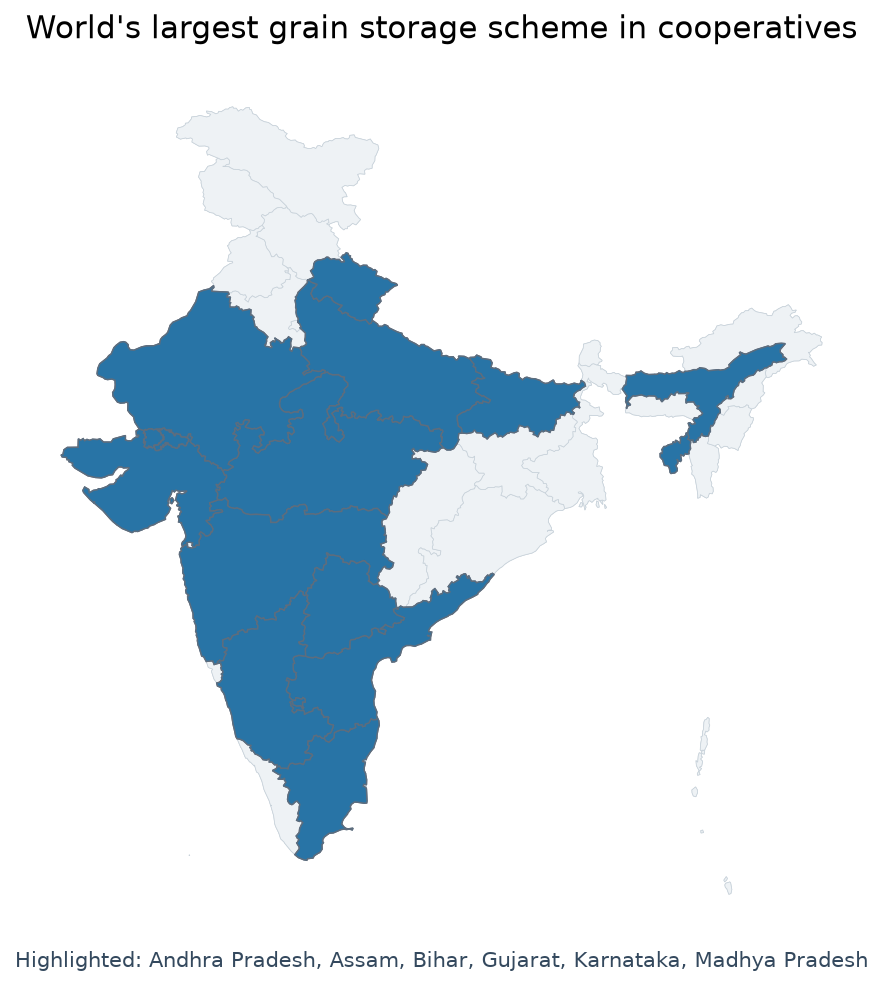
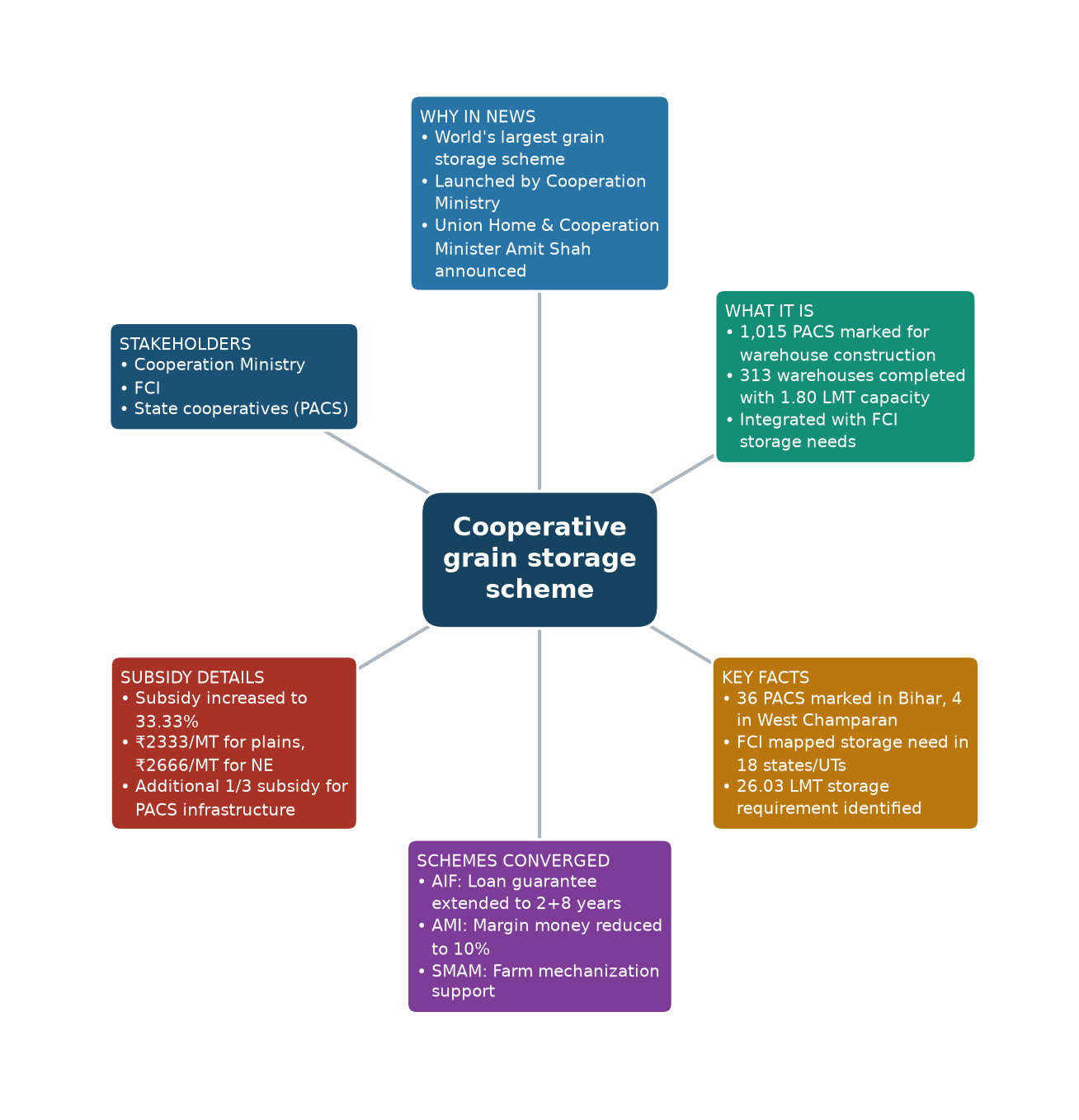
Map & concept mind-map: World’s largest grain storage scheme in cooperatives
Subject Relevance — Where This Topic Fits
- GS Paper III — Agriculture | GS Paper III — Food Security and PDS | GS Paper III — Infrastructure Development | GS Paper II — Government Policies and Interventions
- Prelims: Cooperative Societies (Amendment) Act, 2023, Agricultural Infrastructure Fund (AIF), Food Corporation of India (FCI), Primary Agricultural Credit Societies (PACS), Minimum Support Price (MSP), Public Distribution System (PDS)
- Essay: The Role of Cooperatives in India’s Agricultural Transformation, Sustainable Agricultural Infrastructure: Balancing Growth and Equity
Quick Revision: The scheme integrates AIF, AMI, SMAM, and PMFME to create 1.80 LMT storage capacity in 313 PACS across 14 states, with 9-year rental assurance for godowns ≥2,500 MT, reducing margin money to 10% and increasing subsidy to 33.33%.
Why is this in the news?
The Union Ministry of Cooperation announced the implementation of the world’s largest grain storage scheme in the cooperative sector, marking a paradigm shift in India’s agricultural infrastructure development. This initiative, launched under the aegis of the ‘World’s Largest Grain Storage Scheme in Cooperative Sector,’ aims to address critical gaps in storage capacity, reduce post-harvest losses, and enhance the bargaining power of farmers by leveraging cooperative networks. The scheme integrates multiple existing government programs and aligns with the Food Corporation of India’s (FCI) storage requirements, thereby creating a robust ecosystem for grain management and food security.
Background
- India’s agricultural sector contributes approximately 18% to the national GDP and employs over 40% of the workforce, yet faces significant challenges in post-harvest infrastructure, including inadequate storage facilities and high wastage rates (estimated at 6-7% of total production).
- The existing storage capacity in India is estimated at 60-70 million metric tonnes (MMT), against a requirement of 100 MMT, necessitating urgent augmentation to meet the demands of the Public Distribution System (PDS) and buffer stock requirements.
- Cooperatives, particularly Primary Agricultural Credit Societies (PACS), have historically played a pivotal role in credit disbursement and input supply but have limited engagement in large-scale infrastructure development due to financial and technical constraints.
- The scheme aligns with the government’s broader vision of doubling farmers’ income by 2024-25 and achieving self-reliance in food security, as outlined in the National Mission on Sustainable Agriculture (NMSA) and the Doubling Farmers’ Income (DFI) report.
- The Food Corporation of India (FCI) has identified storage requirements in 216 locations across 18 states/UTs, necessitating an estimated 26.03 million metric tonnes (MMT) of additional storage capacity to mitigate logistical bottlenecks and ensure efficient grain distribution.
- The scheme is a convergence of multiple central sector schemes, including the Agricultural Infrastructure Fund (AIF), Agriculture Marketing Infrastructure (AMI) Scheme, Sub-Mission on Agricultural Mechanization (SMAM), and Pradhan Mantri Formalization of Micro Food Processing Enterprises (PMFME) Scheme, to create a holistic agricultural ecosystem.
What is the World’s Largest Grain Storage Scheme in the Cooperative Sector?
- The scheme is a centrally sponsored initiative aimed at creating world-class storage infrastructure across India’s cooperative sector, primarily through the construction of godowns (warehouses) at the Primary Agricultural Credit Societies (PACS) level, with construction work completed in 313 PACS across 14 states, creating a total capacity of 1.80 lakh metric tonnes (LMT).
- The scheme integrates multiple existing government programs—Agricultural Infrastructure Fund (AIF), Agriculture Marketing Infrastructure (AMI) Scheme, Sub-Mission on Agricultural Mechanization (SMAM), and PMFME Scheme—to ensure financial viability, technical support, and convergence of resources for comprehensive agricultural infrastructure development.
- The scheme includes the creation of ancillary infrastructure such as custom hiring centers, processing units, fair-price shops, internal roads, weighing bridges, and boundary walls to enhance the operational efficiency of PACS and other cooperatives.
- Financial incentives have been revised to improve accessibility: the margin money requirement under the AMI Scheme has been reduced from 20% to 10%, while the subsidy has been increased from 25% to 33.33% (₹2,333/MT for plain areas and ₹2,666/MT for northeastern states).
- The scheme provides a uniform rental assurance of 9 years for godowns with a capacity of 2,500 MT or more (1,671 MT for northeastern and hilly regions), ensuring long-term viability for cooperatives and private investors.
- The Food Corporation of India (FCI) has mapped its storage requirements in 216 locations across 18 states/UTs, and the scheme ensures alignment with FCI’s needs to optimize grain storage and distribution logistics.
- The initiative is expected to reduce post-harvest losses, improve farmers’ income by enabling better price realization through reduced intermediation, and strengthen the cooperative sector’s role in India’s agricultural value chain.
Key Features
| Feature | Significance |
|---|---|
| Scale and Coverage | Identifies 1,015 PACS nationwide for warehouse construction, with 313 already completed, creating 1.80 lakh metric tonne storage capacity; integrates with FCI’s mapped storage needs across 18 states/UTs. |
| Multi-Scheme Convergence | Leverages existing schemes—AIF, AMI, SMAM, PMFME—under a unified framework to create warehouses, custom hiring centres, processing units, and fair-price shops at PACS/cooperative levels. |
| Financial Incentives | Revised guidelines include enhanced subsidies (25% to 33.33%), reduced margin money (20% to 10%), and extended loan guarantee periods (2+5 to 2+8 years) to improve financial viability. |
| Regional Prioritisation | Higher construction costs (₹7,000/MT for plains, ₹8,000/MT for NE) and subsidies (₹2,333/MT for plains, ₹2,666/MT for NE) reflect regional disparities in agricultural infrastructure development. |
| FCI Integration | Aligns cooperative storage capacity with FCI’s identified needs (26.03 lakh MT across 216 locations in 18 states/UTs), ensuring demand-driven infrastructure creation. |
Why it Matters
Agricultural Productivity and Market Efficiency
- Reduces post-harvest losses by providing decentralised storage infrastructure, particularly for small and marginal farmers who lack individual storage facilities.
- Enhances price discovery and market access for farmers by integrating storage with processing and fair-price distribution networks.
- Supports agricultural mechanisation (SMAM) and food processing (PMFME) through backward linkages, improving value addition and farmer incomes.
Cooperative Sector Strengthening
- Empowers Primary Agricultural Credit Societies (PACS) as nodal agencies for rural infrastructure, fostering cooperative-led development models.
- Promotes financial sustainability of cooperatives by linking storage infrastructure with credit (AIF) and market access (AMI).
- Encourages aggregation of small landholdings, enabling economies of scale in storage, processing, and marketing.
Food Security and Supply Chain Resilience
- Aligns with FCI’s storage requirements, reducing logistical bottlenecks and ensuring buffer stocks for public distribution systems.
- Mitigates regional imbalances in storage capacity, particularly in eastern and northeastern states where infrastructure deficits are acute.
- Supports climate-resilient agriculture by enabling better post-harvest management and reducing wastage in vulnerable regions.
Policy Convergence and Governance
- Demonstrates inter-ministerial coordination by integrating multiple central schemes under a single umbrella, reducing duplication and improving resource utilisation.
- Enhances transparency and accountability through standardised guidelines, financial norms, and state-wise mapping of storage needs.
- Sets a precedent for future infrastructure convergence models in other sectors like dairy, horticulture, and rural logistics.
Challenges
1. Implementation Bottlenecks
- Land acquisition and regulatory clearances may delay construction, particularly in densely populated or ecologically sensitive regions.
- Coordination gaps between central schemes, state agencies, and PACS could lead to suboptimal utilisation of infrastructure.
- Financial viability concerns for PACS in low-income states, despite subsidies, may require additional handholding or risk-sharing mechanisms.
UPSC Link: GS3: Agricultural Marketing and Infrastructure
2. Regional Disparities
- Northeastern and hilly states face higher construction costs and logistical challenges, necessitating tailored solutions beyond standardised norms.
- Eastern states like Bihar, with high agricultural potential but low storage capacity, require accelerated implementation to bridge the gap.
- Disparities in PACS capacity and governance across states may lead to uneven development outcomes.
UPSC Link: GS3: Regional Imbalances in Development
3. Sustainability and Maintenance
- Long-term operational viability of warehouses depends on efficient management, maintenance, and utilisation by PACS and farmers.
- Climate change risks, such as extreme weather events, may compromise storage infrastructure if not accounted for in design and location planning.
- Ensuring equitable access to storage facilities for all farmer categories, including tenant farmers and women-led cooperatives, remains a challenge.
UPSC Link: GS3: Sustainable Agriculture and Climate Resilience
4. Technology and Digital Integration
- Lack of digital infrastructure (e.g., inventory management systems, IoT-enabled storage monitoring) may limit the scheme’s efficiency gains.
- Integration with existing digital platforms (e.g., e-NAM, PM-KISAN) requires robust data-sharing mechanisms to avoid fragmentation.
- Cybersecurity risks in financial transactions and data management need proactive mitigation strategies.
UPSC Link: GS3: Science and Technology in Agriculture
5. Farmer Awareness and Participation
- Low awareness among small and marginal farmers about the scheme’s benefits and utilisation processes may hinder adoption.
- Cultural and social barriers in cooperative governance could impede effective participation by marginalised communities.
- Training and capacity-building initiatives for PACS members are essential to ensure sustainable utilisation of infrastructure.
UPSC Link: GS2: Inclusive Development and Governance
Challenges — UPSC Perspective
| Issue | Concern |
|---|---|
| Land Acquisition | Delays due to regulatory hurdles, litigation, or opposition from local communities. |
| Financial Viability of PACS | Subsidies may not cover operational costs, leading to underutilisation or abandonment of infrastructure. |
| Regional Disparities | Higher costs and logistical challenges in NE/hilly states may deter private or cooperative participation. |
| Technology Integration | Lack of digital tools for inventory management and real-time monitoring reduces efficiency. |
| Farmer Participation | Low awareness and trust in cooperatives may limit utilisation of storage facilities. |
| Climate Resilience | Extreme weather events pose risks to storage infrastructure and stored produce. |
Government Initiatives — Must-Memorise for Prelims
- Agriculture Infrastructure Fund (AIF)
- Agricultural Marketing Infrastructure Scheme (AMI)
- Sub-Mission on Agricultural Mechanization (SMAM)
- Pradhan Mantri Formalisation of Micro Food Processing Enterprises (PMFME)
Way Forward
- Accelerate land acquisition and regulatory clearances through single-window clearance mechanisms for PACS-led projects.
- Strengthen PACS governance by providing training in cooperative management, financial literacy, and digital tools.
- Enhance financial sustainability by linking storage infrastructure with agri-credit (AIF) and market linkages (e-NAM).
- Develop region-specific guidelines for NE/hilly states, including higher subsidies and tailored construction norms.
- Integrate digital platforms (e.g., e-NAM, PM-KISAN) with storage infrastructure for real-time monitoring and inventory management.
- Promote public-private partnerships (PPPs) for large-scale warehouses in high-potential regions to supplement cooperative efforts.
- Conduct awareness campaigns in local languages to educate farmers on scheme benefits, utilisation processes, and cooperative roles.
- Establish a monitoring framework with third-party audits to assess utilisation rates, financial health of PACS, and impact on farmer incomes.
UPSC Value Addition
Keywords for Mains Answer-Writing
Cooperative sector reforms · Agricultural infrastructure convergence · Food Corporation of India storage mapping · Agriculture Infrastructure Fund (AIF) · Agricultural Marketing Infrastructure (AMI) Scheme · Sub-Mission on Agricultural Mechanization (SMAM) · PM Formalization of Micro Food Processing Enterprises (PMFME) · Primary Agricultural Credit Societies (PACS) · Uniform rent assurance for warehouses · Northeast and hilly region agricultural logistics
Concept Flow
Post-harvest losses → Need for decentralised storage infrastructure → Identification of PACS as nodal agencies → Convergence of central schemes (AIF, AMI, SMAM, PMFME) → Construction of warehouses and allied infrastructure → Integration with FCI’s storage needs → Enhanced market efficiency and farmer incomes → Strengthening of cooperative sector and rural economy.
Prelims Practice Questions
Q1. Consider the following statements regarding the ‘World’s Largest Grain Storage Scheme in the Cooperative Sector’: 1. It aims to create storage capacity of 1.80 lakh metric tonnes through 313 completed warehouses. 2. The scheme integrates storage requirements mapped by the Food Corporation of India across 18 states/UTs. 3. Uniform rent assurance for warehouses is provided for a period of 9 years. Which of the statements given above are correct?
- 1 and 2 only
- 2 and 3 only
- 1 and 3 only
- 1, 2 and 3
Answer: 1, 2 and 3 — Statement 1 is correct as 313 warehouses with 1.80 lakh metric tonnes capacity have been completed. Statement 2 is correct as FCI has mapped storage requirements in 18 states/UTs. Statement 3 is correct as uniform rent assurance is provided for 9 years.
Q2. Which of the following is NOT a component of the convergence approach under the ‘World’s Largest Grain Storage Scheme’?
- Construction of warehouses by PACS
- Establishment of custom hiring centers
- Setting up of food processing units
- Direct procurement of food grains by the central government
Answer: Direct procurement of food grains by the central government — The convergence approach includes creation of warehouses, custom hiring centers, and food processing units at PACS level, but does not involve direct procurement of food grains by the central government.
Q3. The revised financial parameters under the Agricultural Marketing Infrastructure (AMI) Scheme include: 1. Reduction in margin money requirement from 20% to 10%. 2. Increase in subsidy from 25% to 33.33%. 3. Uniform construction cost across all regions. Which of the statements given above are correct?
- 1 and 2 only
- 2 and 3 only
- 1 and 3 only
- 1, 2 and 3
Answer: 1 and 2 only — Statement 1 and 2 are correct as per the revised guidelines. Statement 3 is incorrect as construction cost varies by region (plain areas: ₹7000/MT; Northeast: ₹8000/MT).
Mains Practice Question
✍ Examine the significance of the ‘World’s Largest Grain Storage Scheme in the Cooperative Sector’ for India’s agricultural supply chain management. How does the scheme address the challenges of post-harvest losses and price volatility in agricultural commodities? Discuss the role of convergence of existing central schemes in achieving these objectives.
Approach: The answer must highlight the scheme’s dual objectives: (1) augmenting storage infrastructure through PACS-led warehouses, custom hiring centers, and processing units, and (2) integrating with FCI’s mapped storage requirements to reduce post-harvest losses and stabilize prices. Discuss the convergence of AIF, AMI, SMAM, and PMFME as a multi-dimensional strategy to enhance agricultural logistics, mechanization, and market linkages. Elaborate on the financial incentives (e.g., subsidy hikes, margin money reduction) and their impact on viability for cooperatives, particularly in Northeast and hilly regions. Conclude with the scheme’s potential to strengthen the cooperative sector’s role in India’s food security framework.
Source: PIB (Press Information Bureau)
Generated by AanyaAi for educational purpose.

- उत्तराखंड में असिस्टेंट प्रोफेसर भर्ती: यूकेपीएससी करेगा चयन, जानिए बदलाव - September 22, 2026
- UKPSC to Recruit Assistant Professors in Uttarakhand Aided Colleges: Draft Policy - September 22, 2026
- हिमाचल में नदियों से रेत-बजरी निकालने पर सरकार ने लगाई रोक, जानिए नए नियम - September 22, 2026

No Comments