


11 Aug UPSC Alert: ₹19,216 Cr SC Scholarships Released in 3 Years
Scheduled Caste studentsScholarship schemesDirect Benefit TransferMinistry of Social JusticeFinancial disbursement✎ Direct Benefit Transfer (DBT) and the National Scholarship Portal (NSP) have transformed the disbursement of scholarships for Scheduled Caste students, reducing delays and leakages while ensuring transparency and accountability…
Subject Relevance — Where This Topic Fits
- GS Paper II — Welfare Schemes for Vulnerable Sections of the population by the Centre and States and the Performance of these Schemes | GS Paper III — Issues relating to Direct Benefit Transfers and Financial Inclusion
- Prelims: Scheduled Castes (SCs), Direct Benefit Transfer (DBT), Pre-Matric Scholarship, Post-Matric Scholarship, National Overseas Scholarship (NOS), Central Sector Schemes, Centrally Sponsored Schemes, Union Budget, Ministry of Social Justice and Empowerment
- Essay: The Role of Public Policy in Bridging Socio-Economic Inequalities in India, Technology as an Enabler in Governance: The Case of Scholarship Disbursement
Quick Revision: Direct Benefit Transfer (DBT) and the National Scholarship Portal (NSP) have transformed the disbursement of scholarships for Scheduled Caste students, reducing delays and leakages while ensuring transparency and accountability in public expenditure.
Why is this in the news?
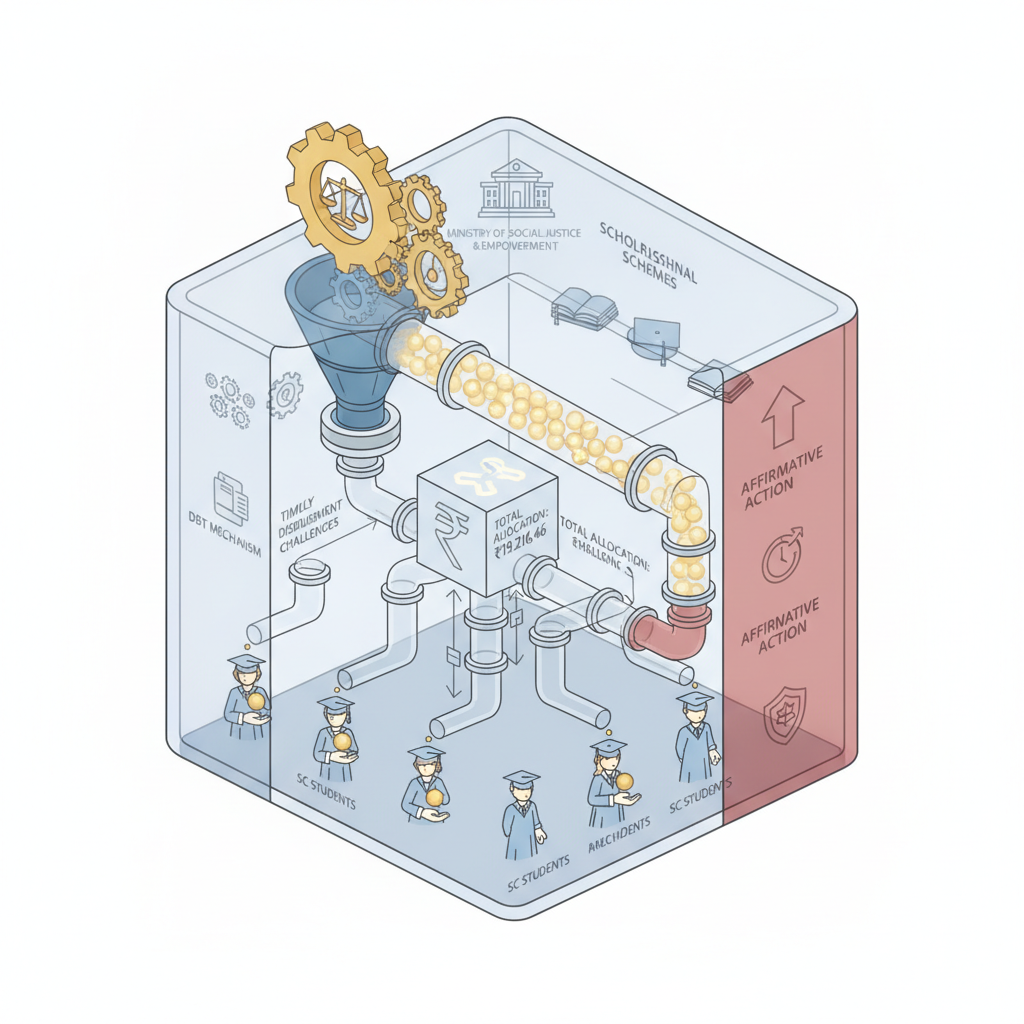
The Ministry of Social Justice and Empowerment, Government of India, has reported the disbursement of ₹19,216.46 crore under various scholarship schemes for Scheduled Caste (SC) students over the last three financial years (2023-24 to 2025-26). This development highlights the scale of affirmative action through financial assistance, the utilisation of Direct Benefit Transfer (DBT) mechanisms, and the structural challenges in timely disbursement that persist despite reforms.
Background
- The Constitution of India, under Articles 15(4) and 16(4), empowers the State to make special provisions for the advancement of socially and educationally backward classes, including Scheduled Castes (SCs).
- The Union Government, through the Ministry of Social Justice and Empowerment, administers multiple scholarship schemes for SC students to mitigate educational disparities arising from socio-economic disadvantages.
- The Pre-Matric Scholarship Scheme for SCs and Others and the Post-Matric Scholarship Scheme for SCs are Centrally Sponsored Schemes (CSS), implemented in collaboration with State governments and Union Territories.
- The National Overseas Scholarship (NOS) and the Scheme for Higher Education for Young Achievers in SC (SHRESHTA-SC) are Central Sector Schemes (CS), fully funded and implemented by the Centre.
- The implementation of scholarship schemes has evolved with the adoption of Direct Benefit Transfer (DBT) to reduce leakages and delays, aligning with the JAM (Jan Dhan-Aadhaar-Mobile) trinity framework.
- The Union Budget 2021-22 introduced the revamped Post-Matric Scholarship Scheme for SC students with enhanced central funding and stricter monitoring mechanisms.
Direct Benefit Transfer (DBT) and Digital Governance Reforms
- The adoption of DBT under scholarship schemes has significantly reduced delays and leakages in fund disbursement, aligning with the government’s Digital India and JAM trinity initiatives.
- Aadhaar seeding of beneficiary bank accounts has enabled real-time tracking of scholarship payments, reducing instances of fraud and duplication.
- The National Scholarship Portal (NSP) serves as a single-window platform for application, processing, and disbursement of scholarships, enhancing transparency and efficiency.
- Regular reviews and capacity-building programmes for state officials have been institutionalised to address bottlenecks in implementation, including delays in state contributions under CSS.
Key Features
| Feature | Significance |
|---|---|
| Direct Benefit Transfer (DBT) Mechanism | Ensures timely disbursement of scholarship funds by eliminating intermediaries, reducing delays and leakages in the distribution process. |
| Regular Review Mechanism | Periodic evaluation of scholarship schemes to identify bottlenecks, streamline processes, and address grievances efficiently. |
| Capacity Building Initiatives | Training programs for state officials and stakeholders to enhance administrative efficiency in scholarship disbursement. |
| State-wise Allocation Distribution | Demonstrates equitable allocation of central funds to states based on demand and demographic needs of SC students. |
| Multi-Scheme Integration | Consolidation of multiple scholarship schemes under a unified framework for better monitoring and impact assessment. |
Why it Matters
Economic
- Allocates ₹19,216.46 crore over three years, directly enhancing financial accessibility for SC students, thereby reducing economic barriers to higher education.
- Supports human capital development by funding post-matric and pre-matric education, contributing to long-term economic productivity.
- Stimulates state-level expenditure in education through matching contributions, fostering collaborative governance in social welfare.
Social
- Promotes educational equity by providing targeted financial support to SC students, addressing historical disparities in access to education.
- Encourages higher enrolment and retention rates among SC students, particularly in higher education, through sustained financial incentives.
- Reduces dropout rates by mitigating financial constraints, thereby improving socio-economic mobility for marginalised communities.
Administrative
- Demonstrates the efficacy of DBT in public welfare schemes, serving as a model for other centrally sponsored social sector initiatives.
- Highlights the role of inter-governmental coordination between the Centre and states in implementing welfare programs effectively.
- Showcases the use of digital platforms (e.g., central portals) for transparent and accountable fund disbursement.
Challenges
1. Delays in Disbursement
- Despite DBT, delays in scholarship disbursement persist due to administrative bottlenecks in state-level processing.
- Lack of real-time tracking systems for scholarship applications and disbursements hampers transparency and accountability.
- Inadequate grievance redressal mechanisms for beneficiaries facing payment delays or errors.
UPSC Link: GS2: Welfare schemes for vulnerable sections
2. State-Level Implementation Gaps
- Variations in state capacity to utilise central funds efficiently, leading to underutilisation or misallocation in some regions.
- Non-uniformity in state matching contributions, creating disparities in scholarship availability across states.
- Bureaucratic inertia and lack of coordination between state departments responsible for scholarship disbursement.
UPSC Link: GS2: Centre-State relations
3. Digital Divide and Exclusion
- SC students in remote or economically disadvantaged areas may lack access to digital infrastructure required for seamless DBT transactions.
- Low digital literacy among beneficiaries and their families poses challenges in availing scholarship benefits without external assistance.
- Cybersecurity risks, such as fraud or data breaches, in online scholarship portals.
UPSC Link: GS2: E-governance and digital inclusion
4. Monitoring and Evaluation Deficits
- Limited real-time data on the actual utilisation of scholarship funds by beneficiaries, hindering impact assessment.
- Absence of a unified national database to track the educational outcomes of SC students receiving scholarships.
- Insufficient third-party audits or independent evaluations to measure the effectiveness of scholarship schemes.
UPSC Link: GS2: Social sector governance
5. Inter-Scheme Coordination Gaps
- Overlapping or fragmented scholarship schemes may lead to duplication of efforts or confusion among beneficiaries.
- Lack of a unified portal for all SC scholarship schemes, complicating the application process for students.
- Inadequate integration between pre-matric and post-matric scholarship schemes, resulting in gaps in educational support.
UPSC Link: GS2: Policy coherence in social welfare
Challenges — UPSC Perspective
| Issue | Concern |
|---|---|
| Delays in Disbursement | Persistent delays despite DBT, affecting beneficiary trust and educational continuity. |
| State-Level Implementation Gaps | Variations in state capacity lead to inequitable distribution of scholarship funds. |
| Digital Divide and Exclusion | Lack of digital access excludes marginalised SC students from availing benefits. |
| Monitoring and Evaluation Deficits | Absence of robust data systems undermines accountability and impact assessment. |
| Inter-Scheme Coordination Gaps | Fragmented schemes create confusion and inefficiencies in the disbursement process. |
Government Initiatives — Must-Memorise for Prelims
- Post-Matric Scholarship for Scheduled Castes (PMSCS)
- Pre-Matric Scholarship Scheme for Scheduled Castes and Others
- Top Class Education Scheme for Scheduled Castes (TCS)
- National Overseas Scholarship (NOS) for Scheduled Castes and Others
Way Forward
- Strengthen real-time tracking systems for scholarship applications and disbursements to enhance transparency and accountability.
- Conduct capacity-building programs for state officials to improve administrative efficiency in fund utilisation.
- Develop a unified national portal integrating all SC scholarship schemes for simplified application and monitoring.
- Expand digital infrastructure and literacy programs in rural and remote areas to bridge the digital divide.
- Introduce third-party audits and independent evaluations to assess the impact and effectiveness of scholarship schemes.
- Establish a grievance redressal mechanism with strict timelines to address beneficiary complaints promptly.
- Enhance inter-departmental coordination between the Centre and states to ensure equitable fund distribution.
- Promote awareness campaigns to inform SC students about available scholarship schemes and eligibility criteria.
UPSC Value Addition
Keywords for Mains Answer-Writing
Scheduled Castes · Scholarships for SC students · Direct Benefit Transfer (DBT) · Central Sector Schemes · Centrally Sponsored Schemes · Social Justice and Empowerment · Pre-Matric Scholarship · Post-Matric Scholarship · National Overseas Scholarship (NOS) · Higher Education Scheme for SC · Aadhaar-enabled Direct Benefit Transfer · Union Budget allocations for SC welfare · Ministry of Social Justice and Empowerment · Financial Inclusion of Marginalised Groups
Constitutional & Policy Linkages
- Article 46: Directive Principle promoting educational and economic interests of weaker sections (including SCs).
- Article 15(4): Special provisions for advancement of socially and educationally backward classes.
- Article 16(4): Reservation in services for backward classes, indirectly linked to educational empowerment.
Concept Flow
Identification of SC students as a vulnerable group requiring targeted educational support → Design of multiple scholarship schemes (pre-matric, post-matric, overseas) → Allocation of central funds (₹19,216.46 crore) → Implementation via Centre-State collaboration → Disbursement through DBT and state matching contributions → Monitoring via regular reviews and capacity-building → Impact assessment on enrolment and retention → Feedback loop for policy refinement → Long-term goal of socio-economic mobility for SC communities.
Prelims Practice Questions
Q1. Consider the following statements regarding scholarship schemes for Scheduled Castes (SCs) in India: 1. The Post-Matric Scholarship for SCs is a Centrally Sponsored Scheme. 2. The National Overseas Scholarship (NOS) is a Central Sector Scheme. 3. The Higher Education Scheme for SCs operates through Direct Benefit Transfer (DBT). 4. The Pre-Matric Scholarship for SCs and Others is a Central Sector Scheme. How many of the above statements are correct?
- Only one
- Only two
- Only three
- All four
Answer: Only three — Statements 1, 2, and 3 are correct. Statement 4 is incorrect as the Pre-Matric Scholarship for SCs and Others is a Centrally Sponsored Scheme, not a Central Sector Scheme.
Q2. Assertion (A): The Direct Benefit Transfer (DBT) mechanism has significantly reduced delays in scholarship disbursement for Scheduled Caste students. Reason (R): DBT ensures that scholarship amounts are directly credited to the bank accounts of beneficiaries linked to their Aadhaar numbers, eliminating intermediaries and streamlining the process.
- Both A and R are true and R is the correct explanation of A
- Both A and R are true but R is not the correct explanation of A
- A is true but R is false
- A is false but R is true
Answer: Both A and R are true and R is the correct explanation of A — Both the assertion and reason are correct. DBT, particularly when linked to Aadhaar, has reduced delays by removing intermediaries and ensuring direct transfers to beneficiaries’ bank accounts.
Q3. Match the following scholarship schemes for Scheduled Castes (SCs) with their respective types:
- {‘scheme’: ‘Post-Matric Scholarship for SCs’, ‘type’: ‘Central Sector Scheme’}
- {‘scheme’: ‘Pre-Matric Scholarship for SCs and Others’, ‘type’: ‘Centrally Sponsored Scheme’}
- {‘scheme’: ‘National Overseas Scholarship (NOS)’, ‘type’: ‘Central Sector Scheme’}
- {‘scheme’: ‘Higher Education Scheme for SCs’, ‘type’: ‘Central Sector Scheme’}
Answer: ? —
Mains Practice Question
✍ The Government of India has significantly increased financial allocations and disbursements for scholarship schemes targeting Scheduled Caste (SC) students over the past three years. Critically examine the role of these scholarship schemes in promoting educational equity and social mobility for SC communities. Also, assess the effectiveness of Direct Benefit Transfer (DBT) and Aadhaar-enabled mechanisms in ensuring timely disbursement and reducing leakages. (15 Marks)
Approach: MODEL-ANSWER SKELETON:
1. **Introduction (2 marks)**
– Briefly define the scholarship schemes for SC students (Post-Matric, Pre-Matric, National Overseas Scholarship, Higher Education Scheme).
– Mention the recent financial allocations (₹19,216.46 crore over three years) and the increase in disbursements.
2. **Role in Promoting Educational Equity and Social Mobility (6 marks)**
– **Access to Education**: How scholarships reduce financial barriers for SC students, particularly those from marginalised backgrounds.
– **Empowerment through Education**: Link to Ambedkarite vision of education as a tool for social transformation (reference to Dr. B.R. Ambedkar’s emphasis on education for Dalits).
– **Breaking Intergenerational Poverty**: Evidence of scholarships enabling upward mobility and reducing dropout rates.
– **Regional Disparities**: Data on state-wise disbursements (e.g., Tamil Nadu, Maharashtra, Uttar Pradesh) to highlight equity in distribution.
– **Limitations**: Gaps in coverage (e.g., students in private institutions, those pursuing vocational courses), and the need for inclusive policies.
3. **Effectiveness of DBT and Aadhaar-Enabled Mechanisms (5 marks)**
– **Direct Benefit Transfer (DBT)**: How DBT ensures transparency, reduces intermediaries, and minimises leakages (reference to JAM trinity—Jan Dhan, Aadhaar, Mobile).
– **Aadhaar Linking**: Role of Aadhaar in authenticating beneficiaries and preventing duplication (reference to Supreme Court’s 2018 Aadhaar judgment upholding its constitutionality for welfare schemes).
– **Challenges**: Issues such as Aadhaar authentication failures, exclusion of genuine beneficiaries, and digital divide in rural areas.
– **Comparative Analysis**: Contrast with traditional scholarship disbursement methods (e.g., physical verification, manual processing).
4. **Conclusion and Way Forward (2 marks)**
– Summarise the transformative potential of scholarships in addressing educational inequities.
– Recommendations: Expansion of scholarship coverage, strengthening of monitoring mechanisms, and integration with skill development programs (e.g., Skill India Mission).
– Emphasise the need for a multi-stakeholder approach involving central and state governments, civil society, and educational institutions.
Source: PIB (Press Information Bureau)
Generated by AanyaAi for educational purpose.

- संसदीय कार्य मंत्री ने 2026 में ‘स्वच्छता ही सेवा’ अभियान के तहत श्रमदान किया - October 1, 2026
- TDB halts Research Innovation Scheme invitations: Key reasons explained - October 1, 2026
- कर्नाटक में 1971 के बाद सबसे खराब मानसून: 35% बारिश की कमी, जानें पूरा मामला - October 1, 2026

No Comments