


04 Aug UPSC Exam Alert: World’s Largest Grain Storage Scheme Progress in 4 States
✎ The World’s Largest Decentralised Grain Storage Scheme integrates PACS, WDRA-compliant godowns, and e-NWRs to decentralise storage, reduce post-harvest losses, and enhance farmers’ access to credit and markets.
Subject Relevance — Where This Topic Fits
- GS Paper III — Agriculture, Food Processing and Related Issues | GS Paper III — Storage, Transport and Marketing of Agricultural Produce | GS Paper II — Government Policies and Interventions for Development in various sectors
- Prelims: Decentralised Grain Storage Scheme, Primary Agricultural Credit Societies (PACS), Warehousing Development and Regulatory Authority (WDRA), Electronic Negotiable Warehouse Receipts (e-NWR), Custom Hiring Centres (CHCs), Fair Price Shops (FPS), Agricultural Marketing Infrastructure (AMI) Scheme
- Essay: Agricultural reforms and cooperative federalism: The case of decentralised grain storage, Sustainable agricultural infrastructure: Balancing public investment and cooperative participation
Quick Revision: The World’s Largest Decentralised Grain Storage Scheme integrates PACS, WDRA-compliant godowns, and e-NWRs to decentralise storage, reduce post-harvest losses, and enhance farmers’ access to credit and markets.
Why is this in the news?
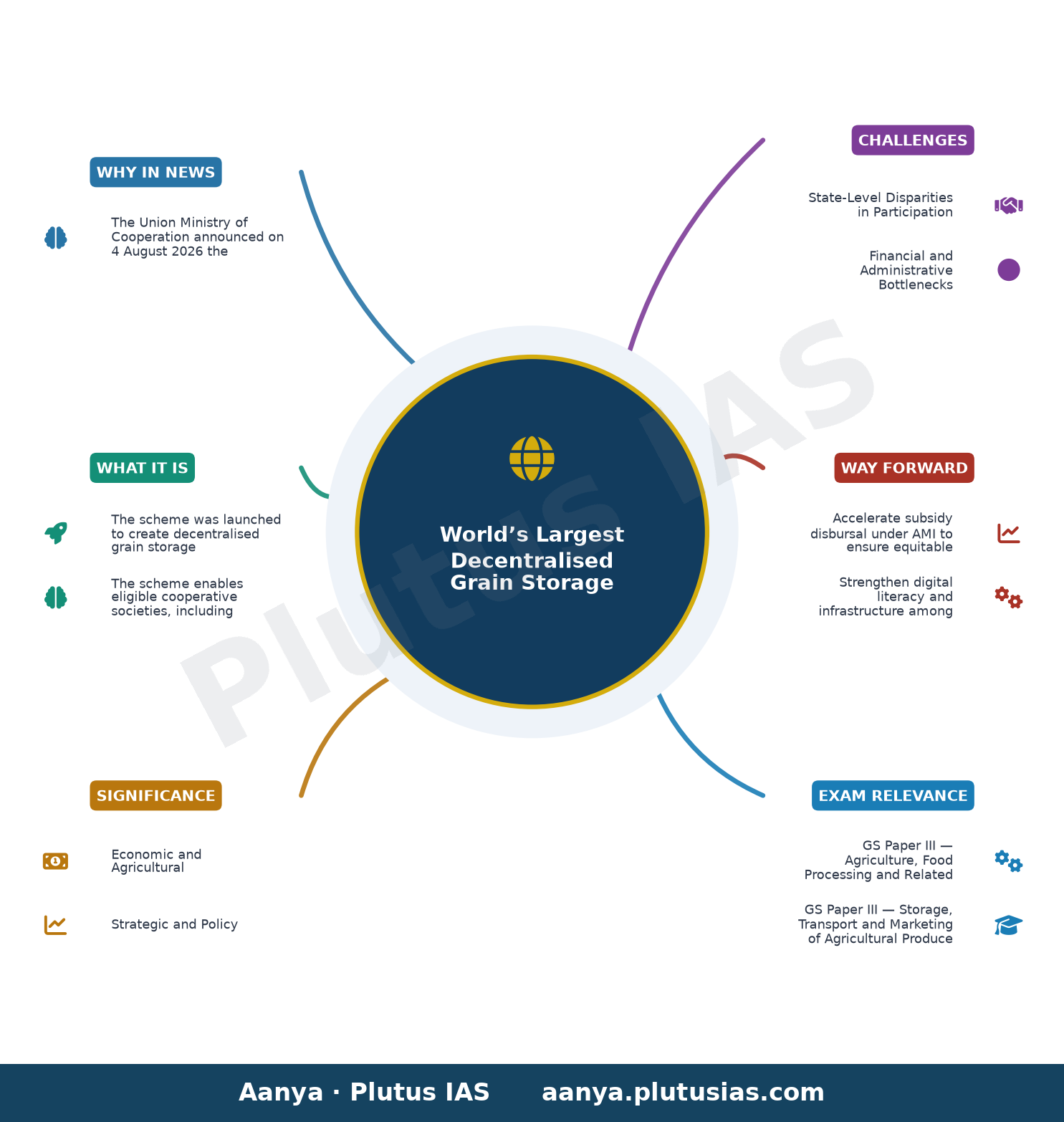
The Union Ministry of Cooperation announced on 4 August 2026 the operational progress of the World’s Largest Decentralised Grain Storage Scheme, highlighting the construction and operationalisation of storage infrastructure, custom hiring centres, and fair price shops across four major agricultural states—Andhra Pradesh, Bihar, Uttar Pradesh, and Madhya Pradesh. This initiative, framed under the broader Agricultural Marketing Infrastructure (AMI) Scheme, aims to decentralise grain storage, enhance market access for small farmers, and integrate cooperative societies into the agricultural supply chain through technologically compliant storage systems.
Background
- India’s agricultural storage capacity has historically been concentrated in centralised Food Corporation of India (FCI) godowns, leading to inefficiencies in last-mile distribution and high logistics costs.
- The decentralised model leverages the existing network of Primary Agricultural Credit Societies (PACS), which serve as grassroots cooperative institutions.
- The Warehousing Development and Regulatory Authority (WDRA), established under the Warehousing (Development and Regulation) Act, 2007, plays a pivotal role in regulating storage standards and enabling the issuance of electronic negotiable warehouse receipts (e-NWRs) for collateralised credit.
- The AMI Scheme provides financial assistance for the creation of agricultural marketing infrastructure, including storage, grading, and processing facilities, with a focus on cooperative and farmer-producer organisations.
What is the World’s Largest Decentralised Grain Storage Scheme?
- The scheme was launched to create decentralised grain storage infrastructure across India by utilising the existing PACS network, thereby enhancing last-mile storage capacity and reducing dependence on centralised FCI godowns.
- The scheme enables eligible cooperative societies, including PACS, to establish storage infrastructure on owned or leased land, with technical and financial support from the central and state governments.
- Storage infrastructure under the scheme must comply with WDRA’s prescribed technical standards, including structural safety, pest control, and moisture management, to ensure quality preservation of stored grains.
- The scheme integrates three key components: (i) construction of godowns, (ii) establishment of Custom Hiring Centres (CHCs) for farm equipment, and (iii) operationalisation of Fair Price Shops (FPS) under the Public Distribution System (PDS) to strengthen market linkages for farmers.
- Financial assistance is provided under the Agricultural Marketing Infrastructure (AMI) Scheme, with subsidies ranging from 25% to 50% of the project cost, depending on the category of beneficiary and location.
- The scheme mandates the registration of all storage infrastructure with WDRA, enabling the issuance of electronic negotiable warehouse receipts (e-NWRs), which facilitate access to institutional credit for farmers by using stored produce as collateral.
- The decentralised model aims to empower small and marginal farmers by providing them with localised storage solutions, reducing transportation costs, and improving bargaining power in agricultural markets.
Key Features
| Feature | Significance |
|---|---|
| Scale and Scope | Designated as the world’s largest decentralised grain storage infrastructure initiative, integrating storage, marketing, and credit functions across four major agricultural states (Bihar, Andhra Pradesh, Uttar Pradesh, Madhya Pradesh). |
| Multi-tier Infrastructure | Includes decentralised warehouses, custom hiring centres, and fair-price shops operated by Primary Agricultural Credit Societies (PACS), enhancing last-mile agricultural logistics. |
| Technical Compliance | Adherence to Warehousing Development and Regulatory Authority (WDRA) standards for structural safety, registration, and electronic warehouse receipt (e-NWR) issuance, ensuring regulatory credibility. |
| Subsidy Mechanism | Centralised financial support under the Agricultural Marketing Infrastructure (AMI) scheme for cooperative storage units, with varying allocations across states (e.g., ₹5.06 crore for Bihar, ₹0.13 crore for Madhya Pradesh). |
| State-wise Participation | Differential engagement: Andhra Pradesh (117 warehouses, 0 under construction), Bihar (36 projects, 5 under construction), Uttar Pradesh (14 projects, 1 under construction), Madhya Pradesh (1 project, 0 under construction). |
Why it Matters
Economic and Agricultural
- Reduces post-harvest losses by providing decentralised storage, estimated at 6-18% of total production in India, thereby enhancing farm income security.
- Facilitates market access for small and marginal farmers by integrating storage with fair-price distribution networks, reducing dependency on middlemen.
- Promotes formal credit access through PACS-led infrastructure, leveraging cooperative banking systems for agricultural financing.
Strategic and Policy
- Aligns with the National Cooperative Development Corporation (NCDC) mandate to strengthen cooperative sector infrastructure, particularly in eastern and central India.
- Supports the ‘One District, One Product’ (ODOP) initiative by enabling localised storage and marketing hubs in high-production districts.
- Integrates with the e-NWR system under WDRA, digitising agricultural commodity trading and reducing transaction costs for farmers.
Institutional and Regulatory
- Demonstrates the role of cooperative societies (PACS) as nodal agencies for rural infrastructure development, enhancing their functional autonomy.
- Ensures compliance with WDRA regulations, improving transparency and reducing disputes in agricultural commodity storage and trade.
- Leverages state government support for land allocation, addressing critical bottlenecks in infrastructure deployment.
Challenges
1. State-Level Disparities in Participation
- Madhya Pradesh’s abstention due to surplus storage capacity highlights uneven state-level preparedness and resource allocation.
- Bihar’s high PACS engagement (5,828 units) contrasts with Andhra Pradesh’s focus on warehouses (685 units), indicating differing state priorities and capacities.
UPSC Link: GS-III: Agricultural Marketing
2. Financial and Administrative Bottlenecks
- Inconsistent subsidy disbursal under AMI (e.g., no subsidy for Andhra Pradesh) raises concerns about equitable resource distribution and implementation delays.
- Limited progress in Uttar Pradesh (only 1 warehouse under construction) suggests bureaucratic or logistical hurdles in project execution.
UPSC Link: GS-III: Government Schemes
3. Technical and Operational Gaps
- Dependence on WDRA registration for e-NWR issuance may exclude smaller PACS lacking digital literacy or infrastructure.
- Risk of underutilisation of storage capacity in states with surplus infrastructure (e.g., Madhya Pradesh), leading to inefficiencies.
UPSC Link: GS-III: Agricultural Infrastructure
4. Market Integration Challenges
- Limited linkage between storage infrastructure and agricultural supply chains in remote districts (e.g., Balaghat, Madhya Pradesh) may hinder equitable benefits.
- Competition from private warehousing and procurement agencies (e.g., FCI) could undermine the cooperative sector’s market share.
UPSC Link: GS-III: Food Security
Challenges — UPSC Perspective
| Issue | Concern |
|---|---|
| State Participation Variability | Madhya Pradesh’s non-participation and Bihar’s high engagement reflect uneven state-level commitment and resource allocation. |
| Subsidy Disbursal Delays | Inconsistent AMI subsidy releases (e.g., ₹0 for Andhra Pradesh) may deter smaller cooperatives from participation. |
| WDRA Registration Gaps | PACS lacking digital infrastructure may struggle to comply with e-NWR requirements, limiting access to formal markets. |
| Infrastructure Utilisation | Surplus storage capacity in Madhya Pradesh risks underutilisation, reducing the scheme’s cost-effectiveness. |
| Supply Chain Integration | Weak linkages between storage units and agricultural markets in remote districts may dilute the scheme’s impact on farmer incomes. |
Government Initiatives — Must-Memorise for Prelims
- Agricultural Marketing Infrastructure (AMI) Scheme
- Warehousing Development and Regulatory Authority (WDRA) Guidelines
- National Cooperative Development Corporation (NCDC) Initiatives
Way Forward
- Accelerate subsidy disbursal under AMI to ensure equitable financial support across states, particularly for lagging regions like Uttar Pradesh.
- Strengthen digital literacy and infrastructure among PACS to facilitate WDRA registration and e-NWR adoption, ensuring seamless market integration.
- Conduct state-specific capacity assessments to address administrative bottlenecks in project execution, with targeted interventions for low-participation states.
- Enhance linkages between decentralised storage units and agricultural supply chains by incentivising private-sector partnerships and market aggregators.
- Expand the scheme’s coverage to include additional states with high post-harvest losses (e.g., Odisha, West Bengal) to maximise national impact.
- Monitor and publish utilisation rates of storage infrastructure to identify underperforming regions and reallocate resources dynamically.
- Integrate the scheme with existing credit schemes (e.g., Kisan Credit Card) to provide end-to-end financial solutions for farmers through PACS.
UPSC Value Addition
Keywords for Mains Answer-Writing
World’s largest decentralised grain storage scheme · Primary Agricultural Credit Societies (PACS) · Warehousing Development and Regulatory Authority (WDRA) · Electronic Negotiable Warehouse Receipt (e-NWR) system · Agricultural Marketing Infrastructure (AMI) Scheme · Cooperative federalism in agricultural storage · Custom hiring centres for farm machinery · Fair Price Shops (FPS) under PACS · Subsidised storage infrastructure for cooperatives · Technical standards for grain storage infrastructure
Concept Flow
Agricultural Production Surplus → Post-Harvest Losses → Need for Decentralised Storage → Government Intervention (AMI Scheme) → Financial Subsidies for Cooperative Infrastructure → Implementation via PACS → Decentralised Warehouses, Custom Hiring Centres, Fair-Price Shops → Regulatory Oversight (WDRA) → Structural Safety, e-NWR System → Market Integration → State-Level Participation Variability → Resource Allocation Challenges → Policy Adjustments → Operational Gaps → Digital Literacy, Supply Chain Linkages → Way Forward Interventions
Prelims Practice Questions
Q1. Consider the following statements regarding the World’s largest decentralised grain storage scheme:
1. The scheme is implemented under the aegis of the Ministry of Cooperation.
2. Primary Agricultural Credit Societies (PACS) are eligible to establish storage infrastructure.
3. The scheme mandates registration of warehouses with the Warehousing Development and Regulatory Authority (WDRA).
4. Subsidies under the scheme are disbursed through the Agricultural Marketing Infrastructure (AMI) Scheme.
How many of the above statements are correct?
- Only one
- Only two
- Only three
- All four
Answer: All four — Statements 1, 2, and 3 are correct. Statement 4 is incorrect as subsidies are disbursed under the AMI Scheme, but the scheme itself is not the sole mechanism for subsidy disbursal under the decentralised grain storage scheme.
Q2. Assertion (A): The Warehousing Development and Regulatory Authority (WDRA) mandates the registration of all storage infrastructure constructed under the decentralised grain storage scheme.
Reason (R): Registration with WDRA is necessary for PACS and cooperatives to avail the benefits of the Electronic Negotiable Warehouse Receipt (e-NWR) system.
Options:
A. Both A and R are true, and R is the correct explanation of A.
B. Both A and R are true, but R is not the correct explanation of A.
C. A is true, but R is false.
D. A is false, but R is true.
- A
- B
- C
- D
Answer: A — Both Assertion (A) and Reason (R) are true, and Reason (R) correctly explains Assertion (A). The WDRA registration is mandatory for availing e-NWR benefits.
Q3. Match the following states with their respective achievements under the decentralised grain storage scheme:
Column I (State) | Column II (Number of PACS-governed warehouses constructed)
1. Andhra Pradesh | A. 2659
2. Bihar | B. 117
3. Madhya Pradesh | C. 1
4. Uttar Pradesh | D. 87
- 1-B, 2-A, 3-D, 4-C
- 1-A, 2-B, 3-C, 4-D
- 1-B, 2-D, 3-A, 4-C
- 1-C, 2-A, 3-B, 4-D
Answer: 1-B, 2-A, 3-D, 4-C — Andhra Pradesh: 117 warehouses; Bihar: 2659 warehouses; Madhya Pradesh: 87 warehouses; Uttar Pradesh: 1 warehouse.
Mains Practice Question
✍ The decentralised grain storage scheme represents a paradigm shift in India’s cooperative federalism approach to agricultural storage infrastructure. Critically examine the scheme’s objectives, institutional framework, and potential challenges in achieving its goals. Also, assess the role of the Warehousing Development and Regulatory Authority (WDRA) in ensuring compliance and standardisation. (15 Marks)
Approach: MODEL-ANSWER SKELETON:
1. **Objectives of the Scheme**:
– Decentralisation of storage infrastructure to enhance last-mile connectivity and reduce post-harvest losses.
– Empowerment of Primary Agricultural Credit Societies (PACS) and cooperatives to manage storage and marketing.
– Integration with the Electronic Negotiable Warehouse Receipt (e-NWR) system for seamless trade.
2. **Institutional Framework**:
– **Ministry of Cooperation**: Nodal ministry for policy formulation and implementation.
– **State Governments**: Provide land and facilitate PACS in infrastructure development.
– **PACS and Cooperatives**: Primary implementers of storage infrastructure.
– **WDRA**: Regulatory authority ensuring compliance with technical standards and e-NWR integration.
3. **Key Provisions**:
– **Technical Standards**: Adherence to WDRA specifications for warehouse construction and maintenance.
– **Subsidies**: Financial support under the Agricultural Marketing Infrastructure (AMI) Scheme for cooperatives.
– **Land Allocation**: State governments assist in land provision for PACS and cooperatives.
4. **Potential Challenges**:
– **Land Availability**: Limited availability of land for warehouse construction in densely populated states.
– **Technical Compliance**: Ensuring adherence to WDRA standards across diverse geographical regions.
– **Financial Sustainability**: Long-term viability of PACS in managing storage infrastructure without continuous subsidies.
– **Awareness and Capacity**: Inadequate training of PACS staff in modern storage management and e-NWR systems.
5. **Role of WDRA**:
– **Regulatory Oversight**: Ensures compliance with storage standards and safety protocols.
– **e-NWR Integration**: Facilitates digitalisation of warehouse receipts, enhancing market linkages.
– **Dispute Resolution**: Addresses grievances related to storage infrastructure quality.
6. **Critical Assessment**:
– **Strengths**: Decentralisation aligns with cooperative federalism; potential to reduce post-harvest losses.
– **Weaknesses**: Limited participation in states like Madhya Pradesh due to surplus storage capacity; uneven progress across states.
– **Opportunities**: Integration with e-NWR can revolutionise agricultural trade and credit access.
– **Threats**: Lack of uniform implementation across states; bureaucratic delays in land allocation.
Conclusion: The scheme holds significant promise for transforming India’s agricultural storage landscape but requires robust monitoring, capacity building, and state-level coordination to overcome existing challenges.
Source: PIB (Press Information Bureau)
Generated by AanyaAi for educational purpose.

- नासा-इसरो सहयोग: अंतरिक्ष अनुसंधान में नया मोड़, जानिए क्या है अगला कदम? - September 20, 2026
- NASA highlights ISRO partnership for future space missions in UPSC focus - September 20, 2026
- सीजी सरकार की श्रीरामलला दर्शन योजना: धमतरी के 2,176 श्रद्धालुओं को मिला अयोध्या दर्शन का अवसर - September 20, 2026

No Comments