


21 Jul UPSC Exam: Benefits of Yuva Sahakar and Swyamshakti Sahakar Schemes Explained
Subject Relevance — Where This Topic Fits
- GS Paper II — Governance, Administration and Challenges | GS Paper III — Agriculture, Food Processing and Allied Sectors, Issues related to Direct and Indirect Farm Subsidies and Minimum Support Prices
- Prelims: National Cooperative Development Corporation (NCDC), Sahyogini Shakti Sahakar Scheme, Yuva Sahakar Scheme, Self-Help Groups (SHGs), Cooperative Societies, Financial Inclusion, Agricultural Credit
- Essay: The Role of Cooperatives in Achieving Inclusive Growth and Sustainable Livelihoods, Financial Inclusion as a Catalyst for Women Empowerment and Rural Development
Quick Revision: NCDC’s Yuva Sahakar scheme fosters youth entrepreneurship through cooperative models, anchored in project-based financing and decentralised monitoring.
Why is this in the news?
On 21 July 2026, the Press Information Bureau (PIB) issued a press release highlighting the implementation status and objectives of the Yuva Sahakar scheme under the Ministry of Cooperation, fully funded and monitored by the National Cooperative Development Corporation (NCDC). The release underscored the scheme’s role in fostering youth-led cooperative enterprises, while also noting the absence of proposals from the Hisar Lok Sabha constituency in Haryana.
Background
- The National Cooperative Development Corporation (NCDC) was established under the National Cooperative Development Corporation Act, 1962, as a statutory body under the Ministry of Cooperation, Government of India.
- Cooperatives in India operate across sectors including agriculture, dairy, handloom, and credit, serving as instruments for collective economic empowerment and rural development.
- The Union Budget 2021-22 announced the establishment of a separate Ministry of Cooperation to strengthen cooperative societies and promote their role in socio-economic transformation.
- Financial inclusion remains a critical policy priority, with schemes like PM-KISAN, PM-SHRI, and Stand-Up India complementing cooperative models to reduce rural-urban disparities.
- Women-led Self-Help Groups (SHGs) have emerged as pivotal agents of grassroots economic empowerment, particularly in states like Kerala, Tamil Nadu, and Bihar.
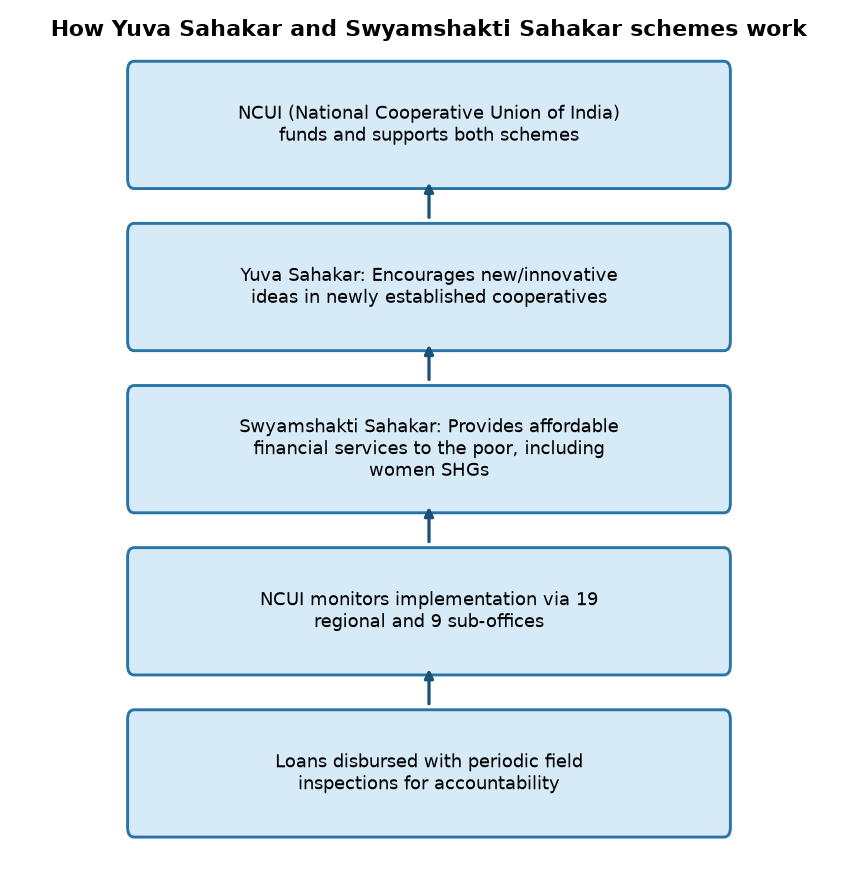
- The NCDC operates through a network of 19 regional offices and 9 sub-offices to ensure decentralised implementation and monitoring of cooperative development programmes.
What is the Yuva Sahakar Scheme?
- Yuva Sahakar Scheme: Launched to encourage the formation of new cooperative societies by young entrepreneurs, particularly those with innovative business models. The scheme provides financial support for project-based funding, thereby fostering entrepreneurship in the cooperative sector.
- The scheme is fully funded and supported by the NCDC, ensuring alignment with national priorities in cooperative development and financial inclusion.
- The scheme operates on a project-based financing model, where proposals are evaluated for viability, innovation, and potential socio-economic impact before sanctioning funds.
- Monitoring mechanisms include regular field visits, inspections, and oversight by NCDC’s regional and sub-regional offices to ensure timely disbursement and utilisation of funds.
- The absence of proposals from the Hisar Lok Sabha constituency highlights the need for greater awareness and outreach to potential beneficiaries in underrepresented regions.
- These initiatives complement existing programmes such as the Deendayal Antyodaya Yojana-National Rural Livelihoods Mission (DAY-NRLM) and the National Rural Livelihood Mission (NRLM), which also focus on SHG empowerment.
Key Features
| Feature | Significance |
|---|---|
| Sponsorship by NCDC | Ensures financial autonomy and accountability of the schemes under the aegis of a statutory body, enhancing credibility and reducing fiscal burden on the Union Budget. |
| Dual Scheme Design | Differentiates between innovation-driven youth cooperatives (युवा सहकार) and poverty-alleviation-focused women SHGs (स्वयं शक्ति सहकार), catering to distinct socio-economic segments. |
| Project-Based Financing | Leverages NCDC’s expertise in project appraisal and monitoring, ensuring cost-effectiveness and alignment with developmental objectives. |
| Decentralised Monitoring | Utilises 19 regional offices and 9 sub-offices for real-time oversight, reducing delays and enhancing transparency in fund disbursement. |
| Inclusion of Women SHGs | Prioritises marginalised women, addressing gender disparities in access to financial services and fostering sustainable livelihoods through collective economic activities. |
Why it Matters
Economic Empowerment
- Facilitates credit access for underprivileged groups, particularly women, thereby enhancing their economic independence and reducing poverty through collective enterprises.
- Promotes innovation in cooperative models by incentivising youth-led initiatives, potentially driving job creation and rural entrepreneurship.
- Strengthens the cooperative sector as a viable alternative to traditional banking, especially in rural and semi-urban areas where formal credit penetration is low.
Social Inclusion
- Bridges the gender gap in financial inclusion by prioritising women-led cooperatives, aligning with Sustainable Development Goals (SDG 5).
- Encourages community-based economic activities, fostering social cohesion and collective decision-making among marginalised groups.
- Targets poverty alleviation through livelihood enhancement, addressing structural inequalities in access to resources.
Governance and Efficiency
- Leverages NCDC’s statutory framework to ensure robust financial governance, reducing leakages and improving accountability in fund utilisation.
- Employs decentralised monitoring mechanisms to enhance transparency and timely disbursement of funds, mitigating bureaucratic delays.
- Integrates project-based financing to align credit disbursement with developmental outcomes, ensuring measurable impact.
Policy Synergy
- Complements existing schemes such as Deendayal Antyodaya Yojana – National Rural Livelihoods Mission (DAY-NRLM) by providing credit linkages for women SHGs.
- Supports the objectives of the National Cooperative Development Policy (2023) by promoting cooperative entrepreneurship and financial inclusion.
- Aligns with the Atal Innovation Mission (AIM) by fostering innovation in cooperative models through youth engagement.
Challenges
1. Low Awareness and Participation
- Limited outreach in certain regions, such as Hissar Lok Sabha constituency, where no proposals have been submitted, indicating potential awareness gaps.
- Need for targeted awareness campaigns to educate cooperatives, especially women SHGs, about the schemes’ benefits and application processes.
UPSC Link: GS-II: Role of NGOs, SHGs and other associations in development
2. Credit Absorption Capacity
- Risk of underutilisation of funds if cooperatives lack the capacity to absorb credit or manage projects effectively.
- Requirement for capacity-building initiatives to enhance financial literacy and project management skills among beneficiaries.
UPSC Link: GS-III: Issues relating to credit and financial inclusion
3. Monitoring and Evaluation
- Ensuring real-time monitoring of fund utilisation across 19 regional offices and 9 sub-offices poses logistical challenges.
- Need for robust data systems to track outcomes, such as livelihood enhancement and job creation, for evidence-based policymaking.
UPSC Link: GS-II: Mechanisms, laws, institutions and Bodies constituted for the protection and betterment of vulnerable sections
4. Sustainability of Cooperatives
- Risk of cooperatives becoming financially unsustainable if they fail to generate adequate returns from their economic activities.
- Importance of linking credit with market access and value-chain integration to ensure long-term viability.
UPSC Link: GS-III: Inclusive growth and issues arising from it
5. Gender-Specific Barriers
- Cultural and social barriers may impede women’s participation in cooperatives, necessitating gender-sensitive policies and support structures.
- Need for childcare and skill development initiatives to enable women to engage effectively in economic activities.
UPSC Link: GS-I: Role of women and women’s organisations, population and associated issues
Challenges — UPSC Perspective
| Issue | Concern |
|---|---|
| Regional Disparities | Uneven participation across states, with some regions like Hissar showing zero proposals, indicating a need for targeted interventions. |
| Financial Literacy | Low awareness among cooperatives, particularly women SHGs, about scheme benefits and application procedures. |
| Capacity Constraints | Limited ability of small cooperatives to absorb credit or manage projects, risking underutilisation of funds. |
| Monitoring Gaps | Challenges in real-time oversight across decentralised offices, necessitating robust data systems. |
| Sustainability Risks | Potential failure of cooperatives to generate sufficient returns, threatening long-term viability. |
| Gender Barriers | Cultural and social norms may restrict women’s participation, requiring gender-sensitive policies. |
Government Initiatives — Must-Memorise for Prelims
- युवा सहकार योजना
- स्वयं शक्ति सहकार योजना
- Deendayal Antyodaya Yojana – National Rural Livelihoods Mission (DAY-NRLM)
Way Forward
- Conduct region-specific awareness campaigns to educate cooperatives and women SHGs about the schemes’ benefits and application processes.
- Strengthen capacity-building programmes to enhance financial literacy, project management, and market access for cooperatives.
- Establish a centralised monitoring dashboard to track fund utilisation, beneficiary outcomes, and scheme performance in real time.
- Promote public-private partnerships to integrate cooperatives with value chains and market linkages for sustainable livelihoods.
- Introduce gender-responsive policies, such as childcare support and skill development, to enhance women’s participation in cooperatives.
- Encourage innovation in cooperative models by providing mentorship and incubation support to youth-led initiatives.
- Undertake periodic impact assessments to evaluate the schemes’ effectiveness and identify areas for improvement.
- Expand the network of NCDC’s regional and sub-offices to improve outreach in underserved regions.
UPSC Value Addition
Keywords for Mains Answer-Writing
National Cooperative Development Corporation · NCDC · Cooperative Sector Reforms · Yuva Sahakar Scheme · Swayam Shakti Sahakar Scheme · Women Self-Help Groups · Financial Inclusion · Sustainable Livelihoods · Cooperative Development Funds · Rural Credit Delivery · Cooperative Governance · Poverty Alleviation through Cooperatives
Constitutional & Policy Linkages
- Article 43: Directive Principles of State Policy – Promotion of cooperative societies for workers’ welfare.
Concept Flow
Cooperative sector development → NCDC’s statutory role → Scheme formulation (युवा सहकार, स्वयं शक्ति सहकार) → Project-based financing → Credit disbursement to cooperatives/SHGs → Capacity building and awareness → Sustainable livelihoods → Poverty alleviation and gender inclusion.
Prelims Practice Questions
Q1. Which statutory body is responsible for the implementation of ‘Yuva Sahakar’ and ‘Swayam Shakti Sahakar’ schemes?
- A. Reserve Bank of India
- B. National Bank for Agriculture and Rural Development (NABARD)
- C. National Cooperative Development Corporation (NCDC)
- D. Small Industries Development Bank of India (SIDBI)
Answer: C. National Cooperative Development Corporation (NCDC) — Both schemes are implemented by the National Cooperative Development Corporation (NCDC), a statutory organisation under the Ministry of Cooperation, Government of India.
Q2. The ‘Swayam Shakti Sahakar’ scheme primarily targets:
- A. Urban youth entrepreneurs
- B. Women Self-Help Groups (SHGs) and marginalised sections
- C. Agricultural cooperatives in drought-prone areas
- D. Start-ups in the IT sector
Answer: B. Women Self-Help Groups (SHGs) and marginalised sections — The scheme aims to provide affordable and reliable financial services to women SHGs and other marginalised sections to promote sustainable livelihoods.
Q3. Which of the following is NOT a feature of the ‘Yuva Sahakar’ scheme?
- A. Encourages innovative ideas in newly established cooperatives
- B. Provides project-based financing
- C. Focuses exclusively on urban cooperatives
- D. Is fully funded by NCDC
Answer: C. Focuses exclusively on urban cooperatives — ‘Yuva Sahakar’ is designed to support newly established cooperatives with innovative ideas and is fully funded by NCDC, but it is not restricted to urban cooperatives.
Q4. The monitoring of loan disbursement under these schemes is conducted through:
- A. Quarterly audits by external agencies
- B. Field visits and inspections by NCDC officials
- C. Digital tracking via blockchain technology
- D. Annual reports submitted to the Ministry of Finance
Answer: B. Field visits and inspections by NCDC officials — NCDC actively monitors loan disbursement through field visits and inspections to ensure timely availability of credit, particularly for women cooperatives.
Mains Practice Question
✍ Examine the role of the National Cooperative Development Corporation (NCDC) in promoting cooperative sector reforms through schemes like ‘Yuva Sahakar’ and ‘Swayam Shakti Sahakar’. How do these schemes contribute to the broader objectives of financial inclusion and sustainable livelihoods in India?
Approach: Begin by outlining the constitutional and statutory framework governing cooperatives in India, highlighting NCDC’s mandate. Analyse the objectives and operational modalities of ‘Yuva Sahakar’ (targeting youth-led cooperatives with innovative ideas) and ‘Swayam Shakti Sahakar’ (focusing on women SHGs and marginalised sections). Discuss how these schemes address gaps in rural credit delivery and promote financial inclusion. Conclude by evaluating their impact on sustainable livelihoods, particularly in rural and semi-urban areas, and suggest measures to enhance their effectiveness, such as strengthening grassroots cooperative governance and leveraging digital tools for monitoring.
Source: PIB (Press Information Bureau)
Generated by AanyaAi for educational purpose.

- मध्य प्रदेश: हाईकोर्ट ने बलात्कार मामले में आरोपी को डीएनए सबूत के आधार पर किया दोषमुक्त - September 21, 2026
- MP High Court Acquits Rape Convict Due to Negative DNA Evidence - September 21, 2026
- Odisha Launches Shree Jagannath Darshan Yojana for Senior Citizens Pilgrimage - September 21, 2026

No Comments