


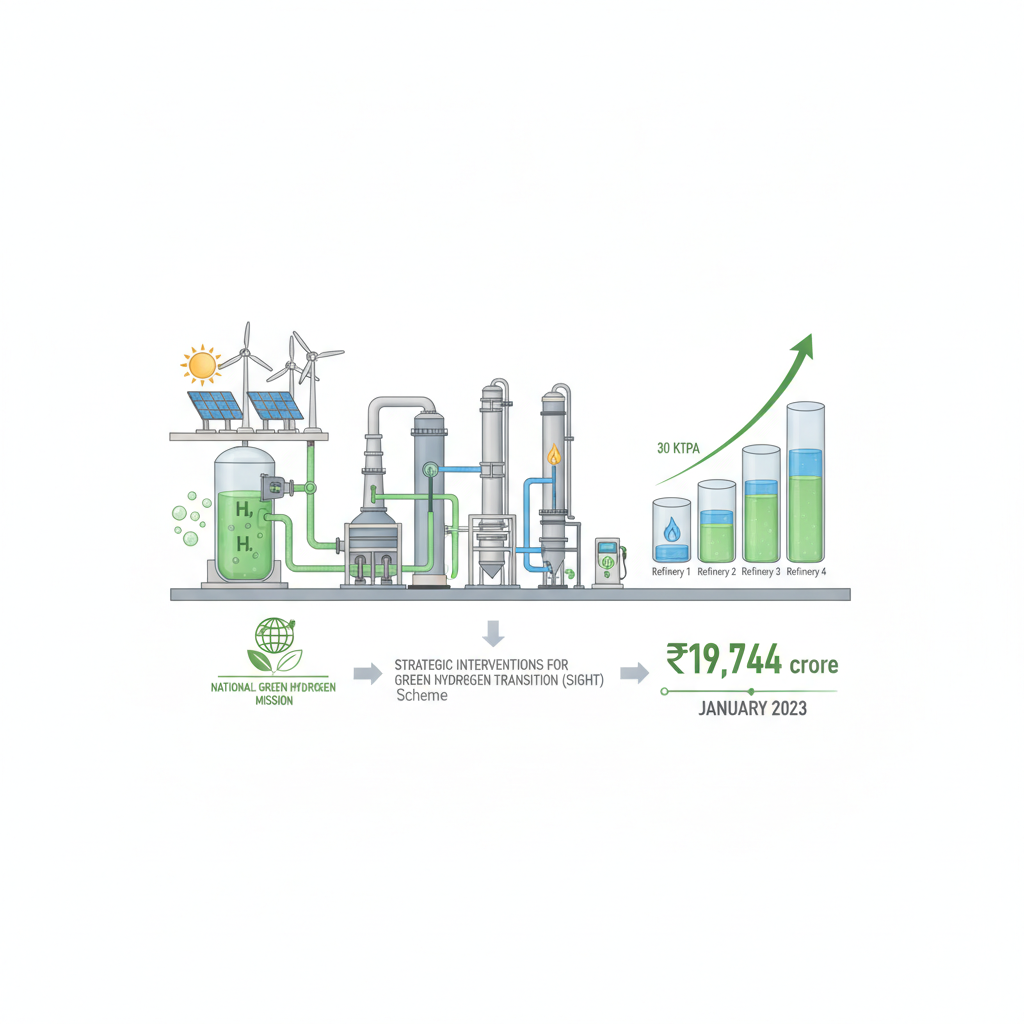
11 Aug UPSC Exam: National Green Hydrogen Mission Boosts Refineries with 30KTPA Capacity
Green hydrogenRefineriesSIGHT Scheme✎ The Strategic Interventions for Green Hydrogen Transition (SIGHT) Scheme under the National Green Hydrogen Mission aims to allocate 30 KTPA of green hydrogen production capacity across refineries via a Build-Own-Operate model to…
Subject Relevance — Where This Topic Fits
- GS Paper III — Environment, Ecology, Bio-diversity and Climate Change | GS Paper III — Science and Technology — Developments and their Applications and Effects in Everyday Life | GS Paper III — Infrastructure — Energy
- Prelims: Green Hydrogen Mission, Strategic Interventions for Green Hydrogen Transition (SIGHT) Scheme, Build-Own-Operate (BOO) model, Net-Zero Emissions Target, Energy Security, Refinery Integration, Kilotonne Per Annum (KTPA), Renewable Energy Integration
- Essay: India’s Energy Transition: Balancing Growth, Sustainability, and Energy Security, The Role of Green Hydrogen in Achieving Net-Zero: Opportunities and Challenges
Quick Revision: The Strategic Interventions for Green Hydrogen Transition (SIGHT) Scheme under the National Green Hydrogen Mission aims to allocate 30 KTPA of green hydrogen production capacity across refineries via a Build-Own-Operate model to reduce fossil fuel dependency and support India’s net-zero targets.
Why is this in the news?
The Ministry of New and Renewable Energy (MNRE) has announced the allocation of 30 kilotonnes per annum (KTPA) of green hydrogen production capacity across four major refineries under the Strategic Interventions for Green Hydrogen Transition (SIGHT) Scheme of the National Green Hydrogen Mission (NGHM). This initiative underscores India’s commitment to reducing fossil fuel dependency, enhancing energy security, and accelerating its clean energy transition while aligning with the country’s net-zero emission targets.
Background
- The National Green Hydrogen Mission (NGHM) was approved by the Union Cabinet in January 2023 with a total outlay of ₹19,744 crore, aiming to make India a global hub for the production, usage, and export of green hydrogen and its derivatives.
- Green hydrogen, produced via electrolysis using renewable energy, is a critical component of India’s decarbonisation strategy, particularly in hard-to-abate sectors such as refining, fertiliser production, and heavy industry.
- The SIGHT Scheme under NGHM is designed to provide financial incentives for the production of green hydrogen and its derivatives, with two distinct modes: Mode-2A (for domestic production) and Mode-2B (for end-use sectors such as refineries).
- India’s refining sector, comprising 23 refineries with a total capacity of 254.7 MTPA, is a major consumer of hydrogen, primarily derived from fossil fuels, making it a key target for green hydrogen integration.
- The Union Budget 2023-24 emphasised the importance of green hydrogen in achieving energy independence by 2047 and outlined provisions for research, pilot projects, and demand aggregation.
- Global demand for green hydrogen is projected to reach 50-70 million tonnes by 2030, with India aiming to capture a significant share through policy-driven incentives and strategic investments.
What is the Strategic Interventions for Green Hydrogen Transition (SIGHT) Scheme under the National Green Hydrogen Mission?
- The SIGHT Scheme is a financial incentive mechanism under the NGHM to accelerate the adoption of green hydrogen in India’s industrial and energy sectors.
- Mode-2B of the SIGHT Scheme specifically targets the petroleum refining sector, offering incentives for the production and utilisation of green hydrogen to replace fossil-based hydrogen.
- Under Mode-2B, the government has allocated 30 KTPA of green hydrogen production capacity across four refineries: Indian Oil Corporation Limited (Panipat), Bharat Petroleum Corporation Limited (Bina), Hindustan Petroleum Corporation Limited (Visakhapatnam), and Numaligarh Refinery Limited (Numaligarh).
- The scheme operates on a Build-Own-Operate (BOO) model, where private developers are responsible for setting up, owning, and operating the green hydrogen production facilities, with project-specific investments.
- Financial incentives under SIGHT are disbursed based on the quantity of green hydrogen produced and utilised, ensuring cost-competitiveness with fossil-based hydrogen.
- The scheme aligns with India’s broader decarbonisation goals, including the net-zero emission target by 2070 and the reduction of fossil fuel imports, thereby enhancing energy security.
- The refinery-specific allocations are designed to leverage existing infrastructure and facilitate seamless integration of green hydrogen into refining processes such as hydrocracking and desulphurisation.
- The scheme also encourages the development of ancillary infrastructure, such as renewable energy plants for powering electrolysers and hydrogen storage and transport systems.
Key Features
| Feature | Significance |
|---|---|
| National Green Hydrogen Mission (NGHM) | Aims to position India as a global hub for production, utilisation, and export of green hydrogen and its derivatives, aligning with net-zero emission targets and energy transition goals. |
| SIGHT Mode – 2B Scheme | Strategic Interventions for Green Hydrogen Transition under NGHM, focusing on sector-specific interventions such as refinery adoption of green hydrogen. |
| Green Hydrogen Production Allocation | 30 kilo tonnes per annum (KTPA) capacity earmarked across four refineries, with private developers executing projects under Build-Own-Operate (BOO) model. |
| Project Implementation Framework | Private developers invest in project-specific infrastructure, ensuring financial and operational efficiency while adhering to NGHM guidelines. |
| Energy Security and Decarbonisation | Reduces dependence on imported fossil fuels, enhances energy security, and supports India’s clean energy transition and net-zero commitments. |
Why it Matters
Economic
- Reduces import dependency on fossil fuels, particularly crude oil and natural gas, thereby improving the trade balance.
- Creates a new industrial vertical for green hydrogen and its derivatives, fostering innovation and entrepreneurship in the energy sector.
- Attracts private investment in clean energy infrastructure, contributing to economic growth and job creation in high-tech sectors.
Strategic
- Strengthens India’s position as a global leader in green hydrogen, aligning with international climate commitments and partnerships.
- Enhances energy security by diversifying the energy mix and reducing vulnerability to geopolitical supply disruptions.
- Supports the development of a domestic green hydrogen supply chain, reducing reliance on imported technologies and materials.
Environmental
- Facilitates the decarbonisation of the refining sector, a major consumer of hydrogen, by replacing grey hydrogen with green hydrogen.
- Contributes to India’s Nationally Determined Contributions (NDCs) under the Paris Agreement by reducing greenhouse gas emissions.
- Supports the achievement of net-zero emissions targets by 2070, as outlined in India’s Long-Term Low Emission Development Strategy.
Technological
- Promotes the adoption of advanced electrolysis technologies and renewable energy integration for hydrogen production.
- Encourages research and development in green hydrogen storage, transport, and utilisation across industrial sectors.
- Fosters collaboration between public and private entities to scale up green hydrogen infrastructure and expertise.
Challenges
1. High Capital Costs and Financing
- Green hydrogen production requires significant upfront investment in electrolysers, renewable energy infrastructure, and operational setups.
- Access to affordable financing remains a challenge, particularly for small and medium-scale developers in the sector.
- Risk-averse financial institutions may hesitate to fund green hydrogen projects due to unproven long-term viability.
UPSC Link: Economic Survey: Investment in Clean Energy
2. Infrastructure and Supply Chain Bottlenecks
- Limited availability of indigenous electrolysers and critical materials (e.g., platinum, iridium) for large-scale deployment.
- Inadequate pipeline and storage infrastructure for green hydrogen, necessitating significant logistical and technological upgrades.
- Dependence on imported equipment and technologies increases costs and delays project timelines.
UPSC Link: NITI Aayog: Hydrogen Economy Roadmap
3. Policy and Regulatory Gaps
- Lack of a unified national framework for green hydrogen pricing, incentives, and carbon credits.
- Inconsistent state-level policies and incentives may create regulatory uncertainty for investors.
- Need for streamlined approval processes for land acquisition, environmental clearances, and grid connectivity.
UPSC Link: Electricity Act, 2003: Renewable Energy Provisions
4. Technological Maturity and Efficiency
- Current electrolysis technologies (e.g., PEM, alkaline) have efficiency limitations, increasing production costs.
- Integration with intermittent renewable energy sources poses challenges for stable and cost-effective hydrogen generation.
- Limited domestic expertise in large-scale green hydrogen production and utilisation systems.
UPSC Link: Science & Tech: Energy Storage Technologies
5. Market and Demand Uncertainty
- Uncertainty in off-take agreements and demand from end-users (e.g., refineries, fertiliser plants) may deter private investment.
- Competition from grey hydrogen and other low-carbon alternatives (e.g., ammonia, biofuels) could slow adoption.
- Global market dynamics and price fluctuations in hydrogen derivatives may impact domestic competitiveness.
UPSC Link: World Energy Outlook: Hydrogen Market Trends
Challenges — UPSC Perspective
| Issue | Concern |
|---|---|
| Electrolyser Technology | Dependence on imported electrolysers increases costs and delays project execution. |
| Renewable Energy Integration | Intermittency of solar/wind power affects the stability and efficiency of green hydrogen production. |
| Policy Fragmentation | Inconsistent state-level incentives and regulatory frameworks create uncertainty for investors. |
| Infrastructure Gaps | Lack of dedicated hydrogen pipelines and storage facilities limits large-scale deployment. |
| Financing Constraints | High capital costs and risk aversion among financiers hinder project viability. |
| Skill Development | Shortage of trained personnel for green hydrogen production, maintenance, and R&D. |
Government Initiatives — Must-Memorise for Prelims
- National Green Hydrogen Mission (NGHM)
- SIGHT Mode – 2B Scheme (Strategic Interventions for Green Hydrogen Transition)
Way Forward
- Strengthen public-private partnerships to mobilise investment in green hydrogen infrastructure and R&D.
- Develop a unified national policy framework for green hydrogen pricing, incentives, and carbon credits to ensure consistency.
- Accelerate indigenous manufacturing of electrolysers and critical components to reduce import dependence and costs.
- Invest in grid-scale renewable energy projects to ensure stable and affordable power supply for green hydrogen production.
- Establish dedicated hydrogen pipelines and storage facilities to address logistical bottlenecks.
- Enhance skill development programmes to build a workforce capable of supporting the green hydrogen ecosystem.
- Promote pilot projects and demonstration plants to validate technologies and build investor confidence.
- Align state-level policies with national goals to create a cohesive and supportive regulatory environment.
UPSC Value Addition
Keywords for Mains Answer-Writing
National Green Hydrogen Mission (NGHM) · Green Hydrogen Transition · Strategic Interventions for Green Hydrogen Transition (SIGHT) Scheme · Build-Own-Operate (BOO) Model · Energy Security · Net-Zero Emission Targets · Refinery Sector Decarbonisation · Green Hydrogen Production Capacity · Renewable Energy Integration · Low-Carbon Economy
Concept Flow
Energy Transition Imperative: Recognition of the need to decarbonise industrial sectors, including refining, to meet climate goals. → Policy Framework: Enactment of the National Green Hydrogen Mission (NGHM) to provide strategic direction and incentives. → Sector-Specific Intervention: Launch of SIGHT Mode – 2B Scheme to target refineries for green hydrogen adoption. → Capacity Allocation: Earmarking 30 KTPA green hydrogen production capacity across major refineries via private developers. → Implementation Model: Adoption of Build-Own-Operate (BOO) framework to leverage private sector efficiency and investment. → Outcome: Reduction in fossil fuel imports, enhanced energy security, and progress toward net-zero emissions targets. → Scalability: Expansion of green hydrogen infrastructure to other sectors (e.g., fertiliser, steel, transport) for broader impact.
Prelims Practice Questions
Q1. Consider the following statements regarding the National Green Hydrogen Mission (NGHM):
1. The NGHM aims to establish India as a global hub for the production, utilisation, and export of green hydrogen and its derivatives.
2. The Strategic Interventions for Green Hydrogen Transition (SIGHT) Scheme under NGHM allocates 30 kilo tonnes per annum (KTPA) of green hydrogen production capacity to refineries.
3. The projects under NGHM are implemented exclusively by public sector undertakings without private participation.
4. The adoption of green hydrogen is expected to reduce dependence on imported fossil fuels and enhance energy security.
How many of the above statements are correct?
- Only one
- Only two
- Only three
- All
Answer: All — Statements 1, 2, and 4 are correct. Statement 3 is incorrect as the projects are implemented through private developers under the Build-Own-Operate (BOO) model.
Q2. Assertion (A): The National Green Hydrogen Mission (NGHM) prioritises the decarbonisation of the refinery sector to achieve India’s net-zero emission targets.
Reason (R): The refinery sector is a significant consumer of fossil fuels, and its decarbonisation aligns with the broader goal of reducing carbon emissions in the energy-intensive industrial processes.
Options:
A. Both A and R are true, and R is the correct explanation of A.
B. Both A and R are true, but R is not the correct explanation of A.
C. A is true, but R is false.
D. A is false, but R is true.
- A
- B
- C
- D
Answer: B — Both the assertion and reason are true. The NGHM’s focus on the refinery sector is a strategic intervention to decarbonise energy-intensive industries, thereby supporting India’s net-zero goals.
Q3. Match the following refineries with their allocated green hydrogen production capacity under the National Green Hydrogen Mission (NGHM):
Column I (Refinery) | Column II (Capacity in KTPA)
———————————–|——————————-
A. Indian Oil Corporation Ltd. | 1. 5
B. Bharat Petroleum Corporation Ltd. | 2. 10
C. Hindustan Petroleum Corporation Ltd. | 3. 10
D. Numaligarh Refinery Ltd. | 4. 5
Answer: ? — The correct matches are: A-2 (Indian Oil Corporation Ltd., Panipat: 10 KTPA), B-1 (Bharat Petroleum Corporation Ltd., Bina: 5 KTPA), C-4 (Hindustan Petroleum Corporation Ltd., Visakhapatnam: 5 KTPA), D-3 (Numaligarh Refinery Ltd.: 10 KTPA).
Mains Practice Question
✍ The National Green Hydrogen Mission (NGHM) represents a transformative policy intervention aimed at decarbonising India’s energy-intensive refinery sector while advancing the country’s net-zero emission targets. Critically examine the strategic rationale behind the NGHM’s focus on the refinery sector, highlighting its potential benefits and challenges. Also, analyse how the Build-Own-Operate (BOO) model under the Strategic Interventions for Green Hydrogen Transition (SIGHT) Scheme facilitates the mission’s objectives. (15 Marks)
Approach: MODEL-ANSWER SKELETON:
1. **Strategic Rationale for Focus on Refineries** (6 points):
– Refineries are energy-intensive industries with high carbon footprints, accounting for ~15% of India’s industrial energy consumption (CII, 2023).
– Decarbonisation aligns with India’s Nationally Determined Contributions (NDCs) under the Paris Agreement and the Long-Term Low Emission Development Strategy (LT-LEDS).
– Reduces reliance on imported fossil fuels, enhancing energy security and reducing trade deficits.
– Supports the transition to a low-carbon economy, fostering innovation in green hydrogen technologies.
– Contributes to achieving net-zero emissions by 2070, as outlined in India’s climate commitments.
– Leverages existing infrastructure and expertise in the refinery sector for rapid scaling of green hydrogen adoption.
2. **Potential Benefits** (4 points):
– **Environmental**: Significant reduction in Scope 1 and Scope 2 emissions from refineries.
– **Economic**: Cost savings from reduced fossil fuel imports and potential revenue from green hydrogen exports.
– **Technological**: Accelerates the development of indigenous green hydrogen technologies and supply chains.
– **Social**: Creation of green jobs and skill development in the renewable energy sector.
3. **Challenges** (3 points):
– **Economic Viability**: High capital expenditure (CAPEX) and operational expenditure (OPEX) for green hydrogen production, requiring subsidies and incentives.
– **Infrastructure Gaps**: Limited availability of renewable energy sources for hydrogen production, especially in industrial clusters.
– **Policy and Regulatory**: Need for a robust policy framework to ensure seamless integration of green hydrogen into refinery operations.
4. **Role of BOO Model under SIGHT Scheme** (2 points):
– **Private Sector Participation**: The BOO model incentivises private developers to invest in green hydrogen projects, leveraging their expertise and capital.
– **Risk Mitigation**: Shifts the financial and operational risks from the government to private developers, ensuring timely project execution.
– **Scalability**: Facilitates rapid scaling of green hydrogen production capacity by attracting diverse stakeholders.
5. **Conclusion** (1 point):
– The NGHM’s focus on the refinery sector, coupled with the BOO model, is a pragmatic approach to achieving India’s decarbonisation goals. However, sustained policy support, technological innovation, and public-private partnerships are essential for long-term success.
Source: PIB (Press Information Bureau)
Generated by AanyaAi for educational purpose.

- NCERT Links Supreme Court Motto to Mahabharata in Class 9 Book - September 30, 2026
- संयुक्त राष्ट्र का समुद्र स्तर घोषणा: भारत के लिए क्या है महत्व - September 30, 2026
- ASEAN-India Maritime Exercise (AIME-2026) Begins in Philippines - September 30, 2026

No Comments