


28 Jul UPSC Exam: PLI Scheme Boosts India’s Auto & EV Manufacturing Sector
Subject Relevance — Where This Topic Fits
- GS Paper III — Indian Economy: Issues relating to Planning, Mobilisation of Resources, Growth, Development and Employment
- Prelims: Production-Linked Incentive (PLI) Scheme, Advanced Automotive Technology (AAT) products, Domestic Value Addition (DVA), Ministry of Heavy Industries (MHI), ₹25,938 crore outlay, Electric Vehicles (EVs), Research and Development (R&D) in manufacturing
- Essay: India’s Manufacturing Competitiveness: The Role of PLI Schemes in Achieving Self-Reliance, Technological Sovereignty and Industrial Policy: Balancing Incentives and Innovation
Quick Revision: The PLI-Auto scheme incentivises domestic manufacturing of advanced automotive technology products with a minimum 50% Domestic Value Addition, linking subsidies to incremental production and permitting R&D expenditures towards investment commitments.
Why is this in the news?
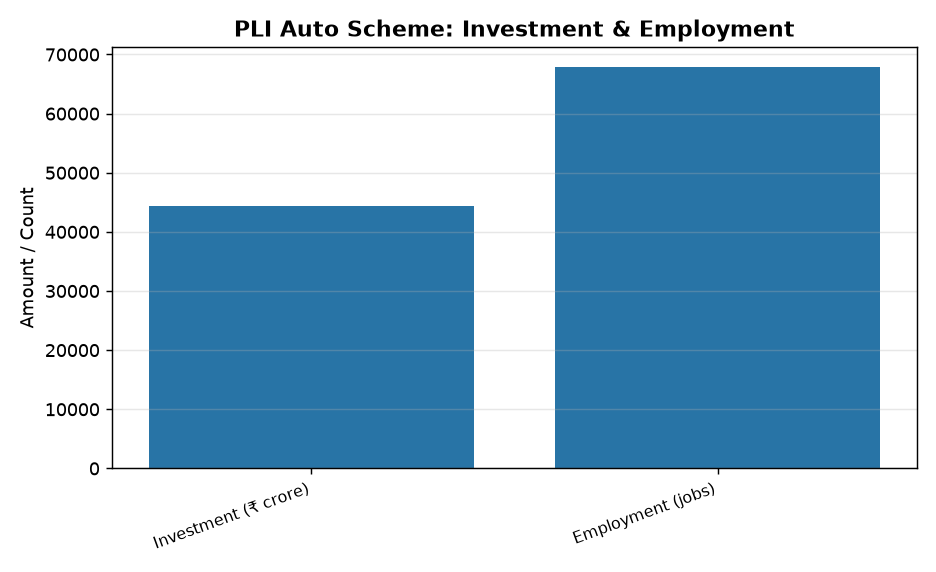
The Ministry of Heavy Industries (MHI) has highlighted the operational performance of the Production-Linked Incentive Scheme for Automobile and Auto Component Industry (PLI-Auto) as of 31 March 2026, with cumulative investments of ₹44,326 crore and 67,820 jobs generated, underscoring its role in accelerating India’s transition towards advanced automotive manufacturing and electric mobility.
Background
- The PLI-Auto scheme was approved by the Government of India on 23 September 2021 with a budgetary outlay of ₹25,938 crore to enhance India’s manufacturing capabilities in advanced automotive technology (AAT) products, including Electric Vehicles (EVs).
- The scheme is part of a broader industrial policy framework aimed at reducing import dependence, fostering domestic innovation, and positioning India as a global hub for high-value automotive manufacturing.
- PLI schemes are designed to provide financial incentives linked to incremental production, thereby incentivising firms to scale up domestic value addition and technological upgradation.
- The scheme mandates a minimum Domestic Value Addition (DVA) of 50% for eligible products, ensuring that benefits accrue primarily to domestic manufacturers and contribute to the broader ‘Make in India’ initiative.
- As of 31 March 2026, the scheme has attracted investments amounting to ₹44,326 crore and generated 67,820 direct and indirect employment opportunities, reflecting its tangible impact on industrial growth and job creation.
- The scheme also permits inclusion of Research and Development (R&D) expenditures towards investment commitments, enabling firms to integrate cutting-edge technologies into their manufacturing processes.
What is the Production-Linked Incentive Scheme for Automobile and Auto Component Industry (PLI-Auto)?
- The PLI-Auto scheme is a production-linked incentive programme launched by the Ministry of Heavy Industries (MHI) to boost domestic manufacturing of advanced automotive technology (AAT) products, including Electric Vehicles (EVs) and their components.
- The scheme offers financial incentives to eligible manufacturers based on incremental sales of qualifying products, thereby linking subsidy directly to production scale and efficiency improvements.
- Eligible products under the scheme include advanced automotive components such as electric vehicle batteries, motors, controllers, and other high-value automotive parts that contribute to the domestic value chain.
- A minimum Domestic Value Addition (DVA) threshold of 50% is required for eligibility, ensuring that the scheme primarily benefits domestic manufacturers and strengthens India’s self-reliance in critical automotive technologies.
- The scheme permits inclusion of Research and Development (R&D) expenditures towards meeting investment commitments, thereby incentivising firms to invest in innovation and technological upgradation.
- The scheme is aligned with India’s broader industrial policy objectives, including the ‘Make in India’ initiative and the push for electric mobility.
- As of 31 March 2026, the scheme has attracted investments of ₹44,326 crore and generated 67,820 jobs, demonstrating its role in catalysing industrial growth and employment generation in the automotive sector.
- The scheme is part of a broader ecosystem of PLI schemes under the Ministry of Heavy Industries, which includes initiatives for advanced chemistry cell batteries and capital goods manufacturing.
Key Features
| Feature | Significance |
|---|---|
| Financial Outlay (₹25,938 crore) | Allocates substantial budgetary support to incentivise high-technology automotive manufacturing, ensuring fiscal sustainability and long-term viability of the scheme. |
| Minimum 50% Domestic Value Addition (DVA) | Mandates domestic manufacturing content to reduce import dependence, enhance self-reliance, and integrate local industries into global value chains. |
| Inclusion of R&D Expenditure in Investment Criteria | Permits R&D spending to qualify as investment, fostering innovation, technological upgradation, and competitive edge in advanced automotive products. |
| Employment Generation (67,820 jobs) | Demonstrates direct socio-economic impact by creating skilled and semi-skilled employment in the automotive sector, addressing unemployment and skill gaps. |
| Investment Attraction (₹44,326 crore) | Shows robust industry response, validating policy effectiveness in mobilising private capital for high-value automotive manufacturing projects. |
Why it Matters
Economic Growth & Industrialisation
- Catalyses the transition of India’s automotive sector from a cost-competitive manufacturing hub to a technology-driven global player in advanced automotive products (AAT).
- Enhances Gross Value Added (GVA) in the manufacturing sector, contributing to India’s GDP growth and export competitiveness.
- Stimulates ancillary industries (e.g., electronics, metallurgy, precision engineering) through backward and forward linkages in the automotive value chain.
Strategic Autonomy & Supply Chain Resilience
- Reduces import dependence for critical automotive components and technologies, particularly in electric vehicles (EVs), batteries, and semiconductors.
- Strengthens India’s position in global automotive supply chains by promoting localisation of high-technology manufacturing.
- Mitigates geopolitical risks associated with supply chain disruptions in traditional automotive manufacturing hubs.
Technological Upgradation & Innovation
- Encourages adoption of Industry 4.0 technologies (AI, IoT, robotics) in automotive manufacturing, improving efficiency and product quality.
- Fosters indigenous R&D in battery technologies, fuel cells, and alternative propulsion systems, aligning with global trends.
- Supports the development of indigenous testing and certification infrastructure for advanced automotive products.
Environmental Sustainability
- Promotes the manufacturing of electric vehicles (EVs) and hybrid technologies, reducing vehicular emissions and aligning with India’s climate commitments (e.g., Paris Agreement, Net-Zero 2070).
- Encourages the use of sustainable materials and energy-efficient manufacturing processes in the automotive sector.
Employment & Skill Development
- Generates high-quality employment opportunities in advanced manufacturing, addressing the skills gap in the automotive and allied sectors.
- Promotes vocational training and upskilling through industry-academia collaborations, enhancing employability of the workforce.
Challenges
1. High Capital Expenditure & Risk Aversion
- Automotive manufacturing, particularly in advanced technologies (EVs, batteries), requires significant upfront investment, deterring risk-averse firms.
- Limited access to long-term financing for MSMEs and startups in the automotive component sector constrains participation.
UPSC Link: Economic Survey: Investment Climate
2. Supply Chain Bottlenecks
- Dependence on imported raw materials (e.g., rare earth metals, lithium, semiconductors) for EV components creates vulnerability to global supply chain disruptions.
- Inadequate domestic manufacturing of critical inputs (e.g., battery cells, power electronics) hampers localisation efforts.
UPSC Link: NITI Aayog: Supply Chain Resilience
3. Regulatory & Compliance Hurdles
- Complex and fragmented regulatory frameworks across states and union territories create compliance challenges for manufacturers.
- Delays in approvals for land acquisition, environmental clearances, and industrial licenses slow down project implementation.
UPSC Link: DPIIT: Ease of Doing Business
4. Skilled Workforce Shortage
- Shortage of skilled labour in advanced manufacturing, particularly in robotics, AI, and battery technologies, limits scaling up of production.
- Inadequate vocational training infrastructure and industry-academia disconnect exacerbate the skills gap.
UPSC Link: Skill India Mission
5. Global Competition & Export Barriers
- Intense global competition from established automotive hubs (e.g., China, Germany, Japan) threatens India’s export competitiveness.
- Non-tariff barriers (e.g., technical standards, safety regulations) in export markets pose challenges for Indian manufacturers.
UPSC Link: WTO: Technical Barriers to Trade
6. Infrastructure Gaps
- Inadequate logistics infrastructure (e.g., port connectivity, warehousing, cold chains) increases operational costs and reduces efficiency.
- Limited availability of EV charging infrastructure and power supply reliability in industrial clusters hinder EV manufacturing growth.
UPSC Link: Logistics Performance Index
Challenges — UPSC Perspective
| Issue | Concern |
|---|---|
| High Capital Requirements | Limited access to finance for MSMEs and startups deters participation in advanced automotive manufacturing. |
| Import Dependence for Critical Inputs | Reliance on imported rare earth metals, lithium, and semiconductors creates supply chain vulnerabilities. |
| Regulatory Delays | Complex approval processes for land acquisition and environmental clearances slow down project implementation. |
| Skills Mismatch | Shortage of skilled labour in advanced manufacturing technologies limits scaling up of production. |
| Global Competition | Established automotive hubs pose a threat to India’s export competitiveness in high-technology products. |
| Infrastructure Deficits | Inadequate logistics and power supply infrastructure increase operational costs and reduce efficiency. |
Government Initiatives — Must-Memorise for Prelims
- Production Linked Incentive (PLI) Scheme for Automobile and Auto Components Industry (PLI-Auto)
- PM E-DRIVE Scheme (for electric vehicle manufacturing and charging infrastructure)
- National Programme on Advanced Chemistry Cell (ACC) Battery Storage under PLI Scheme
Way Forward
- Strengthen domestic manufacturing of critical inputs (e.g., battery cells, power electronics) through targeted PLI schemes and subsidies.
- Enhance vocational training and upskilling programmes in collaboration with industry and academia to address the skilled labour shortage.
- Streamline regulatory approvals for land acquisition, environmental clearances, and industrial licenses through digital platforms and single-window clearances.
- Invest in logistics infrastructure (ports, roads, warehousing) to reduce operational costs and improve supply chain efficiency.
- Promote R&D in advanced automotive technologies through public-private partnerships and tax incentives for innovation.
- Expand EV charging infrastructure and ensure reliable power supply in industrial clusters to support EV manufacturing growth.
- Enhance export competitiveness by aligning Indian automotive standards with global benchmarks and negotiating trade agreements.
- Encourage MSME participation in the automotive value chain through financial incentives, technology transfer, and market linkages.
UPSC Value Addition
Keywords for Mains Answer-Writing
Production Linked Incentive (PLI) Scheme · Automobile and Auto Component Industry · Advanced Automotive Technology (AAT) · Domestic Value Addition (DVA) · Electric Vehicles (EVs) · Research and Development (R&D) in Manufacturing · Self-Reliance in Automobile Sector · Ministry of Heavy Industries (MHI) · Industry 4.0 · Atmanirbhar Bharat · Global Supply Chain Integration · Technological Upgradation in Manufacturing
Concept Flow
Government announces PLI-Auto Scheme (2021) → Focus on advanced automotive technologies (EVs, batteries, semiconductors) → Offers financial incentives for domestic manufacturing with 50% DVA → Attracts investment (₹44,326 crore) and generates employment (67,820 jobs) → Fosters innovation through R&D integration → Enhances India’s self-reliance in automotive manufacturing → Reduces import dependence and strengthens supply chain resilience → Contributes to economic growth, technological upgradation, and environmental sustainability.
Prelims Practice Questions
Q1. Which of the following is NOT a component of the Production Linked Incentive (PLI) Scheme for the Automobile and Auto Component Industry in India?
- A. Financial incentives for Advanced Automotive Technology (AAT) products
- B. Minimum 50% Domestic Value Addition (DVA) requirement
- C. Direct subsidy for fuel consumption in vehicles
- D. Inclusion of R&D expenditure as eligible investment
Answer: C. Direct subsidy for fuel consumption in vehicles — The PLI scheme for automobiles focuses on financial incentives for AAT products, mandates 50% DVA, and allows R&D expenditure as eligible investment. Fuel subsidy is not a component of this scheme.
Q2. The PLI scheme for the Automobile and Auto Component Industry aims to achieve which of the following objectives?
- A. Enhance India’s share in global automobile exports to 20% by 2030
- B. Increase domestic manufacturing capacity for advanced automotive technologies
- C. Provide 100% subsidy for electric vehicle purchases for consumers
- D. Mandate the use of only indigenous raw materials in automobile manufacturing
Answer: B. Increase domestic manufacturing capacity for advanced automotive technologies — The primary objective of the PLI scheme for automobiles is to enhance domestic manufacturing capacity for advanced automotive technologies, including EVs, by providing financial incentives and attracting investments.
Mains Practice Question
✍ Critically examine the role of the Production Linked Incentive (PLI) Scheme for the Automobile and Auto Component Industry in advancing India’s self-reliance in the automotive sector. How does this scheme align with the broader goals of Atmanirbhar Bharat and global supply chain integration? Substantiate your answer with relevant examples.
Approach: Begin by defining the PLI scheme for automobiles and its key components, such as financial incentives for Advanced Automotive Technology (AAT) products and the requirement for 50% Domestic Value Addition (DVA). Highlight how the scheme promotes domestic manufacturing, technological upgradation, and R&D investments, thereby reducing import dependence. Discuss its alignment with Atmanirbhar Bharat by emphasizing self-reliance in critical technologies like EVs and advanced components. Additionally, analyze how the scheme integrates India into global supply chains by attracting investments from multinational corporations and fostering partnerships with global automotive firms. Conclude by evaluating the scheme’s effectiveness in achieving its objectives and suggesting measures for further improvement.
Source: PIB (Press Information Bureau)
Generated by AanyaAi for educational purpose.

- कर्नाटक में ‘वंदे मातरम’ विवाद: राज्यपाल ने सीएम से आदेश वापस लेने को कहा - September 22, 2026
- Karnataka Governor vs CM: Vande Mataram GO row explained for UPSC - September 22, 2026
- मध्यप्रदेश कैबिनेट का बड़ा फैसला: हर विधानसभा में स्पोर्ट्स कॉम्प्लेक्स, 15 हजार बसें 2030 तक - September 22, 2026

No Comments