


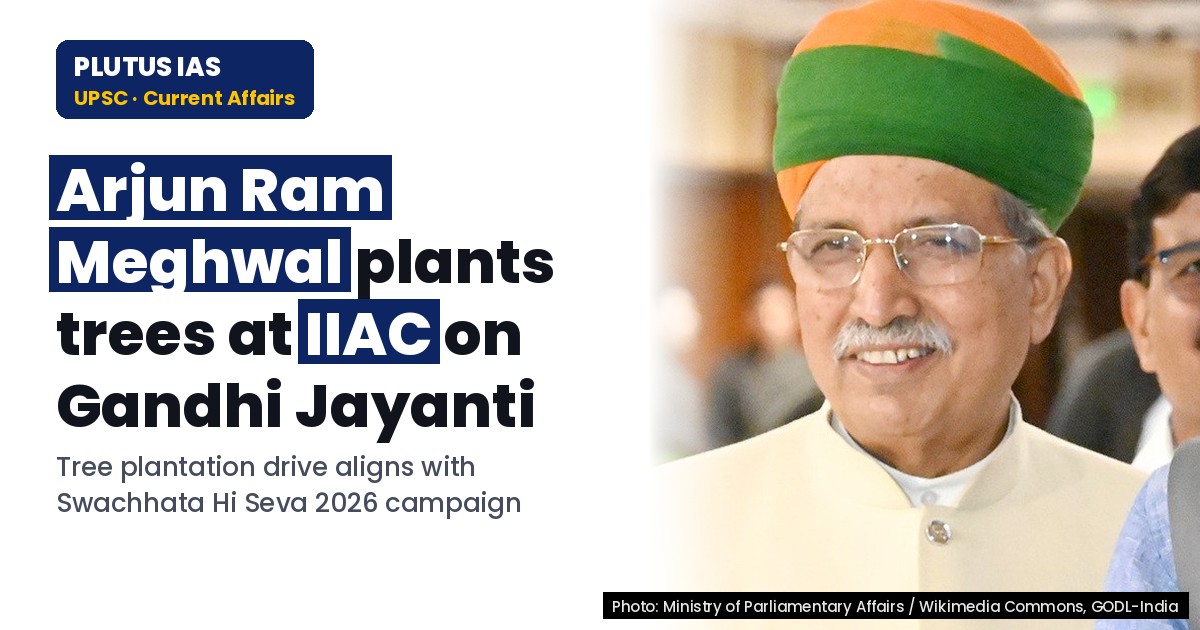
02 Oct UPSC Focus: Arjun Ram Meghwal Leads Tree Plantation at IIAC
✎ The ‘One Tree for Mother’ afforestation drive at IIAC exemplifies how public institutions can integrate environmental sustainability into their governance frameworks, reinforcing the principles of the Swachh Bharat Mission and…
Subject Relevance — Where This Topic Fits
- GS Paper II — Governance, Administration and Challenges | GS Paper III — Environment and Sustainable Development
- Prelims: Swachh Bharat Mission 2.0, National Green Tribunal (NGT), International Arbitration Centre (IAC), Green Arbitration, Champaran Satyagraha
- Essay: Environmental governance as a catalyst for national development, Institutional responsibility in achieving Sustainable Development Goals
Quick Revision: The ‘One Tree for Mother’ afforestation drive at IIAC exemplifies how public institutions can integrate environmental sustainability into their governance frameworks, reinforcing the principles of the Swachh Bharat Mission and institutionalising Gandhian values of trusteeship and collective responsibility.
Why is this in the news?
On 1 October 2026, the Department of Legal Affairs under the Ministry of Law and Justice organised an afforestation campaign titled ‘One Tree for Mother’ at the India International Arbitration Centre (IIAC) in Vasant Kunj, New Delhi, under the thematic umbrella of ‘Swachhata Hi Seva 2026’ and ‘Special Campaign 6’. The event, led by the Union Minister of State (Independent Charge) for Law and Justice, Shri Arjun Ram Meghwal, underscores the integration of environmental sustainability with institutional governance and the promotion of arbitration as a global public good.
Background
- Swachhata Hi Seva (SHS) is an annual mass mobilisation campaign initiated in 2018, observed from 15 September to 2 October, to reinforce the principles of cleanliness and public hygiene as a form of service to the nation.
- Special Campaign 6 (2026) is a government-wide initiative to promote cleanliness, efficiency, and citizen-centric governance, with a specific focus on reducing pendency and improving service delivery in government offices.
- Mahatma Gandhi’s Champaran Satyagraha (1917) is historically significant for its emphasis on cleanliness, sanitation, and social responsibility, themes that continue to inform contemporary governance narratives.
- The Union Ministry of Law and Justice is responsible for framing legal policies, administering justice delivery systems, and promoting legal reforms, including those related to environmental law and institutional governance.
What is the ‘One Tree for Mother’ Afforestation Drive at IIAC?
- The ‘One Tree for Mother’ campaign is an institutional afforestation initiative organised under the aegis of ‘Swachhata Hi Seva 2026’ and ‘Special Campaign 6’, aimed at promoting environmental sustainability and institutional responsibility.
- The event was held on 1 October 2026 at the India International Arbitration Centre (IIAC), New Delhi, led by the Union Minister of State (Independent Charge) for Law and Justice, Shri Arjun Ram Meghwal.
- The campaign aligns with the broader objectives of the Swachh Bharat Mission, which seeks to create a cleaner, greener, and more sustainable India through mass participation and institutional commitments.
- The theme ‘One Tree for Mother’ symbolises reverence for nature and the recognition of environmental stewardship as a form of service to society, echoing Gandhian principles of trusteeship and collective responsibility.
- The IIAC, as a global arbitration hub, integrates environmental sustainability into its institutional ethos, reinforcing the idea that governance institutions must embody the values of transparency, discipline, and service.
- The event highlighted the dual dimensions of cleanliness—physical cleanliness of the environment and the purity of thought and action—emphasising that sustainable development requires both ecological and ethical commitments.
- The campaign underscores the role of arbitration centres as public institutions in promoting global best practices, including environmental governance, as part of their social responsibility.
- The initiative also aligns with India’s commitments under the Sustainable Development Goals (SDGs), particularly SDG 11 (Sustainable Cities and Communities), SDG 13 (Climate Action), and SDG 15 (Life on Land).
Key Features
| Feature | Significance |
|---|---|
| Thematic Campaign: ‘एक पेड़ माँ के नाम’ | Aligns environmental action with cultural values, reinforcing the ethos of ‘स्वच्छता ही सेवा’ through symbolic tree plantation. |
| Institutional Participation: IIAC, Legislative & Law Departments | Demonstrates inter-departmental collaboration under the Ministry of Law and Justice, integrating governance with environmental stewardship. |
| Gandhian Linkage: Champaaran Satyagraha Reference | Connects modern governance initiatives to Mahatma Gandhi’s 1917 campaign, emphasizing continuity in India’s socio-ecological movements. |
| Sustainability Focus: Green Practices in Arbitration Hub | Highlights commitment to sustainable infrastructure in a premier dispute-resolution institution, setting a precedent for similar institutions. |
Why it Matters
Environmental Governance
- Demonstrates integration of environmental action (tree plantation) with institutional governance, reflecting India’s commitment to climate resilience under frameworks like the National Mission for a Green India.
- Promotes institutional responsibility in reducing carbon footprints, particularly in high-visibility public institutions such as IIAC.
Institutional Integrity & Transparency
- Reinforces the role of arbitration centers like IIAC in fostering trust through transparent, sustainable practices, aligning with global standards for dispute resolution.
- Showcases leadership commitment to ethical governance, where environmental action symbolizes broader institutional values of discipline and service.
Cultural & Symbolic Governance
- Leverages cultural symbolism (‘माँ के नाम’) to enhance public engagement in environmental initiatives, bridging tradition with modern governance.
- Uses Mahatma Gandhi’s legacy to frame contemporary policies, reinforcing the continuity of Gandhian principles in India’s developmental discourse.
Operational Synergy
- Illustrates the convergence of multiple governance initiatives (Swachhata Hi Seva 2026, Special Campaign 6) under a single thematic event, optimizing resource utilization.
- Highlights the role of statutory bodies in mainstreaming environmental priorities within their operational frameworks.
Challenges
1. Sustainability of Institutional Commitments
- Ensuring long-term adherence to green practices in high-occupancy institutions like IIAC, where operational demands may conflict with sustainability goals.
- Monitoring and verifying the impact of tree plantations on carbon sequestration and biodiversity over time.
UPSC Link: GS3: Environmental Governance
2. Public Participation & Behavioral Change
- Translating symbolic actions (e.g., tree planting) into sustained behavioral change among institutional stakeholders and the broader public.
- Overcoming skepticism or indifference toward environmental initiatives in professional settings.
UPSC Link: GS4: Ethics in Governance
3. Resource Allocation & Cost Efficiency
- Balancing the financial and logistical costs of sustainability initiatives with institutional priorities, particularly in non-revenue-generating sectors like arbitration.
- Avoiding greenwashing by ensuring that initiatives are substantive and not merely performative.
UPSC Link: GS3: Resource Mobilization
4. Policy-Implementation Gaps
- Addressing discrepancies between national environmental policies (e.g., National Clean Air Programme) and their localized implementation in institutional settings.
- Ensuring alignment between central directives (e.g., Swachhata Hi Seva) and state-level enforcement mechanisms.
UPSC Link: GS2: Centre-State Relations
Challenges — UPSC Perspective
| Issue | Concern |
|---|---|
| Institutional Adoption | Risk of superficial compliance without systemic integration of sustainability practices. |
| Monitoring & Evaluation | Lack of robust frameworks to measure the environmental impact of such initiatives. |
| Stakeholder Engagement | Ensuring sustained participation from employees, visitors, and external partners. |
| Cultural Relevance | Balancing modern environmental goals with traditional values without diluting either. |
| Scalability | Replicating such initiatives in smaller or less-resourced institutions across the country. |
Way Forward
- Institutionalize a quarterly review mechanism to assess the progress of sustainability initiatives at IIAC, including tree growth, carbon footprint reduction, and stakeholder feedback.
- Develop a standardized sustainability protocol for arbitration centers and similar institutions, incorporating benchmarks for energy efficiency, waste management, and green procurement.
- Launch targeted awareness campaigns within IIAC to educate stakeholders on the environmental and ethical rationale behind such initiatives, using Gandhian principles as a pedagogical tool.
- Collaborate with academic and research institutions to study the long-term ecological impact of institutional tree plantations, ensuring data-driven policy refinement.
- Integrate sustainability metrics into the performance appraisal systems of institutional heads and departmental heads to incentivize accountability.
- Expand the thematic campaign to include water conservation and renewable energy adoption in IIAC, aligning with broader national missions like the Jal Jeevan Mission and National Solar Mission.
- Establish a public dashboard to transparently share the environmental impact of IIAC’s sustainability initiatives, fostering trust and encouraging replication.
UPSC Value Addition
Keywords for Mains Answer-Writing
Swachhata Hi Seva 2026 · Champaran Satyagraha · India International Arbitration Centre (IIAC) · Arjun Ram Meghwal · Ministry of Law and Justice · Environmental governance · Sustainable development · Public participation in governance · Gandhi Jayanti initiatives · Institutional sustainability practices
Concept Flow
Governance Initiative (Swachhata Hi Seva 2026) → Institutional Participation (IIAC, Law Ministry) → Symbolic Action (Tree Plantation) → Cultural Reinforcement (Gandhian Values) → Behavioral Change (Sustainability Practices) → Long-Term Impact (Environmental Governance). → Ministry of Law and Justice → Legislative & Law Departments → Inter-Departmental Collaboration → Sustainability Integration → Institutional Trust Building → Global Arbitration Standards. → Environmental Action → Institutional Responsibility → Transparency & Discipline → Service Ethos → Public Engagement → Cultural Continuity. → Policy Directive → Thematic Campaign → Symbolic Governance → Stakeholder Participation → Impact Assessment → Policy Refinement. → Institutional Leadership → Ethical Governance → Sustainability Commitment → Resource Allocation → Performance Monitoring → Institutional Legacy.
Prelims Practice Questions
Q1. Consider the following statements regarding the ‘Swachhata Hi Seva 2026’ campaign:
1. It is an initiative launched under the Ministry of Law and Justice.
2. The campaign includes tree plantation drives as part of its thematic activities.
3. The campaign was inaugurated on 2nd October 2026.
4. The theme ‘One Tree for Mother’ was specifically adopted for the campaign.
How many of the above statements are correct?
- Only one
- Only two
- Only three
- All four
Answer: Only three — Statements 1, 2, and 4 are correct as per the PIB release. Statement 3 is incorrect because the campaign was organized on 1st October 2026, the eve of Gandhi Jayanti.
Q2. Assertion (A): The India International Arbitration Centre (IIAC) is an autonomous institution under the Ministry of Law and Justice.
Reason (R): The IIAC was established to promote India as a preferred destination for international arbitration.
Options:
A. Both A and R are true, and R is the correct explanation of A.
B. Both A and R are true, but R is not the correct explanation of A.
C. A is true, but R is false.
D. A is false, but R is true.
Answer: ? — The IIAC is indeed an autonomous institution under the Ministry of Law and Justice, and its establishment aims to promote India as a hub for international arbitration. However, the reason does not directly explain the assertion.
Q3. Match the following pairs:
Column I
A. Swachhata Hi Seva 2026
B. India International Arbitration Centre (IIAC)
C. Champaran Satyagraha
D. Arjun Ram Meghwal
Column II
1. Tree plantation drive
2. Ministry of Law and Justice
3. Mahatma Gandhi’s 1917 movement
4. Union Minister of State (Independent Charge)
Options:
A-1, B-2, C-3, D-4
A-2, B-1, C-4, D-3
A-4, B-3, C-2, D-1
A-3, B-2, C-1, D-4
Answer: ? — A matches with 1 (Swachhata Hi Seva 2026 includes tree plantation drives), B matches with 2 (IIAC is under the Ministry of Law and Justice), C matches with 3 (Champaran Satyagraha was led by Mahatma Gandhi in 1917), and D matches with 4 (Arjun Ram Meghwal is the Union Minister of State for Law and Justice).
Mains Practice Question
✍ The integration of environmental sustainability with institutional governance is increasingly being recognized as a hallmark of modern public administration. In this context, critically examine the significance of tree plantation drives and thematic campaigns like ‘Swachhata Hi Seva 2026’ under the Ministry of Law and Justice. Also, assess how such initiatives align with the broader objectives of the ‘Swachh Bharat Mission’ and the philosophy of Mahatma Gandhi. (15 Marks)
Approach: MODEL-ANSWER SKELETON:
1. Introduction (2 marks):
– Define environmental governance and its relevance in public administration.
– Mention the role of the Ministry of Law and Justice in promoting sustainability.
2. Significance of Tree Plantation Drives (4 marks):
– Environmental benefits: carbon sequestration, biodiversity conservation, and urban heat island mitigation.
– Symbolic value: fostering a culture of responsibility and collective action.
– Institutional role: demonstrating commitment to sustainability by public institutions.
3. ‘Swachhata Hi Seva 2026’ and Thematic Campaigns (4 marks):
– Objectives of the campaign: public participation, awareness generation, and behavioral change.
– Linkages with Gandhian philosophy: emphasis on cleanliness, self-discipline, and service (e.g., Champaran Satyagraha).
– Role of institutions: how the Ministry of Law and Justice leverages such campaigns for institutional sustainability.
4. Alignment with Swachh Bharat Mission (3 marks):
– Overlapping goals: cleanliness, public health, and environmental sustainability.
– Institutional mechanisms: how the Ministry’s initiatives contribute to the broader national mission.
– Challenges: ensuring long-term impact, avoiding tokenism, and measuring outcomes.
5. Critical Assessment and Way Forward (2 marks):
– Evaluate the effectiveness of such campaigns in achieving sustainability goals.
– Suggest measures for institutionalizing these practices (e.g., regular audits, stakeholder engagement, and policy integration).
Source: PIB (Press Information Bureau)
Generated by AanyaAi for educational purpose.
Related guides on our sites
- Current affairs for upsc 2026
- Best PSIR optional coaching for upsc
- Best PSIR optional teacher for upsc
- Best teacher of PSIR optional for upsc

- UPSC Focus: Arjun Ram Meghwal Leads Tree Plantation at IIAC - October 2, 2026
- गोबरधन योजना: सीबीजी क्षेत्र को बढ़ावा देने के लिए केंद्र सरकार की पहल - October 2, 2026
- NITI Aayog Hosts SDG Budgeting Workshop in Kolkata for State Support - October 2, 2026

No Comments