


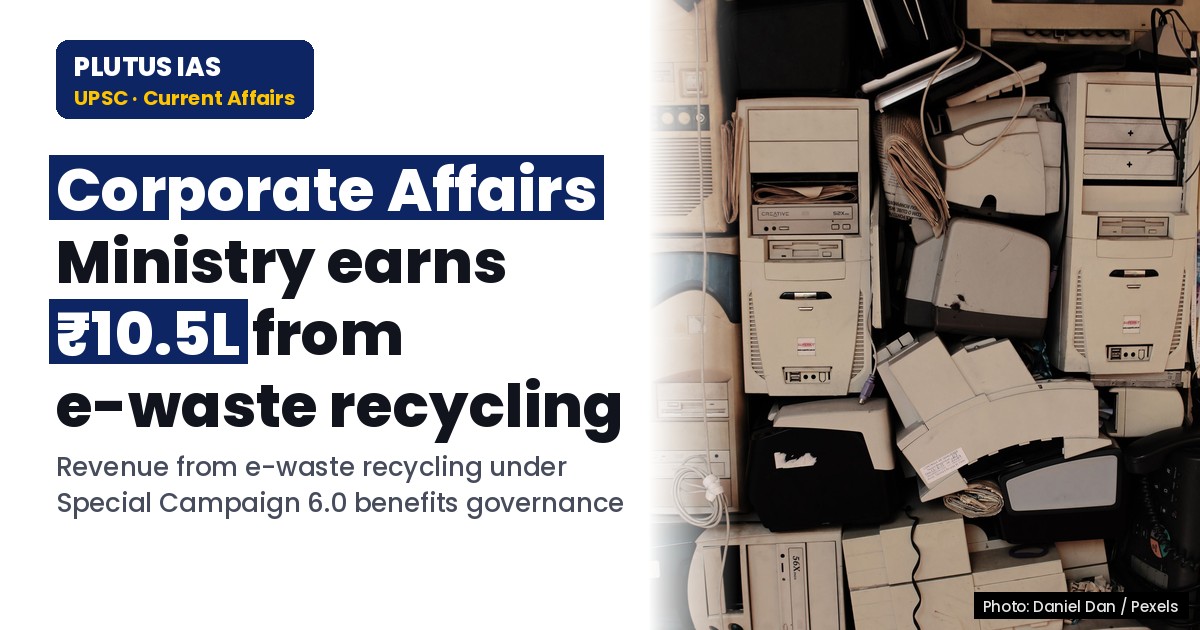
28 Oct UPSC Focus: How Corporate Affairs Ministry Earned ₹10.5L via E-Waste in Special Campaign 6.0
✎ The ‘Swachhata Abhiyan 6.0’ exemplifies how administrative reforms—through digitisation, e-waste recycling, and grievance redressal—can simultaneously advance environmental sustainability, operational efficiency, and…
Subject Relevance — Where This Topic Fits
- GS Paper II — Governance, Transparency and Accountability | GS Paper III — Environmental Pollution and Waste Management, Administrative Reforms
- Prelims: E-Waste (Management) Rules, 2022, Swachh Bharat Mission (Urban), Digital India, Parliamentary Standing Committee on Public Grievances, CPGRAMS, Ministry of Corporate Affairs, Corporate Social Responsibility (CSR)
- Essay: Governance as a catalyst for sustainable development, The role of administrative efficiency in nation-building
Quick Revision: The ‘Swachhata Abhiyan 6.0’ exemplifies how administrative reforms—through digitisation, e-waste recycling, and grievance redressal—can simultaneously advance environmental sustainability, operational efficiency, and citizen-centric governance.
Why is this in the news?
The Ministry of Corporate Affairs (MCA) has achieved significant milestones under its ongoing ‘Swachhata Abhiyan 6.0’, including the generation of ₹10,50,520 in revenue through e-waste management and recycling initiatives. Additionally, the ministry has expedited the redressal of public grievances, with 316 of 330 pending complaints under CPGRAMS resolved, and 217 of 435 appeals disposed of. These efforts underscore the ministry’s commitment to operational efficiency, environmental sustainability, and citizen-centric governance, aligning with broader national objectives of cleanliness, transparency, and administrative reform.
Background
- The ‘Swachhata Abhiyan’ series is a government-wide initiative launched under the ‘Swachh Bharat Mission’ framework, aimed at institutionalising cleanliness, efficiency, and transparency in government offices.
- E-waste management has emerged as a critical environmental and economic challenge, with India generating approximately 3.2 million tonnes of e-waste annually, necessitating robust regulatory and operational frameworks for sustainable recycling and revenue generation.
- The Ministry of Corporate Affairs (MCA) is the nodal ministry for administering the Companies Act, 2013, and the Insolvency and Bankruptcy Code, 2016, making it a key institution for corporate governance and regulatory compliance in India.
- The Centralised Public Grievance Redress and Monitoring System (CPGRAMS) is a digital platform managed by the Department of Administrative Reforms and Public Grievances (DARPG) to streamline and expedite the resolution of public complaints against government agencies.
- Administrative reforms in India have increasingly focused on digitisation, record management, and space optimisation to enhance efficiency and reduce bureaucratic delays.
- The E-Waste (Management) Rules, 2022, mandate extended producer responsibility (EPR) for producers, importers, and brand owners, and promote formal recycling channels to mitigate environmental and health risks.
What is the ‘Swachhata Abhiyan 6.0’ and its key components?
- The ‘Swachhata Abhiyan’ is a government-wide cleanliness and efficiency drive launched under the ‘Swachh Bharat Mission’ to promote cleanliness, digitisation, and operational excellence in government offices.
- ‘Swachhata Abhiyan 6.0’ is the sixth iteration of this campaign, focusing on three core pillars: (a) operational efficiency, (b) environmental sustainability, and (c) citizen-centric governance.
- Under the environmental sustainability pillar, the MCA has prioritised e-waste management and recycling initiatives to generate revenue while reducing environmental pollution and promoting circular economy principles.
- The campaign includes the processing of electronic and electrical equipment (EEE) to recover valuable materials, thereby contributing to resource efficiency and generating revenue of ₹10,50,520 in the reported period.
- In the domain of operational efficiency, the MCA has undertaken space optimisation by clearing 15,740 square feet of office space through the disposal of redundant physical records, with further reductions expected as the campaign progresses.
- Record management reforms under the campaign involve the systematic review and disposal of 850 out of 2,523 marked physical files and the review of 8,823 out of 9,309 targeted files, enhancing transparency and reducing bureaucratic inefficiencies.
- Citizen-centric governance is reinforced through the expedited resolution of public grievances via CPGRAMS, with 316 of 330 pending complaints and 217 of 435 pending appeals disposed of, demonstrating a commitment to accountability and responsiveness.
- The campaign also includes the systematic monitoring of references received from Parliament and the Prime Minister’s Office to ensure timely administrative action, aligning with the principles of participatory governance.
Key Features
| Feature | Significance |
|---|---|
| E-waste management and recycling initiatives | Generated significant revenue of ₹10,50,520 through processing of electronic and electrical equipment, demonstrating a circular economy approach. |
| Physical record reduction | 850 physical files removed from 2,523 marked for weeding out, and 8,823 out of 9,309 targeted files reviewed, enhancing administrative efficiency. |
| Office space optimization | 15,740 sq. ft. of office space vacated through systematic cleanliness drives, improving resource utilization. |
| Grievance redressal acceleration | 316 of 330 pending CPGRAMS complaints resolved and 217 of 435 appeals disposed, reflecting improved citizen-centric governance. |
| Monitoring of parliamentary references | Systematic tracking of references from Parliament and PMO to ensure timely administrative action. |
Why it Matters
Administrative Efficiency
- Demonstrates the tangible outcomes of ‘Special Campaign 6.0’ in streamlining record management and reducing redundant physical files, aligning with the government’s push for ‘Minimum Government, Maximum Governance’.
- Optimization of office space reduces operational costs and enhances functional capacity of government offices.
Environmental Stewardship
- E-waste recycling initiatives contribute to sustainable resource management and align with the E-waste (Management) Rules, 2022, promoting circular economy principles.
- Revenue generation from e-waste processing underscores the economic viability of environmentally responsible practices.
Citizen-Centric Governance
- Expeditious resolution of public grievances through CPGRAMS and appeals mechanism enhances transparency and accountability in public administration.
- Systematic monitoring of parliamentary and PMO references ensures alignment with legislative and executive priorities.
Institutional Excellence
- Achievement of all 75 planned cleanliness drives ahead of schedule reflects proactive institutional commitment to cleanliness and efficiency.
- The campaign’s success in exceeding initial targets sets a benchmark for other ministries and departments.
Challenges
1. Implementation of E-waste Rules
- Ensuring compliance with the E-waste (Management) Rules, 2022, across all stakeholders, including producers, recyclers, and consumers.
- Addressing the informal sector’s dominance in e-waste recycling to formalize and regulate the process.
UPSC Link: Environmental Governance
2. Physical Record Management
- Overcoming resistance to digitization and weeding out of physical records due to institutional inertia and lack of standardized protocols.
- Ensuring data security and confidentiality during the disposal of sensitive physical records.
UPSC Link: Administrative Reforms
3. Space Optimization in Government Offices
- Balancing space optimization with functional requirements, especially in high-density urban offices.
- Overcoming logistical challenges in relocating or repurposing vacated office spaces.
UPSC Link: Public Administration
4. Grievance Redressal Efficiency
- Maintaining the momentum of grievance resolution despite the increasing volume of complaints across departments.
- Ensuring uniformity in grievance redressal mechanisms across different ministries and states.
UPSC Link: Citizen Charter
Challenges — UPSC Perspective
| Issue | Concern |
|---|---|
| E-waste collection and segregation | Inadequate infrastructure for systematic collection and segregation of e-waste, leading to leakage into informal channels. |
| Public awareness and participation | Limited awareness among citizens and businesses about proper e-waste disposal and recycling practices. |
| Data integrity in record management | Risk of data loss or corruption during the transition from physical to digital records. |
| Inter-ministerial coordination | Need for seamless coordination between ministries, departments, and local bodies for effective implementation of cleanliness drives. |
| Monitoring and evaluation | Establishing robust monitoring mechanisms to track progress and ensure accountability in ongoing initiatives. |
Government Initiatives — Must-Memorise for Prelims
- E-waste (Management) Rules, 2022
Way Forward
- Strengthen institutional mechanisms for e-waste collection, segregation, and recycling to formalize the sector and prevent environmental degradation.
- Accelerate digitization of records to reduce reliance on physical files and enhance data accessibility and security.
- Expand public awareness campaigns to educate citizens and businesses on responsible e-waste disposal and recycling practices.
- Enhance inter-ministerial coordination to ensure seamless implementation of cleanliness drives and record management reforms.
- Develop standardized protocols for weeding out physical records to balance transparency with data preservation needs.
- Establish a robust monitoring framework to track progress on cleanliness drives, grievance redressal, and space optimization initiatives.
- Promote public-private partnerships to leverage technology and innovation in e-waste management and recycling.
- Incorporate feedback from citizens and stakeholders to refine and improve the effectiveness of ongoing initiatives.
UPSC Value Addition
Keywords for Mains Answer-Writing
E-waste Management Rules 2022 · Special Campaign 6.0 · Ministry of Corporate Affairs · Corporate Governance · Resource Efficiency · Sustainable Development · Administrative Reforms · Digital India Mission · Circular Economy · Swachh Bharat Mission · E-Governance · Public Grievance Redressal · Record Management · Institutional Efficiency · Environmental Responsibility
Concept Flow
Initiation of ‘Special Campaign 6.0’ under the Ministry of Corporate Affairs → Focus on cleanliness, record management, and e-waste recycling → Implementation of targeted actions (weeding out records, space optimization, grievance redressal) → Generation of revenue (₹10,50,520) from e-waste processing → Demonstration of administrative efficiency and environmental responsibility → Enhanced citizen-centric governance and institutional excellence
Prelims Practice Questions
Q1. Consider the following statements regarding the E-waste (Management) Rules, 2022:
1. The rules mandate the Extended Producer Responsibility (EPR) framework for producers of electronic and electrical equipment.
2. The rules apply to both organized and unorganized sectors involved in e-waste management.
3. The rules prohibit the import of e-waste into India.
How many of the above statements are correct?
- Only one
- Only two
- All three
- None
Answer: Only two — Statement 1 is correct as the E-waste Rules 2022 introduce EPR obligations for producers. Statement 2 is incorrect as the rules primarily target the organized sector, though informal sector participation is encouraged. Statement 3 is incorrect as the rules permit the import of e-waste under specific conditions and authorizations.
Q2. Assertion (A): The Ministry of Corporate Affairs (MCA) is mandated to promote corporate governance and sustainability initiatives under the Companies Act, 2013.
Reason (R): The MCA is the nodal ministry responsible for the implementation of the E-waste (Management) Rules, 2022 in India.
Options:
A. Both A and R are true, and R is the correct explanation of A.
B. Both A and R are true, but R is NOT the correct explanation of A.
C. A is true, but R is false.
D. A is false, but R is true.
Answer: ? — Assertion (A) is correct as the MCA is indeed responsible for corporate governance under the Companies Act, 2013. Reason (R) is also correct but does not directly explain (A), as the MCA shares implementation responsibilities with the Ministry of Environment, Forest and Climate Change for e-waste rules.
Q3. Match the following initiatives with their respective ministries:
Column I (Initiative) Column II (Ministry)
1. Special Campaign 6.0 A. Ministry of Environment, Forest and Climate Change
2. E-waste (Management) Rules, 2022 B. Ministry of Corporate Affairs
3. Swachh Bharat Mission C. Ministry of Housing and Urban Affairs
4. Digital India Mission D. Ministry of Electronics and Information Technology
Options:
A. 1-B, 2-A, 3-C, 4-D
B. 1-A, 2-B, 3-C, 4-D
C. 1-D, 2-A, 3-B, 4-C
D. 1-B, 2-D, 3-C, 4-A
Answer: ? — 1-B: Special Campaign 6.0 is an initiative of the Ministry of Corporate Affairs. 2-A: E-waste (Management) Rules, 2022 are implemented by the Ministry of Environment, Forest and Climate Change. 3-C: Swachh Bharat Mission is under the Ministry of Housing and Urban Affairs. 4-D: Digital India Mission is under the Ministry of Electronics and Information Technology.
Mains Practice Question
✍ The Ministry of Corporate Affairs (MCA) has demonstrated significant progress in operational efficiency, record management, and environmental responsibility through its ‘Special Campaign 6.0’. In this context, critically examine the role of administrative reforms in enhancing institutional efficiency and sustainability in governance. (15 Marks)
Approach: MODEL-ANSWER SKELETON:
1. **Introduction (2 marks)**
– Define administrative reforms and their importance in governance.
– Mention the MCA’s ‘Special Campaign 6.0’ as a contemporary initiative.
2. **Administrative Reforms and Institutional Efficiency (4 marks)**
– Discuss the key reforms under Special Campaign 6.0: space optimization (15,740 sq. ft.), record management (850 files discarded, 8,823 reviewed), and grievance redressal (316/330 CPGRAMS complaints resolved, 217/435 appeals disposed).
– Link reforms to the principles of ‘Minimum Government, Maximum Governance’ and ‘Ease of Doing Business’.
– Cite the Second Administrative Reforms Commission (2005-2009) recommendations on record management and grievance redressal.
3. **Sustainability and Environmental Responsibility (4 marks)**
– Explain the MCA’s initiatives in e-waste management and recycling, leading to revenue generation (₹10,50,520).
– Discuss the E-waste (Management) Rules, 2022, and the Extended Producer Responsibility (EPR) framework.
– Highlight the role of circular economy principles in reducing environmental footprint.
4. **Challenges and Way Forward (3 marks)**
– Identify challenges: informal sector participation in e-waste management, enforcement gaps, and data gaps in grievance redressal.
– Suggest measures: strengthening inter-ministerial coordination (e.g., MCA with MoEFCC), leveraging technology (AI for grievance redressal), and capacity building for informal sector.
5. **Conclusion (2 marks)**
– Summarize the transformative potential of administrative reforms in governance.
– Emphasize the need for sustained efforts to institutionalize these reforms for long-term impact.
Source: PIB (Press Information Bureau)
Generated by AanyaAi for educational purpose.
Related guides on our sites
- Current affairs for upsc 2026
- Best PSIR optional coaching for upsc
- Best PSIR optional teacher for upsc
- Best teacher of PSIR optional for upsc

- UPSC Focus: How Corporate Affairs Ministry Earned ₹10.5L via E-Waste in Special Campaign 6.0 - October 28, 2026
- लोकसभा अध्यक्ष ने लोकतंत्र में मतभेदों के बीच सम्मान की आवश्यकता पर जोर दिया - October 28, 2026
- Vice-President Meets EU Parliament AFET: Key Polity Insights for UPSC & PCS - October 28, 2026

No Comments