


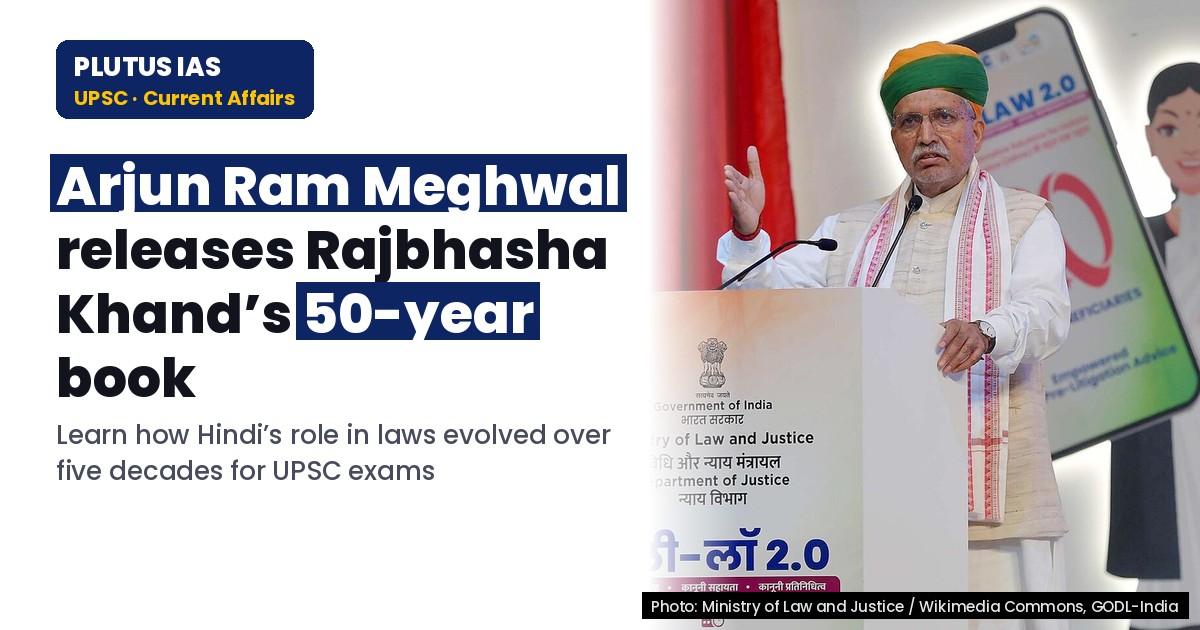
01 Oct UPSC Focus: Rajbhasha Khand’s 50-Year Journey in Legislative Works
✎ The Rajbhasha Khand ensures bilingual legislative drafting under Articles 343–351 of the Constitution and the Official Languages Act, 1963, maintaining equal authenticity of Hindi and English in law-making.
Subject Relevance — Where This Topic Fits
- GS Paper II — Polity and Governance: Constitutional Provisions relating to Official Language | GS Paper III — Role of Language in Governance and Public Administration
- Prelims: Official Languages Act, 1963, Constitution of India: Articles 343-351, Legislative Department under Ministry of Law and Justice, Hindi as Official Language, Bilingual drafting in Parliament and State Legislatures, Rajbhasha Vibhag
- Essay: The Role of Language in National Integration and Governance, Balancing Linguistic Diversity with Administrative Efficiency
Quick Revision: The Rajbhasha Khand ensures bilingual legislative drafting under Articles 343–351 of the Constitution and the Official Languages Act, 1963, maintaining equal authenticity of Hindi and English in law-making.
Why is this in the news?
On 1 October 2026, the Legislative Department’s Rajbhasha Khand (Official Language Wing) marked its golden jubilee, releasing a commemorative volume titled ‘Rajbhasha Khand Ki Swarnim Yatra’ that documents five decades of institutional efforts to promote Hindi in legislative drafting and parliamentary proceedings. The event underscores the sustained governance framework underpinning the use of Hindi alongside English in law-making, reflecting constitutional mandates and administrative continuity.
Background
- The Constitution of India, under Articles 343 to 351, provides a legal and policy framework for the use of Hindi as the Official Language of the Union and for the progressive development of Hindi to meet the administrative needs of the Union.
- The Official Languages Act, 1963, and subsequent Rules, govern the use of Hindi and English in central government offices, including legislative drafting and parliamentary proceedings.
- The Legislative Department, under the Ministry of Law and Justice, is responsible for drafting central legislation and ensuring its bilingual accuracy and clarity.
- The Rajbhasha Khand was established to implement the constitutional and statutory provisions related to Hindi usage in official and legislative contexts.
- Over five decades, the wing has evolved from a compliance-focused unit to a facilitator of citizen-centric, bilingual governance in law-making.
- The commemorative volume highlights institutional memory, policy evolution, and the integration of technological and procedural innovations to enhance Hindi’s role in legislative work.
What is the Rajbhasha Khand and its constitutional-legal mandate?
- The Rajbhasha Khand is the Official Language Wing of the Legislative Department, Ministry of Law and Justice, tasked with promoting Hindi in legislative drafting, parliamentary debates, and official correspondence.
- Its mandate is derived from Articles 343(1), 344, and 351 of the Constitution, which envisage the progressive use of Hindi in Union government functions alongside English.
- The Official Languages Act, 1963, and the Official Languages Rules, 1976, provide the statutory framework for the use of Hindi and English in central government offices, including legislative drafting.
- The wing ensures that all legislative drafts, parliamentary bills, and official documents are prepared in both Hindi and English with equal authenticity, clarity, and consistency.
- It coordinates with parliamentary bodies, state governments, and constitutional authorities to harmonise Hindi usage in inter-governmental and inter-institutional contexts.
- The Rajbhasha Khand also oversees the training of government officials in Hindi drafting, translation, and communication to enhance administrative efficiency.
- Over the past five decades, it has institutionalised bilingual governance by integrating technological tools, standardised glossaries, and quality assurance mechanisms in legislative work.
- The commemorative volume released in 2026 serves as an archival record of policy evolution, administrative reforms, and the cultural-linguistic heritage of Hindi in governance.
Key Features
| Feature | Significance |
|---|---|
| Establishment of the Official Language Section (Rajbhasha Khand) in the Legislative Department | Formal institutionalisation of Hindi as the official language for legislative drafting and documentation, aligning with constitutional provisions. |
| Publication of ‘Rajbhasha Khand ki Swarnim Yatra’ | Chronicles five decades of institutional efforts to promote Hindi in legislative processes, highlighting milestones and contributions. |
| Bilingual Legislative Drafting Framework | Ensures that legislative documents are prepared and maintained in both Hindi and English with precision, clarity, and consistency. |
| Recognition of Retired Officials’ Contributions | Acknowledges five decades of dedicated service by officials in promoting Hindi in governance, fostering institutional continuity. |
| Emphasis on Citizen-Centric Language Use | Promotes accessibility of legislative information to Hindi-speaking citizens, enhancing transparency and inclusivity in governance. |
Why it Matters
Constitutional and Legal
- Reinforces the constitutional mandate under Article 343(1) for Hindi as the official language of the Union, while ensuring its practical application in legislative functions.
- Demonstrates compliance with Article 348(2), which permits the use of Hindi in legislative proceedings subject to prescribed rules.
- Highlights the role of the Legislative Department in implementing the Official Languages Act, 1963, and subsequent rules governing Hindi usage.
Institutional and Governance
- Showcases the Legislative Department’s institutional capacity in maintaining bilingual legislative documentation, a critical function for parliamentary democracy.
- Illustrates the importance of language policy in ensuring equitable access to legal and legislative information for all citizens.
- Underscores the need for continuous capacity-building in Hindi for legislative drafting to meet evolving governance demands.
Cultural and Linguistic
- Preserves and promotes Hindi as a medium of legislative communication, aligning with the cultural ethos of a diverse nation.
- Encourages the use of Hindi in official documentation, reinforcing its role as a unifying language across linguistic regions.
- Supports the preservation of linguistic heritage while adapting to modern governance requirements.
Challenges
1. BALANCING LINGUISTIC UNITY WITH DIVERSITY
- Ensuring Hindi’s effective use in legislative processes without marginalising non-Hindi-speaking regions or languages.
- Addressing the linguistic divide between Hindi and non-Hindi states to foster national integration.
- Mitigating resistance to Hindi imposition while promoting its voluntary adoption in governance.
UPSC Link: GS II: Language Policy
2. CAPACITY AND COMPETENCY GAPS IN HINDI LEGISLATIVE DRAFTING
- Limited proficiency in Hindi among legislative drafters, necessitating specialised training and upskilling.
- Insufficient institutional mechanisms to ensure consistent quality in Hindi legislative documents.
- Need for standardised terminology and style guides to maintain uniformity across legislative texts.
UPSC Link: GS II: Governance
3. TECHNICAL AND DIGITAL INTEGRATION OF HINDI
- Ensuring seamless integration of Hindi in digital legislative platforms and e-governance systems.
- Addressing font, encoding, and software compatibility issues for Hindi in official documentation.
- Developing AI and machine translation tools to support bilingual legislative drafting.
UPSC Link: GS III: Science & Tech
4. PUBLIC AWARENESS AND CITIZEN ENGAGEMENT
- Low public awareness of Hindi legislative documents and their accessibility, limiting citizen participation.
- Need for simplified Hindi versions of laws and rules to enhance comprehension among non-expert stakeholders.
- Encouraging feedback mechanisms to identify gaps in Hindi legislative communication.
UPSC Link: GS II: Governance
Challenges — UPSC Perspective
| Issue | Concern |
|---|---|
| Linguistic Fragmentation | Risk of alienating non-Hindi-speaking states, potentially affecting national cohesion. |
| Drafting Efficiency | Delays in legislative processes due to insufficient Hindi drafting expertise. |
| Digital Divide | Hindrances in adopting Hindi in digital governance platforms due to technical limitations. |
| Citizen Accessibility | Limited reach of Hindi legislative documents among rural and non-Hindi-speaking populations. |
| Institutional Memory | Loss of institutional knowledge in transitioning to newer generations of officials. |
| Standardisation Deficits | Inconsistencies in terminology and style across Hindi legislative documents. |
Way Forward
- Strengthen institutional training programmes for legislative drafters in Hindi to enhance drafting proficiency and accuracy.
- Develop standardised Hindi terminology and style guides for legislative documentation to ensure uniformity.
- Invest in digital infrastructure to seamlessly integrate Hindi in e-governance and legislative platforms.
- Launch public awareness campaigns to educate citizens on the availability and accessibility of Hindi legislative documents.
- Establish a dedicated Hindi language cell within the Legislative Department to monitor and improve Hindi usage.
- Encourage collaboration with state governments to promote Hindi in regional legislative processes.
- Promote research and development in machine translation and AI tools to support bilingual legislative drafting.
- Conduct periodic reviews of Hindi usage in legislative processes to identify and address gaps.
UPSC Value Addition
Keywords for Mains Answer-Writing
Rajbhasha Khand · Official Language Policy · Constitutional provisions on Hindi · Legislative Department · Bilingual legislation · Hindi as Rajbhasha · Institutional efforts for Hindi promotion · Constitutional language provisions · Article 343 to 351 · Language of the Supreme Court and High Courts · Two-language formula · Language of legal drafting · Language rights · Language policy in governance · Hindi as a link language · Constitutional language debates
Constitutional & Policy Linkages
- Article 343(1): Official language of the Union
- Eighth Schedule: Recognition of Hindi as an official language
Concept Flow
Constitutional mandate for Hindi as the official language of the Union (Article 343(1)) → Establishment of the Official Language Section in the Legislative Department → Institutionalisation of bilingual legislative drafting (Hindi and English) → Implementation of the Official Languages Act, 1963 and subsequent rules → Continuous capacity-building and standardisation efforts → Promotion of citizen-centric language use in governance → Preservation of linguistic heritage and national integration
Prelims Practice Questions
Q1. Consider the following statements regarding the Official Languages Act, 1963 and its subsequent amendments:
1. The Act mandates the use of Hindi in all official communications of the Union Government.
2. The Act provides for the use of English for official purposes of the Union as long as it is required.
3. The Act empowers the President to specify the language(s) to be used for official purposes in a State.
4. The Act does not apply to the legislative business of Parliament.
How many of the above statements are correct?
- Only one
- Only two
- Only three
- All
Answer: Only three — Statements 2 and 3 are correct. Statement 1 is incorrect as the Act does not mandate Hindi in all communications but allows for a progressive use of Hindi. Statement 4 is incorrect as the Act applies to the legislative business of Parliament as well.
Q2. Assertion (A): The Official Languages Act, 1963, as amended, provides for the continued use of English for official purposes of the Union Government.
Reason (R): The Act was amended in 1967 to extend the use of English indefinitely for official purposes, reflecting the linguistic diversity of India.
In the context of the above two statements, which one of the following is correct?
- Both A and R are true and R is the correct explanation of A
- Both A and R are true but R is NOT the correct explanation of A
- A is true but R is false
- A is false but R is true
Answer: A is true but R is false — Both A and R are true, but R is not the correct explanation of A. The Act mandates the use of Hindi progressively while allowing English to continue for official purposes, but the amendment in 1967 was not the sole reason for this provision.
Q3. Match the following constitutional provisions with their respective descriptions:
Column I (Constitutional Provision)
A. Article 343
B. Article 344
C. Article 345
D. Article 348
Column II (Description)
1. Language to be used in the Supreme Court and High Courts
2. Official language of the Union
3. Language or languages of a State
4. Commission and Committee of Parliament on official languages
Select the correct match:
- A-2, B-4, C-3, D-1
- A-1, B-2, C-4, D-3
- A-3, B-1, C-2, D-4
- A-4, B-3, C-1, D-2
Answer: A-2, B-4, C-3, D-1 — A-2: Article 343 states Hindi in Devanagari script as the official language of the Union. B-4: Article 344 provides for a Commission and Committee of Parliament on official languages. C-3: Article 345 empowers a State to adopt any language as its official language. D-1: Article 348 specifies the language to be used in the Supreme Court and High Courts.
Mains Practice Question
✍ The Rajbhasha Khand of the Legislative Department has played a pivotal role in promoting Hindi as the official language of the Union Government while ensuring bilingual legislative drafting. Critically examine the constitutional and institutional framework that governs the use of Hindi in legislative processes. Also, analyse the challenges in achieving a balanced bilingual legislative framework in India. (15 Marks)
Approach: A full answer must cover the following dimensions:
1. Constitutional Provisions:
– Article 343: Official language of the Union (Hindi in Devanagari script).
– Article 344: Commission and Committee of Parliament on Official Languages.
– Article 345: Power of a State to adopt any language as its official language.
– Article 348: Language to be used in the Supreme Court and High Courts.
– Article 351: Directive for the development of Hindi to promote its spread.
2. Official Languages Act, 1963:
– Progressive use of Hindi in official communications.
– Continued use of English for official purposes.
– Role of the President in specifying languages for official purposes in States.
3. Institutional Framework:
– Role of the Legislative Department’s Rajbhasha Khand in facilitating bilingual legislative drafting.
– Efforts to make legislative processes citizen-centric through Hindi.
– Training and capacity-building for officials in Hindi legislative drafting.
4. Challenges in Bilingual Legislative Framework:
– Linguistic diversity and regional sensitivities.
– Resistance to Hindi imposition in non-Hindi speaking States.
– Ensuring accuracy, clarity, and consistency in both Hindi and English versions of legislation.
– Balancing the need for uniformity with the federal structure of governance.
5. Recent Initiatives and Judicial Precedents:
– Reference to the Rajbhasha Khand’s 50-year journey and its institutional efforts.
– Any recent Supreme Court or High Court judgments on the use of Hindi in legislative processes (if applicable).
6. Balanced View:
– Acknowledge the progress made in promoting Hindi while highlighting the need for inclusive language policies.
– Discuss the role of English as a link language in a multilingual country.
Source: PIB (Press Information Bureau)
Generated by AanyaAi for educational purpose.
Related guides on our sites
- Best PSIR optional coaching for upsc
- Best PSIR optional teacher for upsc
- Best teacher of PSIR optional for upsc
- Best PSIR optional coaching in delhi for UPSC


No Comments