


28 Jul UPSC Focus: World’s Largest Grain Storage Scheme in Cooperative Sector
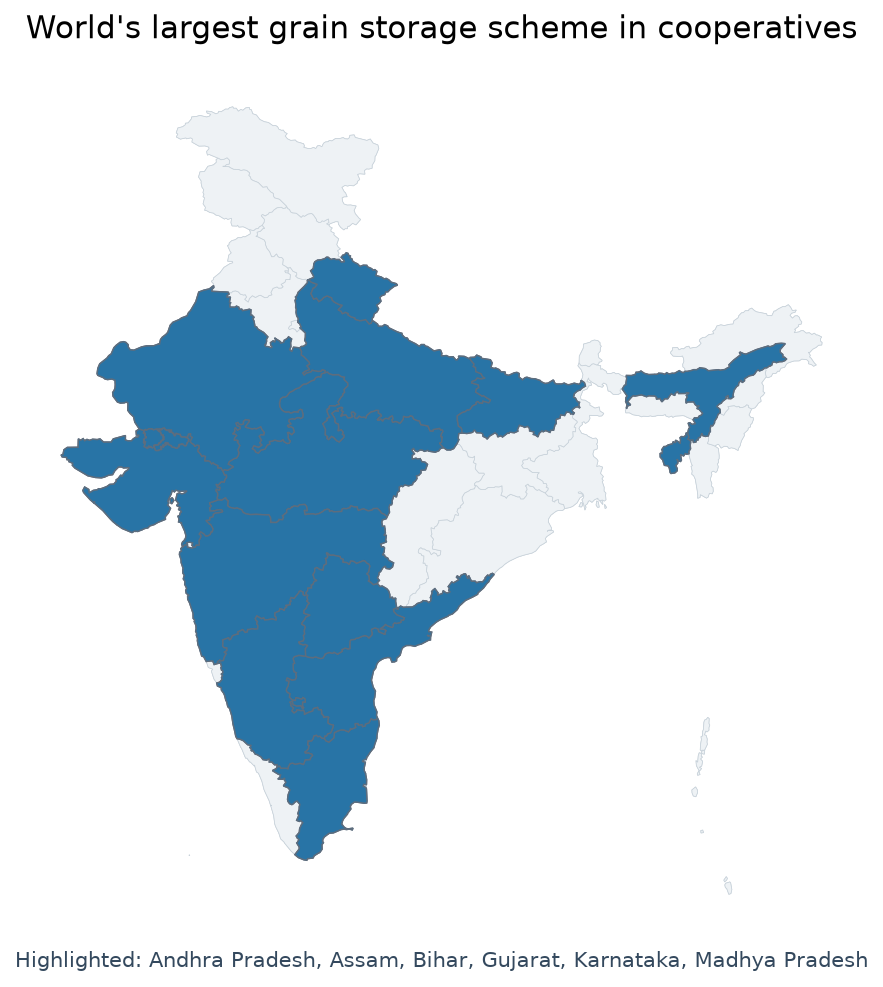
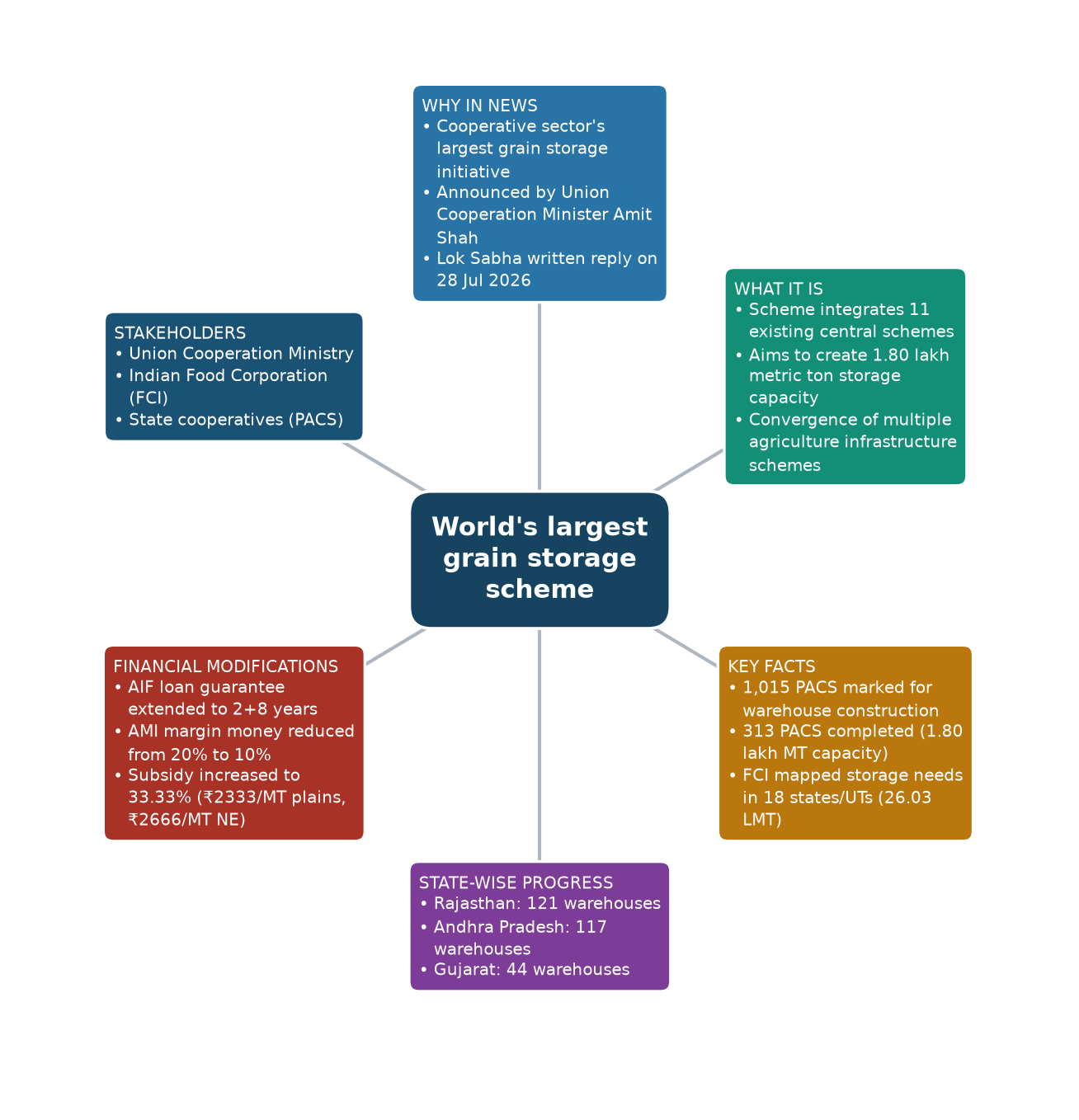
Map & concept mind-map: World’s largest grain storage scheme in cooperatives
Subject Relevance — Where This Topic Fits
- GS Paper III — Agriculture, Food Processing and Related Issues | GS Paper III — Issues Related to Direct and Indirect Farm Subsidies and Minimum Support Prices | GS Paper III — Infrastructure: Energy, Ports, Roads, Airports, Railways and Storage
- Prelims: Cooperative Societies Act, 1912, Food Corporation of India (FCI), Agricultural Infrastructure Fund (AIF), Agricultural Marketing Infrastructure (AMI) Scheme, Minimum Support Price (MSP), Custom Hiring Centres, Sub-Mission on Agricultural Mechanization (SMAM), Pradhan Mantri Micro Food Processing Enterprises Scheme (PMFME), Warehousing Capacity, Metric Tonnage, Rental Assurance, Margin Money, Subsidy Convergence
- Essay: Agricultural Reforms and Rural Prosperity: The Role of Infrastructure, Cooperatives as Vehicles of Inclusive Development
Quick Revision: The scheme converges AIF, AMI, SMAM, and PMFME to create 1.80 lakh MT of decentralized storage at PACS level, reducing post-harvest losses and integrating small farmers into formal supply chains while aligning with FCI’s storage requirements.
Why is this in the news?
On 28 July 2026, the Ministry of Cooperation, Government of India, announced the implementation progress of the world’s largest grain storage scheme in the cooperative sector. The initiative, aimed at augmenting storage infrastructure across Primary Agricultural Credit Societies (PACS), has marked 1,015 PACS for warehouse construction, with 313 already completed, creating a cumulative storage capacity of 1.80 lakh metric tonnes. The scheme integrates multiple central government programmes and aligns with Food Corporation of India’s storage requirements, marking a significant step toward reducing post-harvest losses and enhancing farmers’ income through improved market access and value addition.
Background
- India’s agricultural sector contributes approximately 18% to the national GDP and employs nearly 50% of the workforce, yet faces significant challenges in post-harvest losses—estimated at 6–18% due to inadequate storage infrastructure.
- The Union Budget 2023–24 announced the creation of a world-class grain storage scheme in the cooperative sector to address storage deficits and integrate smallholder farmers into formal supply chains.
- The scheme aligns with the ‘Doubling Farmers’ Income’ (DFI) goal by reducing wastage, improving price realization, and enabling value addition through processing and marketing infrastructure.
- Primary Agricultural Credit Societies (PACS) serve as grassroots-level cooperative institutions, providing credit and input services to farmers, and are now being leveraged to strengthen rural agricultural infrastructure.
- The Food Corporation of India (FCI) operates under the National Food Security Act (NFSA), 2013, and requires robust decentralized storage to reduce transit losses and operational inefficiencies in grain distribution.
- The scheme reflects the convergence of multiple central schemes—Agricultural Infrastructure Fund (AIF), Agricultural Marketing Infrastructure (AMI) Scheme, Sub-Mission on Agricultural Mechanization (SMAM), and PMFME—to achieve synergy and cost efficiency.
What is the World’s Largest Grain Storage Scheme in the Cooperative Sector?
- The scheme is a centrally sponsored initiative under the Ministry of Cooperation, aimed at creating decentralized storage infrastructure at the PACS level to mitigate post-harvest losses and enhance market linkages for small and marginal farmers.
- It integrates multiple existing central government schemes—AIF, AMI, SMAM, and PMFME—through a convergence framework to ensure financial efficiency and avoid duplication of efforts.
- The scheme targets the construction of warehouses, custom hiring centres, processing units, and fair-price shops across 1,015 PACS, with 313 already operational, creating 1.80 lakh metric tonnes of storage capacity.
- State-wise data indicates significant progress in Rajasthan (121 warehouses), Andhra Pradesh (117), and Gujarat (44), with smaller contributions from states like Uttar Pradesh, Maharashtra, and Tamil Nadu.
- The scheme aligns with Food Corporation of India’s (FCI) storage requirements by mapping demand across 216 potential locations in 18 states/UTs, ensuring seamless integration with the public distribution system.
- To enhance financial viability, the scheme offers revised subsidies: 33.33% for warehouse construction (₹2,333/MT for plains and ₹2,666/MT for northeastern states), reduced margin money from 20% to 10%, and extended loan guarantee periods under AIF from ‘2+5 years’ to ‘2+8 years’.
- Additional support is provided for auxiliary infrastructure such as internal roads, weighing bridges, and boundary walls, with one-third of the total subsidy allocated for these components.
- The scheme introduces uniform rental assurance for warehouses of 2,500 MT or more (1,671 MT for northeastern and hilly regions) for a period of 9 years, ensuring long-term viability for PACS and private investors.
Key Features
| Feature | Significance |
|---|---|
| Scale and Coverage | Designation as the world’s largest grain storage scheme under co-operative sector, with 1,015 PACS identified across India and 313 completed, creating 1.80 lakh metric tonnes of storage capacity. |
| Multi-Scheme Convergence | Integration of existing government schemes—AIF, AMI, SMAM, PMFME—ensuring holistic agricultural infrastructure development at PACS and cooperative levels. |
| Geographical Distribution | State-wise distribution of completed warehouses (e.g., 121 in Rajasthan, 117 in Andhra Pradesh, 44 in Gujarat), reflecting equitable regional development. |
| Subsidy Enhancement | Increased subsidy from 25% to 33.33% for warehouses, with higher rates for northeastern states (₹2666/MT vs ₹2333/MT in plains), ensuring fiscal viability. |
| Rental Assurance | FCI’s uniform 9-year rental assurance for warehouses ≥2500 MT (1671 MT for NE/hilly regions), providing long-term stability for co-operatives. |
Why it Matters
Economic
- Enhances agricultural supply chain efficiency by reducing post-harvest losses and improving market access for small farmers through PACS-led storage.
Strategic
- Strengthens food security by integrating FCI’s storage requirements with co-operative infrastructure, ensuring buffer stocks and price stabilization.
Institutional
- Empowers Primary Agricultural Credit Societies (PACS) as nodal agencies for agricultural infrastructure, fostering cooperative federalism and grassroots development.
Fiscal
- Reduces financial burden on co-operatives via enhanced subsidies (33.33%) and extended loan guarantees (8 years), improving project viability.
Regional Equity
- Prioritizes northeastern and hilly states with higher construction costs (₹8000/MT vs ₹7000/MT) and subsidies, addressing developmental disparities.
Challenges
1. Implementation Bottlenecks
- Delays in land acquisition and regulatory clearances for warehouse construction, particularly in densely populated states like Bihar and Uttar Pradesh.
UPSC Link: Land Reforms (GS-III)
2. Technical and Managerial Capacity
- Limited expertise among PACS in managing large-scale storage facilities, necessitating capacity-building under schemes like PMFME.
UPSC Link: Agricultural Extension (GS-III)
3. Logistical Integration
- Inadequate last-mile connectivity (roads, transport) to newly constructed warehouses, undermining their operational efficiency.
UPSC Link: Logistics Infrastructure (GS-III)
4. Sustainability of Co-operatives
- Risk of financial unsustainability for PACS due to low operational margins, despite subsidies, unless linked to value-addition (e.g., processing units under PMFME).
UPSC Link: Cooperative Societies (GS-II)
5. Climate Resilience
- Vulnerability of storage infrastructure to extreme weather events, requiring climate-proofing measures in design and construction.
UPSC Link: Climate Change (GS-III)
Challenges — UPSC Perspective
| Issue | Concern |
|---|---|
| Land Acquisition | Delays due to legal disputes, encroachments, or multiple stakeholder consultations, delaying project timelines. |
| Fund Utilization | Risk of underutilization of enhanced subsidies (33.33%) due to bureaucratic hurdles or lack of awareness among PACS. |
| Quality Control | Potential compromise in construction standards to meet cost targets, leading to structural vulnerabilities. |
| Market Linkages | Uncertainty in linking storage facilities to procurement agencies (e.g., FCI) or private players, affecting revenue streams. |
| Monitoring and Evaluation | Lack of robust MIS for tracking progress, leading to opacity in fund disbursement and project completion. |
Government Initiatives — Must-Memorise for Prelims
- Agriculture Infrastructure Fund (AIF)
- Agricultural Marketing Infrastructure (AMI) Scheme
- Sub-Mission on Agricultural Mechanization (SMAM)
- Pradhan Mantri Formalization of Micro Food Processing Enterprises (PMFME) Scheme
- Food Corporation of India (FCI) Storage Integration
Way Forward
- Streamline land acquisition processes under the Right to Fair Compensation and Transparency in Land Acquisition, Rehabilitation and Resettlement (RFCTLARR) Act to expedite warehouse construction.
- Establish a dedicated capacity-building program for PACS under PMFME to enhance managerial and technical skills in storage and processing.
- Integrate newly constructed warehouses with FCI’s procurement network and private agri-businesses to ensure demand-side linkages.
- Develop a climate-resilient design framework for warehouses, incorporating heat-resistant materials and flood-proofing in vulnerable regions.
- Strengthen last-mile connectivity by converging with the Pradhan Mantri Gram Sadak Yojana (PMGSY) for road infrastructure to PACS-managed facilities.
- Introduce a performance-linked subsidy model to incentivize PACS for timely completion and optimal utilization of storage infrastructure.
- Enhance transparency in fund disbursement through a centralized digital dashboard for real-time monitoring of project progress and expenditure.
- Conduct periodic third-party audits to assess the structural integrity and operational efficiency of warehouses.
UPSC Value Addition
Keywords for Mains Answer-Writing
Cooperative Sector Reforms · Agricultural Infrastructure Fund (AIF) · Agricultural Marketing Infrastructure (AMI) Scheme · Food Corporation of India (FCI) · Primary Agricultural Credit Societies (PACS) · Agricultural Storage Capacity · Sub-Mission on Agricultural Mechanization (SMAM) · PM Formalization of Micro Food Processing Enterprises (PMFME) · Rental Assurance for Warehouses · Subsidy Convergence in Agriculture
Constitutional & Policy Linkages
- Article 243G (Panchayati Raj Institutions and Cooperative Societies)
- Article 243ZH (Cooperative Societies)
Concept Flow
Agricultural Production Surplus → Post-Harvest Losses → Need for Storage Infrastructure → Government Initiatives (AIF, AMI, PMFME) → Convergence at PACS Level → Warehouse Construction → Integration with FCI Procurement → Enhanced Market Access for Farmers → Food Security and Price Stability
Prelims Practice Questions
Q1. Which of the following schemes is NOT converged under the ‘World’s Largest Grain Storage Scheme’ in the cooperative sector?
- Agricultural Infrastructure Fund (AIF)
- Agricultural Marketing Infrastructure (AMI) Scheme
- Pradhan Mantri Kisan Samman Nidhi (PM-KISAN)
- Sub-Mission on Agricultural Mechanization (SMAM)
Answer: Pradhan Mantri Kisan Samman Nidhi (PM-KISAN) — PM-KISAN is a direct benefit transfer scheme for farmers and is not part of the agricultural infrastructure convergence framework under the scheme.
Q2. Under the ‘World’s Largest Grain Storage Scheme,’ the subsidy for warehouse construction in plain areas has been increased to:
- 25% of the project cost
- 33.33% of the project cost
- 50% of the project cost
- 10% of the project cost
Answer: 33.33% of the project cost — The subsidy has been revised from 25% to 33.33% of the project cost for warehouse construction in plain areas, as per the revised guidelines.
Q3. The ‘World’s Largest Grain Storage Scheme’ aims to integrate storage requirements with which of the following entities?
- National Bank for Agriculture and Rural Development (NABARD)
- Food Corporation of India (FCI)
- Small Farmers’ Agribusiness Consortium (SFAC)
- National Cooperative Development Corporation (NCDC)
Answer: Food Corporation of India (FCI) — The scheme is explicitly integrated with the storage requirements of the Food Corporation of India (FCI) to enhance storage capacity.
Mains Practice Question
✍ Evaluate the significance of the ‘World’s Largest Grain Storage Scheme’ in addressing the challenges of agricultural marketing and storage in India. How does the convergence of multiple central schemes under this initiative contribute to its effectiveness?
Approach: The answer must highlight the scheme’s role in augmenting storage infrastructure, reducing post-harvest losses, and enhancing the bargaining power of farmers. Discuss the convergence of schemes like AIF, AMI, SMAM, and PMFME, and their combined impact on creating a robust agricultural marketing ecosystem. Additionally, analyze the financial incentives (subsidies, rental assurances) and their role in incentivizing cooperative societies (PACS) to participate. Conclude with the scheme’s potential to integrate with FCI’s storage requirements and its implications for food security.
Source: PIB (Press Information Bureau)
Generated by AanyaAi for educational purpose.

- उत्तराखंड में असिस्टेंट प्रोफेसर भर्ती: यूकेपीएससी करेगा चयन, जानिए बदलाव - September 22, 2026
- UKPSC to Recruit Assistant Professors in Uttarakhand Aided Colleges: Draft Policy - September 22, 2026
- हिमाचल में नदियों से रेत-बजरी निकालने पर सरकार ने लगाई रोक, जानिए नए नियम - September 22, 2026

No Comments