


27 Jul UPSC: PM Vidyalakshmi Portal for Education Loans – Key Features & Benefits
Subject Relevance — Where This Topic Fits
- GS Paper II — Governance, Transparency and Accountability | GS Paper III — Inclusive Growth and Issues Arising from it
- Prelims: PM Vidya Lakshmi Portal, PM-USP CGFSEL, Education Loan Subsidy Scheme, Gross Enrolment Ratio (GER) in Higher Education, Direct Benefit Transfer (DBT), Credit Guarantee Fund Scheme for Education Loans (CGFSEL)
- Essay: Role of Digital Public Infrastructure in Social Sector Delivery, Financial Inclusion and Access to Education: A Path to Equitable Growth
Quick Revision: The PM Vidya Lakshmi Portal is a digital platform enabling collateral-free education loans and 3% interest subsidies for meritorious students from families earning up to ₹8 lakh annually, with subsidy disbursement linked to academic performance and facilitated through DBT.
Why is this in the news?
The PM Vidya Lakshmi Portal, launched in November 2024 as a central sector scheme, has gained prominence due to its role in facilitating collateral-free education loans and interest subsidies for meritorious students from economically weaker sections. As of July 2026, the portal has processed over 1.12 lakh loans worth ₹15,634.78 crore, underscoring its significance in bridging financial gaps in higher education access. The scheme’s integration with the PM-USP CGFSEL and its digital delivery mechanism through DBT and a dedicated mobile application further highlights its relevance in contemporary governance and financial inclusion.
Background
- The Gross Enrolment Ratio (GER) in higher education in India increased from 23.0 in 2013-14 to 30.0 in 2023-24, reflecting progress in educational access but also highlighting persistent financial barriers for marginalised sections.
- The Government of India, through the Ministry of Education, has implemented multiple schemes to ensure financial inclusivity in higher education, including the Credit Guarantee Fund Scheme for Education Loans (CGFSEL) launched in 2015.
- The PM Vidya Lakshmi Portal was conceptualised to provide a unified digital platform for students to apply for education loans and interest subsidies, eliminating the need for collateral or third-party guarantees.
- The scheme aligns with the National Education Policy (NEP) 2020, which emphasises equitable access to quality education and the reduction of dropout rates through financial support mechanisms.
- The portal operates under the aegis of the Higher Education Department and is accessible to all scheduled banks, regional rural banks, and cooperative banks, ensuring broad coverage.
- The scheme’s financial outlay for the period 2024-25 to 2030-31 is ₹3,600 crore, targeting 7 lakh beneficiaries with a 3% interest subsidy on loans up to ₹10 lakh.
What is the PM Vidya Lakshmi Portal?
- A central sector scheme launched in November 2024 under the Ministry of Education to provide collateral-free education loans to meritorious students admitted to top-quality higher education institutions (QHEIs).
- The portal (https://pmvidyalaxmi.co.in) serves as a digital gateway for students to apply for education loans and interest subsidies, with the platform operational since 25 February 2025.
- Eligibility for the 3% interest subsidy is extended to students with an annual family income up to ₹8 lakh, with a maximum loan limit of ₹10 lakh per student.
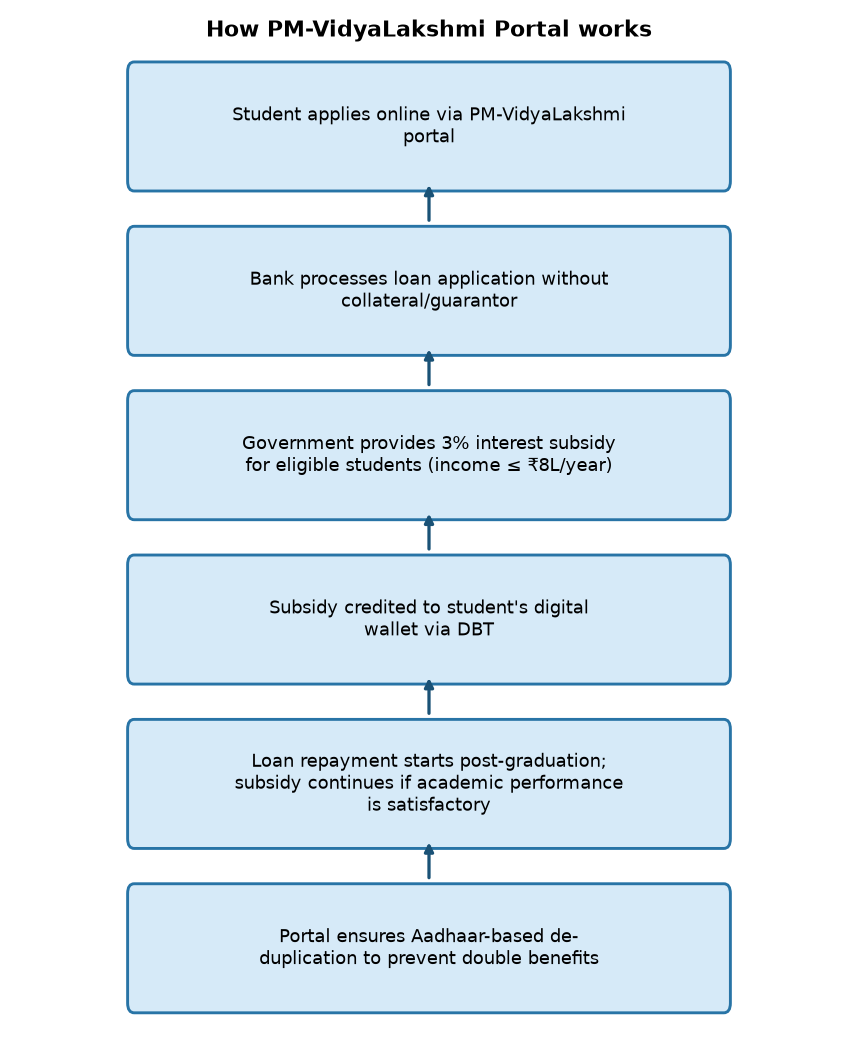
- The scheme ensures transparency through Aadhaar-based de-duplication to prevent duplicate benefits and leverages the PM Vidya Lakshmi Digital Rupee App for subsidy disbursement via Direct Benefit Transfer (DBT).
- The interest subsidy is contingent on satisfactory academic performance from the second year onwards, with institutions required to upload semester-wise progress reports on the portal.
- The PM-USP CGFSEL operates in tandem with the portal, providing guarantee coverage up to 75% of the loan amount, thereby reducing the risk for lending institutions.
- The portal includes 12 public sector banks, 20 private banks, 25 regional rural banks, and 7 cooperative banks, ensuring wide accessibility for students from rural, tribal, and disadvantaged backgrounds.
- The scheme’s design incorporates a digital ecosystem to monitor student progress and disburse subsidies efficiently, with ₹59,843.74 crore in credit guarantees issued under CGFSEL since 2015.
Key Features
| Feature | Significance |
|---|---|
| Zero-collateral education loans up to ₹10 lakh | Removes financial barriers for meritorious students, particularly from economically weaker sections, ensuring equitable access to premier institutions without asset-based security requirements. |
| 3% interest subsidy for family income ≤ ₹8 lakh | Direct fiscal support reduces cost of borrowing, making higher education affordable and mitigating debt burden for low-income households. |
| PM-Vidyalakshmi digital portal (launched 25 Feb 2025) | Centralised, transparent platform streamlines loan applications, subsidy claims, and academic performance monitoring, enhancing efficiency and reducing bureaucratic delays. |
| Credit guarantee via PM-USP CGFSEL for loans up to ₹7.5 lakh | Government-backed guarantee mitigates bank risk, enabling broader institutional participation and reducing collateral requirements for lenders. |
| Academic performance-linked subsidy continuation | Ensures accountability by tying second-year subsidy to satisfactory progress, promoting student commitment to studies. |
Why it Matters
Economic Empowerment
- Facilitates human capital formation by enabling access to quality higher education, which is a critical driver of economic growth and innovation.
- Reduces intergenerational debt traps by providing subsidised loans, particularly for marginalised communities, thereby enhancing social mobility.
- Stimulates demand in the education sector, indirectly benefiting private and public institutions offering courses aligned with employability.
Social Equity
- Targets students from rural, tribal, and economically disadvantaged backgrounds, addressing historical disparities in higher education access.
- Mitigates gender and caste-based educational gaps by removing financial constraints for meritorious candidates from underrepresented groups.
- Contributes to reducing dropout rates, as evidenced by the rise in Gross Enrolment Ratio (GER) from 23.0 (2013-14) to 30.0 (2023-24).
Governance & Digital Public Infrastructure
- Demonstrates the efficacy of digital governance in delivering welfare schemes through Aadhaar-based authentication and Direct Benefit Transfer (DBT).
- Sets a precedent for integrated service delivery platforms, combining loan processing, subsidy disbursement, and academic monitoring in a single ecosystem.
- Enhances transparency and reduces leakages via real-time tracking of loan disbursements and subsidy claims.
Financial Sector Impact
- Expands the education loan market by reducing perceived risks for banks through government credit guarantees, thereby increasing credit flow to the sector.
- Encourages competition among banks to attract borrowers, potentially leading to better terms and lower interest rates over time.
Challenges
1. Implementation Gaps in Rural & Tribal Areas
- Digital divide may limit access to the PM-Vidyalakshmi portal for students in remote regions lacking internet connectivity or digital literacy.
- Banks in rural areas may lack the infrastructure or willingness to process loans under the scheme, leading to underutilisation in these regions.
UPSC Link: GS-II: Social Sector/Schemes
2. Sustainability of Subsidy Burden
- Long-term fiscal sustainability of the 3% interest subsidy is contingent on economic growth and tax revenues; any downturn could strain public finances.
- Subsidy disbursement is capped at 1 lakh beneficiaries annually, which may not suffice for the demand from eligible students.
UPSC Link: GS-III: Fiscal Policy
3. Monitoring of Academic Performance
- Reliance on institutions to upload semester-wise progress reports introduces scope for data manipulation or delays, undermining the accountability mechanism.
- Variations in grading standards across institutions may lead to inconsistent eligibility for subsidy continuation.
UPSC Link: GS-II: Education
4. Banking Sector Participation & Risk Aversion
- Public sector banks may dominate the scheme, sidelining private banks due to lower risk appetite, reducing market competition.
- Default risks, even with credit guarantees, could deter some banks from participating, particularly in regions with higher economic volatility.
UPSC Link: GS-III: Banking Sector
5. Aadhaar-Based De-duplication Challenges
- Aadhaar seeding errors or biometric authentication failures may lead to exclusion of eligible students or duplication of claims.
- Privacy concerns regarding the use of Aadhaar data for subsidy disbursement could pose legal and ethical challenges.
UPSC Link: GS-II: Governance
Challenges — UPSC Perspective
| Issue | Concern |
|---|---|
| Digital divide in rural areas | Limited internet access and digital literacy may exclude deserving students from availing the scheme. |
| Subsidy sustainability under fiscal constraints | High fiscal burden of 3% subsidy could face cuts in economic downturns, reducing scheme effectiveness. |
| Inconsistent academic monitoring by institutions | Variations in grading standards may lead to unfair denial or continuation of subsidies. |
| Banking sector risk aversion | Private banks may avoid participation due to perceived default risks, limiting loan availability. |
| Aadhaar authentication failures | Biometric or seeding errors could exclude eligible students or cause delays in subsidy disbursement. |
Government Initiatives — Must-Memorise for Prelims
- PM-Vidyalakshmi Scheme (2024)
- PM-USP Credit Guarantee Fund Scheme for Education Loans (CGFSEL)
Way Forward
- Strengthen digital infrastructure in rural and tribal regions through targeted awareness campaigns and last-mile connectivity initiatives.
- Expand the subsidy cap beyond 1 lakh beneficiaries annually, subject to fiscal prudence and demand assessment.
- Introduce third-party audits for academic performance monitoring to ensure fairness and transparency in subsidy continuation.
- Incentivise private banks to participate by offering partial risk-sharing mechanisms or performance-linked subsidies.
- Enhance Aadhaar-based authentication robustness with alternative identity verification methods to reduce exclusion errors.
- Integrate the PM-Vidyalakshmi portal with other welfare schemes (e.g., scholarships) to create a unified student support ecosystem.
- Conduct periodic reviews of the scheme’s impact on GER and dropout rates to inform policy adjustments.
UPSC Value Addition
Keywords for Mains Answer-Writing
PM-VidyaLakshmi Portal · Education Loan Scheme · Central Sector Scheme · No Collateral Education Loan · 3% Interest Subsidy on Education Loan · PM-USP CGFSEL Scheme · Credit Guarantee for Education Loans · Gross Enrolment Ratio (GER) in Higher Education · Direct Benefit Transfer (DBT) · Digital Public Infrastructure · Quality Higher Education Institutions (QHEIs) · Merit-based Education Access
Concept Flow
Meritorious students from economically weaker sections seek higher education in premier institutions → → Financial constraints necessitate education loans, but collateral requirements deter access → → Government launches PM-Vidyalakshmi Scheme (2024) offering zero-collateral loans and interest subsidies → → PM-Vidyalakshmi portal digitises loan applications, subsidy claims, and academic monitoring → → Credit guarantee via PM-USP CGFSEL reduces bank risk, expanding loan availability → → Aadhaar-based de-duplication ensures targeted subsidy disbursement → → Academic performance-linked subsidies promote accountability and reduce dropout rates → → Higher GER and social equity outcomes reinforce the scheme’s long-term economic and social impact.
Prelims Practice Questions
Q1. Consider the following statements regarding the PM-VidyaLakshmi Portal:
1. It is a dedicated online platform for applying for education loans and interest subsidies.
2. The portal is operational since 25 February 2025.
3. The portal provides a 3% interest subsidy on education loans for students with an annual family income up to ₹8 lakh.
4. The portal is accessible only to students from public sector banks.
Which of the statements given above are correct?
- 1, 2 and 3 only
- 1, 2 and 4 only
- 2, 3 and 4 only
- 1, 2, 3 and 4
Answer: 1, 2 and 3 only — Statements 1, 2, and 3 are correct as per the official scheme details. Statement 4 is incorrect because the portal is accessible to students from all scheduled banks, including public, private, regional rural, and cooperative banks.
Q2. Which of the following schemes provides a credit guarantee for education loans up to ₹7.5 lakh without requiring collateral or third-party guarantee?
- PM-KISAN
- PM-USP CGFSEL
- PM-VidyaLakshmi
- PM-SHRI
Answer: PM-USP CGFSEL — The PM-USP CGFSEL (Pradhan Mantri Uchchatar Shiksha Protsahan Credit Guarantee Fund Scheme for Education Loans) provides a credit guarantee for education loans up to ₹7.5 lakh without collateral or third-party guarantee, as per the official scheme framework.
Q3. The Gross Enrolment Ratio (GER) in higher education in India increased from 23.0 in 2013-14 to 30.0 in 2023-24. This trend is primarily attributed to which of the following factors?
- Increased availability of scholarships and education loans
- Expansion of higher education institutions only
- Government’s focus on primary education
- Decline in dropout rates due to financial support mechanisms
Answer: Decline in dropout rates due to financial support mechanisms — The increase in GER is primarily attributed to the decline in dropout rates, facilitated by financial support mechanisms such as scholarships and education loans, which enable meritorious students to pursue higher education without financial constraints.
Mains Practice Question
✍ Critically examine the role of the PM-VidyaLakshmi Portal in enhancing access to higher education for meritorious students from economically weaker sections. How does this portal integrate with other government initiatives to ensure inclusive growth in the education sector? Support your answer with relevant examples.
Approach: Begin by outlining the key features of the PM-VidyaLakshmi Portal, including its no-collateral loan scheme and 3% interest subsidy for students with an annual family income up to ₹8 lakh. Discuss its operational framework, such as the PM-USP CGFSEL credit guarantee scheme, which reduces the risk for banks and encourages lending. Analyze how the portal’s digital infrastructure, including Aadhaar-based de-duplication and DBT for subsidy disbursement, ensures transparency and efficiency. Highlight its role in monitoring academic performance through semester-wise progress reports, ensuring accountability. Conclude by linking these features to broader government initiatives like scholarship schemes and the National Education Policy (NEP) 2020, which aim to improve GER and reduce financial barriers in higher education. Use data points such as the approval of 1,12,817 loans worth ₹15,634.78 crore and the increase in GER from 23.0 to 30.0 to substantiate your argument.
Source: PIB (Press Information Bureau)
Generated by AanyaAi for educational purpose.


No Comments