


08 Aug UPSC Polity: National Tribunal Commission Bill to be Introduced in Lok Sabha Next Week
✎ The proposed National Tribunal Commission Bill seeks to institutionalise transparency in tribunal appointments by creating an independent statutory body, thereby addressing the Supreme Court’s concerns over judicial independence…
Subject Relevance — Where This Topic Fits
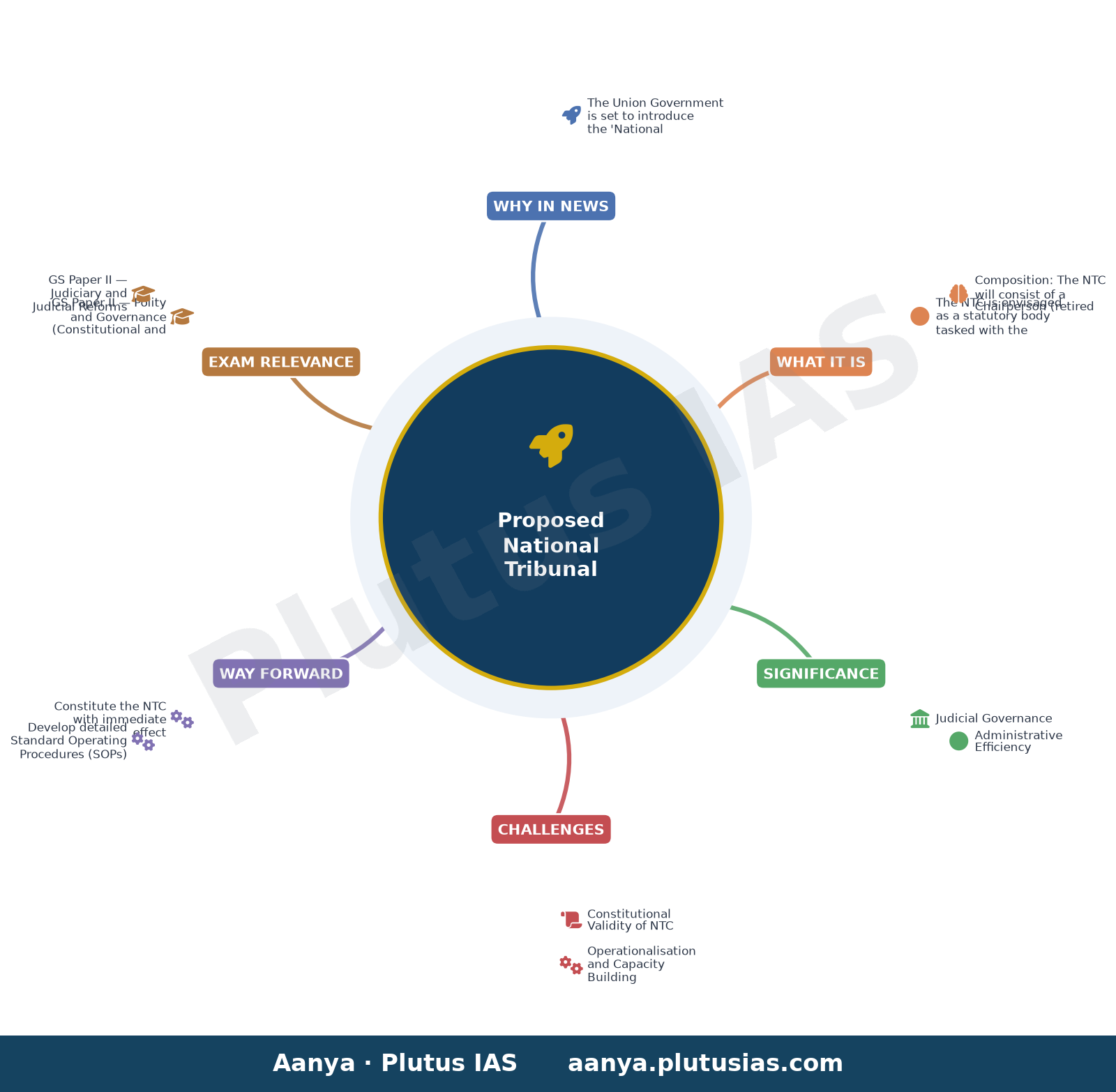
- GS Paper II — Polity and Governance (Constitutional and Statutory Bodies) | GS Paper II — Judiciary and Judicial Reforms
- Prelims: Tribunal Reforms Act, 2021, National Tribunal Commission (NTC), Supreme Court directives on judicial independence, Article 50 (Separation of Judiciary), Administrative Tribunals Act, 1985
- Essay: Judicial Reforms: Balancing Efficiency and Independence in India, Role of Constitutional Courts in Ensuring Good Governance
Quick Revision: The proposed National Tribunal Commission Bill seeks to institutionalise transparency in tribunal appointments by creating an independent statutory body, thereby addressing the Supreme Court’s concerns over judicial independence and arbitrary executive interference.
Why is this in the news?
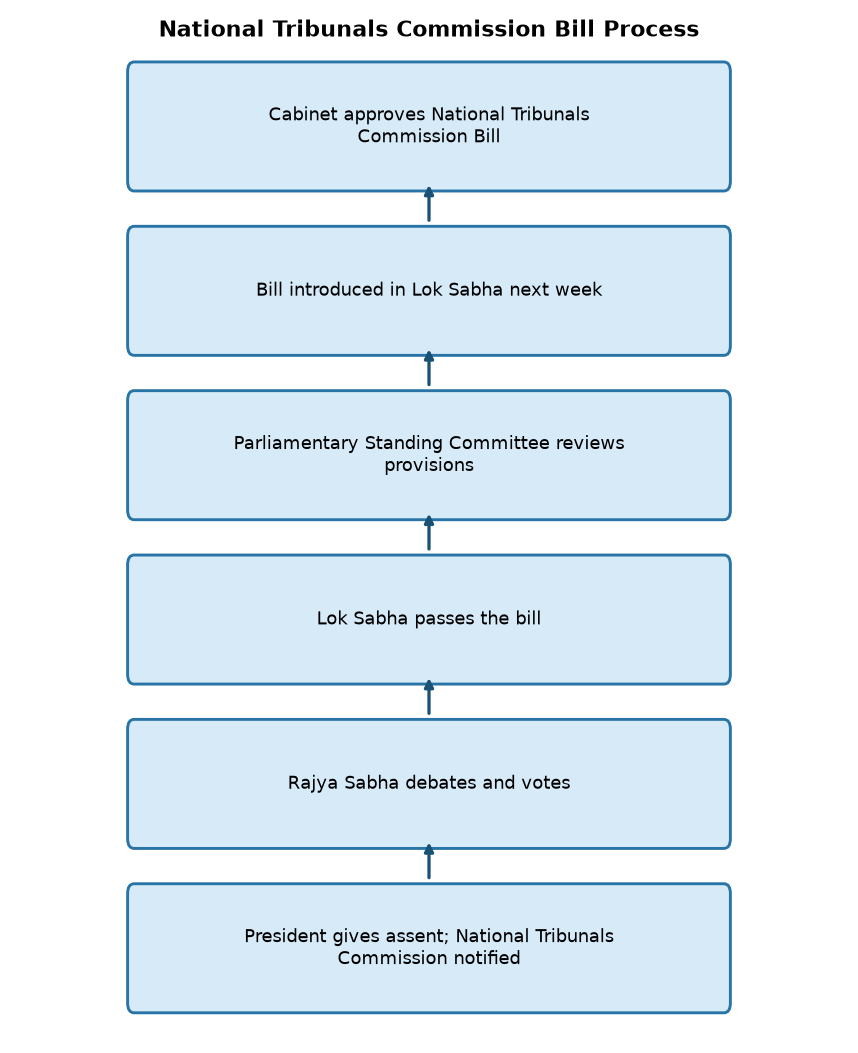
The Union Government is set to introduce the ‘National Tribunal Commission Bill’ in the Lok Sabha next week, aiming to establish a statutory body for the transparent and merit-based appointment of Chairpersons and Members of various tribunals. This legislative initiative responds to the Supreme Court’s 2021 ruling that struck down certain provisions of the Tribunal Reforms Act, 2021, citing violations of the doctrine of separation of powers and judicial independence. The proposed Bill seeks to institutionalise a uniform selection process, thereby addressing long-standing concerns over arbitrariness and lack of accountability in tribunal appointments.
Background
- The Tribunal Reforms Act, 2021, was enacted to streamline the functioning of tribunals by prescribing uniform qualifications, tenure, and service conditions for their Chairpersons and Members.
- The Supreme Court recently struck down key provisions of the Tribunal Reforms Act, 2021, including those related to the appointment process, term limits, and removal procedures, deeming them unconstitutional for undermining judicial independence.
- The Court directed the Union Government to constitute a ‘National Tribunal Commission’ with judicial and technical expertise to ensure transparency, professionalism, and institutional autonomy in tribunal appointments.
- The proposed National Tribunal Commission Bill is the executive’s response to the Supreme Court’s directive, and it will include the formation of the National Tribunal Commission.
- Tribunals in India, established under various statutes (e.g., Income Tax Appellate Tribunal, National Green Tribunal), function as quasi-judicial bodies to provide specialised dispute resolution outside the regular court system.
- The lack of a standardised appointment process has historically led to allegations of executive interference and political patronage in tribunal appointments.
What is the Proposed National Tribunal Commission (NTC)?
- The NTC is envisaged as a statutory body tasked with the appointment, tenure management, and performance evaluation of Chairpersons and Members of tribunals across India.
- Composition: The NTC will consist of a Chairperson (retired Supreme Court Judge or former Chief Justice of a High Court) and four Members (two judicial and two technical experts).
- Functions: It will formulate transparent selection criteria, conduct merit-based appointments, ensure fixed tenures, and enforce accountability mechanisms for tribunal members.
- Autonomy: The NTC is designed to operate independently of the executive and judiciary, reducing the risk of political or judicial interference in tribunal governance.
- Coverage: The Commission will oversee appointments for all central tribunals, including those under the Income Tax Appellate Tribunal, National Green Tribunal, and Central Administrative Tribunal.
- Process: The Bill proposes a two-stage selection process—shortlisting by a Search Committee followed by final appointment by the NTC—to ensure objectivity and expertise.
- Accountability: The NTC will be empowered to recommend removal of underperforming or non-compliant tribunal members, subject to judicial review.
- Legal Framework: The NTC will operate under the aegis of the proposed National Tribunal Commission Bill, which is a response to issues with the Tribunal Reforms Act, 2021, and will establish the NTC.
Key Features
| Feature | Significance |
|---|---|
| Establishment of National Tribunal Commission (NTC) | Centralised authority to streamline appointment, qualification standards, and functioning of tribunals, ensuring institutional independence and reducing executive overreach. |
| Composition of NTC | Comprising a Chairperson (retired SC/HC Chief Justice) and four members (two judicial, two technical experts), ensuring judicial oversight and domain expertise. |
| Transparent Appointment Process | Standardised criteria for selection of tribunal chairs and members, with clear eligibility norms to eliminate subjectivity and favouritism. |
| Judicial Oversight | Supreme Court’s directive mandates NTC’s formation to align with separation of powers and judicial independence principles, addressing prior constitutional infirmities. |
| Repeal of Tribunal Reforms Act, 2021 | Proposed NTC replaces the 2021 Act, which was struck down by the SC for violating constitutional principles, ensuring legal continuity with corrected provisions. |
Why it Matters
Judicial Governance
- Ensures separation of powers by insulating tribunal appointments from executive influence, upholding judicial independence as per Article 50 of the Constitution.
- Introduces a professionalised, merit-based system for tribunal appointments, reducing arbitrariness and enhancing public trust in quasi-judicial bodies.
Administrative Efficiency
- Centralised recruitment mechanism reduces duplication of efforts across 26+ tribunals, improving operational coherence and reducing delays in dispute resolution.
- Standardised qualification criteria and tenure norms ensure uniformity in tribunal functioning, aiding predictability in legal outcomes.
Constitutional Compliance
- Aligns with the Supreme Court’s interpretation of Articles 14, 21, and 50, ensuring that tribunal reforms do not dilute fundamental rights or judicial autonomy.
- Address the lacunae identified in the 2021 Act, particularly regarding arbitrary appointments and lack of transparency, which were struck down as unconstitutional.
Public Trust and Accountability
- Enhances credibility of tribunals by ensuring appointments are based on domain expertise rather than political or bureaucratic considerations.
- Institutionalises grievance redressal mechanisms for stakeholders, improving transparency and reducing corruption risks in tribunal operations.
Challenges
1. Constitutional Validity of NTC
- Risk of NTC being challenged on grounds of excessive delegation of judicial powers to a non-judicial body, violating the doctrine of separation of powers.
- Potential conflict with Article 323B of the Constitution, which empowers Parliament to regulate tribunals but does not explicitly provide for a centralised commission.
UPSC Link: Polity – Tribunals
2. Operationalisation and Capacity Building
- Ensuring adequate infrastructure, human resources, and digital tools for NTC to function effectively across diverse tribunals.
- Training and sensitisation of NTC members on domain-specific issues to avoid over-reliance on judicial members for technical matters.
UPSC Link: Governance – Tribunals
3. Political Interference and Delayed Implementation
- Historical instances of executive delays in implementing judicial directives, risking prolonged vacancies in tribunal positions.
- Lobbying by vested interests to influence NTC’s selection process, compromising its independence.
UPSC Link: Polity – Separation of Powers
4. Resource Allocation and Jurisdictional Overlap
- Ensuring adequate budgetary support for NTC’s functioning without diverting funds from core judicial infrastructure.
- Potential conflicts with existing tribunals’ autonomy, especially those with specialised jurisdictions (e.g., NCLT, CAT).
UPSC Link: Governance – Tribunals
5. Judicial Resistance to Change
- Reluctance of incumbent tribunal members to cede control over appointments to a centralised body, leading to operational friction.
- Courts may resist NTC’s recommendations if perceived as encroaching on judicial prerogatives.
UPSC Link: Judiciary – Judicial Activism
Challenges — UPSC Perspective
| Issue | Concern |
|---|---|
| Constitutional Validity | Risk of NTC exceeding its mandate under Article 323B, leading to legal challenges and delays in implementation. |
| Operationalisation | Lack of clear SOPs for NTC’s functioning, risking inefficiency and bureaucratic bottlenecks. |
| Political Interference | Executive or legislative pressure to influence NTC’s composition or decisions, undermining its independence. |
| Resource Constraints | Inadequate funding or manpower for NTC, limiting its ability to perform oversight functions effectively. |
| Jurisdictional Conflicts | Overlap with existing tribunals’ autonomy, leading to turf wars and operational inefficiencies. |
| Judicial Pushback | Resistance from incumbent tribunal members or courts to NTC’s recommendations, slowing reform implementation. |
Way Forward
- Constitute the NTC with immediate effect post-enactment, ensuring its Chairperson and members are appointed through a transparent, collegium-like process.
- Develop detailed Standard Operating Procedures (SOPs) for NTC’s functioning, including appointment criteria, tenure norms, and grievance redressal mechanisms.
- Conduct capacity-building workshops for NTC members to familiarise them with domain-specific issues and tribunal operations.
- Establish a dedicated secretariat for NTC with adequate staffing and digital infrastructure to support its mandate.
- Ensure periodic audits of NTC’s functioning by an independent body to assess compliance with transparency and accountability norms.
- Collaborate with the Supreme Court to define the scope of NTC’s powers and avoid jurisdictional conflicts with existing tribunals.
- Implement a public grievance portal for stakeholders to report issues related to tribunal appointments or functioning, ensuring accountability.
- Monitor the impact of NTC’s reforms on tribunal efficiency and dispute resolution timelines, with periodic reviews by Parliament.
UPSC Value Addition
Keywords for Mains Answer-Writing
Tribunal Reforms Act 2021 · National Tribunals Commission · Supreme Court directives on tribunals · Judicial appointments · Separation of powers · Tribunal Appellate System · Administrative Tribunals Act 1985 · Judicial independence · Appointment of Tribunal Members · Constitutional validity of tribunal reforms · Lok Sabha legislative process · Judicial review of tribunal appointments · Expert-driven tribunal governance · Transparency in judicial appointments · Doctrine of separation of powers in India
Constitutional & Policy Linkages
- Article 50 – Separation of Judiciary from Executive
- Article 14 – Equality before Law
- Article 21 – Right to Fair Trial
- Article 323B – Power of Parliament to regulate tribunals
Concept Flow
Supreme Court identifies constitutional infirmities in Tribunal Reforms Act, 2021 → Directs formation of National Tribunal Commission (NTC) → Parliament enacts NTC Bill → NTC constituted with judicial and technical members → NTC standardises appointment criteria and processes → Tribunals function with enhanced independence and transparency → Public trust in quasi-judicial bodies improves → Judicial governance aligns with constitutional principles.
Prelims Practice Questions
Q1. Consider the following statements regarding the proposed National Tribunals Commission (NTC):
1. The NTC will consist of a Chairperson and four Members, with two judicial and two technical members.
2. The Chairperson of the NTC must be a sitting judge of the Supreme Court.
3. The NTC is mandated to oversee the appointment, qualifications, and functioning of tribunal members across India.
4. The NTC’s establishment is a direct consequence of the Supreme Court’s suo motu cognizance of tribunal reforms.
How many of the above statements are correct?
- Only one
- Only two
- Only three
- All four
Answer: Only three — Statement 1 is correct: The NTC will have a Chairperson and four Members, with two judicial and two technical members. Statement 2 is incorrect: The Chairperson must be a retired Supreme Court judge or a retired Chief Justice of a High Court, not a sitting judge. Statement 3 is correct: The NTC is tasked with ensuring transparent and merit-based appointments and monitoring tribunal functioning. Statement 4 is incorrect: The NTC’s establishment follows the Supreme Court’s judgment in the case of *Rojer Mathew v. South Indian Bank Ltd.* (2020), not suo motu cognizance.
Q2. Assertion (A): The Tribunal Reforms Act, 2021, was struck down by the Supreme Court for violating the doctrine of separation of powers.
Reason (R): The Act vested excessive control over tribunal appointments in the executive, undermining judicial independence.
In the context of the above statements, which of the following is correct?
- Both A and R are true, and R is the correct explanation of A.
- Both A and R are true, but R is not the correct explanation of A.
- A is true, but R is false.
- A is false, but R is true.
Answer: Both A and R are true, and R is the correct explanation of A. — Assertion (A) is true: The Supreme Court in *Rojer Mathew v. South Indian Bank Ltd.* (2020) struck down several provisions of the Tribunal Reforms Act, 2021, for violating the doctrine of separation of powers. Reason (R) is also true and correctly explains A, as the Act’s provisions diluted judicial independence by centralizing appointments in the executive.
Q3. Match the following tribunals with their respective parent statutes:
Column I (Tribunal) | Column II (Statute)
— | —
A. Central Administrative Tribunal | 1. Administrative Tribunals Act, 1985
B. National Company Law Tribunal | 2. Companies Act, 2013
C. Income Tax Appellate Tribunal | 3. Income Tax Act, 1961
D. Armed Forces Tribunal | 4. Armed Forces Tribunal Act, 2007
Select the correct match:
- A-1, B-2, C-3, D-4
- A-2, B-1, C-4, D-3
- A-3, B-4, C-1, D-2
- A-4, B-3, C-2, D-1
Answer: A-1, B-2, C-3, D-4 — A. Central Administrative Tribunal (CAT) is established under the Administrative Tribunals Act, 1985. B. National Company Law Tribunal (NCLT) is established under the Companies Act, 2013. C. Income Tax Appellate Tribunal (ITAT) functions under the Income Tax Act, 1961. D. Armed Forces Tribunal (AFT) is established under the Armed Forces Tribunal Act, 2007.
Mains Practice Question
✍ The proposed National Tribunals Commission (NTC) seeks to institutionalise transparency and judicial independence in tribunal appointments. Critically examine the constitutional validity of the NTC, with reference to the doctrine of separation of powers and recent judicial precedents. Also, analyse the potential implications of the NTC on the autonomy of tribunals and the balance of powers between the judiciary and the executive. (15 Marks)
Approach: MODEL-ANSWER SKELETON:
1. **Constitutional Framework and Separation of Powers**:
– Briefly define the doctrine of separation of powers in India (as interpreted in *Kesavananda Bharati v. State of Kerala*, 1973, and *Indira Gandhi v. Raj Narain*, 1975).
– Explain the role of tribunals as quasi-judicial bodies under the Constitution (Articles 323A and 323B) and their distinction from courts.
2. **Judicial Precedents on Tribunal Reforms**:
– Discuss the Supreme Court’s judgment in *Rojer Mathew v. South Indian Bank Ltd.* (2020), where the Tribunal Reforms Act, 2021, was struck down for violating the separation of powers.
– Highlight the Court’s emphasis on judicial independence and the need for a transparent, expert-driven appointment mechanism.
3. **Provisions of the NTC Bill**:
– Outline the composition of the NTC (Chairperson: retired SC judge or HC CJ; Members: two judicial and two technical experts).
– Explain the NTC’s mandate: overseeing appointments, ensuring merit-based selection, and monitoring tribunal functioning.
4. **Constitutional Validity of the NTC**:
– Argue that the NTC aligns with the separation of powers by reducing executive overreach in appointments.
– Cite the Court’s observation in *Union of India v. R. Gandhi* (2010) that tribunals must function independently of the executive.
– Address potential challenges: whether the NTC itself becomes an over-centralised body, and whether its composition ensures adequate judicial representation.
5. **Implications for Tribunal Autonomy and Power Balance**:
– **Positive Implications**: Enhanced transparency, reduced executive interference, and improved efficiency in tribunal functioning.
– **Potential Concerns**: Risk of creating a new layer of bureaucracy; dilution of domain-specific expertise in tribunals; possible judicial overreach in appointments.
6. **Comparative Perspective**:
– Briefly compare India’s tribunal reform model with that of the UK (Tribunals, Courts and Enforcement Act, 2007) or Australia (Administrative Appeals Tribunal).
7. **Conclusion**:
– Take a balanced view: the NTC is a step toward judicial independence but must guard against over-centralisation and ensure domain expertise.
Key Cases to Cite:
– *Rojer Mathew v. South Indian Bank Ltd.* (2020)
– *Union of India v. R. Gandhi* (2010)
– *L. Chandra Kumar v. Union of India* (1997) (on tribunals’ power of judicial review)
Key Statutes:
– Administrative Tribunals Act, 1985
– Constitution of India (Articles 323A, 323B, 50)
Balance of Views:
– Proponents: NTC will restore judicial independence and transparency.
– Critics: May lead to bureaucratisation and reduce domain-specific expertise.
Source: amarujala.com
Generated by AanyaAi for educational purpose.

- हिमाचल में बाल पोषण योजना: अब सप्ताह में दो बार मिलेगा अंडा या फल - September 23, 2026
- Himachal Pradesh’s Nutritious Food Scheme: Eggs/Fruits Twice Weekly for 5.5L Students - September 23, 2026
- रिफाइनरी क्षेत्र के लिए ऊर्जा सुरक्षा और नेट-ज़ीरो लक्ष्य में संतुलन जरूरी: विशेषज्ञ - September 23, 2026

No Comments