


27 Mar US–Iran War and the Strait of Hormuz: A Turning Point in Global Geopolitics
This article covers “Daily Current Affairs” and From US–Iran War and the Strait of Hormuz: A Turning Point in Global Geopolitics
SYLLABUS MAPPING
GS- 2- International Relations- US–Iran War and the Strait of Hormuz: A Turning Point in Global Geopolitics
FOR PRELIMS
What are Iran’s main demands to end the US–Iran conflict?
FOR MAINS
What are the possible future outcomes of the US–Iran conflict?
Why in the News?
Iran has formally rejected the United States’ 15-point peace proposal to end the ongoing US–Israel–Iran war, describing it as “extremely maximalist and unreasonable”. The proposal, associated with Donald Trump, was seen by Tehran as lacking sincerity and imposing unilateral conditions. In response, Iran has presented a counter-framework consisting of five key conditions for ending the conflict. Among these, the most controversial is the demand for formal recognition of its sovereignty over the Strait of Hormuz — one of the most critical global energy chokepoints. Iran has further asserted that the timeline for ending the conflict will be determined solely by Tehran, reflecting a shift in negotiating posture and strategic confidence.
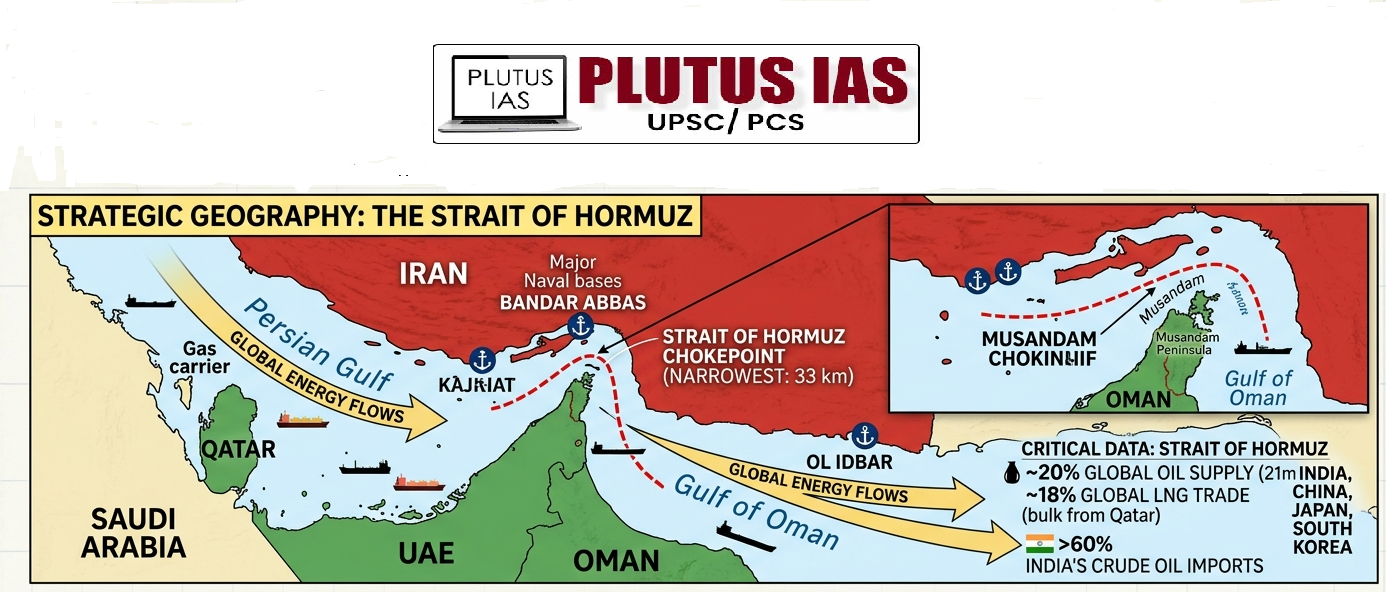
QUICK FACTS AT A GLANCE
1. War Onset: The US–Israel military campaign (Operation Epic Fury) against Iran began in June 2025 and escalated into early 2026.
2. US Proposal: The 15-point plan was rejected as “deceptive in tone and substance.”
3. Iran’s Demand: Five conditions including cessation of attacks, future guarantees, reparations, regional de-escalation, and Hormuz sovereignty.
4. Hormuz Significance: Around 20% of global oil supply (~21 million barrels/day) flows through it.
5. Diplomatic Efforts: Mediation attempts by Turkey, Pakistan, and Egypt have so far failed.
6. US Strikes: Conducted even during negotiations, worsening trust deficits.
BACKGROUND & CONTEXT
A. Historical Roots of the US–Iran Conflict
The US–Iran confrontation is rooted in decades of adversarial history. The 1979 Islamic Revolution transformed Iran from a US ally (under Shah Pahlavi) into a theocratic republic openly hostile to American interests. Key milestones include:
1. 1979: Islamic Revolution and the 444-day American hostage crisis — the foundational rupture in bilateral relations.
2. 1988: US Navy shot down Iran Air Flight 655, killing 290 civilians — a deep scar in Iranian public memory.
3. 2015: Joint Comprehensive Plan of Action (JCPOA) — Iran agreed to limit its nuclear programme in exchange for sanctions relief. The deal briefly normalized economic relations.
4. 2018: Trump unilaterally withdrew from JCPOA (calling it the ‘worst deal ever’), reimposed sweeping sanctions — Iran called it ‘economic warfare’.
5. January 2020: US assassinated IRGC Commander General Qasem Soleimani in Baghdad — Iran launched retaliatory missile strikes on US bases in Iraq.
6. 2021–2024: Failed attempts to revive JCPOA (Vienna talks) as Iran accelerated uranium enrichment to 60%+ purity.
7. June 2025: US and Israel launched coordinated strikes on Iranian military and nuclear facilities (Operation Epic Fury) — triggering the current open war.
B. The Strait of Hormuz — Strategic Geography
Critical Geography
The Strait of Hormuz is a narrow waterway (at its narrowest point, just 33 km wide) between the Oman Sea and the Persian Gulf, flanked by Iran to the north and Oman/UAE to the south. It is the world’s single most important oil transit chokepoint.
Key strategic data on the Strait of Hormuz:
1. ~20% of global oil supply (approximately 21 million barrels per day) passes through it, including to India, China, Japan, South Korea.
~18% of the world’s Liquefied Natural Gas (LNG) trade passes through Hormuz, including bulk of Qatar’s gas exports.
2. For India specifically: over 60% of India’s crude oil imports originate from Gulf countries transiting this Strait.
3. Iran controls the northern coastline; UAE and Oman control the southern shore. Iran’s naval bases (including Bandar Abbas) are positioned right on the Strait.
4. There is no practical alternative pipeline route for all the Gulf oil — making closure or disruption of Hormuz an ‘energy weapon’ of extraordinary power.
5. Iran has repeatedly threatened to close the Strait in past crises (2012, 2019) — but this is the first time formal recognition of Iranian sovereignty has been demanded as a peace condition.
IRAN’S FIVE CONDITIONS
1. Full Halt to Aggression and Assassinations: Iran demands a complete stop to US and Israeli military strikes, including covert operations, targeted killings, and cyberattacks. This stems from past attacks on its nuclear scientists (Mohsen Fakhrizadeh, assassinated in 2020), military officials, and nuclear facilities.
2. Concrete Mechanisms Against Future Attacks: Tehran seeks legally binding and verifiable guarantees to prevent future strikes, not just verbal assurances. This demand arises from past US strikes (June 2025 and February 2026) conducted even during negotiations.
3. War Reparations: Iran demands compensation for infrastructure damage, civilian losses, and economic costs caused by US and Israeli strikes. This is highly contentious, as the US has historically not paid war reparations to adversaries.It also includes demands to unfreeze Iranian assets (~$6–10 billion).
4. End to All Regional Fighting (Including Proxy Groups): Iran calls for a halt to conflicts involving its allied groups such as Hezbollah, Houthis, Iraqi militias, and Hamas. While framed as “comprehensive peace”, the US and Israel see this as an attempt to legitimize Iran’s long-standing “Axis of Resistance” network.
5. Sovereignty Over the Strait of Hormuz: Iran seeks formal recognition of its control over the Strait of Hormuz. Under UNCLOS, the Strait ensures transit passage rights for all vessels. Iran’s demand challenges this principle and, if accepted, would give it major leverage over global energy flows.
MULTI-DIMENSIONAL ANALYSIS
A. Geopolitical Dimension
| Aspect | Analysis |
|---|---|
| Power Transition Dynamics | The conflict reflects erosion of US unipolar dominance. Alex Younger noted the US “lost initiative to Iran” early in the conflict. |
| Axis vs Abraham Accords | Clash between Iran’s Axis of Resistance (Hezbollah, Houthis, Hamas, Iraqi militias) and US-backed Abraham Accords normalizing Israel-Arab ties. |
| Russia & China’s Role | Both act as mediators while benefiting from US overextension; Russia supplies arms, China deepens strategic ties (2021 partnership). |
| Turkey’s Role | A NATO member with ties to both sides; mediation efforts could enhance its regional influence. |
| Regime Change Debate | Claims of regime change vs reality — past examples (Iraq, Libya) show risks of instability and power vacuum. |
B. International Law & Legal Dimension
| Aspect | Analysis |
|---|---|
| Legal Framework | UNCLOS (1982) ensures transit passage through international straits like Strait of Hormuz. |
| UNCLOS vs Iran | Even within territorial waters, transit passage cannot be suspended; Iran’s claim challenges this principle. |
| Law of Armed Conflict | US strikes during negotiations raise concerns about violation of good faith under international humanitarian law. |
| War Reparations | Typically part of formal treaties; Iran signals preference for structured peace agreement. |
| International Courts | Iran has approached ICJ earlier (2018 sanctions case); legal disputes may continue long-term. |
Economic & Energy Security Dimension
1. Impact vs Dependency Table
| Potential Impact if Hormuz Disrupted | Countries Most Dependent on Hormuz Transit |
|---|---|
| Oil prices may rise to $150–200/barrel | China: ~70% oil imports |
| Global inflation surge | India: ~60% crude imports |
| India’s import bill increases (85% import dependence) | Japan: ~80% energy imports |
| Energy shortages in Asia | South Korea: ~70% oil imports |
| Shipping insurance costs surge | EU: LNG dependence (Qatar) |
| LNG supply disruption | Pakistan: highly dependent |
2. Strategic & Country-Specific Analysis
| Aspect | Analysis |
|---|---|
| Iran’s Strategy | By demanding control over Strait of Hormuz, Iran aims to “monetize geography” and gain long-term leverage over global energy flows. |
| India’s Vulnerability | Highly exposed due to oil imports and ~9 million diaspora in Gulf; disruption affects energy, remittances, and safety. |
| Alternative Routes | Saudi Petroline (~5 million bpd) and UAE Fujairah pipeline exist but cannot replace Hormuz (~21 million bpd capacity). |
Security & Strategic Dimension
| Aspect | Analysis |
|---|---|
| Iran’s Military Doctrine — ‘Forward Defence’ | Iran operates through a network of non-state actors (proxy groups) precisely to avoid conventional military confrontation with superior US power. This ‘Axis of Resistance’ doctrine has proven resilient — even as Iranian military infrastructure is degraded, proxy groups continue operations. |
| Anti-Access/Area Denial (A2/AD) | Iran’s military strategy relies on A2/AD capabilities — anti-ship missiles, drone swarms, mine-laying, fast attack craft — designed to deter US naval operations in the Persian Gulf rather than achieve open-sea victory. |
| Nuclear Dimension | A critical unknown — how far has Iran’s nuclear programme progressed? Analysts estimate Iran could achieve nuclear weapon capability within weeks if it chose to weaponize enriched uranium. A military strike that does not eliminate this capacity risks creating a nuclear-armed, highly motivated adversary. |
| Israel’s Strategic Calculus | Israel has long sought to ‘degrade’ Iran’s military and nuclear capabilities. The current conflict may represent Israel’s most significant opportunity — but also its most significant risk — if Iran survives and retaliates through Hezbollah with precision missiles against Israeli cities. |
| US Overextension | Maintaining military operations against Iran while managing tensions with China over Taiwan, supporting Ukraine, and conducting operations in Syria/Iraq stretches US military logistics and political attention. Alex Younger‘s comment about the US ‘underestimating the task’ suggests this concern has reached allied intelligence circles. |
India’s Perspective and National Interest
1. Chabahar Port and Connectivity: India has invested significantly in developing Iran’s Chabahar Port as a gateway to Afghanistan and Central Asia (bypassing Pakistan). The ongoing conflict threatens India’s connectivity ambitions and its $1.6 billion Chabahar investment and future developmental plans.
2. Energy Security: India sources significant oil from Iraq, Saudi Arabia, UAE — all of which transit the Strait of Hormuz. Even partial disruption would be catastrophic for India’s energy security and current account balance.
3. Diaspora Safety: ~9 million Indians live in Gulf countries (UAE ~3.5 million, Saudi Arabia ~2.5 million, Kuwait ~1 million, etc.). Escalation of conflict risks their safety, livelihoods, and India’s remittance inflows (~$120 billion annually from all overseas Indians).
4. Strategic Autonomy: India’s traditional policy of strategic autonomy means it will avoid explicitly endorsing either side. India has historically maintained that ‘all disputes must be resolved through dialogue and diplomacy’ — a position it will reiterate through UN and multilateral forums.
5. Iran Sanctions Dilemma: The US has imposed strict sanctions on Iran. India faces pressure not to trade with Iran — but Chabahar has been given a sanctions exemption previously. India must carefully navigate whether to continue trade with Iran or risk US displeasure.
6. Indian Navy’s Role: India’s Navy has been conducting anti-piracy operations in the Arabian Sea (Operation Sankalp). In a Hormuz crisis, India might need to consider evacuation operations (like Operation Devi Shakti in Afghanistan, Operation Ganga in Ukraine) for its Gulf diaspora.
WAY FORWARD & PROBABLE OUTCOMES
| SHORT-TERM SCENARIOS | Analysis |
|---|---|
| Continued Stalemate | Both sides remain entrenched. Iran continues strikes across the region; US conducts retaliatory operations. No ceasefire in sight. Oil prices remain elevated. Global economy under strain. |
| Negotiated Pause (Not Peace) | A temporary halt to hostilities brokered by a third party (possibly Oman or Turkey), allowing diplomatic talks to begin — but without resolving core issues including Strait of Hormuz sovereignty and reparations. |
| Escalation Risk | Iranian strikes on US bases in the region or disruption of Hormuz transit could trigger a major US escalation, potentially drawing in China (which has strategic interests in Iran).
|
| LONG-TERM STRUCTURAL IMPLICATIONS | Analysis |
|---|---|
| Permanent Shift in Middle East Architecture | Whatever the outcome, the old Middle East order — where US military dominance guaranteed security — is finished. A new multipolar regional order is emerging. |
| Iran’s Deterrence Calculus — Nuclear Question | If Iran concludes that the US will always reserve the right to attack it, the incentive to develop nuclear deterrence becomes overwhelming — potentially triggering the worst proliferation crisis since the Cold War. |
| India’s Strategic Opportunity | A weakened US and a diplomatically isolated Iran both need India’s partnership. India can leverage this for better energy deals, Chabahar concessions, and a more prominent role in shaping the post-war settlement. |
| Energy Transition Acceleration | The Hormuz crisis is an inflection point that will accelerate investment in renewable energy and energy diversification globally — especially in countries like India, Japan, and South Korea that are acutely Hormuz-dependent. |
Conclusion
The US–Iran war and Iran’s bold conditions — particularly the unprecedented demand for Hormuz sovereignty — signal that the post-Cold War Middle Eastern order is undergoing its most fundamental transformation since the 2003 Iraq War. For India, which has historically pursued a West Asia policy built on strategic autonomy, equidistance, and economic engagement, the current crisis presents both acute challenges (energy security, diaspora safety, Chabahar investments) and long-term opportunities (mediator role, energy renegotiation, regional influence). The resolution of this conflict will require not just a halt to hostilities but a comprehensive diplomatic architecture — one that addresses Iran’s security concerns, respects international law, and provides credible guarantees to all parties. India must use this moment to deepen multilateral engagement, accelerate energy diversification, and assert its voice as a responsible
Best ias coaching in delhi Best ias coaching in chandigarh
Prelims question:
Q. With reference to the Strait of Hormuz, consider the following statements:
1. It connects the Persian Gulf with the Arabian Sea.
2. Nearly 20% of global oil supply passes through it.
3. It is fully controlled by Iran under international law.
Which of the statements given above is/are correct?
(a) 1 and 2 only
(b) 2 and 3 only
(c) 1 and 3 only
(d) 1, 2 and 3
Answer: A
Q. Discuss the geopolitical and economic significance of the Strait of Hormuz in the context of the ongoing US–Iran conflict. How does it impact India’s national interests?
(250 words)

- RBI’s Shrinking Real-Rate Cushion Amid Rising Inflation and Strong Demand - September 21, 2026
- India’s NGOs at a New Funding Crossroads - September 21, 2026
- Deep-Sea Discovery, Environmental Responsibility - September 19, 2026

No Comments