


16 Jan Vande Bharat Express: Symbol of India’s Next-Generation Rail Transformation
This article covers “Daily Current Affairs” and From Vande Bharat Express: Symbol of India’s Next-Generation Rail Transformation
SYLLABUS MAPPING
GS-2-Infrastructure- Vande Bharat Express: Symbol of India’s Next-Generation Rail Transformation
FOR PRELIMS
What is Vande Bharat Express?
FOR MAINS
What is the importance of Vande Bharat Express for Indian Railways?
Why in the News?
As India advances towards its vision of becoming a developed nation by 2047, mobility has emerged as a critical pillar of economic growth, regional integration, and social inclusion. Modern transport systems today are not merely about connectivity but act as enablers of productivity, accessibility, and national cohesion. In this context, the Vande Bharat Express represents a transformative leap in India’s passenger rail ecosystem. Conceived, designed, and manufactured indigenously, it symbolises a shift towards faster, safer, energy-efficient, and passenger-centric rail travel, aligned with India’s aspirations for modern infrastructure and technological self-reliance.
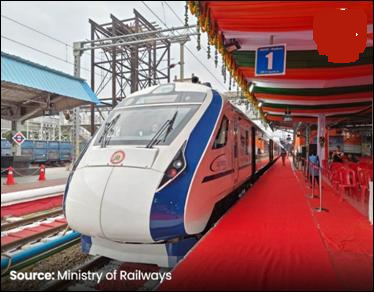
Reimagining Premium Rail Travel in India
Vande Bharat Express marks a new phase in India’s premium passenger rail services. Unlike conventional locomotive-hauled trains, it is a self-propelled semi-high-speed trainset, integrating propulsion, control, and passenger systems into a unified design. This transition enhances operational efficiency, reduces turnaround time, and improves ride quality.
The need for Vande Bharat arose from increasing demand for shorter travel times and superior onboard comfort on medium-distance inter-city routes. Earlier landmark services such as the Rajdhani Express (1969) and Shatabdi Express (1988) revolutionised rail travel in their respective eras. Vande Bharat builds on this legacy while being architecturally aligned with future mobility requirements, forming the backbone of India’s next-generation passenger rail modernisation.
Key Technological and Passenger-Centric Features
Vande Bharat trainsets incorporate advanced systems aimed at safety, comfort, and sustainability:
1. Semi-permanent jerk-free couplers, improved suspension, and aerodynamic design ensure superior ride comfort.
2. Regenerative braking systems enhance energy efficiency by converting braking energy into usable electrical power.
3. KAVACH, India’s indigenously developed Automatic Train Protection (ATP) system with Safety Integrity Level-4 (SIL-4) certification, continuously monitors train movement and signal status, automatically preventing collisions, overspeeding, and signal passing at danger.
4. Centrally controlled automatic plug doors, wider sealed gangways, and modern air-conditioning systems with UV-C lamp-based disinfection enhance safety and hygiene.
5. CCTV surveillance, emergency alarm systems, talk-back units, and Coach Condition Monitoring Systems (CCMS) ensure real-time safety and maintenance oversight.
6. Bio-vacuum toilets, Divyangjan-friendly lavatories, GPS-based passenger information systems, ergonomic seating, and low noise levels significantly elevate passenger experience.
Manufactured at the Integral Coach Factory (ICF) with nearly 90% localisation, Vande Bharat exemplifies the Make in India initiative. In 2024, ICF received the National Energy Conservation Award (NECA), reflecting the emphasis on sustainable manufacturing.
Adding a Cultural Dimension: Vande Bharat Cuisine
From December 2025, Indian Railways introduced regional cuisines on select Vande Bharat services, enriching the travel experience by celebrating India’s culinary diversity. Passengers can now enjoy authentic local dishes such as Kanda Poha (Maharashtra), Kodi Kura (Andhra Pradesh), Methi Thepla (Gujarat), Kosha Paneer (West Bengal), Champaran Paneer (Bihar), and Kashmiri delicacies like Kesar Phirni. This initiative integrates culture with mobility, transforming rail travel into a more immersive experience.
Seven Years of Expansion and Impact
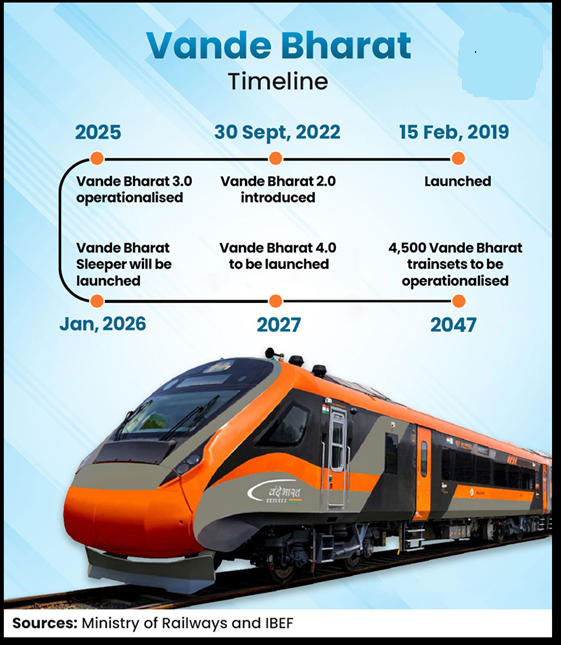
Launched on 15 February 2019 on the New Delhi–Kanpur–Prayagraj–Varanasi route, the first Vande Bharat Express demonstrated India’s capability to design world-class rolling stock. Designed for a maximum speed of 160 kmph, it offered modern amenities and significantly reduced travel time. By December 2025, Vande Bharat services expanded to 164 operational services across 274 districts, carrying over 7.5 crore passengers. Faster acceleration and deceleration enable journey time reductions of up to 45% on several corridors. High occupancy levels—102% in 2024–25 and over 105% in 2025–26 (up to June)—reflect strong passenger preference for clean, reliable, and time-efficient rail travel beyond metropolitan routes.
Evolution of the Platform: Vande Bharat 2.0, 3.0, and Beyond
1. Vande Bharat 2.0, introduced in September 2022, is lighter, more energy-efficient, equipped with enhanced KAVACH integration, and designed for 180 kmph, subject to track readiness.
2. Vande Bharat 3.0 demonstrates improved acceleration (0–100 kmph in ~52 seconds), reduced noise and vibration, and modern onboard connectivity features, matching global semi-high-speed benchmarks while operating on existing infrastructure.
3. Vande Bharat 4.0, expected within 18 months from late 2025, aims to set new global standards in safety, comfort, and build quality. It is envisioned to integrate KAVACH 5.0, improved interiors, upgraded toilets, and enhanced passenger amenities, with long-term potential linked to high-speed corridors supporting speeds up to 350 kmph.
Vande Bharat Sleeper: Extending to Long-Distance Travel
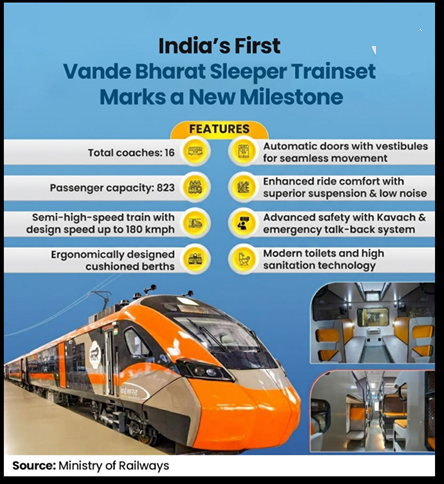
Scheduled for introduction in January 2026, the Vande Bharat Sleeper Train expands the platform to overnight long-distance journeys. The inaugural service between Howrah and Guwahati will strengthen connectivity between Eastern and North-Eastern India, reducing travel time by nearly 3 hours compared to existing services. The 16-coach fully air-conditioned trainset offers modern sleeping arrangements, ample luggage space, and has successfully completed high-speed and endurance trials validated by RDSO. Enhanced ergonomics for loco pilots and improved facilities for onboard staff underline a holistic approach to operational excellence.
Looking Ahead: Scaling for India’s Future
Vande Bharat is envisioned as a cornerstone of India’s passenger rail modernisation. By 2030, around 800 trainsets are planned, with a long-term vision of 4,500 trainsets by 2047, subject to infrastructure readiness. The platform also holds export potential, showcasing India’s growing maturity in indigenous rail technology.
Conclusion
The Vande Bharat Express reflects Indian Railways’ strategic transformation towards modern, efficient, and passenger-focused rail services, backed by indigenous innovation and sustainable practices. Through continuous upgrades, diversified variants, and expanding coverage, Vande Bharat is redefining inter-city mobility in India. More than a train, it represents a symbol of India’s infrastructure renaissance, reinforcing the role of railways as a key enabler of economic integration, inclusive growth, and sustainable national development on the road to Viksit Bharat @2047.
Best ias coaching in delhi Best ias coaching in chandigarh
Prelims question:
Q. With reference to the Vande Bharat Express, consider the following statements:
1. Vande Bharat Express is a self-propelled semi-high-speed trainset manufactured indigenously under the Make in India initiative.
2. It is equipped with KAVACH, India’s indigenously developed Automatic Train Protection (ATP) system.
3. Vande Bharat Express trains are designed exclusively for operation on dedicated high-speed rail corridors.
Which of the statements given above is/are correct?
(a) 1 and 2 only
(b) 2 and 3 only
(c) 1 and 3 only
(d) 1, 2 and 3
Answer: A
Q. Vande Bharat Express represents a paradigm shift in India’s passenger rail services. Examine its significance in terms of technology, passenger experience, and its role in achieving sustainable and inclusive mobility.
(250 words)

- RBI’s Shrinking Real-Rate Cushion Amid Rising Inflation and Strong Demand - September 21, 2026
- India’s NGOs at a New Funding Crossroads - September 21, 2026
- Deep-Sea Discovery, Environmental Responsibility - September 19, 2026

No Comments