


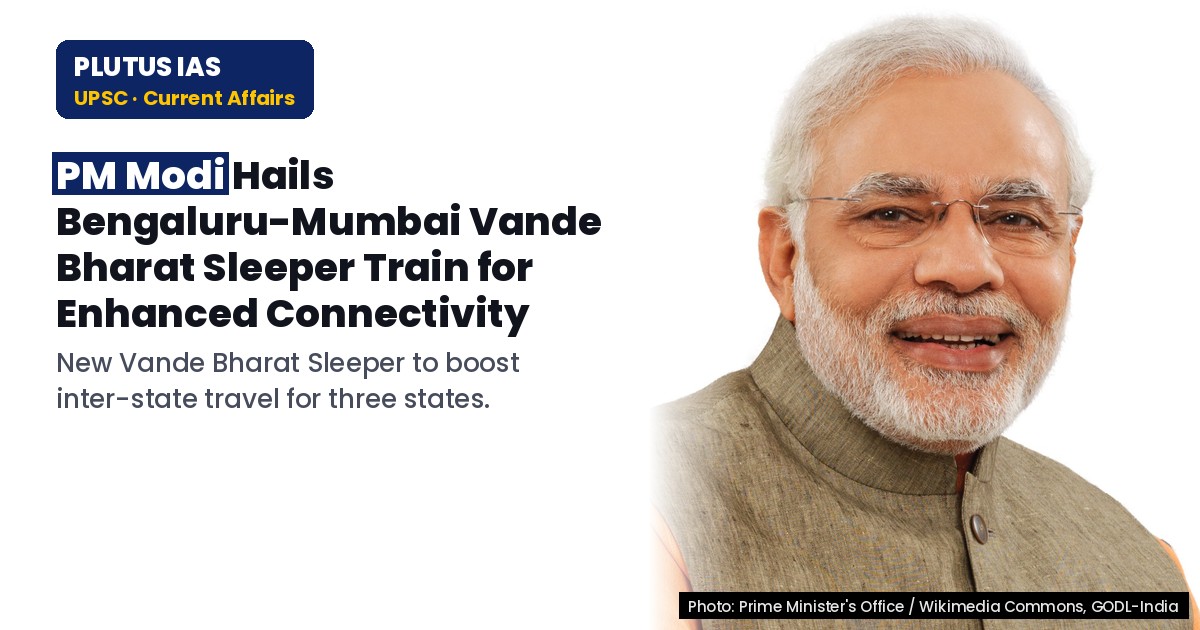
02 Nov Vande Bharat Sleeper: Bengaluru-Mumbai Rail Connectivity Boost
✎ The Vande Bharat Sleeper Train is an indigenously developed, semi-high-speed train designed for overnight journeys, enhancing inter-state rail connectivity and contributing to India's infrastructure modernisation.
Subject Relevance — Where This Topic Fits
- GS Paper III — Infrastructure (Railways) | GS Paper III — Economy (Growth and Development) | GS Paper I — Geography (Transport Systems)
- Prelims: Vande Bharat Sleeper Train, Indian Railways modernisation, High-speed rail corridors, Make in India initiative, National Rail Plan, Inter-state connectivity
- Essay: The role of modern infrastructure in fostering economic growth and regional development., Technological advancements in transportation and their socio-economic implications.
Quick Revision: The Vande Bharat Sleeper Train is an indigenously developed, semi-high-speed train designed for overnight journeys, enhancing inter-state rail connectivity and contributing to India’s infrastructure modernisation.
Why is this in the news?
The Prime Minister recently highlighted the Bengaluru-Mumbai Vande Bharat Sleeper Train as a significant initiative towards enhanced rail connectivity. This development is poised to strengthen inter-state linkages, particularly benefiting the populations of Karnataka, Andhra Pradesh, and Maharashtra, with a specific focus on young professionals, IT sector employees, and students, by offering more convenient and efficient travel options.
Background
- Indian Railways, a vital component of the nation’s infrastructure, is undergoing a comprehensive modernisation drive aimed at improving efficiency, speed, and passenger experience.
- The Vande Bharat Express series represents a key element of this modernisation, designed as semi-high-speed, self-propelled electric multiple unit (EMU) trains.
- The ‘Make in India’ initiative has been central to the Vande Bharat project, with these trains being indigenously designed and manufactured, showcasing India’s engineering capabilities.
- The introduction of Vande Bharat Sleeper trains signifies an expansion of the service, addressing the demand for overnight travel on key inter-city routes with enhanced comfort and amenities.
- Improved rail connectivity is crucial for economic development, facilitating the movement of people and goods, thereby supporting trade, tourism, and regional integration.
- The National Rail Plan (NRP) for 2030 envisions a future-ready railway system capable of meeting growing freight and passenger demands, with Vande Bharat trains contributing to this overarching objective.
What is the Vande Bharat Sleeper Train?
- The Vande Bharat Sleeper Train is an advanced, indigenously designed and manufactured semi-high-speed train, representing an evolution of the existing Vande Bharat Express day-seating services.
- It is specifically configured to provide overnight travel comfort, featuring sleeper berths in addition to seating arrangements, catering to longer journeys.
- These trains are equipped with modern amenities, including superior interiors, improved safety features, advanced braking systems, and enhanced passenger information systems.
- The design prioritises energy efficiency and reduced travel time, contributing to a more sustainable and faster mode of inter-city transportation.
- Manufactured under the ‘Make in India’ initiative, these trains underscore India’s self-reliance in advanced railway technology and manufacturing.
- The introduction of sleeper variants aims to expand the reach of Vande Bharat services to routes requiring overnight travel, thereby enhancing connectivity across major economic and cultural hubs.
- The Vande Bharat Sleeper project is part of a broader strategy to upgrade the Indian Railways network, offering world-class travel experiences and boosting regional economic integration.
Key Features
| Feature | Significance |
|---|---|
| Vande Bharat Sleeper Train | Introduction of a new class of high-speed, long-distance overnight rail travel. |
| Bengaluru-Mumbai Route | Connects two major economic and technological hubs, enhancing inter-state mobility. |
| Improved Connectivity | Facilitates easier and faster travel between Karnataka, Andhra Pradesh, and Maharashtra. |
| Target Beneficiaries | Specifically benefits young professionals, IT sector employees, and students due to enhanced accessibility. |
| Technological Advancement | Represents an advancement in indigenous rail technology and passenger comfort. |
Why it Matters
Economic Development
- Enhanced rail connectivity between major economic centres like Bengaluru and Mumbai is expected to stimulate trade, commerce, and investment flows.
- Improved transport infrastructure reduces logistical costs and travel time, fostering economic efficiency and competitiveness.
- Facilitates business travel and tourism, contributing to regional economic growth and job creation.
Social Impact
- Provides convenient and comfortable travel options for a diverse demographic, including students, professionals, and migrant workers.
- Strengthens inter-state social cohesion by making travel more accessible and affordable.
- Improves quality of life for regular commuters by offering a superior travel experience compared to existing alternatives.
Technological Advancement in Railways
- The Vande Bharat Sleeper Train embodies indigenous engineering prowess and technological innovation in the railway sector.
- Deployment of modern, high-speed sleeper coaches signifies a commitment to upgrading India’s railway infrastructure to global standards.
- Contributes to ‘Make in India’ initiative by showcasing domestic manufacturing capabilities in advanced rolling stock.
Regional Integration
- Strengthens the integration of Karnataka, Andhra Pradesh, and Maharashtra by improving passenger and potentially freight movement.
- Supports the development of a more cohesive national transportation network, crucial for balanced regional development.
- Enhances accessibility to educational institutions and employment opportunities across state borders.
Challenges
1. Infrastructure Development and Upgradation
- Ensuring adequate track infrastructure capable of supporting high-speed operations for Vande Bharat trains across the entire network.
- Upgrading signalling systems and railway stations to accommodate increased traffic and passenger amenities for modern trains.
UPSC Link: Infrastructure: Railways
2. Funding and Investment
- Securing substantial and sustained financial resources for the manufacturing, deployment, and maintenance of advanced train sets.
- Balancing investment in high-speed corridors with the need to upgrade and maintain the vast existing railway network.
UPSC Link: Government Budgeting; Infrastructure
3. Operational Efficiency and Maintenance
- Maintaining high operational punctuality and reliability for Vande Bharat services across diverse geographical and climatic conditions.
- Developing skilled human resources for the maintenance and operation of technologically advanced rolling stock.
UPSC Link: Public Sector Management
4. Passenger Capacity and Demand Management
- Addressing the growing demand for high-speed rail travel while ensuring equitable access and affordability for various segments of the population.
- Optimising seat and berth availability to cater to peak season demand and specific travel patterns.
UPSC Link: Public Services; Social Justice
Challenges — UPSC Perspective
| Issue | Concern |
|---|---|
| Track Modernisation | Existing tracks may require significant upgrades to support the higher speeds and operational demands of Vande Bharat trains, particularly sleeper variants. |
| Resource Allocation | Balancing capital expenditure on new high-speed corridors with the essential maintenance and safety upgrades of the broader railway network. |
| Last-Mile Connectivity | Ensuring seamless integration of Vande Bharat services with other modes of transport at destination stations to enhance overall travel convenience. |
| Fare Structure and Affordability | Determining a fare structure that is commercially viable for the railways while remaining accessible to a broad spectrum of passengers. |
| Environmental Impact | Managing the environmental footprint associated with large-scale infrastructure projects and increased rail traffic. |
Way Forward
- Prioritise holistic infrastructure development, including track upgrades, signalling systems, and station modernisation, to support high-speed rail expansion.
- Invest in indigenous research and development to further enhance the technological capabilities and cost-effectiveness of Vande Bharat trains.
- Develop a robust maintenance and operational framework to ensure high standards of safety, punctuality, and service reliability.
- Formulate a dynamic fare policy that balances commercial viability with passenger affordability and accessibility.
- Strengthen inter-modal connectivity at major railway stations to provide seamless travel experiences for passengers.
- Focus on skill development and training programmes for railway personnel to manage and operate advanced rolling stock and infrastructure.
- Explore public-private partnerships to leverage private sector expertise and capital for accelerated railway development and modernisation.
UPSC Value Addition
Keywords for Mains Answer-Writing
Vande Bharat Sleeper Train · Indian Railways modernization · High-speed rail connectivity · Inter-state connectivity · Economic development · Regional development · Infrastructure development · Technological innovation in railways · Sustainable transportation · Public-private partnerships in railways
Concept Flow
Introduction of Vande Bharat Sleeper Train → Enhanced Bengaluru-Mumbai connectivity → Improved inter-state travel convenience → Benefits for youth, IT professionals, students → Stimulation of economic activity and regional integration
Prelims Practice Questions
Q1. Consider the following statements regarding the Vande Bharat Express trains:
1. Vande Bharat trains are indigenously designed and manufactured in India.
2. They are India’s first semi-high-speed trains.
3. The sleeper variant aims to enhance overnight inter-state travel convenience.
How many of the above statements are correct?
- Only one
- Only two
- All three
- None
Answer: All three — Statement 1 is correct: Vande Bharat trains are indeed indigenously designed and manufactured under the ‘Make in India’ initiative. Statement 2 is correct: They are India’s first semi-high-speed trains, operating at speeds up to 160 km/h. Statement 3 is correct: The introduction of a sleeper variant, as mentioned in the news, is specifically designed to improve convenience for longer, overnight journeys, thereby enhancing inter-state travel.
Q2. Which of the following initiatives is primarily focused on modernizing and upgrading India’s railway infrastructure, including the introduction of advanced train sets like Vande Bharat?
- Sagarmala Project
- Bharatmala Pariyojana
- National Rail Plan
- UDAN Scheme
Answer: National Rail Plan — The National Rail Plan (NRP) 2030 is a comprehensive strategy by Indian Railways to create a ‘future-ready’ railway system by 2030, focusing on capacity expansion, modernization, and improving freight and passenger services. Sagarmala Project focuses on port-led development, Bharatmala Pariyojana on road infrastructure, and UDAN Scheme on regional air connectivity.
Mains Practice Question
✍ Discuss the significance of initiatives like the Vande Bharat Sleeper Train in enhancing inter-state connectivity and fostering regional economic development. Critically examine the challenges that Indian Railways must address to fully leverage such advancements. (15 Marks)
Approach: MODEL-ANSWER SKELETON:
1. **Introduction:** Briefly introduce the Vande Bharat Sleeper Train as a step towards modernizing Indian Railways and improving inter-state connectivity.
2. **Significance of Vande Bharat Sleeper Trains (Inter-state Connectivity):**
* Reduced travel time and increased efficiency for long-distance routes.
* Improved passenger comfort and amenities, attracting more travelers.
* Enhanced accessibility for business, tourism, and educational purposes across states (e.g., Bengaluru-Mumbai route benefiting Karnataka, Andhra Pradesh, Maharashtra).
* Facilitating seamless movement of people, goods, and services.
3. **Significance (Regional Economic Development):**
* Boosting economic activities in connected regions by improving logistics and supply chains.
* Encouraging tourism and hospitality sectors.
* Supporting the growth of IT professionals, students, and other demographics by providing efficient travel options.
* Contributing to ‘Make in India’ and indigenous manufacturing capabilities.
4. **Challenges for Indian Railways:**
* **Infrastructure Constraints:** Need for upgraded tracks, signaling systems, and electrification to support higher speeds and increased traffic.
* **Funding and Investment:** Substantial capital expenditure required for modernization, new rolling stock, and infrastructure development.
* **Safety and Security:** Ensuring robust safety protocols and security measures for high-speed operations.
* **Maintenance and Operations:** Developing skilled workforce and efficient maintenance schedules for advanced train sets.
* **Last-mile Connectivity:** Integrating rail services with other modes of transport for comprehensive connectivity.
* **Environmental Sustainability:** Managing the environmental impact of railway expansion and operations.
* **Fare Affordability:** Balancing advanced features with affordable fares for diverse passenger segments.
5. **Conclusion:** Summarize the transformative potential of such initiatives while emphasizing the need for a holistic approach to address challenges for sustainable and inclusive growth of the railway network.
Source: PIB (Press Information Bureau)
Karnataka PCS (KPSC) — State PCS Practice
Prelims: Which of the following cities will be connected by the recently announced Vande Bharat Sleeper Train, highlighted by the Prime Minister as a significant initiative in rail connectivity?
- A. Bengaluru and Chennai
- B. Bengaluru and Mumbai
- C. Mysuru and Hyderabad
- D. Mangaluru and Goa
Answer: B. Bengaluru and Mumbai — The Prime Minister specifically mentioned the Bengaluru-Mumbai Vande Bharat Sleeper Train as a major initiative in rail connectivity.
Mains: Analyze the potential socio-economic impact of the Bengaluru-Mumbai Vande Bharat Sleeper Train on Karnataka, considering its implications for regional connectivity and development.
Generated by AanyaAi for educational purpose.
Related guides on our sites

- भारतीय नौसेना हेतु 8 नेक्स्ट जनरेशन कॉर्वेट्स का अधिग्रहण - November 2, 2026
- Tribal Healers’ Public Health Role: National Orientation - November 2, 2026
- मध्यप्रदेश स्वामित्व योजना: ग्रामीण संपत्ति अधिकार और चुनौतियाँ - November 2, 2026

No Comments