09 Sep Vice President: The Unique Bridge between Executive and Legislature
Posted at 09 Sep 2025
in
Current Affairs
by Suhani
This article covers “Daily Current Affairs” and Vice President: The Unique Bridge between Executive and Legislature
SYLLABUS MAPPING:
GS-2- Polity and Governance- Vice President: The Unique Bridge between Executive and Legislature
FOR PRELIMS
Why is the Vice President called the ex officio Chairman of the Rajya Sabha?
FOR MAINS
What are the main constitutional roles of the Vice President of India?
Why in the News?
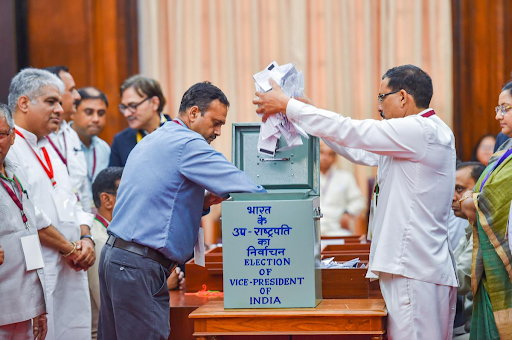
The Vice Presidential election is scheduled for 09 September 2025, where NDA nominee C.P. Radhakrishnan will contest against the INDIA bloc’s nominee B. Sudershan Reddy, following the resignation of Jagdeep Dhankhar in July.
Origin of the office of Vice-President in India:
1. Constitutional Provision: Established under Articles 63–71 of the Indian Constitution (26 January 1950) as the ex officio Chairperson of the Rajya Sabha.
2. Dual Role: Designed to act as a bridge between the executive and legislature and step in as Acting President if the office becomes vacant.
3. Precedent: Dr. Sarvepalli Radhakrishnan (1952–62) set an example, combining constitutional duties with moral authority, enhancing the office’s prestige.
Comparison between the Indian and American Vice Presidents
| Aspect |
Indian Vice President |
American Vice President |
| Constitutional Basis |
Articles 63–71 of the Indian Constitution |
Article II & Amendments XII, XX, XXV of the US Constitution |
| Election |
Indirectly elected by an Electoral College (both Houses of Parliament) through STV system |
Elected along with the President on a joint ticket by the US Electoral College |
| Eligibility |
Must be eligible to be a Rajya Sabha member (Indian citizen, 35 years, other conditions) |
Must be a natural-born US citizen, 35 years old, with 14 years of residency |
| Role in Legislature |
Ex officio Chairman of the Rajya Sabha (Upper House) |
President of the Senate votes in case of a tie |
| Role in Executive |
No direct executive powers; acts as President only in case of vacancy |
Part of the Executive branch; member of the Cabinet, National Security Council, senior-most after the President |
| Succession to Presidency |
Becomes Acting President for max 6 months until a new President is elected |
Becomes President immediately on death/resignation/removal of the President (25th Amendment) |
| Removal |
Removed by a Rajya Sabha resolution with Lok Sabha concurrence |
Removed by Impeachment (same as President) |
| Tenure |
5 years, re-eligible any number of times |
4 years, usually two terms if re-elected with President |
| Visibility in Politics |
Largely ceremonial, limited outside Parliament (exceptions: Dr. Radhakrishnan, Hamid Ansari) |
Highly political, often seen as a future Presidential candidate (e.g., Joe Biden, Kamala Harris) |
| Salary |
Salary as Chairman of Rajya Sabha (₹4,00,000/month) |
Salary as Executive Officer (~$235,000/year) |
Constitutional Provisions Related to the Vice President of India
| Aspect |
Details |
| Article 66 – Qualifications |
Must be a citizen of India, at least 35 years old, not holding any office of profit, and eligible for Rajya Sabha membership |
| Article 66 – Electoral College |
Elected by an Electoral College consisting of all Members of Parliament (Lok Sabha + Rajya Sabha, both elected & nominated) |
| Article 66 & Vice Presidential/Presidential Elections Act, 1952 – Election System |
Elected by proportional representation using the single transferable vote and secret ballot; Nomination requires 20 proposers + 20 seconders; Security deposit: ₹15,000 |
| Article 69 – Oath/Affirmation |
Oath administered by the President; swears to bear allegiance to the Constitution of India |
| Article 67 – Term |
Holds office for 5 years; eligible for re-election; continues until successor assumes office; in vacancy, Deputy Chairman of Rajya Sabha acts |
| Article 67 – Resignation |
Can resign by writing to the President; effective upon acceptance; vacancy must be filled as soon as possible |
| Article 67(b) – Removal |
Removed by a Rajya Sabha resolution (effective majority) + Lok Sabha concurrence (simple majority); 14 days prior notice required; no grounds specified |
| Article 71(1) – Election Disputes |
All disputes regarding the VP election are decided by the Supreme Court; petitions must be filed within 30 days |
| Salary & Perks |
Receives ₹4,00,000/month as Chairman of Rajya Sabha; entitled to free residence, medical facilities, travel allowances; pension of 50% of salary |
| Articles 66 & 89 – Role in Parliament |
VP acts as ex officio Chairman of Rajya Sabha; cannot hold both Vice President and Chairman of Rajya Sabha roles separately—it is a combined function |
Process of Election of the Vice President of India
| Step |
Details |
| 1. Notification of Election |
Issued by the Election Commission of India under the Vice Presidential Elections Act, 1952, about 60 days before the expiry of the term. |
| 2. Filing of Nominations |
Candidate files nomination (Form-3).
• Requires 20 proposers & 20 seconders from MPs.
• Security deposit: ₹15,000.
• Must attach a certified copy of the electoral roll entry. |
| 3. Scrutiny of Nominations |
The Returning Officer scrutinizes all nomination papers and accepts/rejects them based on legal validity. |
| 4. Withdrawal of Candidature |
Candidates can withdraw their candidature by the notified deadline (by submitting notice to the Returning Officer). |
| 5. Voting (Secret Ballot) |
• Voting takes place in Parliament House, New Delhi.
• Electoral College: All MPs (Lok Sabha + Rajya Sabha, including nominated members).
• System: Proportional Representation by Single Transferable Vote (STV).
• MPs mark preferences (1,2,3…) on pink ballot papers. |
| 6. Counting of Votes |
• First preference votes are counted.
• Quota = (Total valid votes ÷ 2) + 1.
• If no candidate meets quota: lowest candidate eliminated → votes redistributed to next preferences.
• Process repeats until a candidate secures the quota. |
| 7. Declaration of Result |
• Candidate securing the quota is declared elected.
• If only two candidates contest, the one with more votes after the first count wins. |
| 8. Challenge to Election (Optional) |
An election petition can be filed in the Supreme Court within 30 days of result declaration. The Court’s decision is final. |
Vice President of India: Role, Importance & Issues Way Forward: Role
|
Main Points
|
Example
|
|
Ex officio Chairman of Rajya Sabha (Art. 64)
|
2023: VP Jagdeep Dhankhar suspended AAP MP Sanjay Singh for repeated disruptions
|
|
Acting President of India (Art. 65)
|
1969: V.V. Giri became Acting President after Zakir Hussain’s sudden death
|
|
Neutral Moderator in Parliament
|
1952: Dr. S. Radhakrishnan as the first VP, calmed heated debates in the Rajya Sabha during refugee rehabilitation issues
|
|
Custodian of Parliamentary Conventions
|
2005: VP Bhairon Singh Shekhawat prevented misuse of Question Hour by insisting on discipline
|
|
Bridge Between States and Union
|
1998–2002: VP Krishan Kant actively engaged states on river water disputes like the Krishna–Godavari
|
Importance
|
Main Points
|
Example
|
|
Ensures Continuity of Governance
|
1977: VP B.D. Jatti acted as President after Fakhruddin Ali Ahmed’s death until the new elections
|
|
Strengthens Parliamentary Democracy
|
2013: VP Hamid Ansari allowed an extended debate on the Lokpal Bill, ensuring consensus
|
|
Upholds Federal Balance
|
2023: VP Dhankhar defended the Rajya Sabha’s role against allegations of the Centre overriding states
|
|
Acts Above Party Politics
|
1950s: Radhakrishnan, as VP, kept the Rajya Sabha above Congress party politics despite being nominated by them
|
|
Safeguards Constitutional Morality
|
2000: VP Krishan Kant openly supported anti-corruption debates before the Tehelka scam revelations
|
Issues / Challenges
|
Main Points
|
Incident / Example
|
|
Frequent Disruptions in the Rajya Sabha
|
2018: VP Venkaiah Naidu said “the nation is losing lakhs per hour” due to washouts
|
|
Perceived Political Bias
|
2022: VP Jagdeep Dhankhar strongly criticized the SC judgment on NJAC, seen as partial
|
|
Limited Role in Executive Functioning
|
1977: B.D. Jatti, as Acting President, had to sign on the cabinet’s advice during the political turmoil (Emergency aftermath)
|
|
Weakening Deliberative Standards
|
2017: Hamid Ansari, in his farewell speech, lamented rising intolerance & falling debate quality
|
|
No Clear Succession Mechanism
|
2002: VP Krishan Kant’s sudden death led to a 2-month vacancy before Bhairon Singh Shekhawat’s election
|
Way Forward to Make VP’s Role More Visible
|
Way Forward
|
Incident / Example
|
|
Strengthen Parliamentary Functioning by ensuring decorum in Rajya Sabha
|
2018: VP Venkaiah Naidu expelled 245 MPs for disruptions, sending a message for discipline
|
|
Institutionalize VP’s outreach to states and universities (build national consensus)
|
1952–1962: VP Dr. Radhakrishnan regularly addressed universities, strengthening the intellectual-political bridge
|
|
Regular Public Engagements & Policy Advocacy
|
2017–2022: Hamid Ansari held discussions on minority rights & democracy, though debated, kept VP’s voice in public sphere
|
|
Promote Research & Capacity Building through Rajya Sabha Secretariat
|
2023: VP Dhankhar launched new digital archive of Rajya Sabha debates for public access
|
|
Clarify & Expand Role in Governance beyond Presiding Chair
|
1977: Acting President B.D. Jatti ensured continuity during political instability; similar clarity can help future crises
|
|
Strengthen Neutrality & Impartiality of Office
|
2002: VP Krishan Kant widely respected for impartial conduct, example to revive trust
|
|
Increase International Representation (soft diplomacy)
|
2006–2007: VP Hamid Ansari represented India in UN forums & NAM Summits, enhanced visibility
|
|
Leverage iGOT–Karmayogi & Digital Platforms for Public Awareness
|
2024: VP’s office onboarded training modules on iGOT portal to spread awareness of Parliament’s role
|
Conclusion
If the Vice President’s office actively engages in parliamentary reforms, public discourse, federal dialogue, and international representation, it can evolve from being a “ceremonial backup” to a visible guardian of constitutional democracy
Prelims Questions
Q. With reference to the Vice President of India, consider the following statements:
1. The Vice President is elected by an Electoral College consisting of all Members of Parliament, both elected and nominated.
2. The Vice President serves as the ex officio Chairman of the Rajya Sabha.
3. In the event of a vacancy in the office of the President, the Vice President acts as President until a new President is elected.
4. The Vice President can be removed by impeachment in the same manner as the President.
Which of the statements given above are correct?
(a) 1, 2 and 3 only
(b) 1 and 2 only
(c) 2 and 4 only
(d) 1, 2, 3 and 4
Answer: A
Mains Questions
Q. “The office of the Vice President of India is often seen as ceremonial, but it plays a crucial role in ensuring parliamentary stability and constitutional continuity.” Discuss the role, importance, challenges, and possible reforms to strengthen the visibility and effectiveness of the Vice President’s office.
(250 words, 15 marks)





No Comments