


25 Nov Vice President’s Maharashtra & Tamil Nadu Visit: UPSC GS Insight
✎ The Vice President of India serves as the ex-officio Chairman of the Rajya Sabha and assumes presidential duties during a vacancy or inability of the President, while also actively participating in public and educational…
Subject Relevance — Where This Topic Fits
- GS Paper II — Indian Polity and Governance: Constitutional Bodies, Role of Vice President | GS Paper II — Social Justice: Education, Human Resource Development
- Prelims: Vice President of India, Constitutional office, Symbiosis International (Deemed University), Nellai Nadar Matriculation Higher Secondary School, Role in education, Public engagements
- Essay: The evolving role of constitutional functionaries in promoting national development and social cohesion., Education as a cornerstone of national progress: Examining the contributions of various stakeholders.
Quick Revision: The Vice President of India serves as the ex-officio Chairman of the Rajya Sabha and assumes presidential duties during a vacancy or inability of the President, while also actively participating in public and educational engagements.
Why is this in the news?
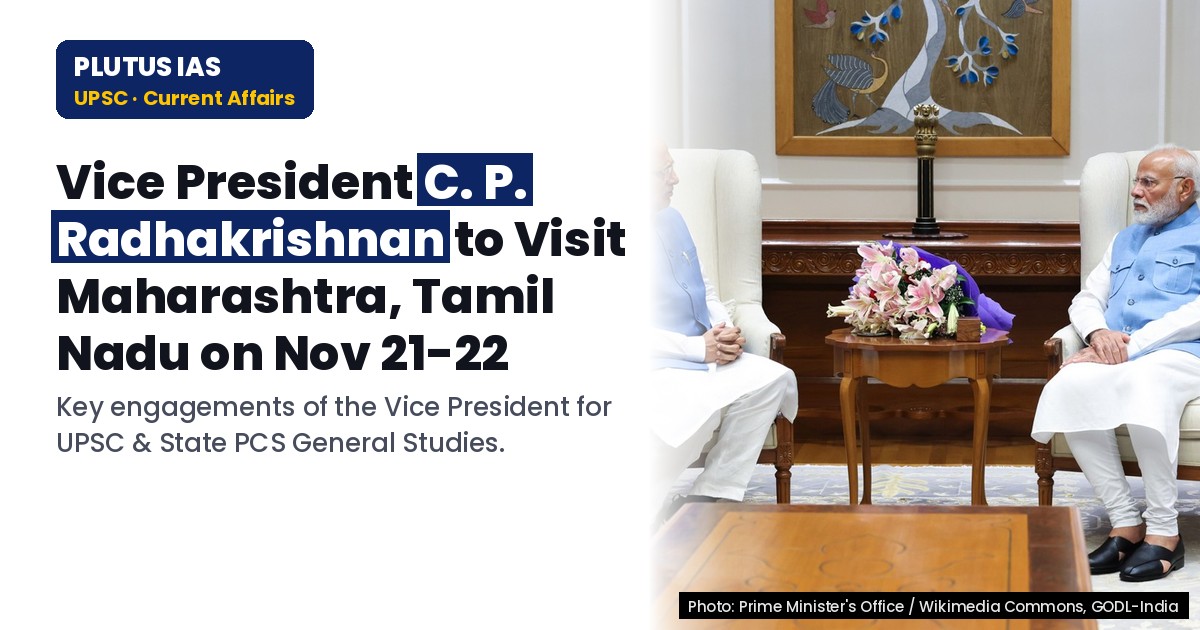
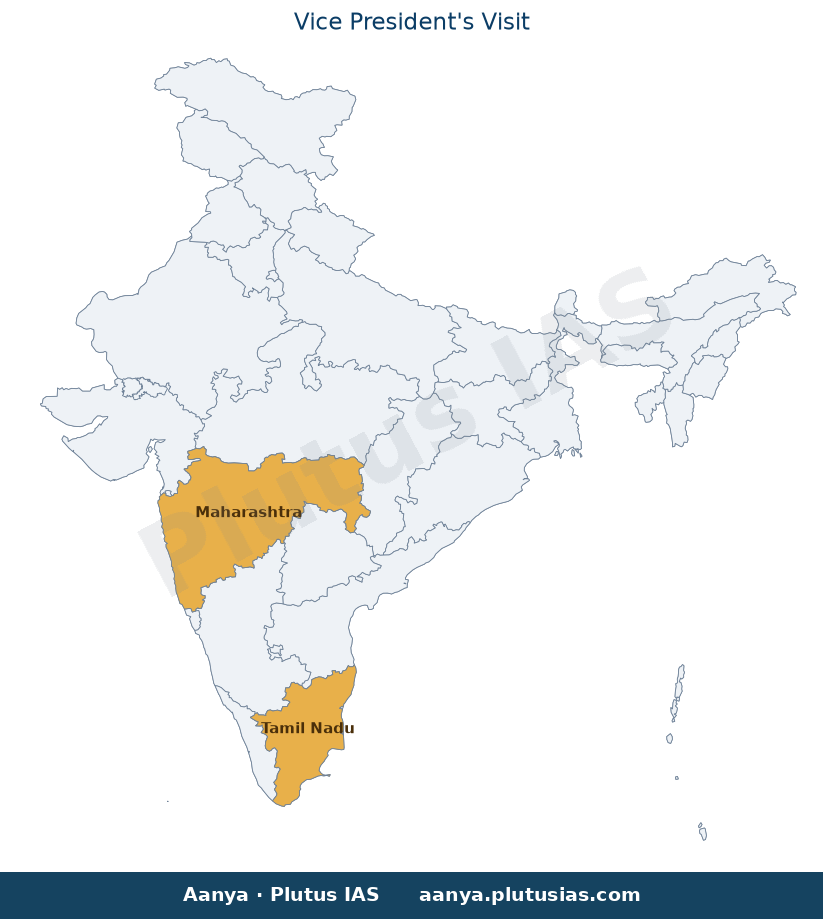
The Vice President of India, Shri C. P. Radhakrishnan, is scheduled to undertake official visits to Maharashtra and Tamil Nadu on November 21-22, 2026. During these visits, the Vice President will participate as the Chief Guest at the Convocation Ceremony of Symbiosis International (Deemed University) in Pune and attend the 42nd Annual Day celebrations of Nellai Nadar Matriculation Higher Secondary School in Chennai, underscoring the significance of educational institutions in national development.
Background
- The Vice President of India holds the second-highest constitutional office in the Republic of India, immediately after the President.
- The office of the Vice President is established under Article 63 of the Constitution of India, which states that there shall be a Vice President of India.
- Beyond constitutional duties, the Vice President frequently engages in public life, including addressing educational institutions, participating in cultural events, and promoting governmental initiatives.
- Such engagements serve to connect the constitutional office with the citizenry, particularly the youth, and to highlight areas of national importance such as education.
- Deemed universities, like Symbiosis International, are institutions granted autonomy by the Ministry of Human Resource Development (now Ministry of Education) to offer their own courses and degrees, playing a crucial role in higher education.
- Matriculation Higher Secondary Schools, such as Nellai Nadar, form a vital part of the foundational education system, preparing students for higher studies and vocational pursuits.
The Office of the Vice President of India
- The Vice President is elected by members of an electoral college consisting of members of both Houses of Parliament, in accordance with the system of proportional representation by means of the single transferable vote.
- The term of office for the Vice President is five years, and they are eligible for re-election.
- The primary constitutional functions of the Vice President include acting as the ex-officio Chairman of the Rajya Sabha (Council of States), the upper house of the Indian Parliament.
- In the event of a vacancy in the office of the President due to death, resignation, removal, or otherwise, the Vice President acts as the President until a new President is elected and assumes office.
- The Vice President also discharges the functions of the President when the latter is unable to perform their duties due to absence, illness, or any other cause.
- The Vice President’s role extends to representing the nation at various national and international forums, contributing to public discourse, and upholding constitutional values.
Key Features
| Feature | Significance |
|---|---|
| Vice President’s Engagements | Participation in academic and educational institutional events underscores the importance of education and youth development in national discourse. |
| Symbiosis International (Deemed University), Pune | A prominent higher education institution, its convocation ceremony highlights the culmination of academic pursuits and the entry of graduates into the workforce. |
| Nellai Nadar Matriculation Higher Secondary School, Chennai | An educational institution at the secondary level, its annual day celebration reflects the ongoing commitment to foundational education. |
| Official Travel | The Vice President’s visits to different states facilitate direct engagement with various segments of society and reinforce the federal structure of governance. |
| Role of Vice President | Beyond constitutional duties, the Vice President often engages in public functions to promote national values, education, and social welfare. |
Why it Matters
Social Significance
- The Vice President’s participation in educational events serves to motivate students and faculty, emphasizing the critical role of education in national development.
- Such engagements highlight the government’s focus on fostering an educated populace and promoting academic excellence across all levels of schooling.
Institutional Significance
- Visits by high constitutional functionaries to educational institutions lend prestige and recognition to their efforts in shaping future generations.
- It reinforces the importance of both higher education (university convocation) and foundational schooling (school annual day) in the overall educational ecosystem.
Constitutional and Governance Significance
- The Vice President, as the second-highest constitutional office, undertakes public engagements that reflect the broader governmental commitment to various sectors, including education.
- These visits contribute to the visibility of constitutional offices and their role in civil society, beyond legislative and executive functions.
Challenges
1. Ensuring Equitable Access to Quality Education
- Despite progress, disparities persist in access to quality education, particularly in rural and remote areas, and among socio-economically disadvantaged groups.
- The challenge involves providing adequate infrastructure, qualified teachers, and relevant curricula across all educational institutions, from primary to tertiary levels.
UPSC Link: Social Justice: Education
2. Bridging the Skill Gap
- A significant challenge is aligning educational outcomes with the demands of the evolving job market, ensuring graduates possess relevant skills for employment and entrepreneurship.
- This requires continuous curriculum reform, emphasis on vocational training, and collaboration between academia and industry.
UPSC Link: Human Resource Development
3. Promoting Research and Innovation
- Indian higher education institutions face the challenge of enhancing their research output and fostering an environment conducive to innovation and critical thinking.
- This necessitates increased funding for research, development of robust research infrastructure, and incentives for academic excellence.
UPSC Link: Science and Technology Development
Challenges — UPSC Perspective
| Issue | Concern |
|---|---|
| Educational Disparities | Unequal access to quality education based on geography, socio-economic status, and gender. |
| Curriculum Relevance | Ensuring educational content remains updated and aligned with contemporary industry needs and global standards. |
| Teacher Training and Retention | Attracting, training, and retaining highly qualified educators, especially in underserved regions and specialized subjects. |
| Infrastructure Deficiencies | Lack of adequate physical and digital infrastructure in many educational institutions, particularly in public sector schools and colleges. |
| Funding for Education | Securing sufficient and sustained financial resources for educational reforms, research, and institutional development. |
Way Forward
- Strengthen public-private partnerships in education to leverage resources and expertise for infrastructure development and quality enhancement.
- Implement continuous professional development programs for teachers to update their pedagogical skills and subject knowledge.
- Promote vocational and skill-based education from an early stage to enhance employability and entrepreneurial capabilities among youth.
- Integrate technology effectively into teaching and learning processes to improve access, personalize learning, and enhance educational outcomes.
- Foster a culture of research and innovation in higher education institutions through increased funding, collaborative projects, and industry linkages.
- Develop robust mechanisms for quality assurance and accreditation across all levels of education to ensure adherence to high academic standards.
- Address regional and socio-economic disparities in education through targeted interventions and inclusive policies to ensure equitable access for all.
UPSC Value Addition
Keywords for Mains Answer-Writing
Vice President of India · Constitutional office · Functions of Vice President · Education sector engagement · Public outreach · Symbolic head of state · Higher education · School education · UPSC Civil Services
Constitutional & Policy Linkages
- {‘article’: ‘Article 63’, ‘note’: ‘Office of the Vice President’}
- {‘article’: ‘Article 64’, ‘note’: ‘Vice President as ex-officio Chairman of Rajya Sabha’}
- {‘article’: ‘Article 65’, ‘note’: ‘Vice President acting as President’}
- {‘article’: ‘Article 21A’, ‘note’: ‘Right to Education’}
- {‘article’: ‘Article 45’, ‘note’: ‘Provision for early childhood care and education’}
Concept Flow
Vice President undertakes official visits to states → Participates in educational institutional events → Highlights importance of education and youth development → Motivates students and faculty → Reinforces governmental commitment to education → Contributes to national human resource development
Prelims Practice Questions
Q1. Consider the following statements regarding the office of the Vice President of India:
1. The Vice President is elected by an electoral college consisting of members of both Houses of Parliament.
2. The Vice President is the ex-officio Chairman of the Rajya Sabha.
3. The Vice President holds office for a term of five years and can be re-elected.
How many of the above statements are correct?
- Only one
- Only two
- Only three
- None
Answer: Only three — Statement 1 is correct: Article 66(1) of the Constitution specifies that the Vice President is elected by members of an electoral college consisting of members of both Houses of Parliament. Statement 2 is correct: Article 64 states that the Vice President shall be ex-officio Chairman of the Council of States (Rajya Sabha). Statement 3 is correct: Article 67 provides for a five-year term, and there is no constitutional bar on re-election.
Q2. Which of the following functions are performed by the Vice President of India?
1. Acting as the President in case of a vacancy in the office of the President.
2. Presiding over the joint sitting of Parliament.
3. Deciding on questions of disqualification of members of the Rajya Sabha on grounds of defection.
Select the correct answer using the code given below:
- 1 only
- 1 and 2 only
- 1 and 3 only
- 1, 2 and 3
Answer: 1 only — Function 1 is correct: Article 65 states that the Vice President shall act as President or discharge his functions during casual vacancies in the office, or during the absence of the President. Function 2 is incorrect: The Speaker of the Lok Sabha presides over a joint sitting of Parliament (Article 108). Function 3 is incorrect: The Chairman of the Rajya Sabha (who is the Vice President) decides on questions of disqualification of members of the Rajya Sabha on grounds of defection under the Tenth Schedule.
Mains Practice Question
✍ Examine the constitutional role and responsibilities of the Vice President of India. Discuss how public engagements, such as attending educational events, contribute to the symbolic and functional aspects of this office. (15 Marks)
Approach: MODEL-ANSWER SKELETON: The answer should begin by outlining the constitutional provisions related to the Vice President’s office (Articles 63-71), including election (Art. 66), term (Art. 67), ex-officio Chairman of Rajya Sabha (Art. 64), and acting President (Art. 65). Discuss the dual role as the second-highest constitutional office and the presiding officer of the Upper House. Subsequently, elaborate on the significance of public engagements, specifically educational events, in enhancing the stature of the office, promoting constitutional values, fostering national unity, and connecting with citizens. Mention how such engagements contribute to soft power and the symbolic representation of the state, beyond formal duties. Reference the role in promoting education and national development.
Source: PIB (Press Information Bureau)
Maharashtra PCS (MPSC) — State PCS Practice
Prelims: Which of the following statements regarding the Vice President’s visit to Maharashtra on November 21-22 is/are correct?
1. The visit is primarily focused on promoting cultural ties between Maharashtra and other states.
2. This visit is part of a broader initiative to review the implementation of central schemes in key states.
3. The Vice President is expected to address a joint session of the Maharashtra State Legislature during this visit.
Choose the correct option:
- A. 1 only
- B. 2 only
- C. 1 and 3 only
- D. None of the above
Answer: D. None of the above — The provided topic only states that the Vice President will visit Maharashtra and Tamil Nadu on November 21-22, without specifying the purpose or agenda of the visit. Therefore, no statement can be confirmed as correct based solely on the given information.
Mains: Analyze the potential significance of a Vice President’s official visit to a state like Maharashtra, considering the state’s political, economic, and cultural importance within the Indian federal structure. Discuss how such visits contribute to center-state relations and the implementation of national policies, specifically from a Maharashtra perspective.
Generated by AanyaAi for educational purpose.
Related guides on our sites
- Current affairs for upsc 2026
- Best PSIR optional coaching for upsc
- Best PSIR optional teacher for upsc
- Best teacher of PSIR optional for upsc

- Vice President’s Maharashtra & Tamil Nadu Visit: UPSC GS Insight - November 25, 2026
- उपराष्ट्रपति ने श्री श्री विश्वविद्यालय में आइकॉनिक टॉवर का उद्घाटन किया - November 25, 2026
- VP Addresses Odisha Assembly Orientation: Key Takeaways - November 25, 2026

No Comments