


12 Aug Vijay’s Resolution: Lok Sabha Strength at 543 & Women’s Reservation in UPSC Focus
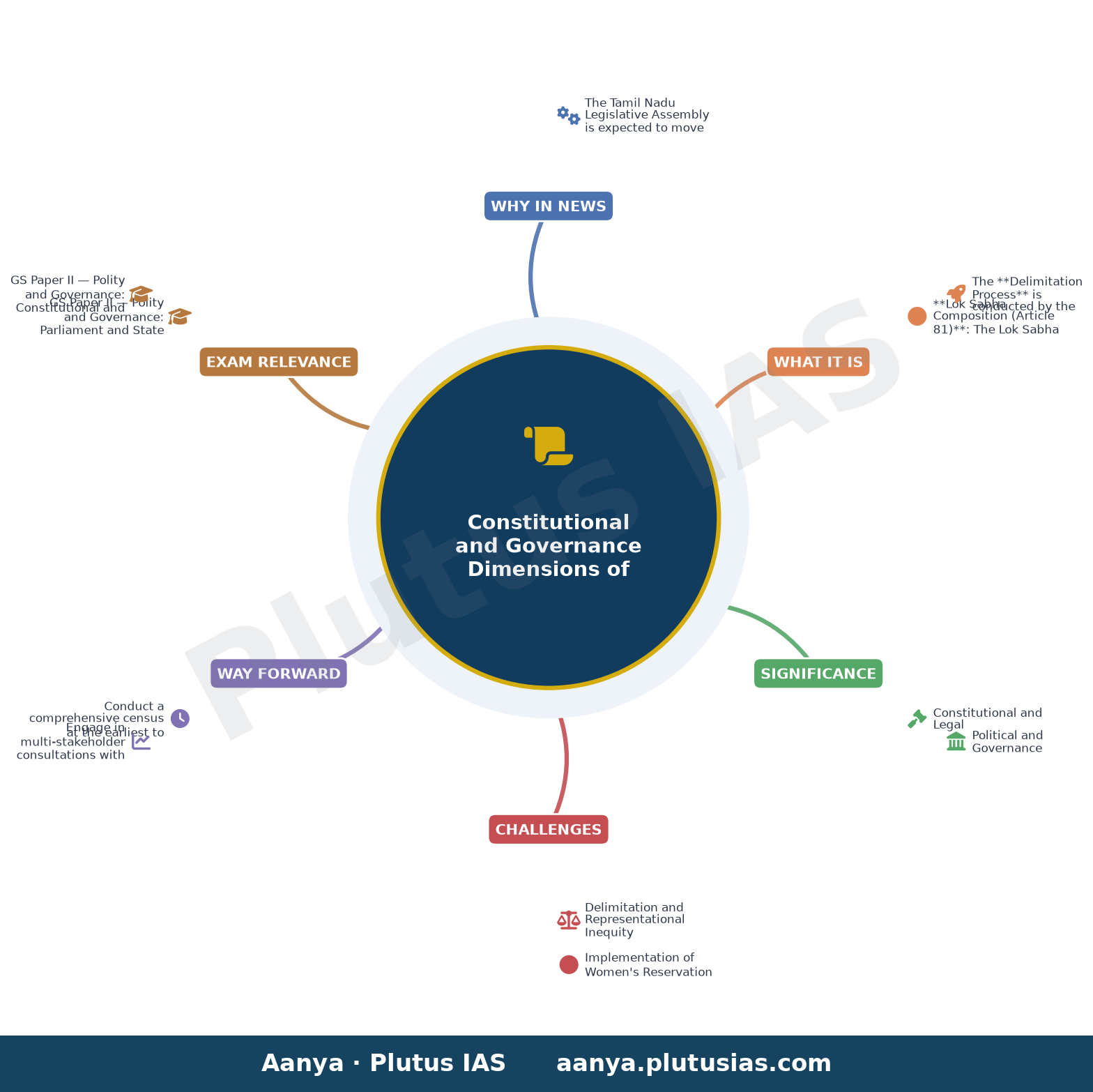
✎ The Tamil Nadu Legislative Assembly is expected to move a resolution urging the Union Government to maintain the current Lok Sabha strength at 543 seats and to implement the 33% women’s reservation in Parliament.
Subject Relevance — Where This Topic Fits
- GS Paper II — Polity and Governance: Parliament and State Legislatures — Structure, Functioning, Conduct of Business, Powers and Privileges | GS Paper II — Polity and Governance: Constitutional and Non-Constitutional Bodies — Functions and Responsibilities | GS Paper II — Polity and Governance: Federalism, Centre-State Relations, and Inter-State Relations
- Prelims: Lok Sabha composition, Article 81, Article 82, Delimitation Commission, Census, Article 334, Women’s Reservation Bill, Article 330A, Article 332, Article 334A, First Past the Post System, Proportional Representation, Union Territories Representation, Population-based Representation, Constitutional Amendments, Concurrent List, State Legislatures, Rajya Sabha Composition, Article 75(3)
Why is this in the news?
The Tamil Nadu Legislative Assembly is expected to move a resolution urging the Union Government to maintain the current Lok Sabha strength at 543 seats and to implement the 33% women’s reservation in Parliament. The resolution also raises concerns regarding the non-conduct of delimitation since 1973 and the implications of population-based delimitation on the representation of states that have successfully controlled population growth. This development intersects with ongoing debates on federalism, demographic justice, and gender representation in India’s parliamentary democracy.
Background
- The Constitution of India, under Article 81, originally provided for a maximum of 550 seats in the Lok Sabha, with 530 representing states and 20 representing Union Territories.
- The delimitation of parliamentary and assembly constituencies is mandated by the Delimitation Commission under the Delimitation Act, 1952, and is based on the decennial Census data.
- The last delimitation exercise was conducted in 1973 based on the 1971 Census, after which the freeze on delimitation was extended until 2026 through the 84th Constitutional Amendment Act, 2001, to protect the interests of states that had controlled population growth.
- The Women’s Reservation Bill, first introduced in 1996, seeks to reserve one-third of seats in the Lok Sabha and State Legislative Assemblies for women, but has not been enacted due to lack of consensus.
- The National Eligibility cum Entrance Test (NEET) has been a subject of legislative resolutions in Tamil Nadu, reflecting ongoing debates on state autonomy and governance.
Constitutional and Institutional Framework Governing Lok Sabha Composition, Delimitation, and Women’s Reservation
- **Lok Sabha Composition (Article 81)**: The Lok Sabha consists of not more than 550 members, of which 530 are elected from states and 20 from Union Territories. The current strength is 543, with two seats reserved for Anglo-Indians being abolished in 2020.
- The **Delimitation Process** is conducted by the Delimitation Commission, a statutory body established under the Delimitation Act, 1952. It redraws constituency boundaries based on the latest Census data to ensure equitable representation.
- The **Lok Sabha-Rajya Sabha Ratio**: The Lok Sabha is the directly elected House of the People, while the Rajya Sabha represents states. The current ratio of Lok Sabha to Rajya Sabha seats is approximately 2.2:1, reflecting the relative representation of states in Parliament.
- The **Women’s Reservation Bill** proposes to reserve 33% of seats in the Lok Sabha and State Legislative Assemblies for women. The bill has been introduced multiple times but has not been enacted due to procedural and political challenges.
- The **Constitutional Basis for Reservation**: Articles 330A, 332, and 334 provide for reservation of seats for Scheduled Castes, Scheduled Tribes, and Anglo-Indians in Parliament and State Legislatures. A similar provision for women’s reservation would require a constitutional amendment.
- The **Role of the Census**: The decennial Census is the primary data source for delimitation. The next Census, originally scheduled for 2021, has been delayed, which has implications for the timing of delimitation and potential changes in parliamentary representation.
- The **Federal Implications of Delimitation**: Delimitation based on post-1971 Census data could alter the balance of representation between states, particularly benefiting states with higher population growth rates, raising concerns about demographic justice and federal equity.
Key Features
| Feature | Significance |
|---|---|
| Proposal to maintain Lok Sabha strength at 543 | Ensures continuity in parliamentary representation ratios and prevents demographic shifts from altering seat distribution disproportionately. |
| Call for immediate implementation of 33% women’s reservation | Advances gender parity in legislative bodies, aligning with constitutional directives and global benchmarks for inclusive governance. |
| Argument for delimitation based on 2011 Census | Highlights the necessity of updating constituency boundaries to reflect current demographic realities and ensure equitable representation. |
| Concerns over representation of southern states | Raises the issue of potential under-representation in Parliament due to delayed delimitation, particularly for states with successful population control measures. |
| Proposed increase in Lok Sabha seats to 850 | Proposes a constitutional amendment to expand parliamentary seats, addressing the need for proportional representation in a growing population. |
Why it Matters
Constitutional and Legal
- The resolution invokes the principle of proportional representation as enshrined in the Constitution, particularly Articles 81 and 82, which govern the composition and delimitation of the Lok Sabha.
- The call for women’s reservation aligns with the 73rd and 74th Constitutional Amendments, which mandate 33% reservation for women in local bodies and seek similar provisions in higher legislatures.
- The proposal to increase Lok Sabha seats to 850 would require a constitutional amendment under Article 368, necessitating a two-thirds majority in Parliament and ratification by state legislatures.
Political and Governance
- The resolution underscores the federal structure of governance by emphasizing the role of states in determining their representation, as outlined in the Constitution.
- It reflects a demand for greater autonomy in state-level governance, particularly in matters of education and social policies, such as the NEET examination.
- The push for women’s reservation highlights the ongoing discourse on gender inclusivity in political institutions, a key aspect of democratic governance.
Demographic and Representational
- The resolution addresses the demographic imbalance caused by delayed delimitation, which has led to unequal representation of states with controlled population growth.
- It raises the issue of ‘one person, one vote’ principle, ensuring that parliamentary representation reflects the current population distribution rather than outdated census data.
- The proposal to increase seats to 850 aims to accommodate India’s growing population while maintaining the Lok Sabha-Rajya Sabha ratio of 2.2:1, as recommended by the Delimitation Commission.
Challenges
1. Delimitation and Representational Inequity
- Delayed delimitation has led to disproportionate representation, with states like Tamil Nadu facing potential under-representation despite effective population control measures.
- The lack of updated census data since 2011 complicates the delimitation process, as any new census would require significant time and resources to conduct.
- Expanding the Lok Sabha to 850 seats would necessitate substantial logistical and administrative reforms, including infrastructure, staffing, and electoral processes.
UPSC Link: GS-II: Federalism, Representation of States
2. Implementation of Women’s Reservation
- Despite constitutional amendments mandating women’s reservation in local bodies, its extension to Parliament remains pending due to political and procedural challenges.
- The resolution’s call for immediate implementation may face resistance from political parties wary of altering existing electoral dynamics.
- Ensuring effective participation of women in Parliament requires not only reservation but also systemic support for their political engagement and leadership.
UPSC Link: GS-II: Gender Empowerment, Political Participation
3. Constitutional Amendment Process
- Amending the Constitution to increase Lok Sabha seats or implement women’s reservation requires a two-thirds majority in Parliament and ratification by state legislatures, a complex and time-consuming process.
- The resolution’s proposal to increase seats to 850 may face opposition from states concerned about reduced relative representation or from parties fearing electoral consequences.
- The need for a new census to facilitate delimitation adds another layer of complexity, as it would require significant administrative and financial resources.
UPSC Link: GS-II: Constitutional Amendments, Federalism
4. Balancing State Autonomy and Central Authority
- The resolution reflects tensions between state demands for greater autonomy in governance and the central government’s authority in matters like delimitation and electoral reforms.
- States like Tamil Nadu argue that their population control measures should not disadvantage them in parliamentary representation, highlighting the need for a fair and transparent delimitation process.
- The central government must balance these demands with the broader goal of ensuring equitable representation across all states.
UPSC Link: GS-II: Federalism, Centre-State Relations
5. Public Trust and Electoral Reforms
- The resolution’s call for the abolition of NEET reflects broader concerns about the efficacy and fairness of national-level entrance examinations, which have been criticized for undermining state-level educational autonomy.
- The demand for the Foreign Contribution (Regulation) Amendment Bill’s withdrawal highlights concerns about the central government’s regulatory overreach in matters affecting state governance.
- These issues underscore the need for comprehensive electoral and governance reforms to restore public trust in institutional processes.
UPSC Link: GS-II: Electoral Reforms, Governance
Challenges — UPSC Perspective
| Issue | Concern |
|---|---|
| Delayed delimitation | Leads to disproportionate representation, particularly for states with controlled population growth. |
| Lack of updated census data | Complicates the delimitation process and delays necessary reforms in parliamentary representation. |
| Implementation of women’s reservation | Faces political and procedural challenges despite constitutional mandates for gender inclusivity. |
| Constitutional amendment process | Requires broad consensus and significant administrative resources, making reforms slow and complex. |
| Balancing state autonomy and central authority | Creates tensions between state demands for governance autonomy and central government’s regulatory role. |
| Public trust in electoral and governance processes | Undermined by issues like NEET and FCRA, necessitating comprehensive reforms. |
Way Forward
- Conduct a comprehensive census at the earliest to facilitate timely delimitation of constituencies and ensure equitable representation.
- Engage in multi-stakeholder consultations with states, political parties, and civil society to build consensus on the proposed increase in Lok Sabha seats and women’s reservation.
- Introduce a constitutional amendment bill to increase the Lok Sabha seats to 850, ensuring it aligns with the principles of proportional representation and federalism.
- Establish a Delimitation Commission to oversee the process of updating constituency boundaries based on the latest census data.
- Strengthen mechanisms for the effective implementation of women’s reservation, including capacity-building for women leaders and systemic support for their political participation.
- Address concerns about state autonomy by fostering cooperative federalism, ensuring that governance reforms respect the diverse needs and priorities of states.
- Review and reform national-level entrance examinations like NEET to ensure they align with state-level educational policies and social justice goals.
- Enhance transparency and accountability in electoral processes to restore public trust in governance institutions.
UPSC Value Addition
Keywords for Mains Answer-Writing
Lok Sabha delimitation · Women’s Reservation Bill 2023 · Constitutional amendment for delimitation · Lok Sabha-Rajya Sabha ratio · Census and representation · Delimitation Act 2002 · Article 82 of the Constitution · Population control and federal equity · Parliamentary representation · Constitutional provisions on delimitation
Constitutional & Policy Linkages
- Article 81: Composition of the Lok Sabha and delimitation of constituencies.
- Article 82: Readjustment of seats after each census.
- Article 153: Governors of States (relevant for state-level autonomy in governance).
- Article 243D: Reservation for women in Panchayati Raj institutions (analogous to proposed Lok Sabha reservation).
- Article 368: Procedure for constitutional amendments (relevant for increasing Lok Sabha seats).
Concept Flow
Population growth and delayed census → Disproportionate representation in Parliament → Demand for delimitation based on updated data. → Delayed delimitation → Potential under-representation of states with controlled population growth → Call for immediate delimitation and seat increase. → Proposal to increase Lok Sabha seats to 850 → Requires constitutional amendment → Need for broad consensus and administrative reforms. → Call for 33% women’s reservation in Lok Sabha → Aligns with constitutional amendments for gender inclusivity → Requires political and procedural support. → Concerns over state autonomy in governance → Demand for greater federalism → Balancing central authority and state rights in electoral reforms. → Public distrust in national-level examinations (NEET) → Demand for state-level autonomy in education policies → Need for comprehensive electoral and governance reforms.
Prelims Practice Questions
Q1. Consider the following statements regarding the delimitation of Lok Sabha constituencies in India:
1. Delimitation is carried out based on the latest census data.
2. The Delimitation Act, 2002, mandates delimitation after every census.
3. The Lok Sabha strength can be increased beyond 543 through a constitutional amendment.
4. The President of India is empowered to initiate the delimitation process.
How many of the above statements are correct?
- Only one
- Only two
- Only three
- All four
Answer: Only three — Statements 1 and 3 are correct. Delimitation is conducted based on the latest census data (Statement 1). The Lok Sabha strength can be increased beyond 543 through a constitutional amendment (Statement 3). Statements 2 and 4 are incorrect. The Delimitation Act, 2002, does not mandate delimitation after every census but after specific census years. The President does not initiate the delimitation process; it is carried out by the Delimitation Commission.
Q2. Assertion (A): The Women’s Reservation Bill, 2023, seeks to reserve one-third of seats in the Lok Sabha for women.
Reason (R): The Bill aims to address the under-representation of women in Parliament and state legislatures.
- Both A and R are true, and R is the correct explanation of A
- Both A and R are true, but R is not the correct explanation of A
- A is true, but R is false
- A is false, but R is true
Answer: Both A and R are true, but R is not the correct explanation of A — Both the Assertion (A) and Reason (R) are true. The Women’s Reservation Bill, 2023, seeks to reserve one-third of seats in the Lok Sabha and state legislative assemblies for women (A). The Bill aims to address the historical under-representation of women in Parliament and state legislatures (R), and the reason correctly explains the assertion.
Q3. Match the following provisions with their respective constitutional articles:
Column I (Provision)
A. Delimitation of constituencies
B. Reservation of seats for Scheduled Castes and Scheduled Tribes
C. Women’s reservation in Parliament
D. Composition of the Delimitation Commission
Column II (Article)
1. Article 330
2. Article 82
3. Article 334A
4. Article 82 read with Delimitation Act, 2002
- A-2, B-1, C-3, D-4
- A-1, B-2, C-3, D-4
- A-4, B-1, C-3, D-2
- A-2, B-3, C-1, D-4
Answer: A-2, B-1, C-3, D-4 — The correct match is: A. Delimitation of constituencies – Article 82 read with Delimitation Act, 2002; B. Reservation of seats for Scheduled Castes and Scheduled Tribes – Article 330; C. Women’s reservation in Parliament – Article 334A; D. Composition of the Delimitation Commission – Article 82 read with Delimitation Act, 2002.
Mains Practice Question
✍ Critically examine the constitutional and federal implications of the proposed delimitation of Lok Sabha constituencies based on the 2011 Census, as advocated by certain states. Also, analyse the potential consequences of increasing the Lok Sabha strength beyond 543 seats through a constitutional amendment. (15 Marks)
Approach: MODEL-ANSWER SKELETON:
1. **Constitutional Framework for Delimitation**
– Article 82 of the Constitution empowers Parliament to enact laws for delimitation after each census.
– The Delimitation Act, 2002, governs the process, with the Delimitation Commission as the statutory body.
– The last delimitation was based on the 2001 Census, and the next was deferred due to the 2021 Census postponement.
2. **Federal Implications of Delimitation**
– Delimitation based on the 2011 Census could disproportionately affect states with effective population control measures (e.g., Tamil Nadu, Kerala).
– Southern states argue that their representation may shrink due to lower population growth, violating the principle of federal equity.
– Article 1 of the Constitution establishes India as a Union of States, necessitating balanced representation.
3. **Proposed Increase in Lok Sabha Strength**
– The Constitution (Article 81) currently caps Lok Sabha seats at 550 (530 territorial + 20 Anglo-Indian, latter removed in 2020).
– Increasing seats beyond 543 requires a constitutional amendment under Article 368, which must be ratified by at least half the state legislatures.
– Potential consequences: Enhanced diversity in representation, but increased legislative size may impact efficiency and governance.
4. **Women’s Reservation and Delimitation**
– The Women’s Reservation Bill, 2023, proposes 33% reservation for women in Parliament and state legislatures.
– Delimitation is a prerequisite for implementing women’s reservation to ensure equitable distribution of reserved seats.
– Critics argue that delimitation may delay the implementation of women’s reservation, which has been pending since 2010.
5. **Balancing Representation and Governance**
– The debate highlights the tension between demographic representation and governance efficiency.
– The Supreme Court’s stance (e.g., in *Jeevandeep v. Union of India*) emphasizes the need for timely delimitation to ensure fair representation.
6. **Conclusion**
– Delimitation must balance federal equity, demographic realities, and constitutional mandates.
– Any amendment to increase Lok Sabha strength should be preceded by broad consultations with states to address federal concerns.
Source: Hindustan Times
Generated by AanyaAi for educational purpose.

- Gurugram’s groundwater extraction exceeds limit by 212%; HC seeks ban - October 4, 2026
- स्वतंत्रता सेनानी श्यामजी कृष्ण वर्मा की जन्म जयंती पर पीएम का श्रद्धांजलि - October 4, 2026
- KWML’s Feasibility Reports for Water Metro in 18 Cities: UPSC & PCS Insights - October 3, 2026

No Comments