


19 Jul Vikram-1: India’s First Private Orbital Rocket Launch by Skyroot
Subject Relevance — Where This Topic Fits
- GS Paper III — Science and Technology | GS Paper III — Economy | GS Paper III — Infrastructure: Energy, Ports, Roads, Airports, Railways etc. | GS Paper II — Government Policies and Interventions for Development in various sectors and Issues arising out of their Design and Implementation
- Prelims: Vikram-1, Skyroot Aerospace, Orbital Launch Vehicle, Sub-orbital Flight, IN-SPACe, Space Sector Reforms, Satish Dhawan Space Centre, Low Earth Orbit (LEO)
- Essay: The Privatisation of Strategic Sectors: Opportunities and Challenges for India, Innovation, Entrepreneurship, and National Development: The Indian Space Odyssey
Quick Revision: Vikram-1’s orbital success by Skyroot Aerospace signifies India’s entry into the elite club of nations with private sector orbital launch capabilities, heralding a new era of innovation, economic growth, and strategic autonomy in space.
Why is this in the news?
Hyderabad-based Skyroot Aerospace successfully launched its Vikram-1 rocket, India’s first privately-built orbital launch vehicle, from the Satish Dhawan Space Centre in Sriharikota. This mission, named ‘Aagaman’, successfully deployed technology demonstration satellites into a Low Earth Orbit, marking a significant milestone in India’s private space sector and positioning India as the third country globally, after the United States and China, to possess private sector orbital launch capabilities.
Background
- Historically, India’s space program has been dominated by the Indian Space Research Organisation (ISRO), a government entity responsible for research, development, and launch activities.
- In 2020, the Indian government initiated significant reforms to open up the space sector to private participation, aiming to foster innovation, create jobs, and enhance India’s global competitiveness in space.
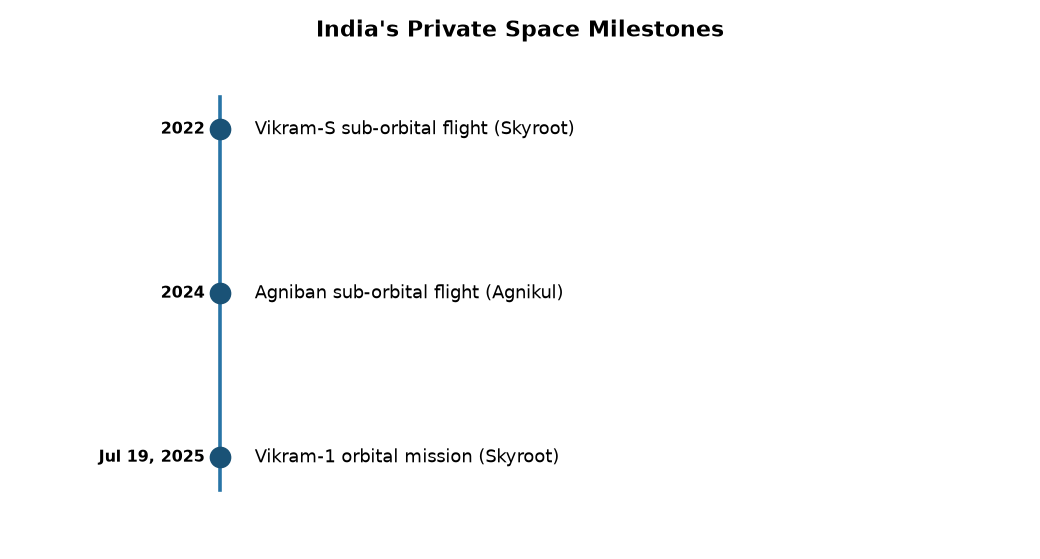
- Skyroot Aerospace had previously conducted a sub-orbital flight of its Vikram-S rocket in 2022, demonstrating foundational technologies for its launch vehicles.
- Another private entity, Chennai-based Agnikul Cosmos, also achieved a sub-orbital flight with its Agniban rocket in 2024, notably featuring a 3D-printed engine.
- Sub-orbital flights are primarily for technology demonstration, where rockets enter space but do not achieve Earth orbit, returning under gravity.
- Orbital flights, such as that of Vikram-1, involve achieving sufficient velocity and altitude to place payloads into a stable orbit around the Earth.
- The ‘Vikram’ series of rockets are named in honour of Dr. Vikram Sarabhai, widely regarded as the father of the Indian space program.
Understanding Orbital and Sub-orbital Flights
- **Sub-orbital Flight:** A trajectory where a spacecraft enters space but does not complete an orbital revolution around the Earth. It typically reaches a peak altitude and then falls back to Earth due to gravitational pull. These flights are often used for technology testing, scientific experiments, and space tourism demonstrations.
- **Orbital Flight:** A trajectory where a spacecraft achieves sufficient velocity and altitude to continuously fall around the Earth without hitting its surface, thereby entering a stable orbit. This requires reaching ‘orbital velocity’, which is approximately 7.9 km/s for Low Earth Orbit (LEO).
- **Low Earth Orbit (LEO):** An orbit with an altitude typically between 160 km and 2,000 km above Earth’s surface. LEO is commonly used for Earth observation satellites, telecommunication satellites, and the International Space Station (ISS). Vikram-1 deployed its payloads into LEO at an altitude of approximately 450 km.
- **Payload Deployment:** The successful release of satellites or other instruments into their intended orbit by a launch vehicle. Vikram-1 successfully deployed a diverse set of technology demonstration satellites.
- **Launch Vehicle:** A rocket system designed to carry payloads, such as satellites or spacecraft, from Earth’s surface into space.
- **Private Space Sector:** Refers to non-governmental entities engaged in space-related activities, including manufacturing rockets and satellites, providing launch services, and developing space applications.
- **Satish Dhawan Space Centre (SDSC), Sriharikota:** India’s primary spaceport, located on Sriharikota island in Andhra Pradesh, operated by ISRO. It serves as the launch site for ISRO’s various rockets, and now, for private entities like Skyroot Aerospace.
Key Features
| Feature | Significance |
|---|---|
| Vikram-1 Rocket | India’s first privately-built orbital launch vehicle, named after Dr. Vikram Sarabhai. |
| Orbital Capability | Achieved stable Low Earth Orbit (LEO) at ~450 km, enabling deployment of functional satellites. |
| Payload Deployment | Successfully placed multiple technology demonstration satellites into orbit, validating mission objectives. |
| Private Sector Participation | Marks the operational entry of Indian private companies into the orbital launch market. |
| Launch Site | Utilised ISRO’s Satish Dhawan Space Centre, Sriharikota, demonstrating collaborative synergy. |
| Mission Name ‘Aagaman’ | Symbolises the ‘arrival’ of a new era in India’s space sector, driven by private innovation. |
Why it Matters
Strategic Significance
- **Enhanced Space Capabilities:** Diversifies India’s launch capabilities beyond ISRO, contributing to national space security and resilience.
- **Global Competitiveness:** Positions India as a significant player in the global commercial space market, competing with established players from the US and China.
- **Technological Sovereignty:** Fosters indigenous development of advanced space technologies, reducing reliance on foreign entities.
- **Dual-Use Technology:** Advances in rocket technology have potential applications for both civilian and defence purposes, strengthening national security.
Economic Significance
- **Job Creation and Economic Growth:** Stimulates the growth of a new high-tech industry, creating skilled jobs and fostering an ecosystem of innovation and entrepreneurship.
- **Foreign Exchange Earnings:** India can offer competitive launch services to international clients, generating revenue and foreign exchange.
- **Cost Reduction:** Private sector efficiency and innovation can lead to more cost-effective launch solutions, making space access more affordable for various applications.
- **Investment Attraction:** Success stories like Vikram-1 attract further domestic and international investment into India’s burgeoning space sector.
Technological and Innovation Significance
- **Accelerated Innovation:** Private sector competition drives rapid technological advancements and encourages novel approaches to space engineering.
- **Democratisation of Space:** Lowering launch costs and increasing access to space can enable a wider range of academic, research, and commercial ventures.
- **Skill Development:** Fosters a highly skilled workforce in aerospace engineering, rocketry, and related fields.
- **Spin-off Technologies:** Space research often leads to spin-off technologies with applications in other sectors, benefiting the broader economy.
Social Significance
- **Inspiration for Youth:** Prime Minister Modi’s commendation highlights the potential for young entrepreneurs, inspiring a new generation to pursue STEM fields and innovation.
- **National Pride:** Achievements in space exploration bolster national pride and project India’s image as a technologically advanced nation.
- **Societal Benefits from Space Applications:** Increased access to space facilitates the deployment of satellites for communication, navigation, weather forecasting, disaster management, and remote sensing, directly benefiting citizens.
Challenges
1. FUNDING AND INVESTMENT
- Securing substantial and sustained capital for research, development, and manufacturing of complex space systems.
- High upfront costs and long gestation periods for returns on investment can deter private investors.
UPSC Link: GS Paper III — Economy, Infrastructure
2. REGULATORY FRAMEWORK
- Developing clear, comprehensive, and agile regulatory policies that balance innovation with safety and national security concerns.
- Ensuring a level playing field and fair competition among private players while safeguarding ISRO’s strategic role.
UPSC Link: GS Paper II — Government Policies and Interventions
3. INFRASTRUCTURE ACCESS
- Reliance on ISRO’s existing launch infrastructure (e.g., Satish Dhawan Space Centre) and testing facilities.
- Building independent private infrastructure requires significant investment and time.
UPSC Link: GS Paper III — Infrastructure
4. TALENT ACQUISITION AND RETENTION
- Attracting and retaining highly skilled aerospace engineers, scientists, and technicians in a competitive global market.
- Bridging the gap between academic research and industrial application in space technology.
UPSC Link: GS Paper III — Science and Technology, Human Resource
5. GLOBAL COMPETITION
- Competing with established international private space companies that have significant financial backing and technological maturity.
- Navigating international space laws and export controls for technology and services.
UPSC Link: GS Paper II — International Relations, GS Paper III — Economy
6. TECHNOLOGICAL COMPLEXITY AND RELIABILITY
- Ensuring the reliability and safety of launch vehicles and spacecraft, where failure can be catastrophic.
- Mastering advanced manufacturing processes, including additive manufacturing (3D printing) for critical components.
UPSC Link: GS Paper III — Science and Technology
Challenges — UPSC Perspective
| Issue | Concern |
|---|---|
| Access to ISRO Facilities | Potential bottlenecks and scheduling conflicts for private launches sharing ISRO’s infrastructure. |
| Data Security and IP Protection | Safeguarding sensitive space technology and data from espionage or unauthorised access. |
| Market Sustainability | Ensuring a robust and diverse customer base for private launch services to sustain long-term operations. |
| Environmental Impact | Managing the environmental footprint of increased rocket launches, including space debris and emissions. |
| Insurance and Liability | Establishing clear frameworks for liability and insurance in case of launch failures or accidents. |
| International Collaboration Barriers | Navigating geopolitical considerations and technology transfer restrictions in global space partnerships. |
Government Initiatives — Must-Memorise for Prelims
- Indian Space Policy 2023
- NewSpace India Limited (NSIL)
- Indian National Space Promotion and Authorisation Centre (IN-SPACe)
- Space Activities Bill (Draft)
- Startup India Initiative
- Make in India Programme
- Production Linked Incentive (PLI) Scheme (potential applicability to space manufacturing)
- National Geospatial Policy 2022
- Digital India Programme (for space-based applications)
- Atmanirbhar Bharat Abhiyan (Self-Reliant India Campaign)
Way Forward
- **Strengthen Regulatory Framework:** Develop a clear, stable, and predictable regulatory environment that fosters innovation while ensuring safety and national security.
- **Invest in Infrastructure:** Encourage and facilitate private investment in dedicated launchpads, testing facilities, and manufacturing units to reduce reliance on ISRO’s infrastructure.
- **Promote Public-Private Partnerships (PPPs):** Foster deeper collaboration between ISRO and private entities, leveraging ISRO’s expertise and infrastructure while enabling private sector agility.
- **Skill Development and R&D:** Invest in human capital development through specialised education and training programs, and incentivise private sector R&D in cutting-edge space technologies.
- **Global Market Penetration:** Actively promote Indian private space capabilities on the international stage to attract global customers for launch services and satellite manufacturing.
- **Address Funding Gaps:** Explore innovative financing mechanisms, including venture capital, government grants, and tax incentives, to support private space startups.
- **Space Debris Management:** Develop and implement robust policies and technologies for space debris mitigation and active debris removal to ensure sustainable space operations.
- **Standardisation and Certification:** Establish national standards and certification processes for private space components and systems to ensure quality and reliability.
UPSC Value Addition
Keywords for Mains Answer-Writing
Private Space Sector · Space Reforms · Orbital Launch Capability · Space Economy · Technological Sovereignty · Public-Private Partnership · IN-SPACe · Space Debris Management · Global Space Market · Indigenous Innovation · Dual-Use Technology · National Security
Constitutional & Policy Linkages
- **Article 51 (Promotion of International Peace and Security):** Space cooperation aligns with India’s foreign policy objectives.
- **Seventh Schedule (Union List – Entry 11):** ‘Atomic energy and mineral resources necessary for its production’ and ‘Space research’ implicitly fall under Union’s purview.
- **Indian Space Policy 2023:** A comprehensive policy framework guiding India’s space activities, including private sector participation.
- **IN-SPACe (Authorisation and Regulation of Space Activities) Act (Proposed):** Aims to provide a legal framework for private sector involvement.
- **Space Activities Bill (Draft 2017):** Proposed legislation to regulate space activities in India.
Concept Flow
Government opens space sector to private players. → Private entities develop launch vehicles and satellites. → IN-SPACe provides regulatory support and authorisation. → Private rockets achieve orbital launch capability. → India becomes a global player in commercial space. → Economic growth, job creation, and technological advancement ensue. → Enhanced national security and strategic autonomy.
Prelims Practice Questions
Q1. Consider the following statements regarding India’s private space sector:
1. Vikram-1 is India’s first privately-built sub-orbital rocket.
2. India is the third country globally to have private sector orbital launch capabilities, after the United States and China.
3. Agnikul Cosmos developed the world’s first rocket engine powered by a 3D printer for its Agniban mission.
Which of the statements given above is/are correct?
- 1 and 2 only
- 2 only
- 2 and 3 only
- 1, 2 and 3
Answer: 2 and 3 only — Statement 1 is incorrect: Vikram-1 is India’s first privately-built *orbital* rocket. Vikram-S was a sub-orbital rocket. Statement 2 is correct: India has indeed become the third country after the US and China to achieve this. Statement 3 is correct: Agnikul’s Agniban rocket featured the world’s first single-piece 3D-printed engine.
Q2. Which of the following bodies is responsible for promoting, authorising, and supervising private space activities in India?
- Indian Space Research Organisation (ISRO)
- NewSpace India Limited (NSIL)
- Indian National Space Promotion and Authorisation Centre (IN-SPACe)
- Department of Space (DoS)
Answer: Indian National Space Promotion and Authorisation Centre (IN-SPACe) — IN-SPACe (Indian National Space Promotion and Authorisation Centre) was established as an independent nodal agency under the Department of Space to facilitate and regulate private sector participation in India’s space activities. ISRO is the primary government space agency, NSIL is the commercial arm of ISRO, and DoS is the overarching government department.
Mains Practice Question
✍ The successful orbital launch of Vikram-1 by Skyroot Aerospace marks a ‘defining moment’ for India’s space journey. Discuss the strategic, economic, and technological implications of increasing private sector participation in India’s space program. What challenges need to be addressed to sustain this momentum and position India as a global leader in the commercial space sector? (250 words)
Approach: Begin by acknowledging the significance of Vikram-1 as a milestone. Subsequently, elaborate on the strategic implications, such as enhanced national security and global competitiveness. Follow with the economic benefits, including job creation, foreign exchange, and cost reduction. Then, discuss the technological advancements and innovation driven by private players. Conclude by outlining the key challenges, such as funding, regulatory clarity, infrastructure access, and global competition, and suggest actionable measures for a sustainable way forward, integrating relevant government policies and initiatives.
Source: The Indian Express
Generated by AanyaAi for educational purpose.


No Comments