


23 Jul Volcanicity
Volcanicity – UPSC Geography Optional Notes
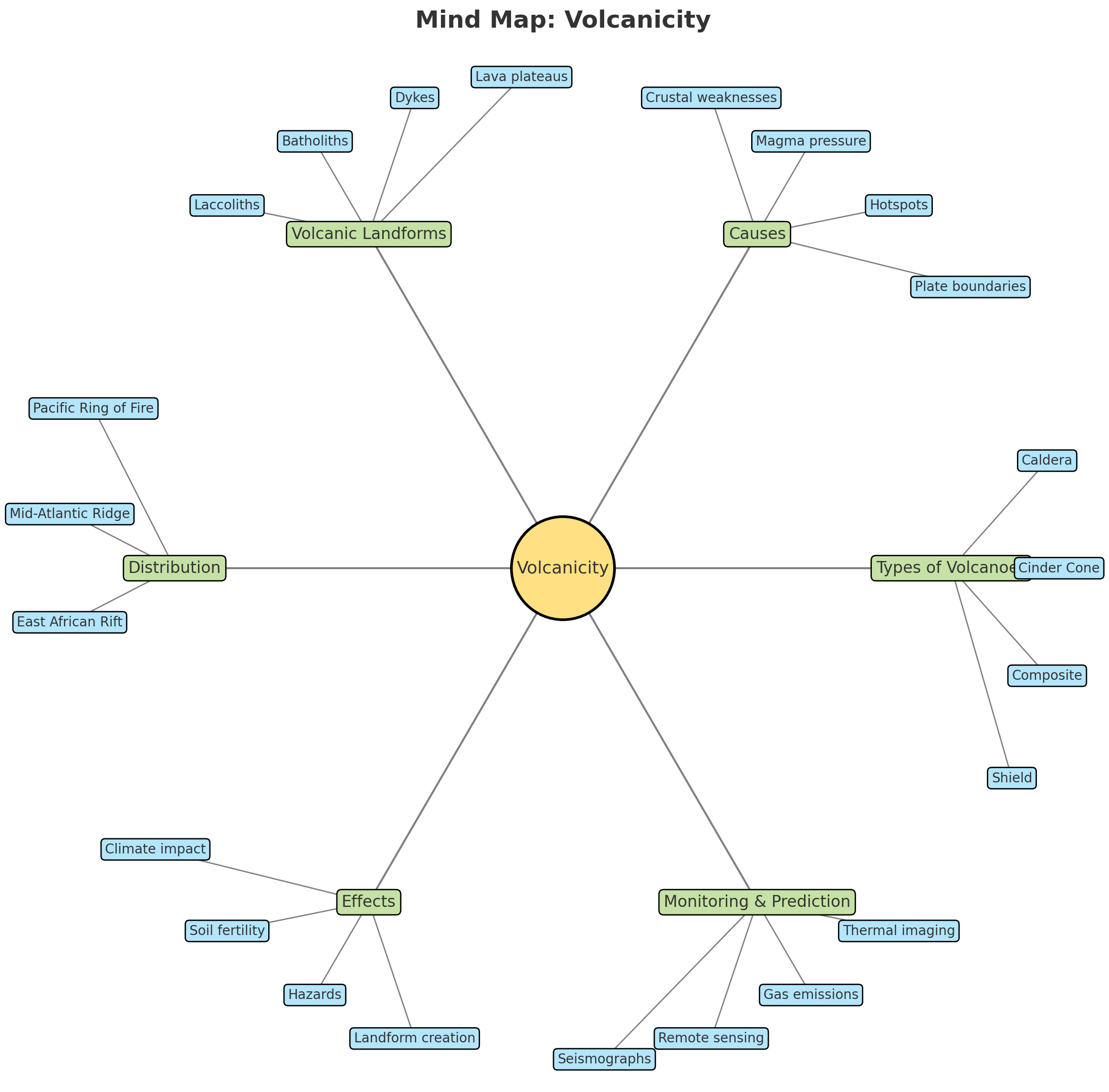
Volcanicity is a crucial topic in the physical geography section of the UPSC Civil Services Examination Geography Optional Paper 1. It deals with the movement of molten material (magma) from the Earth’s mantle to the surface and its associated geological and geomorphological features. Volcanicity shapes landscapes, influences climatic patterns, and impacts both natural ecosystems and human settlements.
1. Definition and Concept
Volcanicity is the geological process through which magma, gases, and other materials erupt from the interior of the Earth. It includes both surface eruptions (extrusive) and subsurface magma movements (intrusive). This process is often linked to tectonic activity and occurs prominently along plate boundaries.
Graduation degree with IAS coaching
2. Causes of Volcanicity
- Tectonic Activity: Most volcanic activity is associated with divergent and convergent plate boundaries.
- Hotspots: Volcanism can also occur at intraplate locations, such as the Hawaiian Islands.
- Magma Generation: Partial melting of the mantle due to decompression or water influx from subduction zones.
- Crustal Weakness: Fractures in the Earth’s crust allow magma to rise to the surface.

Volcanicity Elements
3. Types of Volcanicity
3.1 Extrusive Volcanicity
Occurs when magma reaches the surface and forms volcanic landforms.
- Volcanic Cones – Shield, Composite, Cinder Cone
- Calderas and Lava Domes
- Lava Plateaus (e.g., Deccan Traps)
3.2 Intrusive Volcanicity
Occurs when magma solidifies below the surface, forming plutonic bodies.
- Batholiths: Large dome-shaped plutonic bodies
- Laccoliths: Lens-shaped magma intrusions
- Dykes and Sills: Vertical and horizontal intrusions
-
Best geography optional coaching
4. Types of Volcanoes
- Shield Volcanoes: Broad, gently sloping, made from fluid lava (e.g., Mauna Loa)
- Composite Volcanoes: Layered with lava and pyroclastics, more explosive (e.g., Mount Fuji)
- Cinder Cone Volcanoes: Small, steep-sided, built from ash and tephra
- Calderas: Formed after the collapse of a volcano summit
5. Volcanic Landforms
- Extrusive: Cones, domes, lava plateaus
- Intrusive: Batholiths, Laccoliths, Dykes, Phacoliths
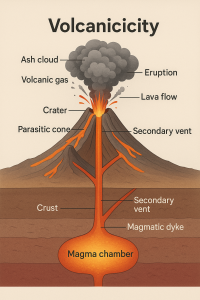
Volcanicity Elements
6. Global Distribution of Volcanoes
Volcanoes are not randomly distributed. They occur mainly along:
- Pacific Ring of Fire: The most active volcanic zone
- Mid-Atlantic Ridge: Volcanism due to divergent plates
- East African Rift Valley: Intraplate volcanism
7. Effects of Volcanicity
7.1 Constructive Effects
- Formation of fertile soils (e.g., volcanic ash)
- Creation of new land (e.g., Surtsey Island)
- Geothermal energy
7.2 Destructive Effects
- Loss of life and property (e.g., Pompeii, 79 AD)
- Climatic disturbances (e.g., Mount Pinatubo, 1991)
- Air traffic disruptions (e.g., Iceland, 2010)
8. Monitoring and Prediction
- Seismographs: Detect magma movement through earthquakes
- Gas sensors: Track changes in SO2 and CO2 emissions
- Thermal imaging and remote sensing
- Ground deformation studies using GPS
9. Indian Context
- Barren Island: The only active volcano in India, in the Andaman Sea
- Deccan Traps: Result of fissure eruption in the Cretaceous-Paleogene period
- Narcondam Island: Dormant volcano in the Andaman region
10. Past Year Questions (PYQs)
- 2019: Discuss the causes and types of volcanicity and associated landforms.
- 2015: Examine the role of volcanism in the formation of landforms with examples.
- 2012: Differentiate between intrusive and extrusive volcanicity.
- 2010: Describe the Pacific Ring of Fire and its volcanic activity.
11. Probable Questions – UPSC Prelims and Mains 2026
Mains:
- Explain the processes and landforms associated with intrusive volcanicity.
- Discuss the causes and global distribution of volcanoes with examples.
- How does volcanicity contribute to soil fertility and landscape formation?
Prelims:
- Which of the following is an intrusive volcanic landform?
- Consider the following volcanoes: 1. Mauna Loa, 2. Mount Fuji, 3. Barren Island. Which of them are active?
- Volcanic activity is most likely to occur along which of the following zones?
12. Conclusion
Volcanicity is a powerful natural force shaping Earth’s surface and influencing climatic and ecological systems. A thorough understanding of its causes, types, and consequences is essential for UPSC Geography optional aspirants. With increasing reliance on modern technology for monitoring volcanic activity, this domain continues to evolve, offering more dynamic insights into Earth’s geodynamics.

- COAS Reviews Indo-Argentine Mountaineering Expedition in Delhi - October 6, 2026
- पीएम स्मृति उपहार: सिक्किम की संस्कृति को जन-जन तक पहुंचाया - October 6, 2026
- Cabinet Approves ₹10,000 Cr SME Growth Fund: Key for UPSC & PCS - October 6, 2026

No Comments