


13 Mar West Asia Crisis and Global Oil Supply Disruptions: Challenges for India’s Energy Security
This article covers “Daily Current Affairs” and From West Asia Crisis and Global Oil Supply Disruptions: Challenges for India’s Energy Security
SYLLABUS MAPPING
GS-3- International Economic Relations- West Asia Crisis and Global Oil Supply Disruptions: Challenges for India’s Energy Security
FOR PRELIMS
Why is the Strait of Hormuz important for global oil trade?
FOR MAINS
Why is India vulnerable to oil supply disruptions in West Asia?
Why in the news?
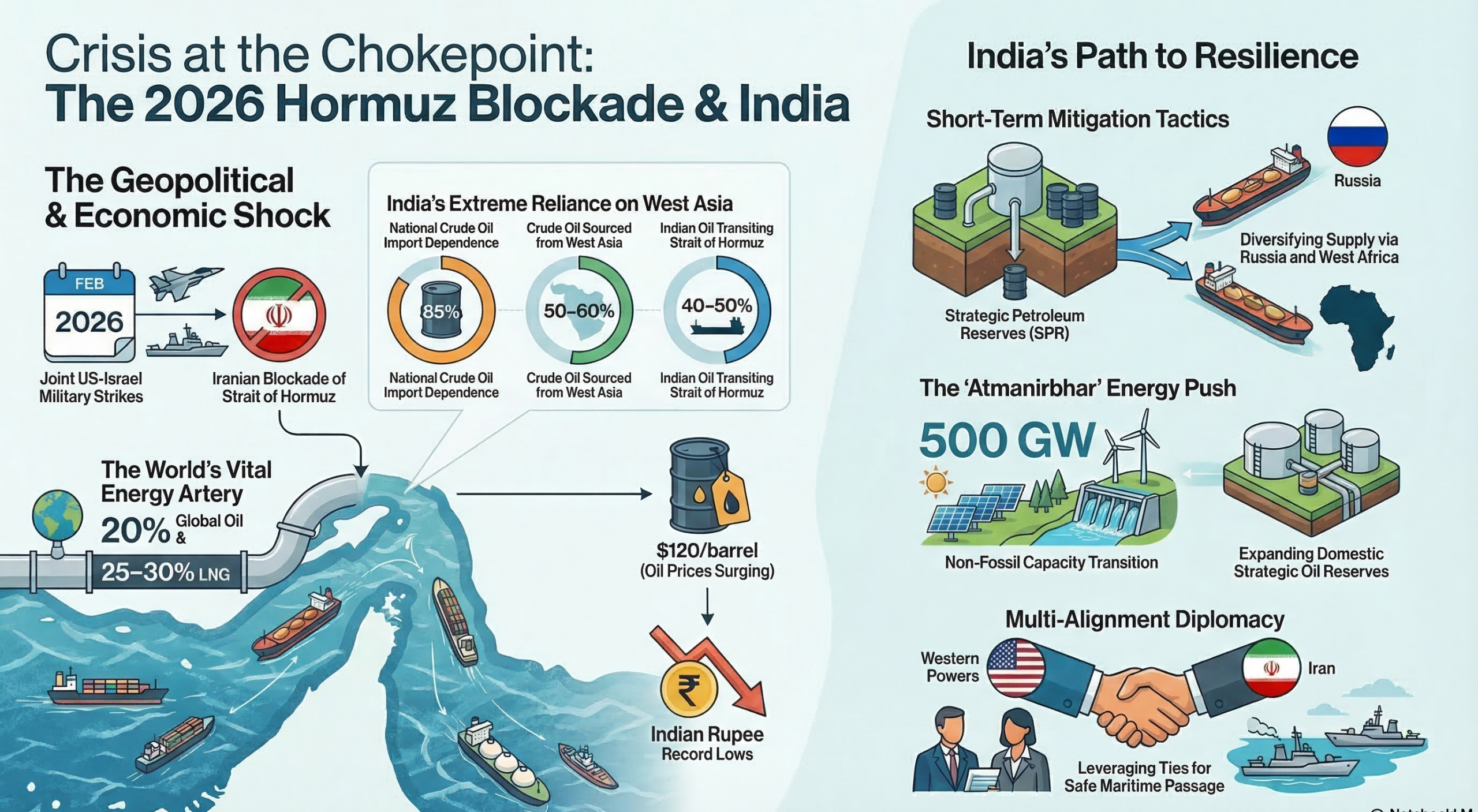
The West Asia conflict escalated dramatically in late February 2026 when the United States and Israel launched joint military strikes on Iran, including the killing of Iran’s Supreme Leader Ayatollah Ali Khamenei on February 28, 2026. In retaliation, Iran launched missile and drone attacks on US military bases, Israeli targets, and energy facilities in Gulf states (Saudi Arabia, Qatar, UAE, Kuwait). Iran has effectively blockaded or closed the Strait of Hormuz — a critical chokepoint for ~20% of global seaborne oil and significant LNG flows — halting tanker traffic and disrupting supplies. As of March 13, 2026, Iran’s new Supreme Leader Mojtaba Khamenei has vowed to keep the strait closed, causing Brent crude prices to surge (briefly nearing $120/barrel, now around $90–100+ levels with volatility). This has triggered global energy market shocks, supply concerns, and direct economic pressures on import-dependent nations like India.
Concept / Definition
The core issue is geopolitical disruption in energy supply chains via the Strait of Hormuz, a narrow waterway (33 km wide at narrowest) between the Persian Gulf and the Gulf of Oman, bordered by Iran and Oman. It serves as the world’s most vital energy chokepoint, carrying ~20% of global oil trade (~16–21 million barrels per day) and ~25–30% of LNG. Iran’s actions represent asymmetric warfare using control over this chokepoint to impose leverage, leading to supply shortages, price spikes (including “war premium”), higher freight/insurance costs, and risks of stagflation globally.
Background and Context
1. Historical tensions: Rooted in long-standing Iran-Israel rivalry, US sanctions on Iran, nuclear concerns, and proxy conflicts (Hezbollah, Houthis). The 2026 escalation marks a direct US-Israel intervention, possibly to prevent Iran’s nuclear advancement.
2. India’s context: India imports ~85% of its crude oil and high shares of LNG/LPG. In 2025, West Asia supplied ~50–60% of crude and ~70% of gas; ~40–50% of India’s oil transits the Strait of Hormuz. Past crises (e.g., 2019 tanker attacks, Ukraine war) highlighted vulnerabilities; diversification (Russia as top supplier since 2022) helped, but Gulf dependence remains high.
3. Global energy dynamics: IEA monitors chokepoints; emergency stock releases considered amid disruptions.
Significance
1. Economy: Oil price spikes widen India’s Current Account Deficit (CAD ~0.8% GDP in H1 FY26, but risks rising), depreciate rupee (hit ~92+ levels), fuel imported inflation (every $10/bbl rise adds 40–100 bps to CPI).
2. International relations: Tests India’s multi-alignment (ties with US, Israel, Gulf states, Iran via Chabahar); diplomacy active (PM Modi-EAM calls with Iranian leaders for safe passage).
3. National security & energy security: Exposes import vulnerabilities; threatens strategic reserves (~20–25 days coverage).
4. Sustainable development: Delays clean energy transition by making fossil fuels costlier temporarily.
Key Issues and Challenges
1. Geopolitical risks: Prolonged blockade risks sustained high prices ($100–150+/bbl worst-case), physical shortages for Asia.
2. Economic vulnerabilities: Dual shock for India (higher oil + LNG costs); impacts fertilisers (Gulf-linked via Hormuz), petrochemicals, shipping (45,000+ containers stuck), exports.
3. Policy gaps: Limited strategic reserves vs. global 90-day norm; over-reliance on single chokepoint.
4. Institutional limitations: Coordination between refiners, MoPNG, MEA for diversification/diplomacy.
Constitutional / Legal Dimensions
1. Energy as concurrent subject (List III, Seventh Schedule); Centre’s role via Petroleum & Natural Gas Ministry.
2. Essential Commodities Act, 1955 invoked for prioritising domestic gas to LPG.
3. Foreign policy under Article 51 (promote international peace); multi-alignment aligns with Directive Principles.
4. No direct SC judgments, but linked to energy security as part of right to life (Art. 21) in broader welfare sense.
Impact
1. Economic stability: Inflation rise (transport, food via fertilisers); CAD widening; rupee pressure; sectors like aviation (fuel surcharges), FMCG, construction hit.
2. Social equity: LPG queues reported; higher costs burden poor households; potential job impacts in export sectors.
3. Environmental sustainability: Temporary setback to renewables push (e.g., solar, EVs); forces reliance on dirtier imports if diversification fails.
Governance and Institutional Aspects
1. Government institutions: Ministry of Petroleum and Natural Gas (diversification to Russia/US/West Africa); Strategic Petroleum Reserves; IEA coordination for emergency releases.
2. Regulatory bodies: PNGRB for gas; refiners (IOC, BPCL) using buffers.
3. Public policies: Atmanirbhar Bharat in energy; National Biofuel Policy; green hydrogen mission.
4. International organizations: IEA (emergency stocks); OPEC+ dynamics affected.
Global Comparison
1. China: Similar high dependence (~40% oil via Hormuz); urged reopening but faces dual shocks.
2. Japan/South Korea: High vulnerability; diversified via long-term contracts.
3. US: Energy exporter now; less impacted, uses leverage in conflict.
4. Best practices: EU’s REPowerEU (post-Ukraine diversification); US SPR releases.
Way Forward
1. Diplomatic Engagement: India should continue active diplomacy with regional stakeholders to ensure the reopening of maritime routes and de-escalation of tensions.
2. Diversification of Energy Sources: Expanding imports from Russia, the United States, and Africa can reduce dependence on a single region.
3. Expansion of Strategic Reserves: India should gradually build reserves covering 90 days of imports, matching global best practices.
4. Accelerating Energy Transition: Investment in renewable energy and electric mobility is essential to reduce fossil-fuel vulnerability. India aims to reach 500 GW of non-fossil capacity by 2030, aligning with climate commitments.
5. Strengthening Supply Chain Resilience: Developing alternate trade routes such as the Chabahar Port can reduce dependence on vulnerable chokepoints.
Conclusion
The 2026 West Asia conflict, centred on the Strait of Hormuz blockade, underscores the fragility of global energy security and India’s deep vulnerabilities as a major importer. While immediate mitigation through diversification and reserves is possible, the crisis reinforces Prime Minister Modi’s call (March 11–12, 2026) for accelerated self-reliance in energy — echoing lessons from COVID and Ukraine.
Best ias coaching in delhi Best ias coaching in chandigar
Prelims question:
Q. With reference to the Strait of Hormuz, consider the following statements:
1. It connects the Persian Gulf with the Gulf of Oman.
2. Nearly one-fifth of global seaborne crude oil trade passes through it.
3. It lies between Iran and Saudi Arabia.
Which of the statements given above are correct?
A. 1 and 2 only
B. 2 and 3 only
C. 1 and 3 only
D. 1, 2 and 3
Answer: A
Mains Question:
Q. The Strait of Hormuz remains one of the most critical energy chokepoints in the world. Discuss how geopolitical conflicts in West Asia affect global energy markets and India’s energy security. Suggest measures India should adopt to reduce its vulnerability.
(250 words)

- Europe’s AI Rules May Become India’s Opportunity - August 14, 2026
- Transparency as the Foundation of Trust in Medicine - August 14, 2026
- A Timely Reset for the Food Security Act: From Foodgrain Security to Nutrition Security - August 13, 2026

No Comments