


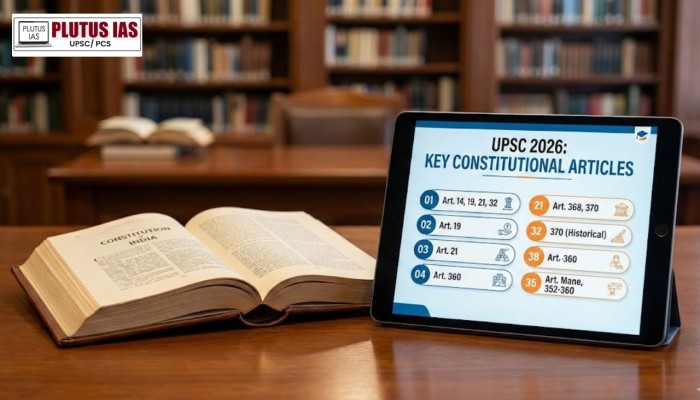
23 Feb What are the most important Constitutional Articles for UPSC 2026?
The Constitution of India is the cornerstone of our nation’s governance, a living document that every aspiring civil servant must intimately understand. For the UPSC Civil Services Examination (CSE) 2026, proficiency in key constitutional articles is not merely an advantage—it’s an absolute necessity. Both the Preliminary Examination (GS Paper I – Polity) and the Main Examination (GS Paper II – Polity & Governance) consistently feature questions directly or indirectly linked to these fundamental provisions. While the sheer volume of 400+ articles can appear daunting, the secret to success lies not in memorizing every single one, but in strategically identifying and mastering the most critical articles that underpin our democratic, just, and administrative systems.
This comprehensive, easy-to-read guide is designed to empower UPSC aspirants. It highlights the pivotal constitutional articles, offering a focused roadmap to prepare for UPSC CSE 2026 efficiently and effectively, ensuring you extract maximum value from your polity studies.
Why is Constitutional Article Knowledge Indispensable for UPSC?
Beyond scoring marks, a deep understanding of the Constitution equips you with vital tools:
- Strengthen Arguments: Ground your Mains answers in constitutional principles, adding authority and depth.
- Sharpen Analysis: Critically evaluate government policies, judicial pronouncements, and current events through a robust constitutional lens.
- Ace Prelims: Confidently tackle direct questions on articles, amendments, and their associated concepts.
- Excel in Interview: Demonstrate a mature, well-informed understanding of India’s political and legal framework, a hallmark of a promising civil servant.
Must Check :- Best IAS Coaching in Delhi
The Golden Rule: Beyond Memorization – Cultivate Understanding!
While some articles require precise recall, UPSC’s evolving pattern increasingly emphasizes your comprehension of an article’s spirit, implications, historical context, and practical application. Rote learning without genuine understanding is a common pitfall; focus on grasping the ‘why’ and ‘how’ behind each provision.
Your Strategic Roadmap: Categorizing Important Articles
To streamline your preparation, let’s categorize the most important articles, mirroring the structure of the Constitution itself.
Part I: The Union and its Territory (Articles 1-4)
Foundation of India’s territorial integrity and federal structure.
- Article 1: Name and territory of the Union. (Defines India as a Union of States)
- Article 2: Admission or establishment of new States.
- Article 3: Formation of new States and alteration of areas, boundaries or names of existing States. (Essential for understanding state reorganization processes)
Part II: Citizenship (Articles 5-11)
Governs who is a citizen of India and Parliament’s powers.
- Article 5: Citizenship at the commencement of the Constitution.
- Article 8: Rights of citizenship of persons of Indian origin residing outside India.
- Article 11: Parliament to regulate the right of citizenship by law. (Crucial for understanding the Citizenship Act and related debates like CAA)
Part III: Fundamental Rights (Articles 12-35) – Absolutely Critical!
This section is a perennial favorite for UPSC. Understand each right, its reasonable restrictions, and landmark Supreme Court judgments.
- Article 12: Definition of the ‘State’ (for enforcing FRs).
- Article 13: Laws inconsistent with or in derogation of the Fundamental Rights. (Basis of Judicial Review)
- Right to Equality (Articles 14-18):
- Article 14: Equality before law and equal protection of laws.
- Article 15: Prohibition of discrimination on grounds of religion, race, caste, sex or place of birth. (Key for social justice, reservations)
- Article 16: Equality of opportunity in matters of public employment.
- Article 17: Abolition of Untouchability.
- Article 18: Abolition of titles.
- Right to Freedom (Articles 19-22):
- Article 19: Protection of six fundamental freedoms (speech, assembly, association, movement, residence, profession). (Highly important, with various interpretations)
- Article 20: Protection in respect of conviction for offences.
- Article 21: Protection of life and personal liberty. (The most expansive right, judicially interpreted to include Right to Privacy, Right to Live with Dignity, etc.)
- Article 21A: Right to education (introduced by 86th Amendment).
- Article 22: Protection against arrest and detention in certain cases.
- Right against Exploitation (Articles 23-24):
- Article 23: Prohibition of traffic in human beings and forced labour.
- Article 24: Prohibition of employment of children in factories, etc.
- Right to Freedom of Religion (Articles 25-28):
- Article 25: Freedom of conscience and free profession, practice and propagation of religion.
- Article 26: Freedom to manage religious affairs.
- Cultural and Educational Rights (Articles 29-30):
- Article 29: Protection of interests of minorities.
- Article 30: Right of minorities to establish and administer educational institutions.
- Right to Constitutional Remedies (Articles 32-35):
- Article 32: Remedies for enforcement of Fundamental Rights. (Dr. Ambedkar called it the ‘heart and soul’ of the Constitution; deals with Writs)
Part IV: Directive Principles of State Policy (Articles 36-51) – Highly Important!
Understand their non-justiciable nature, their role in guiding governance, and their interplay with Fundamental Rights. Categorize them into Socialist, Gandhian, and Liberal-Intellectual principles.
- Article 38: State to secure a social order for the promotion of welfare.
- Article 39: Principles of policy to be followed by the State (e.g., equal pay for equal work, adequate means of livelihood).
- Article 39A: Equal justice and free legal aid.
- Article 40: Organisation of village panchayats.
- Article 43A: Participation of workers in management of industries.
- Article 44: Uniform Civil Code (UCC) for the citizens. (Perennially relevant for Mains, often in news)
- Article 45: Provision for early childhood care and education (for children below six years).
- Article 46: Promotion of educational and economic interests of SCs, STs, and weaker sections.
- Article 48A: Protection and improvement of environment and safeguarding of forests and wild life.
- Article 50: Separation of judiciary from executive.
- Article 51: Promotion of international peace and security.
Part IVA: Fundamental Duties (Article 51A)
Know all 11 duties, their significance, and their enforceability.
- Article 51A: Fundamental duties of citizens.
Part V: The Union (Articles 52-151) – Crucial for Prelims & Mains!
Covers the Executive (President, VP, PM, Council of Ministers, Attorney General), Parliament, and the Union Judiciary (Supreme Court). Focus on their powers, functions, and inter-relationships.
- The President & Vice-President:
- Article 52: The President of India.
- Article 61: Procedure for impeachment of the President.
- Article 63: The Vice-President of India.
- Article 72: Power of President to grant pardons, etc.
- Article 74: Council of Ministers to aid and advise President.
- Article 76: Attorney-General for India.
- Parliament:
- Article 79: Constitution of Parliament.
- Article 80/81: Composition of Council of States (Rajya Sabha) and House of the People (Lok Sabha).
- Article 108: Joint sitting of both Houses.
- Article 110: Definition of “Money Bills”.
- Article 112: Annual financial statement (Budget).
- Article 123: Power of President to promulgate Ordinances.
- Union Judiciary (Supreme Court):
- Article 124: Establishment and constitution of Supreme Court.
- Article 129: Supreme Court to be a court of record.
- Article 131: Original jurisdiction of the Supreme Court.
- Article 136: Special leave to appeal by the Supreme Court.
- Article 137: Review of judgments or orders by the Supreme Court.
- Article 141: Law declared by Supreme Court to be binding on all courts.
- Article 143: Power of President to consult Supreme Court.
- Article 148: Comptroller and Auditor-General of India (CAG).
Part VI: The States (Articles 152-237) – Equally Important!
Mirrors Part V, covering State Executive (Governor, CM, Council of Ministers, Advocate General), State Legislature, and High Courts.
- The Governor:
- Article 153: Governors of States.
- Article 161: Power of Governor to grant pardons, etc.
- Article 163: Council of Ministers to aid and advise Governor.
- Article 165: Advocate-General for the State.
- State Legislature:
- Article 169: Abolition or creation of Legislative Councils in States.
- Article 200: Assent to Bills by Governor (Governor’s discretionary powers, reserving bills for President – very critical).
- Article 213: Power of Governor to promulgate Ordinances.
- High Courts:
- Article 214: High Courts for States.
- Article 226: Power of High Courts to issue certain writs.
Part IX: The Panchayats (Articles 243-243O) & Part IXA: The Municipalities (Articles 243P-243ZG)
These parts, added by the 73rd and 74th Amendments, are fundamental for Local Governance.
- Article 243B: Constitution of Panchayats.
- Article 243D: Reservation of seats (for SC/ST/Women).
- Article 243K: Elections to the Panchayats (State Election Commission).
- Article 243G: Powers, authority, and responsibilities of Panchayats.
- Article 243W: Powers, authority, and responsibilities of Municipalities.
Part XI: Relations between the Union and the States (Articles 245-263) – Very Important!
Crucial for understanding India’s federal structure, covering legislative, administrative, and financial relations.
- Article 246: Subject-matter of laws made by Parliament and State Legislatures (Union, State, Concurrent Lists).
- Article 249: Power of Parliament to legislate on State List subjects in the national interest (Rajya Sabha’s special power).
- Article 262: Adjudication of disputes relating to waters of inter-State rivers.
- Article 263: Provisions with respect to an Inter-State Council.
Part XII: Finance, Property, Contracts and Suits (Articles 264-300A)
- Article 265: Taxes not to be imposed save by authority of law.
- Article 266: Consolidated Funds and public accounts of India and of the States.
- Article 267: Contingency Fund.
- Article 280: Finance Commission (its role and recommendations).
- Article 300A: Persons not to be deprived of property save by authority of law (Right to Property, a legal right).
Part XIV: Services under the Union and the States (Articles 308-323)
- Article 312: All-India Services (creation, importance).
- Article 315: Public Service Commissions for the Union and for the States.
- Article 323A: Administrative Tribunals.
Part XV: Elections (Articles 324-329)
- Article 324: Superintendence, direction, and control of elections to be vested in an Election Commission. (Powers and functions of EC – very relevant)
Part XVI: Special Provisions relating to certain Classes (Articles 330-342)
- Article 330: Reservation of seats for SCs and STs in the House of the People.
- Article 335: Claims of SCs and STs to services and posts.
- Article 338: National Commission for Scheduled Castes.
- Article 338A: National Commission for Scheduled Tribes.
- Article 338B: National Commission for Backward Classes.
Part XVIII: Emergency Provisions (Articles 352-360) – Crucial!
A frequently asked topic, understand the types of emergencies and their implications.
- Article 352: Proclamation of Emergency (National Emergency).
- Article 356: Provisions in case of failure of constitutional machinery in States (President’s Rule – often controversial).
- Article 360: Provisions as to financial emergency.
Part XX: Amendment of the Constitution (Article 368) – Very Important!
- Article 368: Power of Parliament to amend the Constitution and procedure therefor. (The foundational article for the ‘Basic Structure Doctrine’)
Part XXI: Temporary, Transitional and Special Provisions (Articles 369-392)
- Article 370: Temporary provisions with respect to the State of Jammu and Kashmir. (Historical significance, often debated)
- Article 371 & Sub-Articles: Special provisions with respect to certain States (e.g., Maharashtra, Gujarat, Nagaland, Assam, etc.). (Understand the unique provisions for these states)
How to Prepare these Articles Effectively for UPSC 2026:
- Start with M. Laxmikanth: This is your primary resource for Polity. Read it multiple times. As you read, actively highlight or note down the articles mentioned.
- Create Thematic Notes: Instead of just a list, group articles by topic (e.g., “President’s Powers,” “Judicial Review,” “Federal Relations”). This aids conceptual understanding and quick revision.
- Link with Current Affairs: Whenever an article is in the news (e.g., Article 356 during President’s Rule, Article 21 for Right to Privacy), revisit it in your notes and understand its contemporary relevance and recent interpretations.
- Focus on Amendments: Understand how major Constitutional Amendments have impacted or introduced specific articles.
- PYQ Analysis: Go through Previous Year Questions (PYQs) for both Prelims and Mains. This will clearly show you which articles are frequently tested and in what context.
- Judicial Pronouncements: For Articles like 21, 14, 19, 32, link them with important Supreme Court judgments (e.g., Kesavananda Bharati case for Basic Structure, Maneka Gandhi case for Article 21’s expansion).
- Regular Revision: Polity is highly factual. Consistent and spaced revision of these articles and their implications is paramount for long-term retention.
Conclusion
Mastering the most important constitutional articles is not about rote memorization, but about building a deep and nuanced understanding of the framework that governs India. For UPSC CSE 2026, focus your efforts on the articles outlined above, diligently understanding their context, implications, and current relevance.
Must Check :- Best IAS Coaching in Delhi
This strategic approach will not only help you score exceptionally well in the examination but also build a strong, principled foundation for your future role as a civil servant, ensuring you uphold the true spirit of the Indian Constitution.

- Best AI Tool for UPSC Preparation - July 27, 2026
- Best UPSC + Diploma Coaching - April 28, 2026
- Best UPSC + MBA Coaching - April 28, 2026

No Comments