


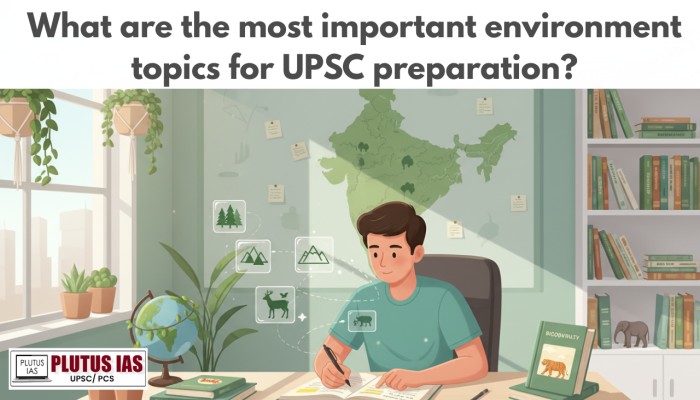
13 Mar What are the most important environment topics for UPSC preparation?
Imagine walking into the UPSC Prelims examination hall. You open the question paper, expecting to see a lot of History and Polity questions. Instead, you are bombarded with questions about critically endangered birds, international climate treaties, carbon credits, and national parks. For many beginners, this is a moment of pure panic.
Over the past decade, the weightage of Environment and Ecology in the UPSC Civil Services Examination has skyrocketed. Every year, you can expect anywhere between 15 to 20 questions purely from this subject in the Prelims. That is 30 to 40 marks—enough to easily make or break your entire attempt.
Why does UPSC ask so many Environment questions? The answer is simple. In 2013, the UPSC combined the Preliminary examination for the Civil Services (IAS) and the Indian Forest Service (IFoS). Because future forest officers take the exact same Prelims exam as you, the paper setter naturally includes a massive chunk of environment-related questions.
However, the syllabus is vast, and the study materials can be overwhelming. You do not need a Ph.D. in Botany or Zoology to clear this exam. You just need to know exactly what the UPSC cares about. In this highly readable, comprehensive guide, we have broken down the absolute most important Environment topics for UPSC preparation. If you master these areas, you will comfortably sail through this section.
1. Basic Ecology and Ecosystems (The Foundation)
Before you can understand global warming or complex climate treaties, you must understand the basic rules of nature. The UPSC loves testing your conceptual clarity. They will not ask complex scientific formulas, but they will ask you to identify how organisms interact with each other.
High-Priority Topics:
- Ecotone and Edge Effect: Understand what happens where two ecosystems meet (like a mangrove forest between land and sea). UPSC frequently asks about the high biodiversity found in these transition zones.
- Ecological Niche: Know that no two species can occupy the exact same niche (role) in the exact same habitat without competing.
- Food Chains and Food Webs: Understand the flow of energy. Remember the 10 Percent Rule (only 10 percent of energy is transferred from one trophic level to the next).
- Ecological Succession: How does a barren rock turn into a dense forest over hundreds of years? Understand primary and secondary succession.
- Nutrient Cycling: Focus on the Carbon Cycle, Nitrogen Cycle, and Phosphorus Cycle. UPSC loves asking how human activities (like farming) disrupt the Nitrogen cycle.
Must Check :- Best IAS Coaching in Delhi
2. Biodiversity and Conservation (The Heavyweight Section)
If you only have time to study one chapter in Environment, make it Biodiversity. This is the absolute favorite area of the UPSC examiners. You will get direct, factual, and map-based questions from this section every single year.
High-Priority Topics:
- IUCN Red List: You do not need to memorize every animal on the planet. Only focus on animals found in India that are classified as Critically Endangered or Endangered (e.g., the Great Indian Bustard, Snow Leopard, Pangolin, and various vulture species). Know their natural habitat and the major threats they face.
- Protected Area Network: This is where map reading is crucial. You must know the important National Parks, Wildlife Sanctuaries, Tiger Reserves, and Biosphere Reserves of India.
- UPSC Trick: They rarely just ask “Where is Kaziranga?” Instead, they ask, “Which river flows through Kaziranga?” or “What type of vegetation is found in Jim Corbett?” Connect rivers, hills, and forests on your map.
- Wetlands and Ramsar Sites: Wetlands are the kidneys of the earth. Keep a strict eye on any new Indian lakes or marshes added to the Ramsar List in the past year. Understand what the Montreux Record is.
- Coral Reefs and Mangroves: Know where they are found in India (Andaman, Gulf of Mannar, Sundarbans) and why they are threatened by ocean acidification.
3. Climate Change (The Global Crisis)
Climate change is no longer just an environmental issue; it is a massive economic and geopolitical issue. Both the Prelims and the Mains (GS Paper 3) heavily feature questions about how the climate is changing and what the world is doing to stop it.
High-Priority Topics:
- Greenhouse Gases (GHGs): Do not just read about Carbon Dioxide. Learn about Methane, Nitrous Oxide, Water Vapor, and fluorinated gases (like HFCs). Understand their “Global Warming Potential” and how long they stay in the atmosphere.
- Ocean Acidification: As oceans absorb more CO2, they become acidic. How does this affect marine life, especially animals with calcium carbonate shells (like corals and oysters)?
- Ozone Depletion: Know the difference between “good ozone” (in the stratosphere) and “bad ozone” (in the troposphere). Understand the Montreal Protocol and the recent Kigali Amendment, which phased out dangerous coolants.
- Mitigation Concepts: You must understand modern economic terms related to climate change. Be very clear on the definitions of Carbon Footprint, Carbon Sequestration, Carbon Credit, Carbon Tax, and Net-Zero Emissions.
4. Environmental Pollution and Degradation (The Everyday Reality)
UPSC wants administrators who can solve real-world problems. Pollution is India’s biggest everyday challenge. Therefore, questions here are highly practical and related to current affairs.
High-Priority Topics:
- Air Pollution: Understand the National Air Quality Index (AQI) and the specific pollutants it measures (PM 2.5, PM 10, Ozone, Lead, etc.). What causes winter smog in Delhi? Understand the concept of stubble burning and vehicle emissions (BS-VI norms).
- Water Pollution: Be clear on concepts like Biological Oxygen Demand (BOD) and Chemical Oxygen Demand (COD). What is Eutrophication? (When too many fertilizers enter a lake, causing algae to grow and choke the oxygen).
- Heavy Metal Toxicity: What diseases are caused by drinking water contaminated with Arsenic, Lead, Mercury (Minamata disease), and Cadmium (Itai-Itai disease)?
- Solid Waste Management: Focus on E-Waste (electronic waste), Microplastics (how they enter the human food chain), and the recent government bans on Single-Use Plastics.
5. Environmental Laws, Acts, and Policies (The Rulebook)
As a future IAS or IPS officer, you will be enforcing laws. Therefore, the UPSC expects you to know the legal framework protecting India’s environment. You do not need to read the laws like a lawyer, but you must know their core objectives and recent amendments.
High-Priority Topics:
- The Wildlife Protection Act (WPA), 1972: This is the most important act. Understand the Schedules of this act. If an animal is in Schedule 1, it has the highest level of protection (equal to a tiger). Also, read up on any recent amendments made to this act by the Parliament.
- The Environment (Protection) Act, 1986: Passed after the Bhopal Gas Tragedy. Understand how the central government uses this act to declare “Eco-Sensitive Zones” around national parks.
- The Forest Rights Act (FRA), 2006: This is highly crucial for both Environment and Polity. It recognizes the rights of forest-dwelling tribal communities. Who gives the final approval for forest rights? (Answer: The Gram Sabha).
- National Green Tribunal (NGT): What is the NGT? How is it different from a regular court? What kind of cases can it hear?
- Project Tiger and Project Elephant: Know the history, the role of the National Tiger Conservation Authority (NTCA), and the concept of tiger census.
6. International Treaties and Organizations (The Global Village)
The environment does not respect national borders. A factory polluting the air in China affects the climate in India. Therefore, the world relies on international treaties. The UPSC loves asking about conferences, funds, and global organizations.
High-Priority Topics:
- UNFCCC and COP: The United Nations Framework Convention on Climate Change. You must follow the annual “Conference of Parties” (COP). What happened at the Paris Agreement? What are Nationally Determined Contributions (NDCs)? What is the Loss and Damage Fund?
- Convention on Biological Diversity (CBD): Understand the Cartagena Protocol (deals with genetically modified organisms) and the Nagoya Protocol (deals with sharing genetic resources fairly).
- CITES and CMS: CITES stops the illegal international trade of endangered animals and plants. CMS (Bonn Convention) protects migratory species (birds and animals that travel across countries).
- Global Financial Institutions: Who funds climate projects? Read about the Global Environment Facility (GEF) and the Green Climate Fund (GCF).
- Reports and Indices: Know who publishes important reports. For example, the UN Environment Programme (UNEP) publishes the “Emissions Gap Report.”
7. Agriculture and Environment Overlap
In recent years, UPSC has started merging Geography, Economy, and Environment into a single theme: Agriculture. Traditional farming methods are harming the earth, and the world is looking for sustainable alternatives.
High-Priority Topics:
- Sustainable Agriculture: Understand concepts like Organic Farming, Zero Budget Natural Farming, and Permaculture. How do they restore soil health?
- Conservation Agriculture: What is minimum tillage? Why is crop rotation important?
- Water Conservation: Micro-irrigation techniques like drip and sprinkler irrigation. How do they save water and reduce electricity usage?
- Genetically Modified (GM) Crops: What is Bt Cotton and Bt Brinjal? What is the role of the Genetic Engineering Appraisal Committee (GEAC) in India?
The Smart Strategy: How to Study Environment for UPSC
Now that you have the list of the most important topics, how do you actually study them without feeling overwhelmed? Here is the smart strategy followed by UPSC toppers.
1. Use the “Reverse Engineering” Technique
Environment is a highly dynamic subject. Do not try to memorize a textbook from cover to cover. Instead, look at the Current Affairs first. If a specific bird (like the Great Indian Bustard) is in the news because of power line collisions, write it down. Then, reverse engineer it: open your static book and find out its IUCN status, its habitat, and the wildlife sanctuary it lives in. Current affairs will always tell you which static topic to study.
2. Make the Map Your Best Friend
Do not learn National Parks from a boring list. Buy a blank physical map of India. Every time you read about a Tiger Reserve in the news, plot it on your map with a pen. Draw the river that flows next to it. Draw the mountain range it sits on. Visual memory is ten times stronger than textual memory.
3. Do Not Overcomplicate International Treaties
When studying international conventions, aspirants often try to read 50-page official documents. Stop doing that. For any treaty, you only need to know three things:
- What is the primary goal? (e.g., Minamata Convention = stop Mercury pollution).
- Is it legally binding? (Does a country get punished if they break the rule?)
- Is India a member?
If you know these three facts, you can solve 95 percent of the UPSC questions regarding international treaties.
Conclusion: A High-Scoring Goldmine
Many aspirants fear the Environment and Ecology section because it seems scattered. There is no single “perfect” book that covers every single current event, new species discovery, or climate summit.
However, once you break the syllabus down into the core topics mentioned above—Basic Ecology, Biodiversity, Climate Change, Pollution, Laws, and Treaties—the subject becomes highly logical and incredibly fascinating. You start understanding the world around you in a much deeper way.
Treat the Environment section not as a burden, but as a high-scoring goldmine. Read your standard reference book, keep a strict eye on the last 15 months of environmental current affairs, and practice extensively with past year question papers. If you master this subject, crossing the difficult UPSC Prelims cutoff will become a very smooth and confident journey.
Frequently Asked Questions (FAQs)
Q1: Can I rely purely on Current Affairs magazines for Environment?
No, that is a dangerous mistake. While a lot of questions are inspired by current affairs, the options given in the exam test your static, foundational knowledge. For example, a news item might be about a new carbon tax, but the UPSC question will test your basic understanding of the carbon cycle. You must read a static textbook first, and then supplement it with a monthly current affairs magazine.
Q2: How many months of Environment Current Affairs should I cover?
Because environmental issues (like climate change policies and wildlife protection projects) take a long time to develop, you should ideally cover 12 to 15 months of current affairs before your Prelims exam date. Pay special attention to the Yearly Compilations released by coaching institutes a few months before the exam; they perfectly summarize the whole year’s news.
Must Check :- Best IAS Coaching in Delhi
Q3: Do I need to memorize the scientific names of plants and animals?
Absolutely not. UPSC rarely asks for complex Latin scientific names. Focus only on the common English or Indian names of the species. What you actually need to memorize is their conservation status (like Endangered or Vulnerable) and the specific region or state in India where they are naturally found.
Related Articles
- Best Economics Optional Coaching in Delhi
- Best History Optional IAS Coaching in Delhi
- Best PSIR Optional Coaching in Delhi
- Best Mathematics Optional Coaching in Delhi
- Best Sociology Optional Coaching in Delhi
- Best Anthropology optional Coaching in Delhi
- Best Anthropology Optional Teacher for UPSC
- Best Teacher for Sociology Optional UPSC
- Best Teacher for Mathematics Optional UPSC Exam
- Best Teacher for UPSC PSIR Optional UPSC
- Best Teacher for History Optional UPSC Exam
- Best Teacher For UPSC Economics Optional

- Best AI Tool for UPSC Preparation - July 27, 2026
- Best UPSC + Diploma Coaching - April 28, 2026
- Best UPSC + MBA Coaching - April 28, 2026

No Comments