


27 Aug Wheels of Change: India’s Electric Leap for Green Mobility
This article covers “Daily Current Affairs” and the Wheels of Change: India’s Electric Leap for Green Mobility
SYLLABUS MAPPING:
GS-3-Environment- Wheels of Change: India’s Electric Leap for Green Mobility
FOR PRELIMS
What are the challenges faced by consumers in adopting EVs in India?
FOR MAINS
What role can electric mobility play in India’s commitment towards achieving net-zero emissions by 2070?
Why in the News?
Prime Minister Narendra Modi marked a historic milestone in India’s green mobility journey by inaugurating Suzuki’s first global strategic Battery Electric Vehicle (BEV), the “e VITARA,” at the Hansalpur plant in Ahmedabad today. This marks an important step leading to export of Made-in-India BEVs to over 100 countries. The Prime Minister also inaugurated localized production of hybrid battery electrodes at the TDS Lithium-Ion Battery plant, a joint venture of Toshiba, Denso and Suzuki, ensuring that more than 80 percent of battery value is manufactured within India, helping in achieving the shared goal of “Make in India, Make for the World”. These landmark developments not only position India as a major player in the global EV supply chain but also mark a decisive leap towards Aatmanirbhar Bharat and clean energy innovation.

India’s electric vehicle market is charging ahead at full speed, with FY 2024–25 posting record-breaking numbers. Electric two-wheeler (e-2W) sales hit 11.49 lakh units, up 21% from the previous year’s 9.48 lakh. These figures signal a rapidly accelerating shift towards cleaner, more sustainable mobility on Indian roads.
Charged with Advantages
Electric vehicles (EVs) are transforming the way we travel by offering a cleaner, smarter, and more efficient alternative to traditional fuel-based transport. As India pushes towards sustainable mobility, switching to an electric vehicle is becoming a practical and future-ready choice.

The Government’s Roadmap for Clean Mobility
India’s green mobility story is not built on a single track but on a network of bold initiatives driving change. India’s journey toward green mobility is being powered by a series of forward-looking government schemes that are paving the way for a future where every ride is a step towards a healthier planet
National Electric Mobility Mission Plan and FAME- I
India’s electric mobility journey received a major push from the government with the launch of a clear policy: the National Electric Mobility Mission Plan (NEMMP) 2020. This plan was brought into effect to accelerate the adoption and production of electric vehicles (EVs), laying the foundation for a cleaner, greener transport future. As part of this mission, the FAME India Scheme (Faster Adoption and Manufacturing of Hybrid and Electric Vehicles) was implemented from 2015 till 2019 to encourage the adoption of electric and hybrid vehicles. FAME-I not only focused on increasing EV uptake but also on building essential charging infrastructure. Around 520 charging stations were approved under the scheme with a total allocation of ₹43 crore to support this infrastructure.
EVs Supported under FAME-I
| Category | Number of EVs Supported |
|---|---|
| e-2 Wheelers | 1,51,648 |
| e-3 Wheelers | 786 |
| e-4 Wheelers | 1,02,446 |
| Electric Buses | 425 |
| Total | 2,55,305 |
FAME II (Faster Adoption and Manufacturing of Electric Vehicles) — Phase II
Building on the momentum of the previous phase, FAME-II shifted the gears, injecting bold investments for the transition to electric mobility. Launched in April 2019, FAME India Phase-II came with a budget of ₹11,500 crore. The scheme focuses on increasing EV adoption, expanding the e-bus network, and strengthening the charging infrastructure.
EVs Supported under FAME-II (as of June 2025)
| Category | Number of EVs Supported |
|---|---|
| e-2 Wheelers | 14,35,065 |
| e-3 Wheelers | 1,65,029 |
| e-4 Wheelers | 22,644 |
| e-Buses | 5,165 (6,862 sanctioned) |
| Total | 16,29,600 |
Production Linked Incentive (PLI) Scheme for Automobile and Auto Component Industry in India (PLI-Auto)
The PLI scheme is fueling India’s ambition to become a global hub for advanced automotive technologies, putting homegrown innovation in the driver’s seat. Launched in September 2021, the Production Linked Incentive (PLI) Scheme for the automobile and auto component industry brings a budget of ₹25,938 crore to boost domestic manufacturing of Advanced Automotive Technologies (AAT). As of March 2025, the scheme has attracted ₹29,576 crore in cumulative investment and created 44,987 (nos.) jobs. Major players like Tata Motors and Mahindra & Mahindra have stepped up with significant EV production investments. A key mandate is that companies must ensure at least 50% domestic value addition (DVA) to qualify for incentives.
PLI Scheme for National Programme on Advanced Chemistry Cell (ACC) Battery Storage
Batteries are the heartbeat of electric mobility, and with the ACC PLI scheme, India is set to power its future from within, reducing imports and building cutting-edge energy storage capabilities at home. The Production Linked Incentive (PLI) Scheme for Advanced Chemistry Cell (ACC) Battery Storage, launched in 2021, aims to supercharge India’s battery manufacturing capacity for 50 GWh of ACC batteries with an investment of ₹18,100 crore. As of February 2025, 40 GWh has been awarded under which, within two years, the beneficiaries must achieve a minimum investment of ₹225 crore per GWh of committed capacity and ensure at least 25% domestic value addition (DVA), scaling up to 60% within five years. This initiative is key to strengthening India’s electric mobility and energy storage ecosystem.
PM E -Drive
Though trucks make up only 3% of all vehicles on the road, they’re heavy hitters when it comes to pollution, pumping out 34% of total CO₂ emissions and a staggering 53% of Particulate Matter (PM) emissions like dust, soot, and smoke. Buses, too, account for less than 1% of the fleet, but their environmental footprint is far from small, contributing roughly 15% of all CO₂ emissions. The PM Electric Drive Revolution in Innovative Vehicle Enhancement (PM‑E DRIVE), approved in September 2024 and implemented until March 2028, is a focused push to curb such emissions, tackling one of the most pressing challenges in urban air quality. It is a comprehensive ₹10,900 crore initiative to accelerate electric mobility in India. As of July 2025, the scheme Is incentivizing consumers by providing subsidies. 24.79 lakh e‑two‑wheelers (with ₹1,772 crore subsidy), 3.15 lakh e‑three‑wheelers (₹907 crore subsidy), 5,643 e‑trucks (₹500 crore, the government’s first direct incentive plan for electric trucks), e‑ambulances (₹500 crore subsidy) have benefitted from the Scheme. The Scheme has further supported 14,028 electric buses with ₹4,391 crore in funding as of July, 2025.
Scheme for Promotion of Manufacturing of Electric Passenger Cars in India (SPMEPCI)
India’s goal to become a global hub for electric car manufacturing has been brought into motion with the SPMEPCI, which was notified in March 2024. Applicants must commit to an investment of at least ₹4,150 crore, achieve 25% domestic value addition (DVA) within three years, and ramp up to 50% DVA by the end of five years. The application portal for SPMEPCI has been launched on 24th June 2025, and it’s open until 21st October 2025. To draw global automakers to invest, the scheme grants approved applicants a five-year window to import Completely Built-in Units (CBUs) of electric four-wheelers (e-4W) valued at a minimum CIF (Cost, Insurance, and Freight) of USD 35,000 at a significantly reduced customs duty of 15%, starting from their application approval date. The scheme blends incentives with localization to drive clean-mobility growth along with the ‘Make in India’ and ‘Aatmanirbhar Bharat’ initiatives.
PM-eBus Sewa Scheme
Taking a giant leap towards cleaner urban travel, the PM eBus Sewa scheme is set to reshape public transport by putting thousands of electric buses on India’s roads, bringing comfort, connectivity, and sustainability to every ride. The Government launched this scheme in August 2023 to boost public transport in cities. With a budget of ₹20,000 crore for deploying 10,000 electric buses under the Public-Private Partnership (PPP) model, the scheme focuses on making urban travel cleaner and more efficient. Eligible cities include those with a population between 3 and 40 lakh, as well as State and UT capitals with fewer than 3 lakh residents as per Census 2011. As of August 2025, 7,293 electric buses have been approved across 14 States and 4 Union Territories. To support this expansion, ₹1,062.74 crore has been sanctioned for depot and power infrastructure in 12 states and 3 UTs, with ₹475.44 crore already disbursed to 9 states/UTs for creating key facilities.
PM e-Bus Sewa-Payment Security Mechanism (PSM) Scheme
Keeping the electric wheels rolling, the PM-eBus Sewa‑PSM Scheme, a ₹3,435.33 crore initiative approved in October 2024, aims to support the deployment over 38,000 electric buses across India between FY 2024–25 and FY 2028–29, with operations supported for up to 12 years from their date of deployment. The scheme aims to act as a financial safety shield for e-bus operators, offering a payment security mechanism in case of default by Public Transport Authorities (PTAs). The PM e-Bus Sewa scheme continues to drive India’s urban mobility into the future by enabling scalable electric bus deployment and addressing operational risks through payment security.
India Electric Mobility Index (IEMI)
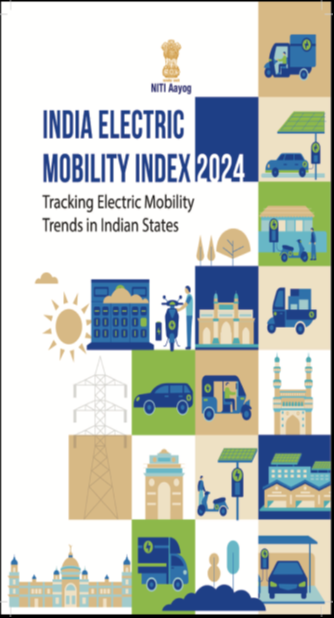
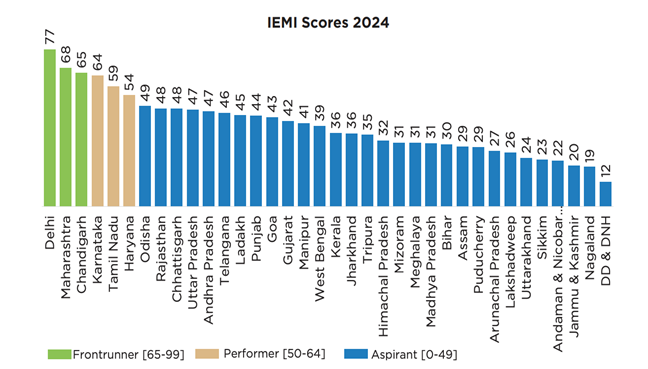
In a major step towards shaping India’s clean transport future, NITI Aayog unveiled the India Electric Mobility Index (IEMI) in August 2025, a pioneering tool designed to track, measure, and compare how States and Union Territories are progressing on their electric mobility ambitions. This first-of-its-kind framework not only benchmarks achievements but also provides a clear picture of where each region stands on the road to an electrified, sustainable transport ecosystem. The IEMI score is calculated by assessing performance across 16 indicators under three core themes — Transport Electrification Progress, Charging infrastructure readiness, and EV Research and Innovation Status.
Milestones Made, Track to Tomorrow
1. India has been making significant progress in the transition to green energy and electrification. With a clear vision and decisive targets, the roadmap ahead charts a course for cleaner air, stronger infrastructure, and a future-ready transit network.
2. The Government of India has set a vision to achieve 30% EV penetration by 2030, aligning with the global EV30@30 initiative.
3. As of February 2025, a total of 56.75 lakh electric vehicles have been registered in India out of 389.77 million registered vehicles.
4. India has set its sights on an ambitious green horizon, aiming to slash projected carbon emissions by 1 billion tonnes by 2030.
5. In a decisive step towards a low-emission future, India aims to cut the economy’s carbon intensity to below 45% by 2030 and ultimately transform into a net-zero nation by 2070.
Conclusion
Green mobility in India is no longer just an aspiration, it’s a movement reshaping how the nation moves, breathes, and grows. India’s green mobility drive is rewriting the story of transportation, replacing the roar of engines with the quiet hum of innovation. From sleek electric buses gliding through city streets to highways lined with charging points, the nation is building a network where speed meets sustainability. It’s not just about getting from point A to point B, but about creating a future where every mile travelled leaves a lighter footprint and a lasting legacy of cleaner air, healthier cities, and a planet that can keep pace with our ambitions.
Prelims Questions
Q. Which of the following schemes is/are correctly matched with their objectives?
1. FAME-I – Adoption of EVs and charging infra
2. PLI-ACC – Domestic manufacturing of advanced batteries
3. PM e-Bus Sewa – Deployment of e-buses under PPP model
Select the correct answer:
(a) 1 & 2 only
(b) 2 & 3 only
(c) 1 & 3 only
(d) 1, 2 & 3
Answer: D
Mains Questions
Q. Discuss the role of flagship schemes such as FAME, PLI, and PM E-Drive in transforming India into a global hub of electric mobility. Highlight the challenges that remain in achieving the targets of 30% EV penetration by 2030.
(250 words, 15 marks)

- RBI’s Shrinking Real-Rate Cushion Amid Rising Inflation and Strong Demand - September 21, 2026
- India’s NGOs at a New Funding Crossroads - September 21, 2026
- Deep-Sea Discovery, Environmental Responsibility - September 19, 2026

No Comments