


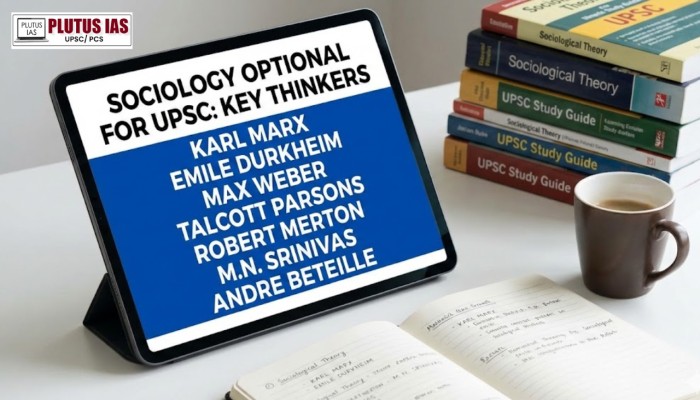
24 Feb Which thinkers are most important for Sociology optional in UPSC?
If you have chosen Sociology as your optional subject for the UPSC Civil Services Examination (CSE), you have made a strategic and popular choice. However, as you dive into the syllabus, you will quickly realize one fundamental truth: Sociology is not just about studying society; it is about studying how different scholars have interpreted society. The sociological thinkers form the absolute bedrock of your entire preparation.
A common mistake beginners make is treating the “Sociological Thinkers” chapter as just another topic to be memorized and checked off the list. In reality, these thinkers provide the theoretical lenses through which you must view every other topic in the syllabus—from religion and politics to family and social movements. Understanding them is non-negotiable for securing a 280+ score.
This comprehensive guide breaks down the most important thinkers for UPSC Sociology Optional (for both Paper I and Paper II), detailing what you need to focus on and how to integrate their theories into your Mains answer writing.
The “Holy Trinity” of Classical Sociology (Paper I)
Chapter 4 of Paper I in the UPSC Sociology syllabus explicitly lists six major thinkers. Among them, three are considered the founding fathers of the discipline. You must know their theories inside out, as their concepts can be applied to almost any question in the exam.
Must Check :- Best IAS Coaching in Delhi
1. Karl Marx (The Conflict Theorist)
Marx views society through the lens of economics and class conflict. For UPSC, you must master his concept of Historical Materialism, which argues that the material/economic base dictates the ideological superstructure (laws, religion, state) of society.
- Key Concepts to Master: Historical Materialism, Mode of Production, Alienation, Class Struggle.
- Application in UPSC: Marx is your go-to thinker for questions on inequality, poverty, industrialization, and labor movements. You can apply his theory of Alienation to modern gig economy workers or IT sector employees. You can also use his critique of religion (“opium of the masses”) when discussing secularization in Chapter 8.
2. Emile Durkheim (The Functionalist)
If Marx saw conflict, Durkheim saw order and solidarity. He was obsessed with what holds society together. Durkheim established Sociology as a distinct empirical science, separate from psychology and philosophy.
- Key Concepts to Master: Division of Labor (Mechanical vs. Organic Solidarity), Social Fact, Suicide (as a social, not psychological, phenomenon), Religion and the Sacred/Profane.
- Application in UPSC: Durkheim is crucial for understanding social cohesion. His theory of Suicide (specifically Anomic suicide) is highly relevant today when discussing farmer suicides or student stress in India. His perspective on religion is vital for Chapter 8 (Religion and Society).
3. Max Weber (The Interpretivist)
Weber argued against Marx’s pure economic determinism. He believed that ideas and values could also drive social change. He focused on “Social Action” and the subjective meanings people attach to their behavior.
- Key Concepts to Master: Social Action, Ideal Types, Authority (Traditional, Charismatic, Legal-Rational), Bureaucracy, The Protestant Ethic and the Spirit of Capitalism.
- Application in UPSC: Weber’s concept of Bureaucracy is indispensable for GS Paper 2 (Governance) and Sociology Paper I (Politics and Society). His “Protestant Ethic” thesis is a brilliant example to quote when discussing how religion impacts economic development.
The Modern Sociological Thinkers (Paper I)
After the classical theorists, the syllabus introduces three modern thinkers who developed distinct frameworks for analyzing society.
4. Talcott Parsons (The Grand Theorist)
Parsons is the king of Structural Functionalism. He attempted to create a grand, all-encompassing theory of society, arguing that society is a system with interconnected parts that work together to maintain equilibrium.
- Key Concepts to Master: Social System, Pattern Variables.
- Application in UPSC: Parsons can be quite abstract. His “Pattern Variables” are excellent tools for contrasting traditional Indian society with modern, globalized Indian society (e.g., moving from Ascription to Achievement).
5. Robert K. Merton (The Middle-Range Theorist)
Merton, a student of Parsons, rejected “grand theories” and advocated for “middle-range theories” that were more grounded and testable. He is arguably the most practically applicable thinker in Paper I.
- Key Concepts to Master: Latent and Manifest Functions, Conformity and Deviance (Strain Theory), Reference Group.
- Application in UPSC: Merton is a goldmine for UPSC answers. His “Reference Group” theory is crucial for understanding M.N. Srinivas’s concept of “Sanskritization” in Paper II. His “Strain Theory of Deviance” can be applied to explain rising crime rates, corruption, or youth unrest in modern India.
6. George Herbert Mead (The Symbolic Interactionist)
Unlike the others who looked at macro-level structures (capitalism, bureaucracy), Mead looked at the micro-level. He focused on everyday interactions and how individuals develop a sense of self through society.
- Key Concepts to Master: Self and Identity (the “I” and the “Me”).
- Application in UPSC: Mead is highly useful for questions on socialization, education, and family. You can use his theories to explain the impact of social media on the identity formation of modern youth.
The Pioneers of Indian Sociology (Paper II)
Paper II (Indian Society: Structure and Change) requires you to analyze India using sociological frameworks. The syllabus explicitly mentions three primary perspectives and their respective pioneering thinkers.
1. G.S. Ghurye (The Indological Perspective)
Ghurye is often called the father of Indian Sociology. The Indological perspective relies heavily on ancient texts, scriptures, and historical documents to understand Indian society.
- Key Focus Areas: Caste and Race in India, features of the caste system, tribes (viewed as “backward Hindus”).
- UPSC Relevance: Ghurye’s textual view of caste is the starting point for any answer on the Indian caste system. However, in your answers, you must always contrast his text-based approach with field-based empirical studies (like those of M.N. Srinivas).
2. M.N. Srinivas (The Structural-Functional Perspective)
Srinivas revolutionized Indian sociology by moving away from ancient texts and focusing on intensive fieldwork and village studies. He looked at what was actually happening on the ground.
- Key Concepts to Master: Sanskritization, Dominant Caste, Westernization, Secularization, Village Studies.
- UPSC Relevance: Srinivas is the most frequently cited thinker in Paper II. His concept of “Dominant Caste” is essential for answering questions on rural power dynamics, Panchayati Raj, and agrarian class structures. “Sanskritization” is crucial for explaining social mobility among lower castes.
3. A.R. Desai (The Marxist/Dialectical Perspective)
Desai applied Karl Marx’s theories to the Indian context. He analyzed Indian society, the freedom struggle, and state policies through the lens of class conflict and economic structures.
- Key Focus Areas: Social background of Indian Nationalism, peasant struggles, critique of the welfare state.
- UPSC Relevance: Desai is your primary thinker for topics related to agrarian struggles, the impact of colonial rule on the Indian economy, and the critical evaluation of poverty alleviation programs. He provides the necessary critical counter-narrative to functionalist views.
Other Crucial Indian Thinkers (Implicit in Syllabus)
While Ghurye, Srinivas, and Desai are explicitly mentioned in the “Perspectives” chapter, to score high marks in Paper II, you must quote a broader range of sociologists to substantiate your answers across different chapters.
- B.R. Ambedkar (The Subaltern Perspective): Absolutely vital for questions on caste annihilation, Dalit movements, and untouchability. His perspective provides the view from “below.”
- Andre Beteille: Known for his study of caste, class, and power. Crucial for understanding how the rigid caste system is slowly giving way to a more fluid class system in rural India.
- Yogendra Singh: Famous for his book “Modernization of Indian Tradition.” Use him for questions on globalization, cultural change, and how Indian society adapts to modernity without losing its traditional core.
- Dipankar Gupta: Excellent for contemporary views on the caste system (e.g., the concept of “hierarchy” vs. “difference”) and rural-urban dynamics.
- Sylvia Walby / Sharmila Rege / Leela Dube: Essential feminist thinkers to quote when answering questions on patriarchy, the role of women, and gender inequality in India.
How to Strategically Study Thinkers for UPSC 2026
Knowing the thinkers is only half the battle; knowing how to use them is what fetches marks. Here is a proven strategy for UPSC aspirants:
1. Do Not Isolate Chapter 4
Do not study Marx, Weber, and Durkheim, close the book, and forget about them. When you move to Chapter 5 (Stratification), ask yourself: “What would Marx say about class? What would Weber say about status?” When you study Chapter 8 (Religion), apply Durkheim’s sacred/profane concept. Thinkers are the tools; the rest of the syllabus is the material you apply them to.
2. Interlink Paper I and Paper II
The secret to scoring 280+ in Sociology is cross-pollination. Use Paper I thinkers in Paper II, and Paper II examples in Paper I. For example, when discussing Robert Merton’s “Reference Group” in Paper I, use M.N. Srinivas’s “Sanskritization” as the Indian example. When analyzing the Indian caste system in Paper II, use Max Weber’s concept of “Status Groups.”
3. Avoid “GS-Style” Answers
A General Studies answer on poverty will talk about government schemes and GDP data. A Sociology answer on poverty must talk about Karl Marx’s view on the exploitation of the proletariat, A.R. Desai’s critique of capitalist state policies, and the social exclusion faced by the poor. Always drop the names of relevant sociologists to show the examiner you are writing an academic paper, not a newspaper editorial.
4. Keep a “Thinker Fact-Sheet”
Create a dedicated notebook. For every topic in the syllabus (e.g., Family, Education, Social Movements), write down the names of 3 or 4 relevant thinkers and a one-line summary of their perspective. Revise this fact-sheet constantly before the Mains exam.
Must Check :- Best IAS Coaching in Delhi
Conclusion
The thinkers in the UPSC Sociology syllabus are not historical artifacts to be memorized; they are vibrant, analytical frameworks that help decode the complexities of human society. By mastering the core theories of Marx, Durkheim, Weber, Srinivas, and Desai, and learning how to seamlessly apply them to contemporary issues, you elevate your answers from average to exceptional. Treat these thinkers as your mentors in the exam hall, let their perspectives guide your pen, and you will find Sociology to be one of the most rewarding and high-scoring optional subjects in the UPSC Civil Services Examination.

- Best AI Tool for UPSC Preparation - July 27, 2026
- Best UPSC + Diploma Coaching - April 28, 2026
- Best UPSC + MBA Coaching - April 28, 2026

No Comments