


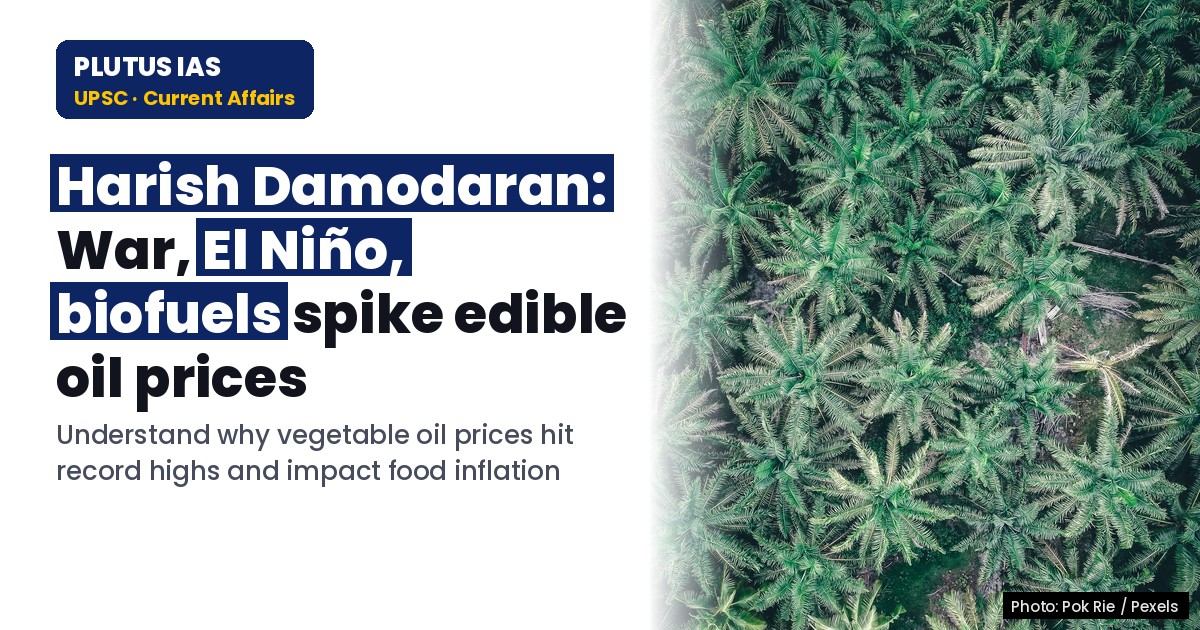
09 Oct Why Edible Oils Face Severe Food Inflation: War, El Niño & Biofuels Explained
✎ Edible oil inflation in 2026 is driven by a triad of geopolitical disruptions (Russia-Ukraine war), climate anomalies (El Niño), and biofuel mandates (e.g., Indonesia’s B50), which collectively reduce supply and divert feedstock…
Subject Relevance — Where This Topic Fits
- GS Paper III — Indian Economy: Issues relating to food inflation, agricultural commodities, and biofuel policies | GS Paper III — Effects of Liberalisation, Globalisation, and Disinvestment on Indian Economy | GS Paper III — Major Crops and Cropping Patterns in India | GS Paper III — Food Processing and Related Industries in India: Scope and Significance
- Prelims: Edible oil inflation, FAO Food Price Index, Biodiesel (FAME), Biofuel blending mandates, Monoculture plantations, Transesterification, El Niño phenomenon, Supply chain disruptions, Vegetable oil trade, Crude Palm Oil (CPO), Soyabean Oil, Rapeseed Oil, B20, B30, B40, B50, Ethanol Blending Programme (EBP), National Biofuel Policy 2018, Food and Agriculture Organization (FAO)
- Essay: The interplay of climate change, geopolitics, and agricultural policies in shaping global food security, India’s strategic imperatives in managing edible oil inflation while balancing biofuel mandates and food security
Quick Revision: Edible oil inflation in 2026 is driven by a triad of geopolitical disruptions (Russia-Ukraine war), climate anomalies (El Niño), and biofuel mandates (e.g., Indonesia’s B50), which collectively reduce supply and divert feedstock from food to fuel.
Why is this in the news?
The Food and Agriculture Organization’s (FAO) vegetable oil price index reached 198.6 points in September 2026, marking an 18.3% increase over the previous year and the highest level since June 2022. This surge reflects the compounded effects of geopolitical disruptions (e.g., the Russia-Ukraine war), climate anomalies (El Niño), and aggressive biofuel blending mandates by major producing nations (e.g., Indonesia’s B50 mandate). Edible oils, being a globally traded commodity with significant biofuel feedstock demand, are disproportionately impacted, exacerbating food inflation in importing countries like India.
Background
- The global edible oil market is highly integrated, with palm oil, soyabean oil, and rapeseed oil accounting for over 60% of total production and trade.
- The Russia-Ukraine conflict disrupted sunflower oil supplies, a key substitute for palm and soyabean oils, leading to a 30% decline in global sunflower oil exports by 2023.
- El Niño events, characterized by abnormal warming of the Pacific Ocean, disrupt rainfall patterns, reducing palm oil and soyabean yields in Southeast Asia and South America, respectively.
- The global biofuel sector has expanded rapidly, with vegetable oils constituting 25–30% of total biofuel feedstock, driven by mandates in the EU, US, Indonesia, and Malaysia.
- India, the world’s largest edible oil importer, meets 60% of its demand through imports, making it vulnerable to global price volatility.
- The National Biofuel Policy 2018 and subsequent amendments in India aim to achieve 20% ethanol blending in petrol by 2025-26, with parallel efforts to promote biodiesel from non-edible oils and waste fats.
What are the systemic drivers of edible oil inflation?
- **Geopolitical Supply Shocks**: The Russia-Ukraine war disrupted sunflower oil exports, a critical substitute for palm and soyabean oils, creating a supply vacuum that elevated global prices.
- **Climate Variability**: El Niño-induced droughts in Southeast Asia and South America reduce palm oil and soyabean yields, tightening global supply and amplifying price volatility.
- **Biofuel Mandates as Demand-Side Pressure**: National blending mandates (e.g., Indonesia’s B50, Malaysia’s B10) divert about 25% of soyabean oil, 28% of palm oil, and 29% of rapeseed oil to biodiesel, reducing available supply for food consumption.
- **Transesterification Process**: Vegetable oils are chemically converted into Fatty Acid Methyl Esters (FAME) via transesterification to produce biodiesel, a process that competes directly with food uses for feedstock.
- **Monoculture Dependence**: Large-scale monoculture plantations (e.g., oil palm in Indonesia/Malaysia) are vulnerable to climate shocks, pests, and price volatility, exacerbating supply instability.
- **Global Trade Dynamics**: Edible oils are among the most traded agricultural commodities, with price transmission occurring rapidly across markets due to arbitrage and futures trading.
- **Policy Coherence Challenges**: Balancing biofuel mandates with food security requires coordination between energy, agriculture, and trade ministries, often leading to delayed or suboptimal policy responses.
- **Storage and Logistics Bottlenecks**: Inadequate storage infrastructure in producing countries (e.g., Indonesia, Malaysia) and logistical constraints in exporting nations (e.g., Argentina, Brazil) exacerbate price spikes during supply disruptions.
Key Features
| Feature | Significance |
|---|---|
| Vegetable Oil Price Index | FAO’s vegetable oil price index (198.6 points in September 2026) remains structurally elevated due to persistent supply-demand imbalances, making edible oils the most inflation-sensitive food commodity globally. |
| Biofuel Blending Mandates | National mandates (e.g., Indonesia’s B50, US 54% soyabean oil diversion) artificially inflate demand for feedstock oils, diverting supply from food markets and exacerbating price volatility. |
| Geopolitical Supply Shocks | Russia-Ukraine conflict disrupted sunflower oil supplies; El Niño-induced crop failures in Southeast Asia further tightened palm oil availability, compounding inflationary pressures. |
| Transesterification Process | Chemical conversion of vegetable oils into FAME (biodiesel) requires methanol and catalysts, adding cost layers and reducing edible oil availability in the food supply chain. |
| Monoculture Dependence | Global reliance on palm, soyabean, and rapeseed oil—dominated by a few producing nations—creates systemic vulnerability to climate shocks and policy shifts in major markets. |
Why it Matters
Economic/Strategic
- Edible oil inflation directly impacts household budgets, particularly in lower-income groups, as oils constitute a staple in diets and are price-inelastic commodities.
- India’s import dependence (≈70% of edible oil consumption) exposes the economy to global price shocks, affecting trade deficits and fiscal stability through subsidy burdens.
- Biofuel mandates, while reducing fossil fuel dependence, introduce a structural demand-side pressure on food commodities, creating a trade-off between energy security and food security.
- Price volatility in edible oils disrupts agricultural planning, discourages investment in oilseed cultivation, and risks long-term supply chain disruptions.
Agricultural/Environmental
- Expansion of oil palm monocultures (e.g., in Southeast Asia) accelerates deforestation, biodiversity loss, and carbon emissions, conflicting with climate mitigation goals.
- El Niño-driven droughts reduce palm oil yields in Indonesia/Malaysia, the world’s largest producers, demonstrating the ecological fragility of high-yield monocultures.
- Biofuel feedstock cultivation competes for arable land and water resources, potentially displacing food crops and exacerbating land-use conflicts.
Policy/Regulatory
- Government-imposed blending mandates (e.g., India’s B20, Indonesia’s B50) prioritize energy policy over food security, requiring careful calibration to avoid unintended inflationary consequences.
- Price stabilization measures (e.g., import duty adjustments, buffer stock policies) must balance short-term relief with long-term market incentives for domestic oilseed production.
- International coordination on biofuel policies is essential to prevent conflicting mandates from amplifying global commodity price volatility.
Social/Developmental
- Persistent edible oil inflation disproportionately affects vulnerable populations, exacerbating malnutrition risks and widening socio-economic disparities.
- Smallholder farmers in oilseed-dependent regions face income instability due to price fluctuations, necessitating safety nets and diversified livelihood strategies.
- Urban consumers, particularly in low-income households, experience reduced purchasing power, with cascading effects on nutrition and health outcomes.
Challenges
1. Structural Supply-Demand Mismatch
- Global demand for edible oils is rising due to population growth, dietary shifts, and biofuel mandates, while supply remains constrained by climate shocks and land-use limitations.
- Geographical concentration of production (e.g., Indonesia/Malaysia for palm oil) creates systemic vulnerability to localized disruptions (e.g., El Niño, export bans).
- Limited diversification in oilseed crops (palm, soyabean, rapeseed) reduces resilience to climate variability and pest outbreaks.
UPSC Link: GS-III: Agricultural Marketing & Supply Chain
2. Policy-Induced Price Volatility
- Biofuel blending mandates artificially inflate demand for feedstock oils, diverting supply from food markets and creating price spikes (e.g., FAO vegetable oil index at 198.6 in 2026).
- Sudden changes in mandates (e.g., Indonesia’s B50 transition) disrupt market expectations and exacerbate short-term price instability.
- Lack of harmonized global biofuel policies leads to conflicting national mandates, amplifying cross-border price transmission effects.
UPSC Link: GS-II: Government Policies & Interventions
3. Climate Change & Ecological Degradation
- El Niño events are intensifying, reducing palm oil yields in Southeast Asia and sunflower oil output in Ukraine/Russia, the world’s top producers.
- Monoculture oil palm plantations contribute to deforestation in tropical regions, undermining biodiversity and carbon sequestration efforts.
- Water scarcity in major oilseed-producing regions (e.g., US Midwest for soyabean) threatens long-term agricultural productivity.
UPSC Link: GS-III: Conservation & Environmental Pollution
4. Trade Dependence & Currency Risks
- India’s heavy reliance on edible oil imports (≈70% of consumption) exposes the economy to global price shocks, trade deficits, and currency depreciation pressures.
- Export restrictions by major producers (e.g., Indonesia’s palm oil export bans in 2022) disrupt global supply chains and exacerbate domestic inflation.
- Fluctuations in the Indian Rupee against the US Dollar directly impact import costs for edible oils, compounding inflationary pressures.
UPSC Link: GS-III: Foreign Trade & Balance of Payments
5.
- Persistent edible oil inflation reduces dietary diversity, particularly among low-income households, increasing risks of micronutrient deficiencies.
- Price volatility discourages consumption of healthier oils (e.g., mustard, groundnut) in favor of cheaper, less nutritious alternatives, undermining public health goals.
- Government interventions (e.g., subsidies) may distort market signals, leading to inefficient resource allocation in the agricultural sector.
UPSC Link: GS-II: Health & Nutrition Policies
Challenges — UPSC Perspective
| Issue | Concern |
|---|---|
| Supply Chain Disruptions | Climate shocks (El Niño) and geopolitical conflicts (Russia-Ukraine) reduce global edible oil output, creating persistent shortages. |
| Biofuel Demand Divergence | National blending mandates divert 25-57% of vegetable oil production to biofuels, reducing food availability and inflating prices. |
| Monoculture Vulnerability | Dependence on palm, soyabean, and rapeseed oil limits crop diversification, increasing systemic risks from pests, diseases, and climate change. |
| Trade Policy Instability | Export bans (e.g., Indonesia’s palm oil restrictions) and import duties create unpredictable supply conditions, exacerbating domestic inflation. |
| Agricultural Investment Lag | Price volatility and policy uncertainty discourage private investment in oilseed cultivation, threatening long-term self-sufficiency. |
| Nutritional Inequities | Edible oil inflation disproportionately affects low-income groups, reducing dietary quality and increasing malnutrition risks. |
Way Forward
- Enhance domestic oilseed production through research and development in high-yield, climate-resilient varieties (e.g., mustard, groundnut, sunflower) to reduce import dependence.
- Implement calibrated biofuel blending mandates that balance energy security goals with food security objectives, avoiding abrupt policy shifts.
- Strengthen climate-resilient agriculture by promoting agroforestry, integrated farming systems, and precision agriculture to mitigate El Niño impacts on oilseed yields.
- Diversify import sources for edible oils to reduce geographical concentration risks, including partnerships with Latin American and African producers.
- Expand public distribution systems (PDS) and targeted subsidies for edible oils to shield vulnerable populations from price volatility.
- Promote sustainable oilseed cultivation through incentives for organic farming, reduced chemical inputs, and certification programs (e.g., RSPO for palm oil).
- Develop regional buffer stocks and emergency procurement mechanisms to stabilize prices during supply shocks.
- Encourage private sector investment in oilseed processing and storage infrastructure to reduce post-harvest losses and improve market efficiency.
UPSC Value Addition
Keywords for Mains Answer-Writing
Food inflation · edible oils · biofuel mandates · FAO Food Price Index · El Niño · Russia-Ukraine war · transesterification · Fatty Acid Methyl Esters (FAME) · biodiesel blending · vegetable oil supply chain · monoculture plantations · energy transition policies · agricultural commodity markets · global supply shocks · sustainable agriculture
Constitutional & Policy Linkages
- [‘Article 39(b) – Directive Principles of State Policy’, ‘Ensuring equitable distribution of essential commodities.’]
- [‘Article 47 – Directive Principles of State Policy’, ‘Public health and nutrition standards.’]
Concept Flow
Geopolitical conflict (Russia-Ukraine) → Disruption in sunflower oil supply → Global edible oil price surge → El Niño-induced droughts → Reduced palm oil yields in Southeast Asia → Tightened global supply → National biofuel mandates (e.g., Indonesia B50) → Increased demand for feedstock oils → Competition with food markets → Transesterification process → Conversion of vegetable oils to FAME biodiesel → Reduced edible oil availability → Supply-demand imbalance → Persistent inflation in FAO vegetable oil price index → Domestic price transmission effects → Import dependence (India) → Currency depreciation → Higher import costs for edible oils → Household budget constraints → Reduced dietary diversity → Nutritional security risks
Prelims Practice Questions
Q1. Consider the following statements regarding the FAO Food Price Index (FFPI):
1. The FFPI is a weighted average of the international prices of a basket of food commodities.
2. The base period value for the FFPI is taken at 100 for the years 2014-16.
3. The FFPI for vegetable oils reached its highest recorded value in March 2022.
4. The FFPI for vegetable oils in September 2026 was 18.3% lower than in September 2025.
How many of the above statements are correct?
- Only one
- Only two
- Only three
- All
Answer: Only three — Statements 1, 2, and 3 are correct. Statement 4 is incorrect as the FFPI for vegetable oils in September 2026 was 18.3% higher than in September 2025.
Q2. Assertion (A): The transesterification process converts vegetable oils into Fatty Acid Methyl Esters (FAME), which can be used as biodiesel.
Reason (R): FAME is produced by reacting triglycerides in vegetable oils with methanol in the presence of a catalyst.
Options:
A. Both A and R are true, and R is the correct explanation of A.
B. Both A and R are true, but R is NOT the correct explanation of A.
C. A is true, but R is false.
D. A is false, but R is true.
Answer: ? — Both the assertion and reason are true, and the reason correctly explains the assertion. Transesterification is the chemical process that converts vegetable oils into FAME biodiesel.
Q3. Match the following biofuel blend mandates with their respective countries:
Column I (Country) | Column II (Biofuel Blend Mandate)
1. Indonesia | A. B10
2. Malaysia | B. B20
3. United States | C. B30
4. European Union | D. B40
Options:
A. 1-D, 2-A, 3-C, 4-B
B. 1-D, 2-A, 3-B, 4-C
C. 1-B, 2-A, 3-D, 4-C
D. 1-C, 2-D, 3-A, 4-B
Answer: ? — 1-D (Indonesia: B40), 2-A (Malaysia: B10), 3-B (United States: B20), 4-C (European Union: B30). The correct match is option A.
Mains Practice Question
✍ The convergence of climate anomalies, geopolitical disruptions, and energy transition policies has rendered edible oils among the most volatile components of global food inflation. Critically analyse the interplay of these factors in shaping the supply and price dynamics of vegetable oils, with reference to India’s policy responses. (15 Marks)
Approach: MODEL-ANSWER SKELETON:
1. **Climate Anomalies and Supply Shocks**: El Niño-induced droughts in palm oil-producing regions (e.g., Indonesia, Malaysia) and Russia-Ukraine war disruptions in sunflower oil exports. Cite FAO data on price spikes (e.g., FFPI for vegetable oils at 198.6 in September 2026 vs. 115.8 in June 2023).
2. **Energy Transition Policies**: Role of biofuel mandates (e.g., Indonesia’s B50, Malaysia’s B15, EU’s 57% rapeseed oil diversion) in diverting edible oils from food to fuel. Explain transesterification and FAME production as a demand-side pressure.
3. **Monoculture and Market Structure**: Critique of monoculture oil palm plantations in Southeast Asia and their vulnerability to climate shocks; contrast with India’s diversified oilseed basket (mustard, groundnut, soyabean).
4. **India’s Policy Responses**:
– **National Biofuel Policy 2018**: Targets for ethanol blending (E20 by 2025) and biodiesel (B5 by 2030).
– **Price Stabilisation Measures**: Import duty adjustments (e.g., reduction on crude palm oil in 2022), buffer stock operations, and Minimum Support Prices (MSPs) for oilseeds.
– **Trade Policy**: Restrictions on edible oil imports (e.g., tariff rate quotas) to protect domestic farmers.
5. **Critical Analysis**:
– **Trade-offs**: Balancing food security vs. energy transition goals.
– **Long-term Solutions**: Promotion of non-edible oilseeds (e.g., jatropha), research on high-yielding varieties, and diversification of import sources (e.g., African palm oil).
– **Institutional Mechanisms**: Role of the Directorate General of Foreign Trade (DGFT), Commission for Agricultural Costs and Prices (CACP), and Food Corporation of India (FCI).
6. **Conclusion**: Argue for a multi-pronged strategy integrating climate resilience, sustainable agriculture, and calibrated biofuel policies to mitigate volatility in edible oil markets.
Source: The Indian Express
Generated by AanyaAi for educational purpose.
Related guides on our sites
- Best economics optional coaching for upsc
- Best economics optional teacher for upsc
- How to prepare for GS paper 1 for UPSC CSE mains exam
- Best UPSC coaching for IFOS exam


No Comments