


07 Aug Why Kisan Janata opposes Kerala’s welfare pension shift from coop banks
✎ Cooperative banks, particularly Primary Agricultural Credit Societies (PACS), have historically ensured last-mile delivery of social welfare pensions in rural India, but the shift towards Aadhaar-linked DBT systems risks…
Subject Relevance — Where This Topic Fits
- GS Paper II — Welfare Schemes for Vulnerable Sections of the Population; Mechanisms, Laws, Institutions and Bodies Constituted for the Protection and Betterment of these Sections | GS Paper III — Indian Economy and Issues Relating to Planning, Mobilisation of Resources, Growth, Development and Employment; Role of Cooperative Sector in Rural Economy
- Prelims: Aadhaar-enabled Payment System (AePS), Direct Benefit Transfer (DBT), Primary Agricultural Credit Societies (PACS), Cooperative Banks, Social Security Pensions, Rashtriya Janata Dal (RJD), Kisan Janata, Akshaya Centres
- Essay: Financial Inclusion and Social Justice: Balancing Efficiency with Equity, The Role of Cooperative Institutions in India’s Development Paradigm
Quick Revision: Cooperative banks, particularly Primary Agricultural Credit Societies (PACS), have historically ensured last-mile delivery of social welfare pensions in rural India, but the shift towards Aadhaar-linked DBT systems risks excluding elderly and digitally illiterate beneficiaries unless safeguards are implemented.
Why is this in the news?
The Kisan Janata, an affiliate of the Rashtriya Janata Dal (RJD), has publicly opposed the Kerala government’s decision to disengage cooperative banks from the disbursement of social welfare pensions, advocating for the restoration of a doorstep delivery system via cooperative banks. This intervention highlights a critical debate on the trade-offs between administrative efficiency and inclusive access in welfare delivery systems, particularly for elderly and economically vulnerable populations.
Background
- Kerala has historically relied on cooperative banks, particularly Primary Agricultural Credit Societies (PACS), for the disbursement of social welfare pensions, leveraging their extensive rural network and community trust.
- The state government’s decision to transfer pension disbursements directly to Aadhaar-linked commercial bank accounts aligns with the broader national push towards Direct Benefit Transfer (DBT) and the Aadhaar-enabled Payment System (AePS), aimed at reducing leakages and improving efficiency.
- The Aadhaar-linked DBT system, while reducing intermediaries, has been criticised for excluding beneficiaries who lack access to commercial bank branches or digital literacy, particularly in rural and remote areas.
- Cooperative banks, especially in states like Kerala, have played a pivotal role in financial inclusion by providing last-mile connectivity for welfare schemes, including pensions, agricultural credit, and subsidies.
- The opposition by Kisan Janata underscores the socio-economic challenges faced by elderly and economically backward beneficiaries, who may struggle with the procedural and physical barriers of accessing pensions through commercial banks or Akshaya centres.
- This debate reflects broader tensions between modernising welfare delivery systems and preserving inclusive, community-based mechanisms that ensure equitable access for marginalised groups.
What are Cooperative Banks and their Role in Social Welfare Delivery?
- Cooperative banks are financial institutions owned and operated by their members, governed by the principles of cooperation, mutual help, and democratic control, as enshrined in the Cooperative Societies Act, 1912, and subsequent amendments.
- In India, cooperative banks are categorised into urban cooperative banks (UCBs) and rural cooperative banks, with the latter including Primary Agricultural Credit Societies (PACS) and District Central Cooperative Banks (DCCBs), which are critical to rural financial inclusion.
- Cooperative banks have been instrumental in extending banking services to rural and semi-urban areas, where commercial banks have limited presence, thereby facilitating access to credit, savings, and welfare disbursements.
- The Reserve Bank of India (RBI) regulates cooperative banks under the Banking Regulation Act, 1949, and the Cooperative Societies Act, ensuring prudential norms, governance standards, and depositor protection.
- Social welfare pensions in India, including old-age pensions, disability pensions, and widow pensions, are disbursed through multiple channels, including cooperative banks, commercial banks, and post offices, with the choice of channel often state-specific.
- The Aadhaar-enabled Payment System (AePS) and Direct Benefit Transfer (DBT) have introduced efficiency in welfare delivery by reducing leakages and delays, but their implementation has also highlighted challenges in accessibility for elderly and digitally illiterate populations.
- Kerala’s model of using cooperative banks for pension disbursement leverages the state’s strong cooperative movement, which has over 2,000 PACS and a robust rural banking network, ensuring doorstep delivery and minimising beneficiary inconvenience.
- The debate in Kerala reflects a broader national discourse on the optimal balance between technological efficiency and inclusive access in welfare delivery, particularly for vulnerable sections of the population.
Key Features
| Feature | Significance |
|---|---|
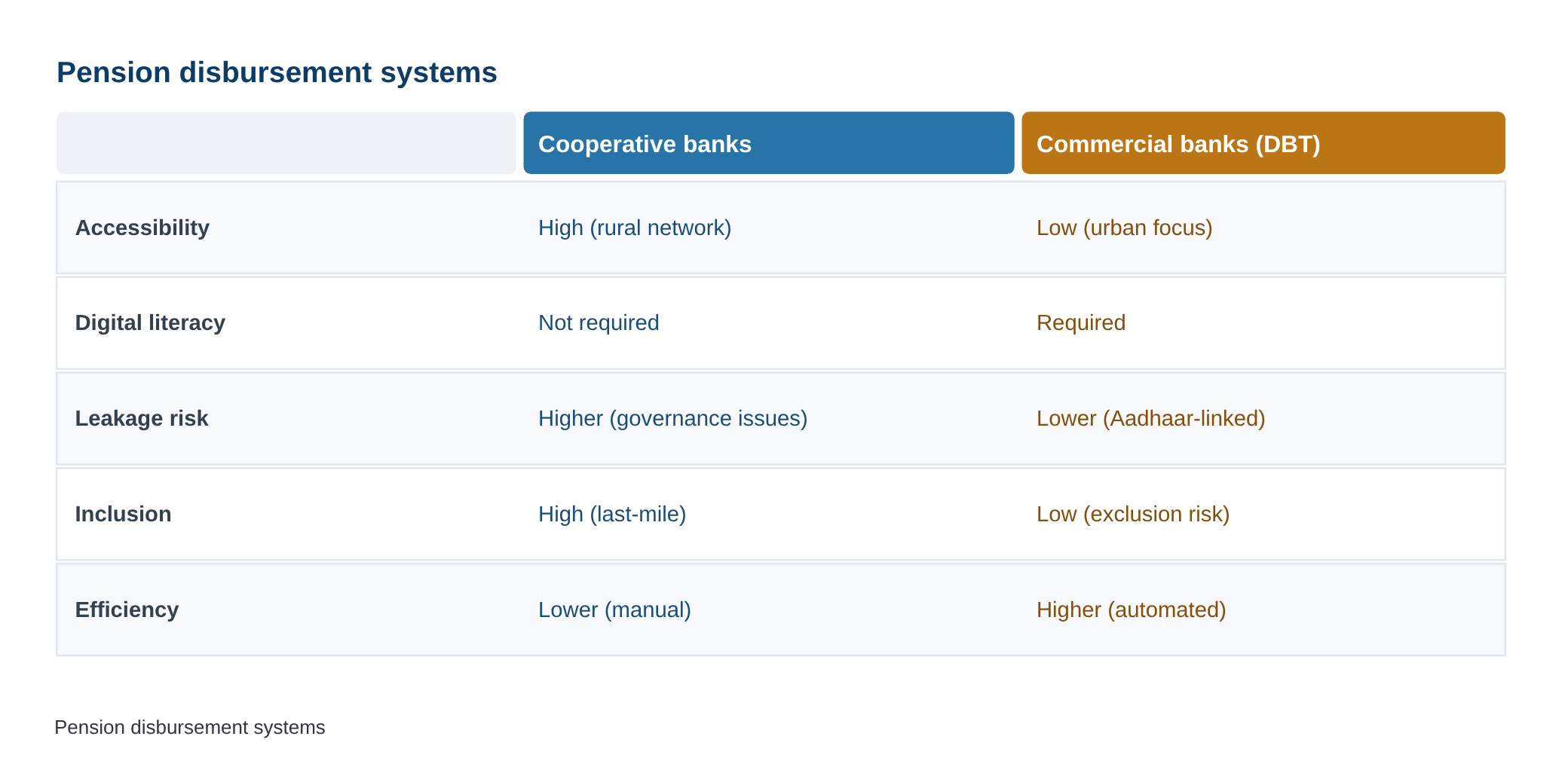
| Direct disbursement of welfare pensions to Aadhaar-linked commercial bank accounts | Eliminates intermediaries, reduces transaction costs, and enhances transparency in fund flow |
| Doorstep delivery of pensions through cooperative banks | Ensures accessibility for elderly and economically weaker sections, reduces physical and financial exclusion |
| State government’s disengagement of cooperative banks from pension disbursement | Rationale likely includes streamlining processes, reducing operational inefficiencies, and leveraging digital infrastructure |
| Kisan Janata’s opposition to the disengagement | Highlights concerns over exclusion risks, logistical challenges for vulnerable groups, and disruption of established delivery mechanisms |
| Aadhaar linkage for pension disbursement | Facilitates identity verification, reduces duplication, and prevents leakages in welfare distribution |
Why it Matters
Economic
- Direct disbursement to commercial banks may reduce the operational burden on cooperative banks, which often face liquidity constraints and governance challenges.
- Enhanced transparency in pension disbursement can reduce leakages and improve fiscal efficiency in welfare spending.
- Aadhaar-linked disbursement ensures targeted delivery, minimising inclusion and exclusion errors in welfare schemes.
Social
- Doorstep delivery through cooperative banks addresses the needs of elderly and economically weaker sections, who may lack access to commercial bank infrastructure.
- Disruption of existing mechanisms risks increasing financial exclusion for marginalised groups, particularly in rural areas.
- The shift may exacerbate digital divide issues, where beneficiaries lack familiarity with digital banking or Aadhaar-based transactions.
Administrative
- State governments may prioritise digital infrastructure and commercial banks for efficiency, but must balance this with inclusivity concerns.
- Cooperative banks play a critical role in rural financial inclusion; their disengagement could weaken local financial ecosystems.
- The move reflects a broader trend of digitisation in welfare delivery, but requires robust grievance redressal mechanisms for vulnerable beneficiaries.
Challenges
1. Financial Exclusion of Vulnerable Groups
- Elderly beneficiaries may struggle with Aadhaar-linked commercial bank transactions, leading to withdrawal challenges.
- Lack of digital literacy and access to smartphones or internet in rural areas could exacerbate exclusion.
- Long queues at bank branches and Akshaya centres may disproportionately affect the elderly and differently-abled.
UPSC Link: GS2: Welfare schemes for vulnerable sections
2. Operational Disruptions in Pension Delivery
- Disengagement of cooperative banks may create temporary gaps in pension disbursement, leading to delays or defaults.
- Cooperative banks often provide last-mile delivery in rural areas; their exclusion could disrupt established logistics.
- State governments must ensure seamless transition to avoid beneficiary distress.
UPSC Link: GS2: Mechanisms, laws, institutions for welfare delivery
3. Governance and Transparency Concerns
- Direct disbursement to commercial banks may reduce transparency if oversight mechanisms are weak.
- Risk of Aadhaar-related fraud or identity theft in commercial bank transactions requires stringent safeguards.
- Lack of grievance redressal for beneficiaries facing technical or access issues could undermine trust in the system.
UPSC Link: GS2: Transparency and accountability in governance
4. Digital Divide and Infrastructure Gaps
- Inadequate digital infrastructure in rural areas may hinder Aadhaar-linked transactions, particularly for pensioners.
- Limited access to smartphones or internet connectivity could exclude beneficiaries from digital pension systems.
- State governments must invest in digital literacy programmes and infrastructure to mitigate these challenges.
UPSC Link: GS3: Inclusive growth and digital infrastructure
5. Impact on Cooperative Banking Ecosystem
- Disengagement of cooperative banks from pension disbursement may weaken their financial viability and operational sustainability.
- Cooperative banks play a vital role in rural credit and savings; their exclusion could disrupt local financial ecosystems.
- State governments must explore alternative roles for cooperative banks to prevent their marginalisation.
UPSC Link: GS3: Financial inclusion and cooperative societies
Challenges — UPSC Perspective
| Issue | Concern |
|---|---|
| Financial exclusion | Risk of elderly and rural beneficiaries being unable to access pensions due to lack of digital literacy or infrastructure |
| Operational disruption | Temporary gaps in pension disbursement leading to delays or defaults during transition to new system |
| Governance risks | Potential for increased leakages, fraud, or beneficiary distress due to weak oversight mechanisms |
| Digital divide | Exclusion of beneficiaries lacking access to smartphones, internet, or Aadhaar-linked bank accounts |
| Impact on cooperative banks | Weakening of rural financial ecosystems due to reduced role in welfare delivery |
Way Forward
- Conduct a pilot phase to test the new disbursement system in select districts, with robust monitoring for exclusion risks.
- Ensure doorstep delivery mechanisms are maintained as a fallback for elderly and vulnerable beneficiaries during the transition.
- Invest in digital literacy programmes and infrastructure upgrades in rural areas to support Aadhaar-linked transactions.
- Strengthen grievance redressal mechanisms, including dedicated helplines and local facilitation centres for pensioners.
- Explore hybrid models where cooperative banks act as last-mile facilitators for commercial bank transactions.
- Mandate regular audits of pension disbursement systems to detect and prevent leakages or fraud.
- Engage with stakeholders, including cooperative banks and beneficiary groups, to address concerns and refine the transition plan.
- Develop contingency plans to ensure uninterrupted pension disbursement in case of technical or logistical failures.
UPSC Value Addition
Keywords for Mains Answer-Writing
Social welfare pensions · Cooperative banks · Aadhaar-enabled payment system · Direct Benefit Transfer · Financial inclusion · Doorstep delivery of pensions · Elderly and vulnerable populations · Rashtriya Janata Dal · Kisan Janata · Aadhaar-linked bank accounts · Akshaya centres · Public policy and service delivery
Constitutional & Policy Linkages
- {‘Article 41’: ‘Directive Principle of State Policy on public assistance for elderly’}
- {‘Article 42’: ‘Directive Principle on securing just and humane conditions of work’}
- {‘Article 38’: ‘Directive Principle on securing social order for welfare of people’}
Concept Flow
State government disengages cooperative banks from pension disbursement → Direct disbursement to Aadhaar-linked commercial bank accounts → Kisan Janata opposes move citing exclusion risks → Vulnerable groups face challenges accessing pensions → State must balance efficiency with inclusivity → Hybrid models or fallback mechanisms are explored → Digital literacy and infrastructure upgrades are prioritised
Prelims Practice Questions
Q1. Consider the following statements regarding the distribution of social welfare pensions in India:
1. The Aadhaar-enabled Payment System (AePS) is designed to facilitate direct benefit transfers to beneficiaries.
2. Cooperative banks are exclusively regulated by the Reserve Bank of India under the Banking Regulation Act, 1949.
3. The ‘Akshaya’ centres in Kerala are primarily used for the doorstep delivery of welfare pensions.
How many of the above statements are correct?
- Only one
- Only two
- All
- None
Answer: All — Statements 1 and 3 are correct. Statement 2 is incorrect as cooperative banks are regulated by the Registrar of Cooperative Societies under state legislation, not solely by the RBI.
Q2. Assertion (A): The Direct Benefit Transfer (DBT) mechanism for welfare pensions aims to reduce leakages and improve efficiency in service delivery.
Reason (R): The Aadhaar-enabled Payment System (AePS) ensures that beneficiaries receive their entitlements without intermediaries.
- Both A and R are true, and R is the correct explanation of A.
- Both A and R are true, but R is not the correct explanation of A.
- A is true, but R is false.
- A is false, but R is true.
Answer: Both A and R are true, but R is not the correct explanation of A. — Both A and R are true. DBT reduces leakages by eliminating intermediaries, and AePS enables direct transfers to beneficiaries’ Aadhaar-linked accounts, making R the correct explanation of A.
Q3. Match the following pairs related to welfare delivery mechanisms in India:
Column I (Mechanism) Column II (Description)
A. Aadhaar-enabled Payment System (AePS) 1. A centralised platform for direct benefit transfers
B. Direct Benefit Transfer (DBT) 2. Uses biometric authentication for withdrawals
C. Doorstep delivery of pensions 3. Delivery of pensions at the beneficiary’s residence
D. Akshaya centres 4. Common service centres in Kerala for digital services
Select the correct match:
- A-2, B-1, C-3, D-4
- A-1, B-2, C-3, D-4
- A-3, B-1, C-2, D-4
- A-4, B-2, C-1, D-3
Answer: A-2, B-1, C-3, D-4 — AePS uses biometric authentication (A-2), DBT is a centralised platform (B-1), doorstep delivery involves home delivery (C-3), and Akshaya centres are common service centres in Kerala (D-4).
Mains Practice Question
✍ The State government’s decision to disengage cooperative banks from the distribution of social welfare pensions and transfer the disbursements directly to Aadhaar-linked commercial bank accounts represents a shift in the architecture of welfare delivery. Critically examine the implications of this policy change for financial inclusion, administrative efficiency, and the welfare of elderly and vulnerable populations. (15 Marks)
Approach: MODEL-ANSWER SKELETON:
1. **Context and Policy Change**: Define Direct Benefit Transfer (DBT) and Aadhaar-enabled Payment System (AePS). Explain the rationale behind disengaging cooperative banks.
2. **Financial Inclusion**: Discuss how cooperative banks contribute to financial inclusion, particularly in rural and semi-urban areas. Contrast with challenges faced by commercial banks in reaching marginalised groups.
3. **Administrative Efficiency**: Analyse the efficiency gains of DBT in reducing leakages and corruption. Cite data or reports on leakage reduction (e.g., Economic Survey, NITI Aayog).
4. **Welfare of Elderly and Vulnerable**: Examine the hardships posed by the shift, such as queueing at bank branches, lack of digital literacy, and exclusion risks. Reference the concerns raised by Kisan Janata.
5. **Balancing Views**: Present counterarguments, such as the potential for greater transparency and reduced administrative costs under the new system.
6. **Conclusion**: Weigh the trade-offs and suggest measures to mitigate adverse impacts, such as strengthening last-mile delivery through Akshaya centres or reviving cooperative bank partnerships.
Source: The Hindu
Generated by AanyaAi for educational purpose.

- हिमाचल में डिजिटल भुगतान क्रांति: बिलासपुर अव्वल, महिलाओं की भागीदारी 93% तक पहुंची - September 23, 2026
- Himachal Pradesh Leads in Digital Payments: Bilaspur Tops, Women’s Role Rises - September 23, 2026
- केरल लोक सेवा आयोग ने उच्च न्यायालय में दायर किया मामला, सदस्यों के खिलाफ मामला रद्द करने की मांग - September 23, 2026

No Comments