


23 Apr Why Women Reservations won’t solve the problem alone
This article covers “Daily Current Affairs”
SYLLABUS MAPPING : GS- 1 & 2 : Society and Polity
FOR PRELIMS : Data and Facts with respect to women participation in India
FOR MAINS : Discuss the structural barriers that limit women’s effective political participation in India. Suggest measures beyond reservation to address these challenges.

Context & Background
The recent defeat of the Constitution (One Hundred and Thirty-First Amendment) Bill, (popularly known as Nari Shakti Vandan Adhiniyam) in practical implementation debates has revived concerns about substantive vs symbolic representation of women in politics.
Although the Bill promises structural inclusion, questions remain about whether reservation alone can transform women’s real participation and influence in governance.
The Women’s Reservation Framework
The Bill proposes:
- 33% reservation for women in: Lok Sabha , State Legislative Assemblies
- Reservation to be implemented after delimitation and census
- Sub-reservation for SC/ST women
- Rotation of reserved constituencies
👉 Objective:
- Enhance descriptive representation (number of women)
- Promote inclusive governance
- Correct historical gender imbalance
Why Reservation Alone is Not a Sufficient Reform
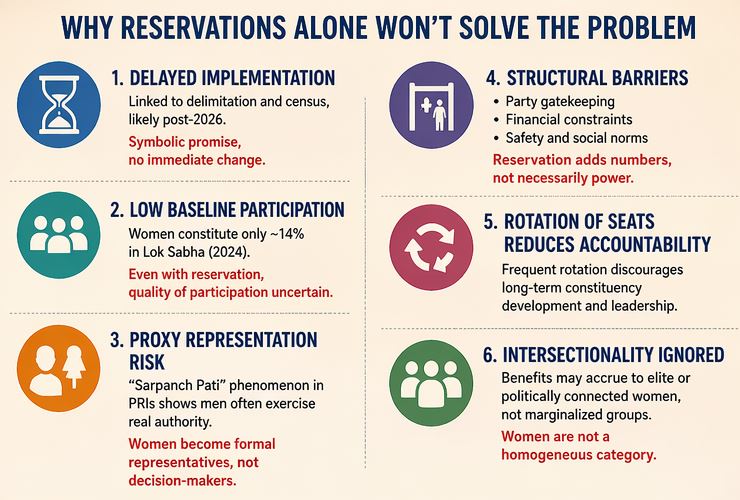
1. Delayed Implementation Weakens Impact
- Linked to delimitation and census, likely delaying implementation until post-2026
- Creates a policy promise without immediate change
2. Low Baseline of Women Participation
- Women constitute only ~14% in Lok Sabha (2024)
- India ranks low globally in women parliamentary representation
3. Proxy Representation Problem
- Evidence from Panchayati Raj Institutions (PRIs) shows: Emergence of “Sarpanch Pati” phenomenon
- Male relatives often exercise real authority
4. Structural Barriers Beyond Representation
(a) Political Party Gatekeeping
- Parties rarely give tickets to women (~10–12%)
- Reservation bypasses but does not reform internal party democracy
(b) Electoral Financing Constraints
- Women have less access to campaign finance
- Politics remains resource-intensive
(c) Safety and Social Norms
- Gender-based violence in politics
- Social expectations discourage leadership roles
5. Rotation of Seats Reduces Accountability
- Discourages long-term constituency development
- Weakens political career building for women
6. Intersectionality Ignored : Women are not a homogeneous category:
- Caste
- Class
- Religion
- Rural-urban divide
👉 Reservation may benefit: Elite or politically connected women, not marginalized groups
What More Needs to Be Done?

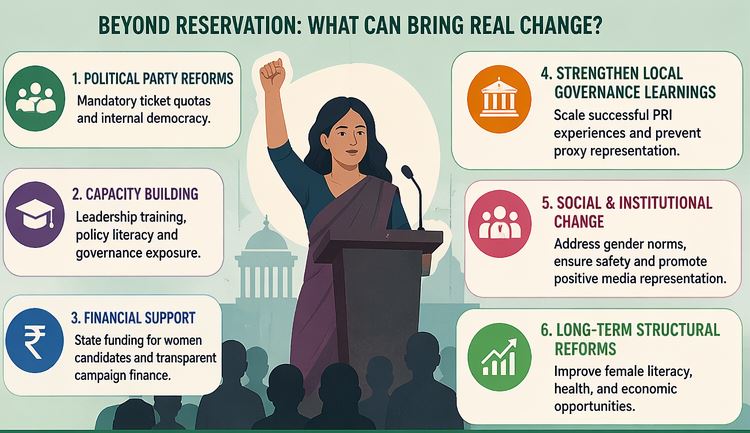
1. Political Party Reforms
- Mandatory ticket quotas within parties
- Internal democracy mechanisms
2. Capacity Building
- Leadership training programs for women
- Policy literacy and governance exposure
3. Financial Support Mechanisms
- State funding for women candidates
- Transparent campaign finance systems
4. Strengthening Local Governance Learnings
- Scale successful PRI experiences: Training, Institutional support
- Prevent proxy representation through: Legal safeguards , Monitoring
5. Social and Institutional Change
- Address gender norms via: Education , Media representation
- Ensure safe political environments
6. Long-Term Structural Reforms
- Improve: Female literacy , Workforce participation (~25% in India)
- Economic empowerment → Political empowerment
Conclusion
Reservation is a necessary but not sufficient condition for enhancing women’s political participation. Without complementary reforms in political structures, social norms, and economic empowerment, it risks becoming a numerical exercise rather than a transformative reform.
Prelims Practice Question:
Q. Consider the following statements regarding women’s political representation in India:
- The Constitution mandates reservation for women in Parliament.
- Political parties are legally required to nominate a fixed percentage of women candidates.
- Reservation in local bodies has led to increased participation but also instances of proxy leadership.
Which of the above is/are correct?
A) 1 and 2 only
B) 3 only
C) 2 and 3 only
D) 1, 2 and 3
Answer: B) 3 only
Mains Practice Question:
Q1 “Women’s reservation in legislatures ensures representation but not necessarily empowerment.” Critically examine. (10 Marks)

- India’s Youth Unemployment and Education Crisis - August 5, 2026
- India’s Sports Infrastructure and the 2036 Olympics Ambition - August 5, 2026
- Critical Minerals: The Foundation of Strategic Power - August 4, 2026

No Comments