


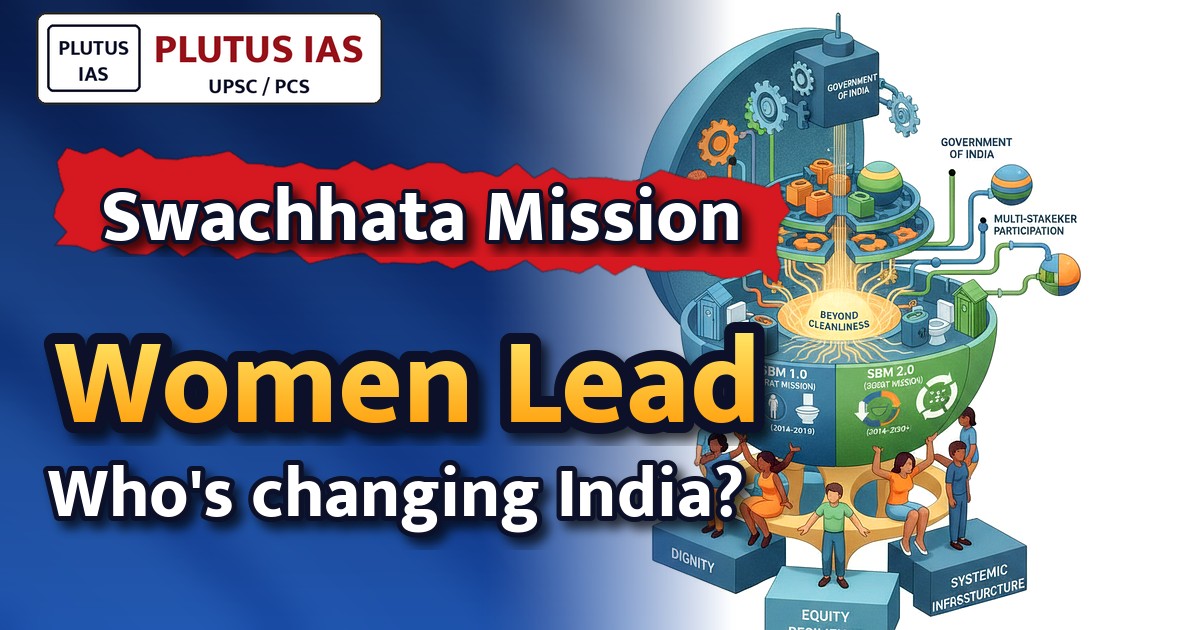
30 Sep Women and Transgender Changemakers in Swachhata Mission
✎ Women and transgender individuals are not just beneficiaries but critical agents of change in India’s sanitation revolution, driving both behavioural transformation and structural reforms in Swachh Bharat Mission through…
Subject Relevance — Where This Topic Fits
- GS Paper II — Governance, Constitution, Polity, Social Justice and International Relations (Role of women and marginalised groups in public service delivery) | GS Paper III — Environment and Ecology (Solid Waste Management, Water Quality and Sanitation) | GS Paper IV — Ethics, Integrity and Aptitude (Role of empathy, social justice and gender sensitivity in public service)
- Prelims: Swachh Bharat Mission (SBM) 2.0, Menstrual Hygiene Management (MHM), Community-Led Total Sanitation (CLTS), Transgender Persons (Protection of Rights) Act, 2019, Mahatma Gandhi National Rural Employment Guarantee Scheme (MGNREGS) convergence in sanitation
- Essay: The role of marginalised communities in nation-building: A case study of sanitation workers and changemakers, Gender, inclusion and sustainable development: Lessons from India’s sanitation revolution
Quick Revision: Women and transgender individuals are not just beneficiaries but critical agents of change in India’s sanitation revolution, driving both behavioural transformation and structural reforms in Swachh Bharat Mission through inclusive governance and community-led models.
Why is this in the news?
The Government of India has highlighted the contributions of women and transgender individuals as ‘changemakers’ in the Swachh Bharat Mission, underscoring their pivotal role not only in behavioural change but also in driving structural improvements in sanitation governance. This recognition aligns with the Mission’s broader objectives of inclusive, participatory, and sustainable sanitation practices, moving beyond mere cleanliness to address dignity, equity, and systemic resilience in public health infrastructure.
Background
- Swachh Bharat Mission (SBM) was launched in 2014 to achieve universal sanitation coverage and eliminate open defecation by 2 October 2019, with a subsequent phase (SBM 2.0) focusing on sustainability, solid and liquid waste management, and behaviour change.
- The Mission operates through a multi-stakeholder framework involving central ministries, state governments, local bodies, NGOs, and community organisations, with a strong emphasis on grassroots participation.
- Women have historically been key stakeholders in sanitation, often acting as primary caregivers and users of household toilets, yet their roles as decision-makers and leaders in sanitation programmes have been under-recognised.
- Transgender persons, particularly in urban areas, face significant barriers in accessing sanitation facilities, including stigma, lack of gender-sensitive infrastructure, and exclusion from mainstream sanitation programmes.
- The National Urban Sanitation Policy (2008) and the National Rural Sanitation Strategy (2019) mandate gender-responsive and inclusive sanitation planning, though implementation gaps persist.
- India’s sanitation workforce, including manual scavengers and sanitation workers, remains one of the most marginalised, necessitating legal protections and social security measures under the Prohibition of Employment as Manual Scavengers and their Rehabilitation Act, 2013.
What is the significance of recognising women and transgender changemakers in Swachh Bharat Mission?
- Gender-responsive sanitation: Women’s participation in SBM is critical for addressing menstrual hygiene, child sanitation practices, and household-level decision-making, ensuring that sanitation policies are responsive to gender-specific needs.
- Inclusive sanitation governance: Transgender individuals, as users and providers of sanitation services, bring unique perspectives on accessibility, safety, and dignity, which are essential for designing gender-neutral and inclusive infrastructure.
- Behavioural and structural change: Women and transgender changemakers act as catalysts for behavioural change by challenging social norms, promoting hygiene education, and advocating for policy reforms in sanitation governance.
- Community-led models: Programmes such as Community-Led Total Sanitation (CLTS) and Swachhagrahis (sanitation volunteers) leverage local leadership, with women and marginalised groups often leading grassroots movements for open defecation-free (ODF) status.
- Legal and policy frameworks: The Transgender Persons (Protection of Rights) Act, 2019, provides the statutory basis for integrating gender and transgender inclusion in sanitation programmes.
- Economic empowerment: Participation in sanitation programmes, such as waste segregation and composting, offers livelihood opportunities for women and transgender individuals, aligning with the Mission’s objectives of sustainability and economic inclusion.
- Monitoring and accountability: Recognising changemakers enhances transparency and accountability in sanitation governance, as their involvement ensures that programmes are demand-driven and responsive to local needs.
- Global commitments: India’s sanitation initiatives align with the Sustainable Development Goals (SDG 6: Clean Water and Sanitation), particularly targets 6.2 (equitable sanitation) and 6.a (international cooperation), where gender and inclusion are central pillars.
Key Features
| Feature | Significance |
|---|---|
| Inclusion of marginalised groups (women, transgender individuals) in sanitation governance | Demonstrates participatory governance in line with constitutional principles of social justice and equality (Article 14, 15, 17). |
| Community-led sanitation initiatives (CLTS) with gender-sensitive design | Enhances effectiveness of Swachh Bharat Mission (SBM) by addressing local needs and cultural barriers to toilet usage. |
| Transgender participation in waste management and sanitation services | Promotes livelihood opportunities and reduces stigma, aligning with the Transgender Persons (Protection of Rights) Act, 2019. |
| Use of wastewater as a resource (greywater recycling, biogas generation) | Supports circular economy principles and aligns with Sustainable Development Goal (SDG) 6: Clean Water and Sanitation. |
| Capacity-building programmes for women sanitation workers | Empowers local communities to sustain sanitation infrastructure beyond external funding cycles. |
Why it Matters
Social
- Advances gender equity by integrating women and transgender persons into sanitation governance, reducing their marginalisation in public service delivery.
- Challenges traditional gender roles by recognising women and transgender individuals as agents of change in community sanitation.
- Promotes inter-sectional inclusion by addressing the sanitation needs of both cisgender women and gender-diverse populations.
Economic
- Creates livelihood opportunities for marginalised groups through sanitation-related employment, contributing to local economic resilience.
- Reduces healthcare costs by preventing waterborne diseases, thereby lowering the economic burden on public health systems.
- Enhances property values and tourism potential in areas with improved sanitation infrastructure.
Environmental
- Facilitates resource recovery from wastewater, reducing pollution and supporting sustainable urban development.
- Contributes to climate resilience by promoting water conservation and reducing the carbon footprint of sanitation systems.
- Supports biodiversity conservation by preventing contamination of natural water bodies.
Governance
- Demonstrates the efficacy of decentralised governance models in achieving national sanitation targets (e.g., ODF+ and ODF++ certifications).
- Strengthens community ownership of sanitation programmes, ensuring long-term sustainability.
- Aligns with the principle of cooperative federalism by empowering local governments (Panchayati Raj Institutions, Urban Local Bodies) in sanitation planning.
Challenges
1. Social Stigma and Discrimination
- Persistent societal stigma against transgender individuals limits their participation in sanitation roles despite legal protections.
- Cultural taboos around menstrual hygiene and open defecation persist in certain communities, requiring targeted behavioural change interventions.
UPSC Link: GS-II: Social Justice
2. Institutional Capacity Gaps
- Limited technical and managerial capacity in local bodies to design gender-sensitive sanitation infrastructure.
- Inadequate funding allocation for maintenance of sanitation facilities post-construction, leading to premature disuse.
UPSC Link: GS-III: Infrastructure
3. Data Disaggregation and Monitoring
- Lack of gender-disaggregated data on sanitation access hampers evidence-based policy formulation.
- Monitoring mechanisms often fail to capture the participation of marginalised groups, undermining accountability.
UPSC Link: GS-II: Governance
4. Climate Vulnerability
- Flood-prone and drought-affected regions face challenges in maintaining sanitation infrastructure due to extreme weather events.
- Wastewater treatment systems are vulnerable to climate-induced disruptions, necessitating resilient design standards.
UPSC Link: GS-III: Environment
5. Economic Disparities
- Low-income households, particularly in rural and peri-urban areas, struggle to afford sanitation solutions despite subsidies.
- Informal settlements lack access to piped water and sewerage, exacerbating sanitation inequities.
UPSC Link: GS-II: Poverty
Challenges — UPSC Perspective
| Issue | Concern |
|---|---|
| Legal and Policy Framework | Implementation gaps between the Transgender Persons (Protection of Rights) Act, 2019, and ground-level inclusion in sanitation programmes. |
| Infrastructure Design | Sanitation facilities often designed without considering the needs of women, persons with disabilities, or transgender individuals. |
| Behavioural Change | Deep-rooted cultural practices (e.g., open defecation in certain communities) resist change despite awareness campaigns. |
| Resource Allocation | Insufficient budgetary provisions for the maintenance and upgrading of sanitation infrastructure. |
| Technology Adoption | Limited adoption of low-cost, gender-inclusive sanitation technologies in rural and remote areas. |
| Monitoring and Evaluation | Absence of gender-sensitive metrics in sanitation programme assessments. |
Government Initiatives — Must-Memorise for Prelims
- Swachh Bharat Mission (SBM) 2.0 (Urban and Rural)
- Menstrual Hygiene Scheme (MHS)
- Jal Jeevan Mission (JJM) – Component for Grey Water Management
- Ayushman Bharat – Health and Wellness Centres (HWCs) – Sanitation-linked primary healthcare services
Way Forward
- Conduct gender and transgender-inclusive audits of sanitation infrastructure to identify gaps in access and usability.
- Integrate transgender persons into sanitation workforce training programmes under NULM to enhance livelihood opportunities.
- Develop low-cost, modular wastewater treatment systems for peri-urban and rural areas to promote resource recovery.
- Strengthen community-led total sanitation (CLTS) approaches with gender-sensitive messaging and participatory design.
- Establish a national-level data repository on sanitation access, disaggregated by gender, caste, disability, and transgender status.
- Expand subsidies for sanitation infrastructure in informal settlements and flood-prone regions to reduce inequities.
- Promote public-private partnerships (PPPs) for the maintenance of sanitation facilities in high-density urban areas.
- Incorporate climate-resilient design standards in sanitation infrastructure to mitigate extreme weather impacts.
UPSC Value Addition
Keywords for Mains Answer-Writing
Swachh Bharat Mission 2.0 · Gender mainstreaming in sanitation · Transgender inclusion in governance · Community-led sanitation · Wastewater management · Fecal sludge management · Menstrual Hygiene Management (MHM) · Sustainable Development Goal 6 (SDG 6) · Participatory governance · Social entrepreneurship in sanitation · Right to Sanitation · Behavior change communication · Inclusive urban planning · Decentralized sanitation systems · Women Self-Help Groups (SHGs) · Transgender rights and welfare
Constitutional & Policy Linkages
- Article 14: Equality before law and equal protection of laws – Ensures non-discrimination in sanitation access.
- Article 15: Prohibition of discrimination on grounds of religion, race, caste, sex, or place of birth – Mandates inclusive sanitation policies.
- Article 17: Abolition of untouchability – Addresses stigma faced by marginalised groups in sanitation roles.
- Article 21: Right to life and personal liberty – Includes the right to a clean and safe environment.
- Article 46: Promotion of educational and economic interests of weaker sections – Supports livelihood opportunities for marginalised groups in sanitation.
Concept Flow
Identification of sanitation gaps → Recognition of marginalised groups (women, transgender persons) as key stakeholders → Design of gender-inclusive sanitation programmes → Implementation via community-led models (CLTS) → Monitoring with gender-disaggregated data → Sustained maintenance through livelihood linkages → Policy feedback loop to address emerging challenges
Prelims Practice Questions
Q1. Consider the following statements regarding the Swachh Bharat Mission 2.0:
1. It is a centrally sponsored scheme with 100% central funding.
2. The mission includes components for wastewater management and fecal sludge management.
3. The mission mandates the inclusion of transgender individuals in sanitation governance.
4. It is aligned with Sustainable Development Goal 6 (Clean Water and Sanitation).
How many of the above statements are correct?
- Only one
- Only two
- Only three
- All four
Answer: Only three — Statements 2 and 4 are correct. Statement 1 is incorrect as SBM 2.0 involves shared funding between the Centre and States. Statement 3 is incorrect as the mission does not explicitly mandate transgender inclusion in governance, though it encourages inclusivity.
Q2. Assertion (A): The Swachh Bharat Mission 2.0 emphasizes community-led sanitation models over top-down approaches.
Reason (R): Community participation ensures sustainability and behavioral change in sanitation practices.
Options:
A. Both A and R are true, and R is the correct explanation of A.
B. Both A and R are true, but R is not the correct explanation of A.
C. A is true, but R is false.
D. A is false, but R is true.
Answer: ? — Both A and R are true, and R correctly explains A. Community-led models are central to SBM 2.0 to ensure ownership and long-term impact.
Q3. Match the following sanitation initiatives with their respective objectives:
Column I (Initiative)
A. Swachh Bharat Mission 2.0
B. Jal Jeevan Mission
C. Namami Gange Programme
D. Solid Waste Management Rules, 2016
Column II (Objective)
1. Provision of piped water supply to all rural households
2. Comprehensive sanitation coverage including wastewater management
3. Rejuvenation of the Ganga river basin
4. Regulation of solid waste management in urban areas
Select the correct match:
- A-2, B-1, C-3, D-4
- A-1, B-2, C-3, D-4
- A-4, B-1, C-2, D-3
- A-3, B-2, C-1, D-4
Answer: A-2, B-1, C-3, D-4 — Correct match: A-2 (SBM 2.0 focuses on comprehensive sanitation including wastewater), B-1 (Jal Jeevan Mission aims at piped water supply), C-3 (Namami Gange targets Ganga rejuvenation), D-4 (Solid Waste Management Rules regulate urban solid waste).
Mains Practice Question
✍ The Swachh Bharat Mission 2.0 has expanded its scope beyond mere cleanliness to include wastewater management, menstrual hygiene, and inclusive governance. Critically examine the extent to which these expansions address the structural challenges of sanitation in India, particularly for marginalized groups such as transgender individuals and women in urban informal settlements. (15 Marks)
Approach: MODEL-ANSWER SKELETON:
1. **Introduction (2 marks)**: Define Swachh Bharat Mission 2.0 and its objectives, highlighting the shift from ODF (Open Defecation Free) to ODF+ and ODF++. Mention the inclusion of wastewater management, fecal sludge management, and menstrual hygiene under its ambit.
2. **Structural Challenges in Sanitation (3 marks)**:
– Highlight the urban-rural divide in sanitation infrastructure.
– Discuss the lack of access to safe sanitation in informal settlements and slums.
– Address the specific vulnerabilities of transgender individuals and women in sanitation governance.
– Cite data from the National Family Health Survey (NFHS-5) or other credible sources on sanitation access.
3. **Expansion of SBM 2.0 (4 marks)**:
– Wastewater and fecal sludge management: Discuss the inclusion of decentralized systems (e.g., STPs, FSTPs) and their role in urban sanitation.
– Menstrual Hygiene Management (MHM): Link to the provision of sanitary napkin vending machines, incinerators, and awareness campaigns under SBM 2.0.
– Inclusive governance: Examine the role of women Self-Help Groups (SHGs) and transgender inclusion in sanitation planning and implementation. Reference the ‘Swachhagrahis’ model and its gender dynamics.
4. **Critical Analysis (4 marks)**:
– **Strengths**: Evaluate the potential of SBM 2.0 to address structural gaps through community participation, technological innovations (e.g., IoT-based monitoring of STPs), and multi-sectoral convergence (e.g., with Jal Jeevan Mission).
– **Limitations**: Discuss challenges such as inadequate funding, lack of skilled manpower for fecal sludge management, cultural barriers in menstrual hygiene, and systemic exclusion of transgender individuals in governance. Reference the Transgender Persons (Protection of Rights) Act, 2019 and its implementation gaps.
– **Comparative Perspective**: Contrast India’s approach with global models (e.g., Bangladesh’s community-led total sanitation or South Africa’s inclusive sanitation policies).
5. **Way Forward (2 marks)**:
– Suggest measures such as strengthening decentralized governance, leveraging technology for real-time monitoring, and ensuring intersectional inclusion in policy design.
– Highlight the need for convergence with other schemes (e.g., AMRUT 2.0, Jal Jeevan Mission) and robust data systems to track progress.
**Balanced View**: The answer must weigh the progress made by SBM 2.0 against the persistent structural inequities, emphasizing the need for sustained political will, financial allocation, and community ownership.
Source: PIB (Press Information Bureau)
Generated by AanyaAi for educational purpose.
Related guides on our sites
- Best sociology optional coaching
- Best coaching for sociology optional
- Best sociology optional coaching online
- is sociology good optional

- Women and Transgender Changemakers in Swachhata Mission - September 30, 2026
- चुनाव आयोग ने फॉर्म-6 से SIR घोषणा हटाई: UPSC-PCS के लिए महत्वपूर्ण बदलाव - September 30, 2026
- झारखंड डीजीपी नियुक्ति: सुप्रीम कोर्ट 9 अक्टूबर को सुनवाई, राज्य सरकार से जवाब तलब - September 30, 2026

No Comments