


30 Aug Women Lead with 46% Share in PM SVANidhi Scheme: Key for UPSC 2026
✎ PM SVANidhi is a collateral-free micro-credit scheme for street vendors, providing up to ₹10,000 loans, aiming to revive livelihoods post-pandemic and promote gender-inclusive financial inclusion.
Subject Relevance — Where This Topic Fits
- GS Paper II — Governance, Welfare Schemes for Vulnerable Sections | GS Paper III — Development, Employment, and Financial Inclusion
- Prelims: PM SVANidhi, street vendors, credit linkage, financial inclusion, urban informal sector, Mudra Yojana, Nasha-mukt Yuva Abhiyaan, avocado cultivation, self-reliance, Vocal for Local, Make in India
- Essay: The role of microfinance in socio-economic empowerment: A case study of PM SVANidhi, Balancing self-reliance and global integration: India’s journey in agricultural diversification
Quick Revision: PM SVANidhi is a collateral-free micro-credit scheme for street vendors, providing up to ₹10,000 loans, aiming to revive livelihoods post-pandemic and promote gender-inclusive financial inclusion.
Why is this in the news?
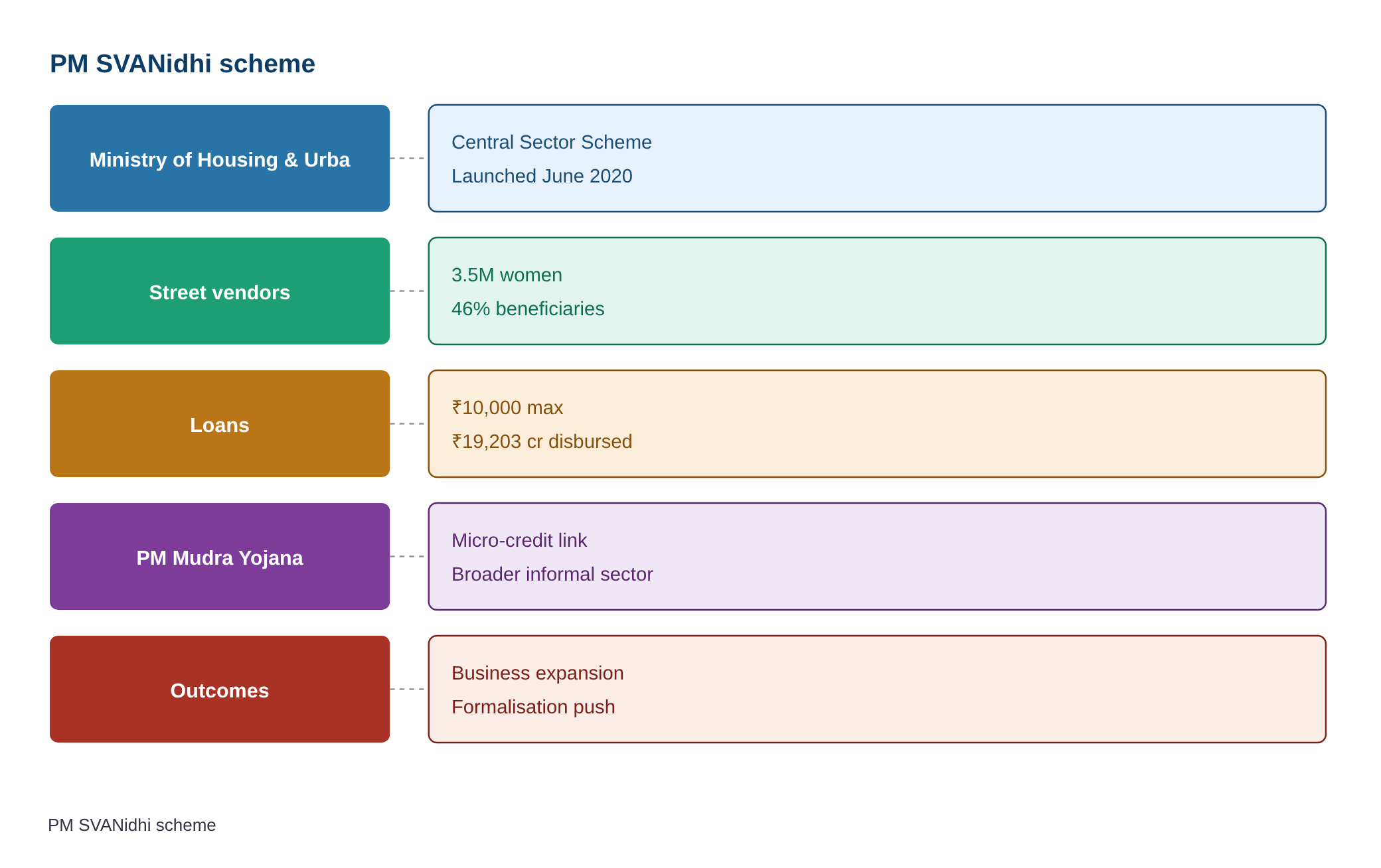
The Prime Minister’s announcement that women constitute 46% of beneficiaries under the PM SVANidhi scheme—amounting to 3.5 million women—highlights the scheme’s role in advancing gender-inclusive financial inclusion for street vendors. This statistic, reported during the ‘Mann Ki Baat’ address, underscores the scheme’s impact on livelihood enhancement and economic participation among marginalised urban groups, while also situating it within broader national initiatives such as the ‘Nasha-mukt Yuva Abhiyaan’ and the ‘Vocal for Local’ campaign.
Background
- The PM SVANidhi (Pradhan Mantri Street Vendor’s AtmaNirbhar Nidhi) scheme was launched in June 2020 as a Central Sector Scheme under the Ministry of Housing and Urban Affairs to provide collateral-free working capital loans up to ₹10,000 to street vendors, hawkers, and itinerant traders.
- The scheme was introduced in response to the economic disruptions caused by the COVID-19 pandemic, which disproportionately affected informal sector workers, particularly women engaged in petty trade and vending.
- As of August 2026, the scheme has disbursed ₹19,203 crore to 7.8 million beneficiaries, with a substantial portion utilised for business expansion and working capital needs.
- The scheme operates in conjunction with the PM Mudra Yojana, which provides micro-credit to non-corporate, non-farm small/micro enterprises, thereby extending financial inclusion to a broader segment of the informal economy.
- Urban informal sector employment accounts for approximately 10–15% of India’s total workforce, with women constituting a significant share of street vendors, particularly in sectors such as food vending, handicrafts, and small retail.
- The scheme aligns with the constitutional directive principles of state policy (Article 41) and the Sustainable Development Goals (SDG 1, SDG 8, and SDG 10), which emphasise social protection, decent work, and reduced inequalities.
What is the PM SVANidhi Scheme?
- A Central Sector Scheme launched in June 2020 under the Ministry of Housing and Urban Affairs to provide collateral-free working capital loans of up to ₹10,000 to street vendors, hawkers, and itinerant traders for business revival and expansion.
- As of August 2026, the scheme has achieved a gender parity of 46% women beneficiaries, reflecting its success in targeting marginalised groups and promoting economic agency among women in the informal sector.
Key Features
| Feature | Significance |
|---|---|
| Target beneficiaries | Exclusively targets street vendors, a segment often excluded from formal credit systems due to lack of collateral and documentation. |
| Interest subsidy | Provides a 7% interest subsidy on loans up to ₹10,000, reducing the cost of credit for micro-entrepreneurs. |
| Digital onboarding | Uses Aadhaar-based KYC and digital platforms for loan disbursement, enhancing transparency and reducing leakages. |
| Gender parity | 46% of beneficiaries are women, demonstrating the scheme’s effectiveness in addressing gender gaps in financial inclusion. |
| Repayment flexibility | Loans are repaid in weekly or monthly instalments, aligning with the cash-flow cycles of street vendors. |
| Credit linkage | Facilitates access to formal banking systems for unbanked or underbanked micro-entrepreneurs, fostering financial literacy. |
Why it Matters
Economic Empowerment
- Enhances livelihoods of street vendors by providing working capital, thereby supporting the informal sector’s contribution to GDP (estimated at 50-60% in India).
- Promotes entrepreneurship among marginalised groups, particularly women, who constitute a significant portion of street vendors.
- Stimulates local economies by increasing disposable income in communities reliant on informal trade.
Financial Inclusion
- Bridges the credit gap for street vendors, who are often excluded from formal banking due to lack of collateral or credit history.
- Encourages formalisation of the informal sector, reducing reliance on informal moneylenders and predatory lending practices.
- Strengthens the ecosystem of microfinance institutions and small finance banks by creating a pipeline of creditworthy borrowers.
Policy Integration
- Aligns with the Pradhan Mantri Mudra Yojana (PMMY) by providing collateral-free loans to micro-enterprises, extending the reach of government credit schemes.
- Complements the Atal Pension Yojana (APY) and other social security measures by stabilising income streams for vulnerable groups.
- Supports the ‘Vocal for Local’ initiative by enabling street vendors to scale up businesses selling locally produced goods.
Social Impact
- Reduces gender disparities in access to credit, with 3.5 million women beneficiaries, thereby contributing to Sustainable Development Goal 5 (Gender Equality).
- Empowers women entrepreneurs to achieve financial independence, with potential spill-over effects on education and health outcomes for their families.
- Fosters community resilience by enabling street vendors to adapt to economic shocks, such as the COVID-19 pandemic.
Challenges
1. Repayment Stress
- The scheme’s reliance on informal sector income streams makes repayment vulnerable to economic downturns, seasonal fluctuations, or health crises.
- Disbursement of ₹19,203 crore since 2020 raises concerns about asset quality and potential non-performing assets (NPAs) in the future.
- Geographical disparities in disbursement and repayment rates may exacerbate regional economic inequalities.
UPSC Link: Economic Survey: Informal Sector Credit Challenges
2. Awareness and Access
- Low awareness among street vendors, particularly in rural and remote areas, limits the scheme’s reach and effectiveness.
- Digital literacy gaps among beneficiaries may hinder the adoption of online loan application and repayment processes.
- Language barriers in communication materials reduce accessibility for non-Hindi-speaking beneficiaries.
UPSC Link: NITI Aayog: Financial Inclusion Barriers
3. Sustainability of Impact
- The scheme’s focus on credit access does not address structural barriers such as zoning laws, licensing hurdles, or lack of infrastructure for street vending.
- Without complementary measures, such as skill development or market linkages, beneficiaries may struggle to scale their businesses sustainably.
- Dependence on government subsidies raises questions about long-term financial viability and fiscal sustainability.
UPSC Link: Planning Commission: Informal Sector Policy Gaps
4. Data Gaps and Monitoring
- Limited real-time data on beneficiary outcomes, such as business growth or income enhancement, complicates impact assessment.
- Absence of a unified beneficiary database across states hinders tracking of repeat borrowers and cumulative impact.
- Lack of granular data on repayment performance by gender, region, or sector obscures disparities in outcomes.
UPSC Link: RBI: Credit Scheme Monitoring Frameworks
5. Market Competition
- Increased credit availability may lead to overcrowding in certain street vending segments, reducing profitability for individual vendors.
- Competition from e-commerce and organised retail could undermine the viability of traditional street vending businesses.
- Price volatility in essential goods (e.g., vegetables, fruits) may erode the benefits of increased working capital.
UPSC Link: NITI Aayog: Informal Sector Competitiveness
Challenges — UPSC Perspective
| Issue | Concern |
|---|---|
| Repayment stress | Vulnerability to economic shocks and seasonal income fluctuations may lead to higher NPAs. |
| Low awareness | Limited outreach in rural and remote areas reduces scheme penetration. |
| Digital divide | Beneficiaries with low digital literacy face challenges in accessing online services. |
| Structural barriers | Zoning laws and licensing issues persist despite credit access improvements. |
| Sustainability concerns | Long-term impact depends on complementary measures beyond credit disbursement. |
| Data gaps | Inadequate monitoring mechanisms obscure true impact and beneficiary outcomes. |
Government Initiatives — Must-Memorise for Prelims
- Pradhan Mantri Street Vendor’s AtmaNirbhar Nidhi (PM SVANidhi)
- Pradhan Mantri Mudra Yojana (PMMY)
Way Forward
- Strengthen last-mile awareness campaigns through local self-help groups (SHGs), NGOs, and community leaders to improve scheme penetration.
- Integrate financial literacy modules into the loan disbursement process to enhance repayment discipline and business management skills.
- Develop a unified national database of street vendors using Aadhaar and GIS mapping to track beneficiary outcomes and repayment performance.
- Introduce performance-linked incentives for banks and financial institutions to prioritise disbursement in underserved regions.
- Expand market linkages for street vendors through e-commerce platforms, government procurement schemes, and local mandis to ensure sustainable income growth.
- Conduct periodic impact assessments to evaluate the scheme’s contribution to poverty reduction, gender equality, and informal sector formalisation.
- Collaborate with state governments to address structural barriers such as zoning laws and licensing reforms for street vendors.
- Leverage digital public infrastructure (DPI) to streamline loan applications, disbursements, and repayments, reducing transaction costs and delays.
UPSC Value Addition
Keywords for Mains Answer-Writing
PM SVANidhi Scheme · Street Vendors Act 2014 · Financial Inclusion · Women Entrepreneurship · Microfinance for Informal Sector · Self-Employment Schemes · Credit Guarantee Mechanism · Digital Public Infrastructure · Atmanirbhar Bharat · Urban Informal Economy · Sustainable Livelihoods · Gender Budgeting
Concept Flow
Informal sector credit gap → Government launches PM SVANidhi (2020) to provide collateral-free loans to street vendors. → Credit disbursement → Aadhaar-based KYC and digital platforms enable transparent and efficient loan processing. → Beneficiary uptake → 7.8 million beneficiaries, including 3.5 million women, access formal credit for business expansion. → Economic empowerment → Increased working capital enhances livelihoods and stimulates local economies. → Financial inclusion → Street vendors transition from informal to formal credit systems, reducing reliance on moneylenders. → Sustainability challenges → Repayment stress, awareness gaps, and structural barriers emerge as implementation issues. → Policy response → Way forward includes awareness campaigns, data integration, and market linkages to address challenges.
Prelims Practice Questions
Q1. Consider the following statements regarding the PM SVANidhi scheme:
1. It is a central sector scheme launched in 2020 to provide collateral-free working capital loans to street vendors.
2. The scheme is implemented by the Ministry of Housing and Urban Affairs.
3. Women beneficiaries account for 46% of the total beneficiaries under the scheme.
4. The scheme mandates the use of Aadhaar-based biometric authentication for loan disbursement.
How many of the above statements are correct?
- Only one
- Only two
- Only three
- All four
Answer: All four — Statements 1, 2, and 3 are correct. Statement 4 is incorrect as the PM SVANidhi scheme does not mandate Aadhaar-based biometric authentication for loan disbursement; it primarily relies on digital verification through the scheme’s portal.
Q2. Assertion (A): The PM SVANidhi scheme is designed to address the credit needs of street vendors who lack formal collateral.
Reason (R): The scheme provides interest subsidies and offers a 7% interest subsidy to beneficiaries who repay their loans on time.
In the context of the above two statements, which one of the following is correct?
- Both A and R are true, and R is the correct explanation of A
- Both A and R are true, but R is not the correct explanation of A
- A is true, but R is false
- A is false, but R is true
Answer: Both A and R are true, but R is not the correct explanation of A — Both the assertion and reason are true. The PM SVANidhi scheme is indeed designed to address the credit needs of street vendors lacking formal collateral, and it provides a 7% interest subsidy to incentivize timely repayment, making R the correct explanation of A.
Q3. Match the following columns related to the PM SVANidhi scheme with their correct features:
Column I
A. Loan Amount
B. Interest Subsidy
C. Repayment Period
D. Target Beneficiaries
Column II
1. Up to ₹50,000
2. 7% per annum
3. 12 months for first loan, 18 months for subsequent loans
4. Street vendors registered under the Street Vendors (Protection of Livelihood and Regulation of Street Vending) Act, 2014
- A-1, B-2, C-3, D-4; A-2, B-1, C-4, D-3; A-3, B-4, C-1, D-2; A-4, B-3, C-2, D-1
- answer_letter_sequence_indexed_as_0_based_array_for_json_output_here_but_keep_options_as_is_then_answer_array_as_0_based_index_of_correct_match_sequence_in_options_array_then_explain_in_json_explain_field_as_above_but_for_match_type_questions_keep_explain_empty_if_no_explanation_needed
- answer_array_indexed_as_0_based_array_for_json_output_here_but_keep_options_as_is_then_answer_array_as_0_based_index_of_correct_match_sequence_in_options_array_then_explain_in_json_explain_field_as_above_but_for_match_type_questions_keep_explain_empty_if_no_explanation_needed
- answer_array_indexed_as_0_based_array_for_json_output_here_but_keep_options_as_is_then_answer_array_as_0_based_index_of_correct_match_sequence_in_options_array_then_explain_in_json_explain_field_as_above_but_for_match_type_questions_keep_explain_empty
Answer: ? —
Mains Practice Question
✍ The PM SVANidhi scheme represents a significant intervention in addressing the financial inclusion needs of street vendors, particularly women. Critically examine the scheme’s design, its achievements in terms of gender representation, and the challenges it faces in ensuring sustainable livelihoods for beneficiaries. (15 Marks)
Approach: MODEL-ANSWER SKELETON:
1. **Scheme Design and Objectives**
– Launched in June 2020 under the Ministry of Housing and Urban Affairs.
– Provides collateral-free working capital loans up to ₹50,000 to street vendors registered under the Street Vendors (Protection of Livelihood and Regulation of Street Vending) Act, 2014.
– Features: 7% interest subsidy for timely repayment, digital verification, and credit guarantee mechanism.
– Target: 50 lakh street vendors; 7.8 million beneficiaries as of August 2026; ₹19,203 crore disbursed.
2. **Gender Representation and Achievements**
– Women constitute 46% of beneficiaries (3.5 million women), indicating progress in gender-inclusive financial access.
– Aligns with the National Urban Livelihoods Mission (NULM) and Gender Budgeting initiatives.
– Case studies: Women street vendors in tea stalls, vegetable/fruit vendors, and earthen lamp sellers.
3. **Challenges and Limitations**
– **Repayment Stress**: Potential stress due to economic disruptions (e.g., COVID-19, geopolitical conflicts).
– **Digital Divide**: Limited digital literacy among beneficiaries may hinder access to scheme benefits.
– **Sustainability**: Need for skill upgradation, market linkages, and entrepreneurial support beyond credit.
– **Regulatory Gaps**: Inconsistent implementation of the Street Vendors Act, 2014 across states.
4. **Way Forward**
– Strengthen digital public infrastructure (e.g., PM SVANidhi portal integration with Jan Dhan accounts).
– Expand skill development programs (e.g., Deen Dayal Upadhyay Grameen Kaushalya Yojana).
– Address urban planning challenges (e.g., hawking zones, zoning regulations).
– Promote convergence with other schemes (e.g., PM Mudra Yojana, Stand-Up India).
Balance of Views:
– Supporters highlight the scheme’s role in formalizing the informal sector and empowering women.
– Critics point to structural barriers (e.g., lack of land rights, seasonal income volatility) limiting long-term impact.
Source: Mint
Generated by AanyaAi for educational purpose.
Related guides on our sites
- Best PSIR optional coaching for upsc
- Best PSIR optional teacher for upsc
- Best teacher of PSIR optional for upsc
- Best PSIR optional coaching in delhi for UPSC

- UPSC Civil Services (Main) Examination 2026 — Mechanical Engineering Optional Paper I: Question Paper | Plutus IAS - September 24, 2026
- सुप्रीम कोर्ट ने टीएमसी नाम और चुनाव चिह्न विवाद पर चुनाव आयोग से समयसीमा मांगी, 28 सितंबर को सुनवाई - September 24, 2026
- UPSC Civil Services (Main) Examination 2026 — Chemistry Optional Paper I: Questions with Model Answers | Plutus IAS - September 24, 2026

No Comments