


09 Aug Women’s Role in Judiciary: Why Gender Diversity Matters for UPSC/PCS
✎ The judiciary must integrate women’s perspectives across all legal domains—not as a token gesture but as a constitutional imperative—to ensure justice that is equitable, comprehensive, and reflective of societal diversity.
Subject Relevance — Where This Topic Fits
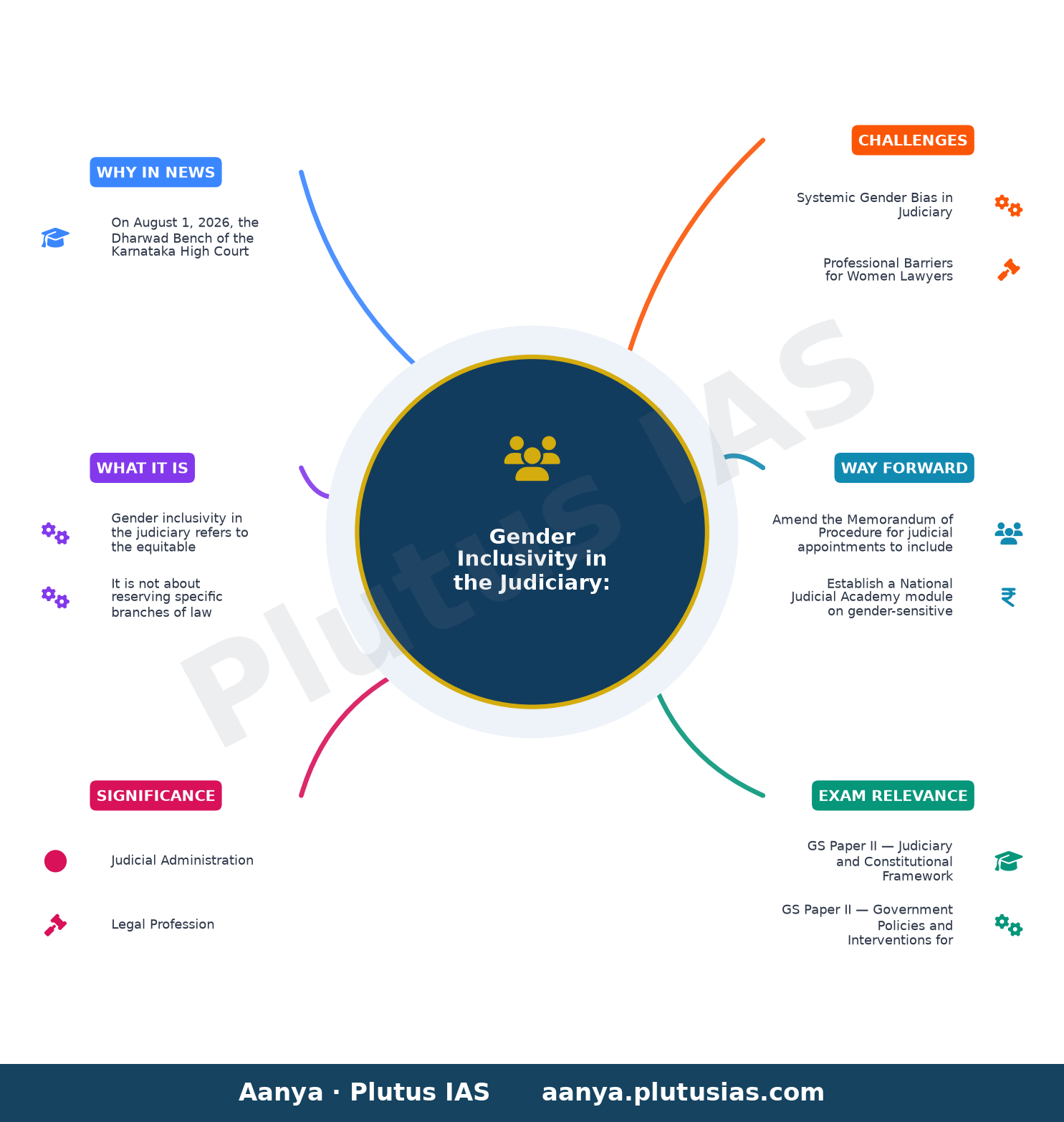
- GS Paper II — Judiciary and Constitutional Framework | GS Paper II — Government Policies and Interventions for Development in various Sectors
- Prelims: Judicial appointments, Collegium System, Gender Representation in Judiciary, All-Women Benches, POCSO Act, Advocate General’s Office
- Essay: Gender Justice and Judicial Reform: Bridging the Representation Gap, The Role of Women in Strengthening Democratic Institutions
Quick Revision: The judiciary must integrate women’s perspectives across all legal domains—not as a token gesture but as a constitutional imperative—to ensure justice that is equitable, comprehensive, and reflective of societal diversity.
Why is this in the news?
On August 1, 2026, the Dharwad Bench of the Karnataka High Court witnessed a historic milestone where all judicial benches were presided over exclusively by women judges, and the State was represented by an all-women team of law officers. This event, coupled with statements by High Court judges Anu Sivaraman, P.S. Hemalekha, and S. Sunil Dutt Yadav, underscores the ongoing discourse on gender inclusivity in the judiciary and the necessity of integrating women’s perspectives across all legal domains to enhance judicial equity and comprehensiveness.
Background
- The collegium system, while ensuring judicial independence, has faced criticism for its lack of transparency and underrepresentation of women in higher judiciary.
- The Constitution of India guarantees equality under Articles 14, 15, and 16, but practical implementation in judicial appointments remains uneven.
- Landmark judgments such as *Vishaka Guidelines* (1997) and *The Secretary, Ministry of Defence v. Babita Puniya* (2020) have emphasized the need for gender-sensitive judicial processes and equal opportunities in the armed forces, respectively.
- The Protection of Children from Sexual Offences (POCSO) Act, 2012, necessitates gender-sensitive adjudication due to the prevalence of sexual offenses against women and children.
- Global benchmarks, such as the UN Sustainable Development Goal 5 (Gender Equality), encourage nations to achieve gender parity in public institutions, including the judiciary.
What is Gender Inclusivity in the Judiciary?
- Gender inclusivity in the judiciary refers to the equitable representation and participation of women across all levels and branches of the legal system, ensuring their perspectives are integrated into judicial decision-making.
- It is not about reserving specific branches of law exclusively for women but about dismantling systemic biases that limit women’s access to judicial roles and influence in legal proceedings.
- Women’s participation in the judiciary enhances the quality of justice by incorporating diverse viewpoints, particularly in cases involving gender-based violence, family disputes, and child welfare, where women’s experiences are critical.
- The judiciary, as a constitutional pillar, must reflect the diversity of society to uphold the principles of equality and justice enshrined in the Constitution.
- Studies indicate that gender-diverse judicial benches are more likely to deliver verdicts that are sensitive to the nuances of gender-based discrimination and violence.
- The presence of women judges in higher judiciary serves as an inspiration for younger women to pursue legal careers, thereby fostering long-term systemic change.
- Institutional mechanisms such as the *Memorandum of Procedure (MoP)* for judicial appointments can be revised to include gender-sensitive criteria and timelines for increasing women’s representation.
- Judicial training programs should incorporate modules on gender sensitivity to ensure that all judges, regardless of gender, are equipped to adjudicate cases with an inclusive perspective.
Key Features
| Feature | Significance |
|---|---|
| All-women judicial benches at Dharwad Bench | Demonstrates the judiciary’s capacity to function with gender-inclusive adjudication, setting a precedent for institutional inclusivity. |
| Exclusive representation by women law officers | Highlights systemic support for women professionals in legal advocacy, reinforcing gender parity in courtroom representation. |
| Justice Anu Sivaraman’s statement on women’s perspectives | Emphasises the necessity of gender-sensitive adjudication across all legal domains, not just family or POCSO cases. |
| Judicial assertion of gender-neutral professionalism | Rejects the notion of women as inferior professionals, aligning with constitutional principles of equality (Article 14). |
Why it Matters
Judicial Administration
- Institutionalises gender diversity in adjudication, enhancing the legitimacy and fairness of judicial processes.
- Challenges traditional gender biases in legal institutions, fostering a more inclusive professional environment.
- Demonstrates the judiciary’s adaptability to progressive reforms, aligning with constitutional mandates of equality.
Legal Profession
- Validates the competence of women lawyers in diverse legal domains, countering systemic underrepresentation.
- Encourages law schools and bar councils to promote gender parity in legal education and practice.
- Sets a benchmark for other constitutional courts to adopt gender-inclusive practices.
Societal Impact
- Reinforces the principle that gender diversity in institutions strengthens democratic governance.
- Inspires young women to pursue legal careers, particularly in litigation and judicial roles.
- Contributes to the evolution of jurisprudence by incorporating intersectional perspectives.
Challenges
1. Systemic Gender Bias in Judiciary
- Historical underrepresentation of women in higher judiciary (e.g., Supreme Court bench strength).
- Cultural stereotypes that associate women primarily with family law or social justice cases.
- Lack of institutional mechanisms to ensure sustained gender diversity in appointments.
UPSC Link: GS-II: Judiciary – Gender Representation
2. Professional Barriers for Women Lawyers
- Glass ceiling in senior roles, including designation as Senior Advocates or judicial appointments.
- Work-life balance challenges in litigation-heavy roles, deterring long-term career commitment.
- Subtle discrimination in case allocation and mentorship opportunities.
UPSC Link: GS-II: Legal Profession – Gender Disparities
3. Institutional Resistance to Reform
- Conservative attitudes within legal fraternity resisting gender-inclusive practices.
- Lack of data-driven policies to track and address gender gaps in judicial and legal roles.
- Ad hoc measures (e.g., one-off all-women benches) without structural reforms.
UPSC Link: GS-II: Judicial Reforms – Gender Inclusivity
Challenges — UPSC Perspective
| Issue | Concern |
|---|---|
| Low representation in higher judiciary | Only 11% of Supreme Court judges are women as of 2026. |
| Gendered case allocation | Women lawyers often steered towards family law or pro bono cases. |
| Lack of mentorship networks | Fewer women in senior roles to guide junior lawyers. |
| Workplace culture | Hostile environments in courts and chambers discouraging retention. |
| Appointment biases | Subjective criteria in judicial appointments favouring male candidates. |
Way Forward
- Amend the Memorandum of Procedure for judicial appointments to include gender diversity benchmarks.
- Establish a National Judicial Academy module on gender-sensitive adjudication for judges and lawyers.
- Mandate gender parity in case allocation and senior designation processes.
- Create fast-track appointment committees for women lawyers to higher judiciary.
- Launch mentorship programmes pairing women lawyers with senior advocates and judges.
- Conduct annual gender audits of judicial institutions to track progress.
- Expand all-women bench initiatives to High Courts and district judiciary on a rotational basis.
UPSC Value Addition
Keywords for Mains Answer-Writing
Gender representation in judiciary · Women judges in Indian courts · Judicial diversity and inclusivity · Protection of Children from Sexual Offences (POCSO) Act · Judicial appointments and gender parity · Constitutional courts and gender sensitivity · Legal profession gender equality · Judicial benches and gender composition · Article 14 of the Constitution of India · Judicial accountability and inclusivity · All-women benches in constitutional courts · Gender-neutral professionalism in judiciary
Constitutional & Policy Linkages
- Article 14: Equality before law and equal protection of laws.
- Article 15(3): Special provisions for women.
- Article 39(a): Equal justice and free legal aid.
- Article 51A(e): Fundamental duty to renounce practices derogatory to women.
Concept Flow
Underrepresentation of women in judiciary → Gender bias in legal profession → Systemic exclusion from adjudication → Need for institutional reform → All-women bench initiative → Validation of competence → Reinforcement of constitutional principles → Long-term gender parity in judiciary.
Prelims Practice Questions
Q1. Consider the following statements regarding the representation of women in the Indian judiciary:
1. The Constitution of India explicitly mandates reservation for women in the higher judiciary.
2. The recent initiative of all-women benches in the Karnataka High Court’s Dharwad Bench is unprecedented.
3. The Protection of Children from Sexual Offences (POCSO) Act, 2012, mandates that a woman judge must preside over all cases involving child victims.
How many of the above statements are correct?
- Only one
- Only two
- All three
- None
Answer: Only two — Statement 1 is incorrect: The Constitution does not mandate reservation for women in the higher judiciary. Statement 2 is correct: The all-women benches at the Karnataka High Court’s Dharwad Bench are a rare and unprecedented milestone. Statement 3 is incorrect: The POCSO Act does not mandate that a woman judge must preside over all cases involving child victims.
Q2. Assertion (A): The Indian judiciary has achieved near-parity in gender representation across all branches of law.
Reason (R): The recent constitution of all-women benches in the Karnataka High Court signifies that women judges are equally capable of adjudicating all categories of cases.
Options:
A. Both A and R are true, and R is the correct explanation of A.
B. Both A and R are true, but R is not the correct explanation of A.
C. A is true, but R is false.
D. A is false, but R is true.
Answer: ? — Assertion (A) is false: The Indian judiciary has not achieved near-parity in gender representation across all branches of law. Reason (R) is true: The constitution of all-women benches demonstrates the capability of women judges to adjudicate all categories of cases, but it does not imply overall parity.
Q3. Match the following provisions/acts with their respective objectives:
Column I
1. Article 14 of the Constitution of India
2. Protection of Children from Sexual Offences (POCSO) Act, 2012
3. The Code of Criminal Procedure, 1973
Column II
A. Ensures equality before law and equal protection of laws
B. Provides a child-friendly system for the trial of offences against children
C. Governs the procedure for the investigation and trial of criminal offences
Options:
A. 1-A, 2-B, 3-C
B. 1-B, 2-A, 3-C
C. 1-C, 2-A, 3-B
D. 1-A, 2-C, 3-B
- A
- B
- C
- D
Answer: A — Article 14 ensures equality before law and equal protection of laws. The POCSO Act provides a child-friendly system for the trial of offences against children. The Code of Criminal Procedure, 1973 governs the procedure for the investigation and trial of criminal offences.
Mains Practice Question
✍ Critically examine the proposition that ‘a judiciary becomes more comprehensive, equitable and just only when women’s perspectives are reflected across every field of law.’ Substantiate your arguments with reference to constitutional provisions, judicial precedents, and contemporary initiatives in the Indian judiciary. (15 Marks)
Approach: MODEL-ANSWER SKELETON:
1. Introduction (2 lines): Define judicial diversity and its constitutional foundation (Article 14, 15(3), 16, 39A).
2. Arguments in favour (6 lines):
– Women’s perspectives enhance fairness in family disputes, POCSO cases, and service matters (cite Justice Anu Sivaraman’s remarks).
– Judicial diversity reduces gender bias and improves public trust (reference to studies like ‘Gender and the Judiciary’ by UN Women).
– All-women benches at Karnataka High Court’s Dharwad Bench as a contemporary example.
– Article 51A(e) (fundamental duty to renounce practices derogatory to women).
3. Counter-arguments/limitations (4 lines):
– Lack of explicit constitutional mandate for gender representation in higher judiciary.
– Structural barriers: collegium system, lack of transparency in appointments (cite Second and Third Judges Cases).
– Tokenism vs. substantive inclusion (reference to Justice Indu Malhotra’s observations on gender bias in appointments).
4. Judicial precedents (3 lines):
– Supreme Court’s emphasis on gender sensitivity in cases like *Vishaka Guidelines* (1997) and *Independent Thought v. Union of India* (2017).
– High Court judgments on gender-inclusive adjudication (e.g., *Himachal Pradesh High Court’s all-women benches*).
5. Conclusion (2 lines): Balance between constitutional ideals and ground realities; suggest measures like gender-sensitive training for judges and transparent appointment processes.
Source: The Hindu
Generated by AanyaAi for educational purpose.

- वस्त्र मंत्रालय ने शुरू किया ‘स्वच्छता ही सेवा 2026’ अभियान: जाने प्रमुख पहल - September 24, 2026
- Swachhata Hi Seva 2026: Textile Ministry’s Nationwide Cleanliness & Green Initiatives - September 24, 2026
- आरबीआई ने क्लेम एक्सिवा फाइनेंस पर लगाया 2.70 लाख रुपये का जुर्माना - September 24, 2026

No Comments