


17 Oct World Food Day 2025: Building a Nourished and Sustainable Nation
This article covers “Daily Current Affairs” and the Topic World Food Day 2025: Building a Nourished and Sustainable Nation
SYLLABUS MAPPING:
GS- 2- Welfare Schemes and Nutrition- World Food Day 2025: Building a Nourished and Sustainable Nation
FOR PRELIMS
What are the key objectives and recent reforms under the National Food Security & Nutrition Mission (NFSNM)?
FOR MAINS
What challenges does India face in achieving sustainable food security, and what steps can be taken to overcome them?
Why in the News?
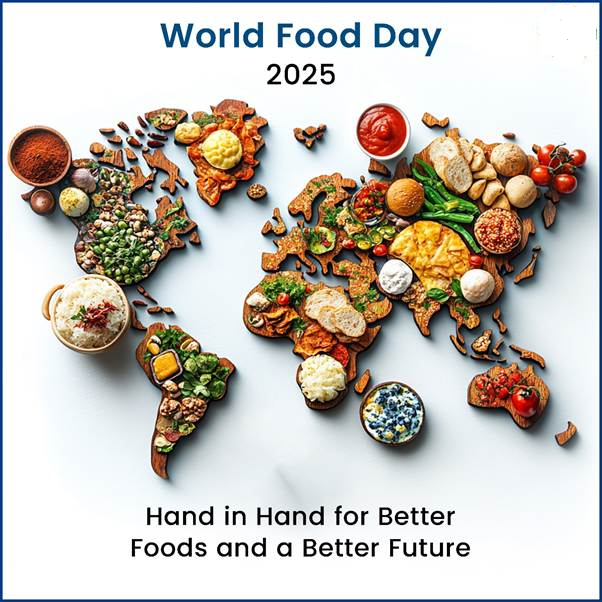
World Food Day, observed globally on 16 October each year, marks a collective commitment to ensuring food security, nutrition, and sustainable agriculture. It serves as a powerful reminder of the persistent global challenge of hunger and malnutrition, despite significant advances in food production. Food is the foundation of life—essential for health, growth, and well-being—and yet millions worldwide remain food insecure. The day urges renewed focus on resilient food systems, equitable access, and sustainable agricultural practices.
India’s Progress in Food and Nutrition Security
As one of the world’s most populous nations, India has made remarkable progress in reducing hunger and improving nutritional outcomes through an integrated framework of policies and programmes. The country’s efforts align with the World Food Day 2025 theme—“Hand in Hand for Better Foods and a Better Future”, reflecting a holistic approach to food availability, affordability, and sustainability.
Over the past decade, foodgrain production in India has risen by nearly 90 million metric tonnes, while fruit and vegetable output has grown by more than 64 million metric tonnes. India ranks first globally in milk and millet production, and second in fish, fruit, and vegetable output. Honey and egg production have also doubled since 2014. Additionally, agricultural exports have nearly doubled over the past 11 years, strengthening India’s position as a global food supplier.
Key Government Initiatives for Food and Nutritional Security
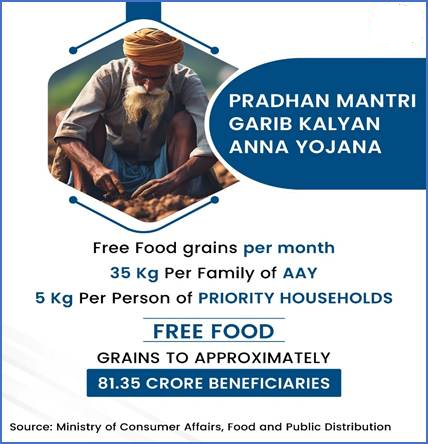
2. National Food Security Act (NFSA), 2013: The NFSA ensures equitable food distribution, covering 75% of the rural and 50% of the urban population—about 81.35 crore beneficiaries—through Antyodaya Anna Yojana (AAY) and Priority Households (PHH). Together, NFSNM and NFSA form the twin pillars of India’s food security—one driving production, the other ensuring distribution.
3. Pradhan Mantri Garib Kalyan Anna Yojana (PMGKAY): Launched during the COVID-19 pandemic, PMGKAY provided free foodgrains to all NFSA beneficiaries. Its continuation from January 2024 to December 2028, with a financial outlay of ₹11.80 lakh crore, demonstrates India’s long-term commitment to eradicating hunger and shielding the poor from economic distress.
4. PM POSHAN (Poshan Shakti Nirman) Scheme: Formerly the Mid-Day Meal Scheme, PM POSHAN provides nutritious cooked meals to children in government and aided schools, enhancing learning outcomes and promoting classroom attendance. In FY 2024–25, 22.96 LMT of rice and wheat were allocated under this programme.
5. Rice Fortification Initiative: To address micronutrient deficiencies, the government introduced fortified rice containing Iron, Folic Acid, and Vitamin B12. By March 2024, 100% of rice under schemes like PMGKAY, ICDS, and PM POSHAN was fortified. The initiative has been extended until December 2028 with ₹17,082 crore in funding.
Modernizing Food Distribution Systems
To enhance transparency and efficiency, India has introduced SMART-PDS (Scheme for Modernisation and Reforms through Technology). It incorporates biometric authentication, e-KYC, and digital ration card management to ensure accountability.
The launch of Mera Ration 2.0 (2024) further improved accessibility by providing real-time entitlement information and location details for Fair Price Shops. Nearly 99.9% of ration cards are Aadhaar-linked, while the One Nation, One Ration Card (ONORC) initiative ensures portability of benefits nationwide.
Supplementary Interventions
Open Market Sale Scheme (OMSS-D): Under OMSS(D), surplus foodgrains are sold in the open market to control inflation and ensure price stability. Products like Bharat Atta and Bharat Rice have been introduced at subsidised rates to maintain affordability.
Mission for Aatmanirbharta in Pulses (2025–31): Launched in October 2025, this mission aims to achieve self-reliance in pulse production by expanding cultivation by 35 lakh hectares, benefiting nearly 2 crore farmers and enhancing nutritional self-sufficiency.
India’s Global Food Leadership
World Food India 2025: Organised by the Ministry of Food Processing Industries, the event showcased India’s potential as a global food hub, with participation from 90+ countries and 2,000 exhibitors. It emphasized innovation, investment, and sustainability in the food processing sector.
Indian Thali in Global Spotlight: India’s traditional plant-based Thali was recognized by the WWF Living Planet Report for its nutritional value and environmental sustainability. The report highlighted that adopting India’s dietary pattern could reduce global resource use to 0.84 Earths by 2050, proving its sustainability and climate-friendliness.
Conclusion
Q. Consider the following pairs regarding Government initiatives related to food and nutrition security in India:
| No. | Scheme / Mission | Objective (as per question) |
|---|---|---|
| 1 | PM POSHAN | Providing mid-day meals to school children |
| 2 | NFSA (National Food Security Act, 2013) | Ensuring free food distribution to all citizens |
| 3 | NFSNM (National Food Security & Nutrition Mission) | Enhancing foodgrain productivity and nutritional outcomes |
| 4 | Rice Fortification Initiative | Addressing micronutrient deficiencies |
Which of the pairs given above are correctly matched?
(a) 1, 3 and 4 only
(b) 1 and 2 only
(c) 2 and 3 only
(d) 1, 2, 3 and 4
Answer: A
Mains Question:
Q. “Ensuring food security is not just about producing enough food but also about ensuring equitable access and nutrition for all.” In light of this statement, discuss the role of India’s recent initiatives, such as the National Food Security & Nutrition Mission (NFSNM), PMGKAY, and SMART-PDS in achieving sustainable food and nutritional security.
(250 words)

- Europe’s AI Rules May Become India’s Opportunity - August 14, 2026
- Transparency as the Foundation of Trust in Medicine - August 14, 2026
- A Timely Reset for the Food Security Act: From Foodgrain Security to Nutrition Security - August 13, 2026

No Comments