


18 Sep Yogi Adityanath, Union Minister discuss NCR pollution plan: Key focus areas
✎ The Commission for Air Quality Management (CAQM) is the nodal statutory body for coordinating air pollution control measures in the National Capital Region, integrating technological monitoring, regulatory enforcement, and…
Subject Relevance — Where This Topic Fits
- GS Paper III — Environment and Pollution Control | GS Paper II — Federalism and Centre-State Relations
- Prelims: National Capital Region (NCR), Commission for Air Quality Management (CAQM), Online Continuous Emission Monitoring Systems (OCEMS), Solid Waste Management Rules 2016, Construction and Demolition Waste Management Rules 2016, National Electric Mobility Mission Plan (NEMMP), National Clean Air Programme (NCAP)
- Essay: Environmental governance and cooperative federalism in India: Balancing development and sustainability
Quick Revision: The Commission for Air Quality Management (CAQM) is the nodal statutory body for coordinating air pollution control measures in the National Capital Region, integrating technological monitoring, regulatory enforcement, and multi-stakeholder governance under the National Clean Air Programme framework.
Why is this in the news?
The meeting between the Chief Minister of Uttar Pradesh and the Union Minister of Environment, Forest and Climate Change highlights the ongoing institutional efforts to address air pollution in the National Capital Region (NCR) through coordinated policy implementation, technological interventions, and multi-stakeholder coordination. This reflects the Centre’s emphasis on strengthening the enforcement of existing environmental regulations and the adoption of innovative pollution control measures in peri-urban and industrial zones adjacent to the NCR.
Background
- The National Capital Region (NCR) is a contiguous urban agglomeration spanning parts of Delhi and surrounding districts in Haryana, Uttar Pradesh, Rajasthan, and Punjab, facing severe air pollution due to vehicular emissions, industrial activities, construction dust, and agricultural residue burning.
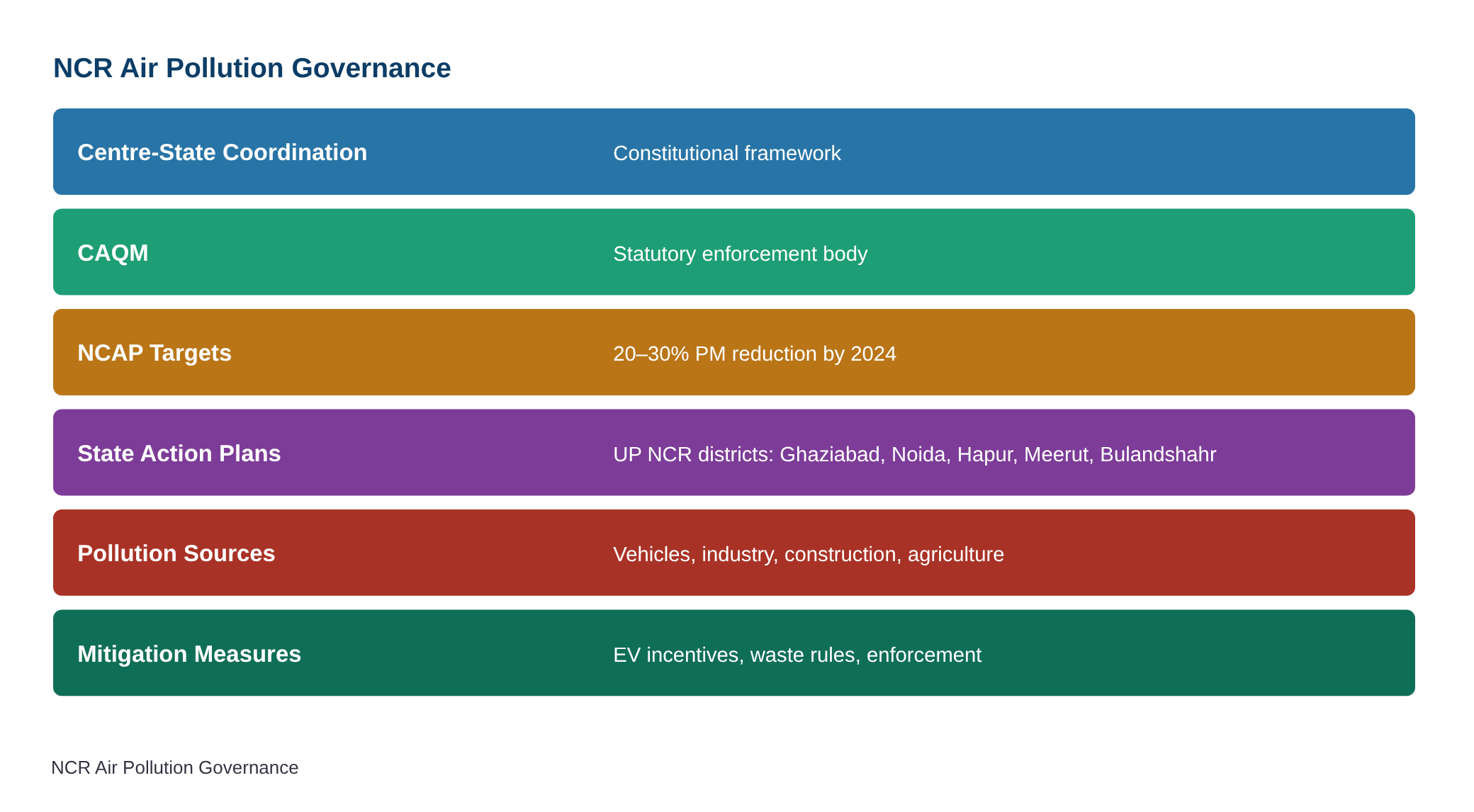
- The Commission for Air Quality Management (CAQM), established under the Commission for Air Quality Management in National Capital Region and Adjoining Areas Act, 2021, serves as a statutory authority for formulating and enforcing air quality management plans in the NCR.
- The National Clean Air Programme (NCAP), launched in 2019, sets a national target of 20–30% reduction in particulate matter (PM10 and PM2.5) concentrations by 2024, with city-specific action plans including Uttar Pradesh’s NCR districts.
- Uttar Pradesh’s NCR-linked districts—Ghaziabad, Noida, Hapur, Meerut, and Bulandshahr—are critical hotspots due to their proximity to Delhi and high industrial and vehicular density.
- The Solid Waste Management Rules, 2016, and Construction and Demolition Waste Management Rules, 2016, mandate the segregation, processing, and disposal of waste to mitigate secondary pollution sources such as landfill fires and open burning.
- The Government of India’s National Electric Mobility Mission Plan (NEMMP) 2020 and the Faster Adoption and Manufacturing of Hybrid and Electric Vehicles (FAME) scheme incentivize the adoption of electric vehicles (EVs) to reduce vehicular emissions.
What is the NCR Air Pollution Action Plan?
- The NCR Air Pollution Action Plan is a multi-sectoral strategy developed under the aegis of the CAQM to reduce air pollution through targeted interventions in vehicular emissions, industrial pollution, dust control, and waste management across NCR states.
- It includes phased measures such as the phasing out of old and polluting vehicles, promotion of electric mobility through subsidies and infrastructure development, and stricter enforcement of the Bharat Stage VI emission norms.
- Industrial pollution control measures involve mandating the installation of Online Continuous Emission Monitoring Systems (OCEMS) for real-time tracking of emissions, with penalties for non-compliance and retrofitting of pollution control devices.
- Dust pollution mitigation includes mechanised sweeping of roads, water sprinkling on construction sites, and the use of anti-smog guns, alongside enforcement of green construction practices and mandatory dust suppression measures.
- Waste management reforms focus on the implementation of the Solid Waste Management Rules, 2016, and Construction and Demolition Waste Management Rules, 2016, including setting up of waste processing facilities and strict penalties for open dumping.
- The plan also incorporates agricultural residue management strategies, including the promotion of Happy Seeders and other residue management machinery to reduce stubble burning, particularly in Punjab, Haryana, and western Uttar Pradesh.
- Institutional coordination is facilitated through the CAQM, which conducts regular reviews with state governments, local bodies, and technical agencies to assess progress and address implementation bottlenecks.
- Public awareness campaigns and stakeholder consultations are integral to the plan, aiming to foster community participation in reducing pollution through behavioral changes and compliance with environmental norms.
Key Features
| Feature | Significance |
|---|---|
| NCR Air Pollution Action Plan | A coordinated multi-stakeholder framework to address air pollution in eight UP districts linked to the National Capital Region (NCR), integrating vehicular, industrial, and dust pollution controls. |
| Online Continuous Emission Monitoring Systems (OCEMS) | Real-time monitoring of industrial emissions to ensure compliance with environmental standards and facilitate data-driven enforcement. |
| Solid Waste Management Rules (2016) & Construction & Demolition Waste Management Rules (2016) | Legal frameworks mandating systematic waste segregation, processing, and disposal to mitigate secondary pollution sources. |
| Commission for Air Quality Management (CAQM) | Statutory body coordinating air quality monitoring, policy implementation, and inter-state cooperation across the NCR region. |
| Electric Vehicle (EV) Policy Implementation | Regulatory and incentive-based measures to accelerate the adoption of electric vehicles and reduce vehicular emissions. |
Why it Matters
Environmental Governance
- Demonstrates the Centre-State coordination required under the Constitution to address transboundary air pollution, particularly in the NCR, a critical ecological and economic zone.
- Highlights the role of statutory bodies like the CAQM in enforcing pollution control measures across state boundaries.
- Emphasises the integration of technological solutions (OCEMS, mechanised cleaning) in environmental management.
Public Health
- Direct correlation between air pollution and respiratory diseases, cardiovascular ailments, and premature mortality, particularly in densely populated urban areas.
- Focus on vehicular and industrial emissions targets high-risk populations in industrial and transport corridors.
Economic Impact
- Reduction in air pollution can lower healthcare costs, improve labour productivity, and enhance urban livability, attracting investment.
- Compliance with environmental norms may impose short-term costs on industries but fosters long-term sustainability and green growth.
Institutional Capacity
- Showcases the Centre’s role in convening state governments for collective action under the CAQM framework.
- Illustrates the importance of inter-departmental coordination (environment, transport, urban development) in policy execution.
Regulatory Compliance
- Enforcement of OCEMS and pollution certificates ensures adherence to the Air (Prevention and Control of Pollution) Act, 1981.
- Waste management rules strengthen compliance with the Environment Protection Act, 1986, and the National Green Tribunal’s directives.
Challenges
1. Inter-State Coordination
- Air pollution in the NCR transcends state boundaries, requiring seamless cooperation among Uttar Pradesh, Delhi, Haryana, Rajasthan, and Punjab.
- Differences in enforcement capacity, political priorities, and resource allocation may hinder uniform implementation.
UPSC Link: Federalism – Centre-State relations
2. Industrial Compliance Gaps
- Approximately 20% of industries in the NCR-linked UP districts lack OCEMS, delaying real-time emission tracking.
- Small and medium enterprises (SMEs) face higher compliance costs, necessitating targeted support and incentives.
UPSC Link: Environmental regulation – Industrial pollution
3. Vehicular Emission Control
- Old and unregulated vehicles contribute disproportionately to pollution; phasing them out requires political and economic consensus.
- Aggregator-driven transport (e.g., ride-hailing, delivery services) complicates enforcement of emission norms.
UPSC Link: Urban transport – Pollution control
4. Waste Management Infrastructure
- Construction and demolition waste, if improperly managed, contributes to dust and particulate matter pollution.
- Solid waste processing facilities are inadequate in many NCR-linked districts, leading to open dumping and burning.
UPSC Link: Urban governance – Waste management
5. Stubble Burning Management
- Agricultural residue burning in Punjab, Haryana, and western Uttar Pradesh exacerbates seasonal air quality deterioration.
- Mechanised solutions like Happy Seeders and bio-decomposers require farmer awareness and financial incentives.
UPSC Link: Agricultural practices – Environmental impact
6. Public Awareness and Behavioural Change
- Low public participation in pollution control measures (e.g., waste segregation, vehicle maintenance) undermines policy effectiveness.
- Misinformation and resistance to regulatory measures (e.g., odd-even schemes) can derail enforcement efforts.
UPSC Link: Environmental governance – Community participation
Challenges — UPSC Perspective
| Issue | Concern |
|---|---|
| OCEMS Compliance | Lack of real-time monitoring in 20% of industries delays enforcement and data accuracy. |
| Vehicular Emissions | Old vehicles and aggregator transport evade regulation, contributing to persistent pollution. |
| Waste Management | Inadequate infrastructure for C&D waste and solid waste leads to secondary pollution sources. |
| Stubble Burning | Agricultural residue burning in neighbouring states worsens NCR air quality seasonally. |
| Inter-State Disparities | Variations in enforcement capacity and priorities among NCR states hinder uniform pollution control. |
| Public Compliance | Low awareness and behavioural resistance undermine the effectiveness of pollution control measures. |
Government Initiatives — Must-Memorise for Prelims
- National Clean Air Programme (NCAP)
- Solid Waste Management Rules, 2016
- Construction and Demolition Waste Management Rules, 2016
Way Forward
- Strengthen inter-state coordination mechanisms under the CAQM to ensure uniform enforcement of pollution control measures across NCR states.
- Accelerate the installation and operationalisation of OCEMS in all industries, with phased penalties for non-compliance.
- Expand public transport infrastructure, including electric buses, and enforce stricter emission norms for old and aggregator vehicles.
- Enhance waste management infrastructure through public-private partnerships and incentives for decentralised processing.
- Launch targeted awareness campaigns to educate citizens on waste segregation, vehicle maintenance, and stubble management practices.
- Incentivise farmers to adopt mechanised stubble management solutions through subsidies and technical support.
- Establish a real-time air quality monitoring network with public dashboards to enhance transparency and accountability.
- Conduct periodic reviews of the NCR Air Pollution Action Plan with participation from local bodies, industries, and civil society.
UPSC Value Addition
Keywords for Mains Answer-Writing
National Capital Region (NCR) air pollution · Commission for Air Quality Management (CAQM) · Online Continuous Emission Monitoring Systems (OCEMS) · Solid Waste Management Rules, 2016 · Construction and Demolition Waste Management Rules, 2016 · National Green Tribunal (NGT) · stubble management · mechanised cleaning of roads · electric vehicle (EV) policy · pollution control measures in Uttar Pradesh · inter-state coordination for pollution control · Air (Prevention and Control of Pollution) Act, 1981 · Environment Protection Act, 1986 · stubble burning management · urban air quality monitoring
Concept Flow
Urbanisation and industrialisation in NCR-linked districts → Increase in vehicular and industrial emissions → Rise in particulate matter (PM2.5/PM10) levels → Public health crisis (respiratory diseases, economic burden) → Enactment of Air (Prevention and Control of Pollution) Act, 1981 → Establishment of CAQM for inter-state coordination → Formulation of NCR Air Pollution Action Plan → Implementation of OCEMS, EV policies, and waste management rules → Monitoring and enforcement → Gradual reduction in pollution levels → Improved public health and urban livability.
Prelims Practice Questions
Q1. Consider the following statements regarding the Commission for Air Quality Management (CAQM) in the National Capital Region (NCR):
1. The CAQM is a statutory body established under the Commission for Air Quality Management in National Capital Region and Adjoining Areas Act, 2021.
2. The CAQM has the power to impose penalties on states for non-compliance with air quality norms.
3. The CAQM is mandated to coordinate with state governments, local bodies, and other stakeholders for air quality management in the NCR.
4. The CAQM is empowered to ban the use of certain fuels in the NCR without prior consultation with the state governments.
How many of the above statements are correct?
- Only one
- Only two
- Only three
- All four
Answer: Only three — Statements 1, 2, and 3 are correct as the CAQM is a statutory body with powers to coordinate and impose penalties. Statement 4 is incorrect as the CAQM cannot unilaterally ban fuels without consultation with state governments.
Q2. Assertion (A): The National Green Tribunal (NGT) can entertain civil cases related to environmental protection without the need for a prior reference from a civil court.
Reason (R): The NGT Act, 2010 empowers the tribunal to exercise the powers of a civil court for the purpose of discharging its functions under the Act.
Options:
A. Both A and R are individually true, and R is the correct explanation of A.
B. Both A and R are individually true, but R is not the correct explanation of A.
C. A is true, but R is false.
D. A is false, but R is true.
Answer: ? — Both A and R are true, and R correctly explains A as the NGT Act, 2010 grants the tribunal the powers of a civil court, enabling it to entertain environmental cases directly.
Q3. Match the following columns related to pollution control measures in India:
Column I (Legislative/Institutional Framework) | Column II (Purpose)
1. Air (Prevention and Control of Pollution) Act, 1981 | a. Regulates the management of solid and hazardous waste
2. Environment Protection Act, 1986 | b. Provides for the prevention, control, and abatement of air pollution
3. Solid Waste Management Rules, 2016 | c. Empowers the Central Government to take measures for environmental protection
4. Construction and Demolition Waste Management Rules, 2016 | d. Regulates the management of construction and demolition waste
Options:
A. 1-b, 2-c, 3-a, 4-d
B. 1-a, 2-b, 3-c, 4-d
C. 1-d, 2-a, 3-b, 4-c
D. 1-c, 2-d, 3-a, 4-b
Answer: ? — The correct matches are: 1-b (Air Act, 1981 regulates air pollution), 2-c (Environment Protection Act, 1986 empowers central measures), 3-a (Solid Waste Management Rules, 2016), and 4-d (Construction and Demolition Waste Management Rules, 2016).
Mains Practice Question
✍ The management of air pollution in the National Capital Region (NCR) requires multi-dimensional governance involving statutory bodies, inter-state coordination, and technological interventions. Critically examine the institutional and legal framework governing air pollution control in the NCR, with reference to recent initiatives such as the Commission for Air Quality Management (CAQM) and the role of state governments like Uttar Pradesh. (15 Marks)
Approach: MODEL-ANSWER SKELETON:
1. **Institutional Framework**:
– **Commission for Air Quality Management (CAQM)**: Statutory body under the Commission for Air Quality Management in National Capital Region and Adjoining Areas Act, 2021. Powers: coordination, enforcement, and penalty imposition. Recent role in directing states like Uttar Pradesh on mechanised cleaning and stubble management.
– **State Governments**: Uttar Pradesh’s action plan for 8 NCR-linked districts (Noida, Ghaziabad, Meerut, etc.) focusing on vehicular emissions, industrial pollution, and dust control. Coordination with Centre on EV policy, OCEMS, and waste management rules.
2. **Legal Framework**:
– **Air (Prevention and Control of Pollution) Act, 1981**: Primary legislation for air pollution control; empowers state pollution control boards.
– **Environment Protection Act, 1986**: Provides overarching powers to the Central Government for environmental protection.
– **Solid Waste Management Rules, 2016** and **Construction and Demolition Waste Management Rules, 2016**: Regulate waste management to reduce dust and particulate matter.
– **National Green Tribunal (NGT)**: Adjudicates environmental disputes; recent orders on stubble burning and industrial emissions.
3. **Technological and Policy Interventions**:
– **Online Continuous Emission Monitoring Systems (OCEMS)**: Mandated for industries; 80% compliance in UP, action on remaining.
– **Electric Vehicle (EV) Policy**: Promotion of EVs and electric buses to reduce vehicular emissions.
– **Stubble Management**: Coordination with agriculture departments; CAQM’s role in monitoring stubble burning.
4. **Challenges and Critique**:
– **Inter-State Coordination**: Need for stronger collaboration among NCR states (Delhi, Haryana, Rajasthan, Punjab) for uniform implementation.
– **Enforcement Gaps**: Penalties under CAQM often face delays; industrial and vehicular compliance remains uneven.
– **Technological Limitations**: OCEMS and mechanised cleaning require sustained funding and capacity building.
5. **Conclusion**:
– The NCR’s air pollution governance is a model of multi-level coordination but requires stronger enforcement, technological upgradation, and inter-state synergy to achieve tangible results.
Source: The Indian Express
Uttar Pradesh PCS (UPPSC) — State PCS Practice
Prelims: Which of the following initiatives was discussed between Uttar Pradesh Chief Minister Yogi Adityanath and the Union Environment Minister to address air pollution in the National Capital Region (NCR) as part of the state’s pollution control strategy?
- A. Implementation of the ‘Clean UP Mission’ with a focus on industrial emission reduction in Ghaziabad and Noida
- B. Launch of a joint ‘Ganga Action Plan Phase-III’ to clean the river and its tributaries in Uttar Pradesh
- C. Expansion of the ‘One District One Product’ scheme to promote eco-friendly manufacturing in rural areas
- D. Introduction of a state-wide ban on stubble burning with strict monitoring through satellite imagery
Answer: A. Implementation of the ‘Clean UP Mission’ with a focus on industrial emission reduction in Ghaziabad and Noida — The ‘Clean UP Mission’ was a key initiative discussed to target industrial emissions in Ghaziabad and Noida, which are critical contributors to NCR pollution.
Mains: Discuss the role of inter-state coordination between Uttar Pradesh and the Union Government in mitigating air pollution in the National Capital Region (NCR). Highlight administrative, technological, and policy measures that can be implemented to ensure effective pollution control in Uttar Pradesh’s NCR districts.
Generated by AanyaAi for educational purpose.
Related guides on our sites
- Best geography optional coaching
- Best geography optional coaching
- Best geography optional teacher
- Best geography optional teacher

- Yogi Adityanath, Union Minister discuss NCR pollution plan: Key focus areas - September 18, 2026
- भारत ने अरब सागर में नौसेना जहाज टक्कर पर पाकिस्तान के आरोपों को किया खारिज, नौसेना का किया बचाव - September 18, 2026
- India Rejects Pakistan’s False Claims After Arabian Sea Navy Collision - September 18, 2026

No Comments