


09 Aug YSRCP Slams AP Govt Over Krishna Water Policy: UPSC & State PCS Analysis
✎ The Krishna Water Disputes Tribunal’s awards, operationalised through the Inter-State Water Disputes Act, 1956, govern water allocation among basin states, but compliance and equitable utilisation remain contentious, particularly…
Subject Relevance — Where This Topic Fits
- GS Paper II — Polity and Governance (Inter-State Water Disputes) | GS Paper III — Agriculture, Water Resources, and Environmental Conservation
- Prelims: Krishna Water Disputes Tribunal, Inter-State Water Disputes Act 1956, ayacut, lift irrigation, minimum drawdown level, tmc ft, kharif season, agrarian crisis, tenant farmers, Pulichintala project, Pattiseema project
- Essay: Inter-State River Water Sharing: Challenges of Equity and Sustainability, Agrarian Distress in India: Causes and Policy Responses
Quick Revision: The Krishna Water Disputes Tribunal’s awards, operationalised through the Inter-State Water Disputes Act, 1956, govern water allocation among basin states, but compliance and equitable utilisation remain contentious, particularly in drought-prone regions like the Krishna delta.
Why is this in the news?
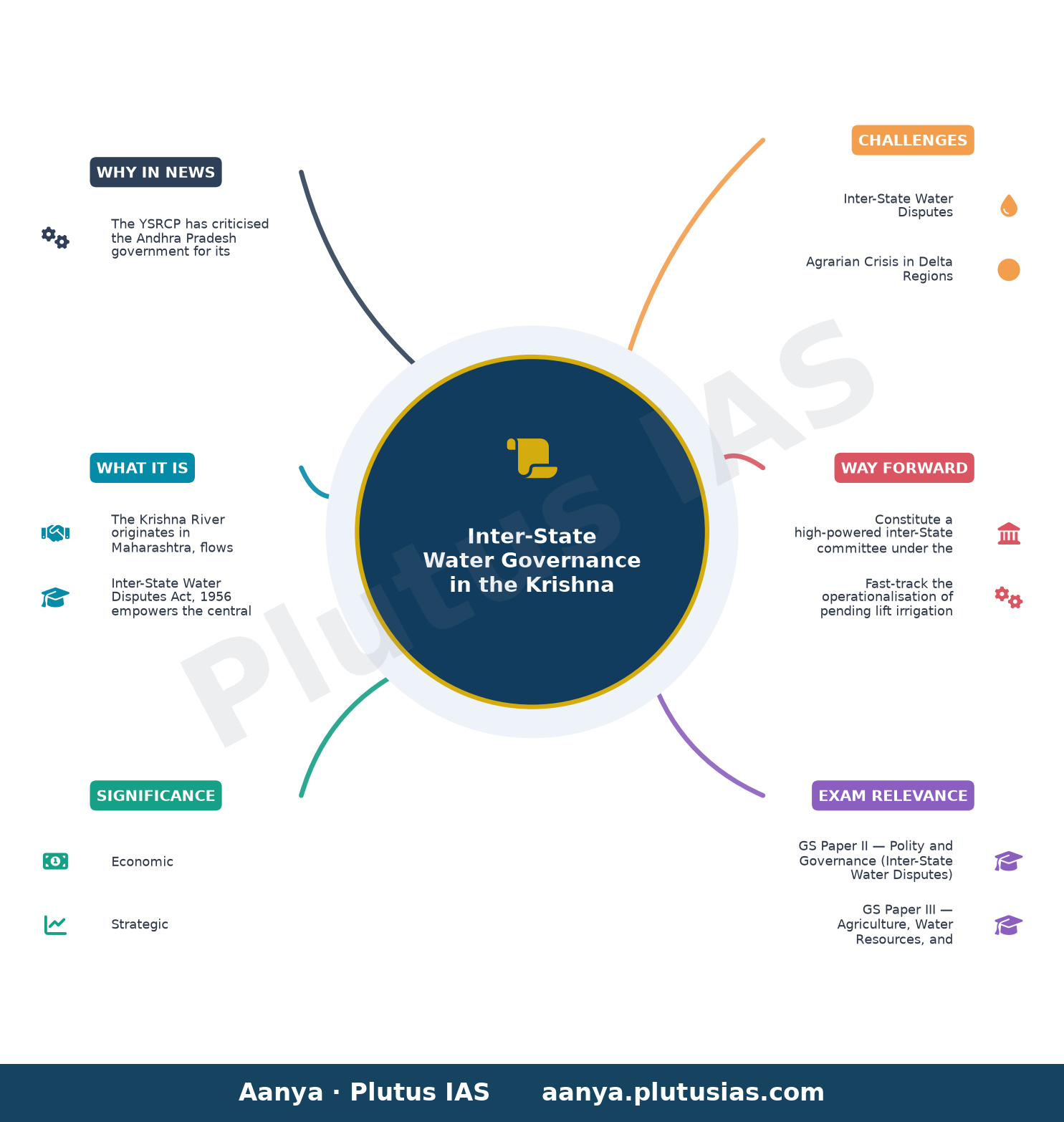
The YSRCP has criticised the Andhra Pradesh government for its policy on Krishna water releases, alleging inadequate utilisation of available water resources for irrigation in drought-prone regions and the Krishna delta, and advising farmers against paddy cultivation during the kharif season. The criticism highlights inter-state water governance challenges, agrarian distress, and the operational dynamics of major irrigation projects in the Krishna basin.
Background
- The Krishna River, India’s third-largest river by discharge, is a critical water source for Maharashtra, Karnataka, Telangana, and Andhra Pradesh, governed by the Krishna Water Disputes Tribunal (KWDT) awards and subsequent modifications.
- The Krishna basin faces recurring water scarcity due to erratic monsoons, over-extraction for irrigation, and competing demands from urban centres, industry, and agriculture.
- The Pulichintala and Pattiseema projects in Andhra Pradesh were designed to stabilise irrigation in the Krishna delta and augment water supply to the Krishna delta and coastal regions, respectively.
- Telangana has operationalised multiple lift irrigation schemes (Bhima-I, Bhima-II, Nettempadu, Koilsagar, Kalwakurthy) to utilise its share of Krishna waters, while Andhra Pradesh’s Handri-Neeva and Muchumarri schemes remain underutilised due to policy and infrastructural constraints.
- The kharif season (June–October) is crucial for paddy cultivation in the Krishna delta, which supports 10.5 lakh acres of ayacut and sustains livelihoods for tenant farmers and agricultural labourers.
- The Andhra Pradesh government’s advisory against paddy cultivation in the delta during kharif 2026 reflects acute water scarcity, exacerbated by delayed releases from upstream reservoirs and competing demands from urban water supply projects like Metrowater’s Chennai supply initiative.
What is the Krishna River Basin and its Governance Framework?
- The Krishna River originates in Maharashtra, flows through Karnataka and Telangana, and empties into the Bay of Bengal in Andhra Pradesh, covering a basin area of approximately 258,948 sq. km.
- Inter-State Water Disputes Act, 1956 empowers the central government to adjudicate disputes and implement tribunal awards, though compliance remains a challenge due to political and administrative constraints.
- The Krishna delta in Andhra Pradesh, spanning parts of West Godavari and Krishna districts, is a highly fertile region with an ayacut of 10.5 lakh acres, historically dependent on Krishna waters for paddy, sugarcane, and aquaculture.
- Lift irrigation schemes, such as Handri-Neeva, Muchumarri, and Telangana’s Nettempadu, are designed to overcome topographical barriers and utilise allocated water shares, but their efficacy depends on timely water releases and infrastructure maintenance.
- The Pulichintala project (29 tmc ft capacity) was constructed to stabilise irrigation in the Krishna delta, while the Pattiseema project (with a capacity of 80 tmc ft) augments water supply to the delta and coastal regions, including Chennai via the Krishna-Cauvery link.
- Minimum Drawdown Level (MDL) is the lowest reservoir level from which water can be drawn for irrigation or other uses without compromising structural integrity or downstream ecological needs.
- Agrarian distress in the delta is compounded by factors such as fragmented landholdings, tenancy issues, and market fluctuations, making water availability a critical determinant of rural livelihoods.
Key Features
| Feature | Significance |
|---|---|
| Krishna River Basin | A major inter-State river basin in South India, shared by Maharashtra, Karnataka, Telangana, and Andhra Pradesh, critical for irrigation, drinking water, and hydroelectric power generation. |
| Jurala Project | A key irrigation project on the Krishna River in Telangana, enabling regulated water releases for downstream states and supporting multi-purpose water utilisation. |
| Srisailam Reservoir | A critical multi-purpose reservoir on the Krishna River, used for irrigation, hydroelectric power generation, and drinking water supply, with a minimum drawdown level ensuring operational reliability. |
| Handri-Neeva Lift Scheme | An inter-State lift irrigation scheme in Andhra Pradesh, designed to utilise surplus Krishna waters for irrigation in drought-prone regions, enhancing agricultural productivity. |
| Pulichintala Project | A balancing reservoir on the Krishna River in Andhra Pradesh, constructed to stabilise water supply to the Krishna delta, particularly during lean periods. |
Why it Matters
Economic
- The Krishna delta region is a major agricultural hub, with paddy, sugarcane, and aquaculture as primary economic activities, contributing significantly to Andhra Pradesh’s GDP.
- Timely water releases are essential to sustain kharif and rabi seasons, preventing crop losses and ensuring food security for the state and the nation.
- Agrarian distress in the delta region can trigger migration, indebtedness, and socio-economic instability, impacting rural livelihoods and political stability.
Strategic
- Inter-State water disputes over the Krishna River necessitate equitable utilisation, as governed by the Krishna Water Disputes Tribunal (KWDT) awards and agreements.
- Delays in water releases can escalate tensions between Andhra Pradesh and Telangana, undermining cooperative federalism and long-term water-sharing mechanisms.
- Efficient water management in the Krishna basin is critical for meeting urban water demands, including for cities like Chennai, which relies on inter-State water transfers.
Environmental
- Unregulated water releases or delays can lead to ecological imbalances, including soil salinisation in delta regions and reduced downstream flow, affecting aquatic ecosystems.
- Sustainable water utilisation practices, such as conjunctive use of surface and groundwater, are essential to mitigate drought impacts and preserve riverine biodiversity.
Challenges
1. Inter-State Water Disputes
- Competing claims over Krishna River waters between Andhra Pradesh, Telangana, Karnataka, and Maharashtra create a complex governance challenge.
- Delays in operationalising lift irrigation schemes (e.g., Handri-Neeva, Muchumarri) exacerbate inequities in water distribution.
- Lack of a robust dispute resolution mechanism for real-time water-sharing decisions, relying on ad-hoc releases rather than pre-agreed protocols.
UPSC Link: GS-II: Federalism
2. Agrarian Crisis in Delta Regions
- Farmers in the Krishna delta face existential threats due to delayed or inadequate water releases, leading to crop failures and financial distress.
- Tenant farmers, who lack land ownership, are disproportionately affected, as their investments in cultivation are at risk without assured water supply.
- Over-reliance on paddy cultivation, despite water scarcity, reflects a structural challenge in transitioning to water-efficient cropping patterns.
UPSC Link: GS-III: Agriculture
3. Infrastructure and Operational Delays
- Underutilisation of lift irrigation schemes (e.g., Handri-Neeva, Muchumarri) due to bureaucratic inertia or lack of political will.
- Disputes over the operational efficiency of projects like Pattiseema and Pulichintala, with conflicting claims on water utilisation priorities.
- Inadequate real-time monitoring and data-sharing mechanisms between States to optimise water releases based on basin-wide inflows and demands.
UPSC Link: GS-II: Governance
4. Climate Change and Variability
- Increasing frequency of droughts and erratic monsoons in the Krishna basin reduces inflows into reservoirs, straining water allocation decisions.
- Rising temperatures and evapotranspiration rates exacerbate water scarcity, necessitating adaptive water management strategies.
- Long-term planning for climate-resilient agriculture, including drought-resistant crop varieties and precision irrigation, remains underdeveloped.
UPSC Link: GS-III: Environment
Challenges — UPSC Perspective
| Issue | Concern |
|---|---|
| Water Allocation Disputes | Competing claims between States lead to ad-hoc releases, undermining equitable distribution and cooperative federalism. |
| Agricultural Dependence on Paddy | High water-intensive cropping in delta regions exacerbates scarcity, with limited alternatives for tenant farmers. |
| Underutilised Infrastructure | Lift irrigation schemes and reservoirs remain underutilised due to bureaucratic delays and operational inefficiencies. |
| Climate Variability | Increasing droughts and erratic monsoons reduce reservoir inflows, complicating water-sharing decisions. |
| Urban vs. Agricultural Prioritisation | Competing demands for drinking water (e.g., Chennai) and irrigation create trade-offs in water allocation policies. |
Government Initiatives — Must-Memorise for Prelims
- Krishna Water Disputes Tribunal (KWDT) Awards
- Handri-Neeva Lift Irrigation Scheme
- Muchumarri Lift Irrigation Scheme
- Pattiseema Project
Way Forward
- Constitute a high-powered inter-State committee under the aegis of the Ministry of Jal Shakti to review real-time water allocation based on inflows, demands, and KWDT awards.
- Fast-track the operationalisation of pending lift irrigation schemes (e.g., Handri-Neeva, Muchumarri) to enhance water utilisation efficiency in drought-prone regions.
- Promote water-efficient cropping patterns in the Krishna delta through subsidies for alternative crops (e.g., millets, pulses) and farmer awareness campaigns.
- Develop a basin-wide water-sharing protocol with pre-agreed triggers for water releases, accounting for climate variability and seasonal demands.
- Invest in real-time monitoring systems (e.g., telemetry, satellite data) to improve data-sharing between States and enable evidence-based decision-making.
- Strengthen climate-resilient agriculture by integrating drought-resistant varieties, precision irrigation, and soil moisture conservation techniques.
- Establish a grievance redressal mechanism for farmers, including expedited compensation for crop losses due to delayed water releases.
- Enhance public-private partnerships for water conservation projects (e.g., check dams, farm ponds) to augment local water resources.
UPSC Value Addition
Keywords for Mains Answer-Writing
Krishna River water disputes · Inter-State River Water Disputes Act, 1956 · Andhra Pradesh-Telangana water sharing · Kharif season irrigation policy · Pulichintala and Pattiseema projects · Krishna delta agriculture · Inter-State Water Disputes Tribunal · Agrarian crisis and water governance · Lift irrigation schemes in Krishna basin · Minimum drawdown level of reservoirs · Economic activities in delta regions · Tenant farmers and water allocation policy · Water governance and federalism in India
Constitutional & Policy Linkages
- Article 262: Adjudication of disputes relating to inter-State rivers and river valleys.
- Seventh Schedule: Entry 17 (Water) under the State List and Entry 56 (Inter-State water disputes) under the Union List.
Concept Flow
Krishna River inflows into reservoirs (Srisailam, Jurala) → State-level water allocation decisions → Operationalisation of lift irrigation schemes → Agricultural utilisation in delta regions → Economic and socio-political impacts on farmers. → Inter-State water disputes (KWDT awards) → Competing claims between Andhra Pradesh and Telangana → Delays in infrastructure utilisation → Agrarian distress in delta regions. → Climate variability (droughts, erratic monsoons) → Reduced reservoir inflows → Water scarcity → Policy decisions on crop prioritisation and urban demands. → Bureaucratic delays in project operationalisation → Underutilisation of Handri-Neeva, Muchumarri schemes → Inequitable water distribution → Farmer protests and political criticism. → Urban water demands (e.g., Chennai) → Competing allocations with agriculture → Trade-offs in water policy → Long-term sustainability challenges. → Lack of real-time data-sharing mechanisms → Ad-hoc water releases → Escalation of disputes → Erosion of cooperative federalism. → Farmer investments in kharif season → Delayed water releases → Crop failures → Financial distress and migration.
Prelims Practice Questions
Q1. Consider the following statements regarding the Krishna River and its basin:
1. The Krishna River originates in the Western Ghats and flows eastward into the Bay of Bengal.
2. The Pulichintala project is primarily designed to stabilise irrigation in the Krishna delta region.
3. The Inter-State River Water Disputes Act, 1956, empowers the Union Government to constitute a tribunal for resolving inter-state water disputes.
4. The Krishna delta region is primarily known for wheat cultivation during the kharif season.
How many of the above statements are correct?
- Only one
- Only two
- Only three
- All four
Answer: Only three — Statements 1, 2, and 3 are correct. The Krishna River originates in the Western Ghats and flows eastward into the Bay of Bengal. The Pulichintala project is indeed designed to stabilise irrigation in the Krishna delta. The Inter-State River Water Disputes Act, 1956, empowers the Union Government to constitute tribunals for resolving inter-state water disputes. Statement 4 is incorrect as the Krishna delta region is primarily known for paddy, sugarcane, and aquaculture, not wheat cultivation.
Q2. Assertion (A): The Pulichintala project in Andhra Pradesh is currently holding 29 tmc ft. of water, primarily reserved for drinking water needs until June 2027.
Reason (R): The project was constructed to stabilise irrigation in the Krishna delta region and mitigate agrarian distress.
In the context of the above two statements, which one of the following is correct?
- Both A and R are true, and R is the correct explanation of A
- Both A and R are true, but R is not the correct explanation of A
- A is true, but R is false
- A is false, but R is true
Answer: A is true, but R is false — Assertion (A) is true as the Pulichintala project holds 29 tmc ft. of water reserved for drinking water needs until June 2027. Reason (R) is also true as the project was constructed to stabilise irrigation in the Krishna delta. However, R is not the correct explanation of A, as the primary purpose of reserving water is for drinking needs, not irrigation.
Q3. Match the following lift irrigation schemes with their respective states:
Column I (Scheme) Column II (State)
A. Handri-Neeva 1. Telangana
B. Muchumarri 2. Andhra Pradesh
C. Bhima-I 3. Karnataka
D. Kalwakurthy 4. Maharashtra
Select the correct match:
- A-2, B-2, C-1, D-1
- A-1, B-1, C-2, D-2
- A-2, B-2, C-1, D-3
- A-1, B-2, C-3, D-4
Answer: A-2, B-2, C-1, D-1 — Handri-Neeva and Muchumarri are lift irrigation schemes in Andhra Pradesh, while Bhima-I and Kalwakurthy are in Telangana. Karnataka and Maharashtra are not directly involved in these schemes as per the given context.
Mains Practice Question
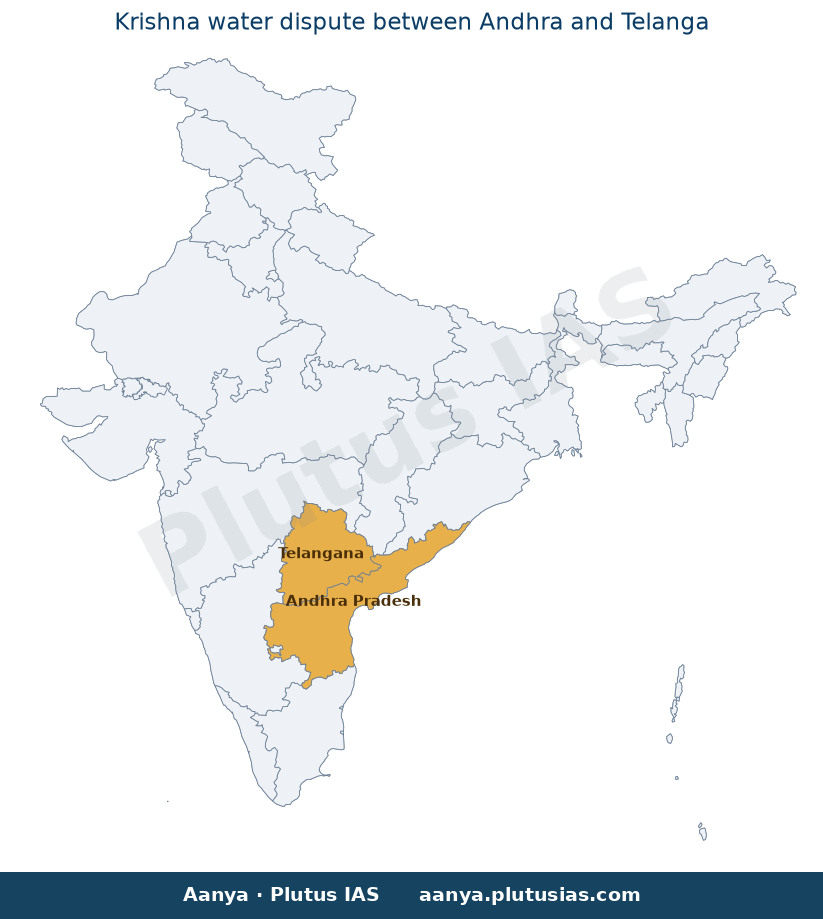
✍ The management of Krishna River water resources has become a critical issue in inter-state relations, particularly between Andhra Pradesh and Telangana. Critically examine the institutional, legal, and economic dimensions of this dispute, with reference to the Inter-State River Water Disputes Act, 1956, recent judicial interventions, and the agrarian crisis in the Krishna delta. Also, assess the role of lift irrigation schemes in mitigating water scarcity and their impact on federal relations. (15 Marks)
Approach: MODEL-ANSWER SKELETON:
1. **Institutional Framework**:
– Role of the Inter-State River Water Disputes Act, 1956: Tribunal formation (e.g., Krishna Water Disputes Tribunal-I and II), powers, and limitations.
– Composition and functioning of the Krishna Water Disputes Tribunal, including its recommendations and binding nature.
– Role of the Union Government in water governance and dispute resolution.
2. **Legal and Judicial Dimensions**:
– Recent judicial interventions: Key judgments by the Supreme Court or High Courts on Krishna water disputes (e.g., 2016 judgment on the Krishna Water Disputes Tribunal-II, or any subsequent orders).
– Legal ambiguities: Interpretation of ‘equitable apportionment’ and ‘principles of distributive justice’ in water allocation.
– Federal tensions: Conflict between state autonomy and Union intervention in water disputes.
3. **Economic and Agrarian Dimensions**:
– Economic activities in the Krishna delta: Paddy cultivation, sugarcane, and aquaculture as primary livelihoods.
– Agrarian crisis: Impact of delayed water releases on tenant farmers, crop choices, and investment decisions.
– Water allocation policies: Critique of the government’s decision to reserve Pulichintala water for drinking needs and its impact on irrigation.
4. **Lift Irrigation Schemes and Federal Relations**:
– Role of lift irrigation schemes (e.g., Handri-Neeva, Muchumarri, Bhima-I, Kalwakurthy) in mitigating water scarcity.
– Impact on federal relations: Cooperation vs. competition between Andhra Pradesh and Telangana in utilising shared water resources.
– Challenges: Technical, financial, and political constraints in implementing lift irrigation projects.
5. **Way Forward**:
– Need for integrated water resource management: Adoption of modern irrigation techniques (e.g., drip irrigation, precision farming).
– Strengthening inter-state cooperation: Institutional mechanisms for real-time data sharing and conflict resolution.
– Policy recommendations: Revisiting water allocation policies to balance drinking water and irrigation needs, and addressing the agrarian crisis.
Source: The Hindu
Generated by AanyaAi for educational purpose.

- Gurugram’s groundwater extraction exceeds limit by 212%; HC seeks ban - October 4, 2026
- स्वतंत्रता सेनानी श्यामजी कृष्ण वर्मा की जन्म जयंती पर पीएम का श्रद्धांजलि - October 4, 2026
- KWML’s Feasibility Reports for Water Metro in 18 Cities: UPSC & PCS Insights - October 3, 2026

No Comments