


15 Jul खादी इंडिया पवेलियन: भारत टेक्स 2026 में ‘नए भारत की नई खादी’ का प्रदर्शन
Subject Relevance — Where This Topic Fits
- GS Paper I — Indian Heritage and Culture, Post-independence Consolidation and Reorganization within the country | GS Paper II — Government Policies and Interventions for Development in various sectors and issues arising out of their design and implementation | GS Paper III — Indian Economy and issues relating to Planning, Mobilization of Resources, Growth, Development and Employment; Inclusive Growth and issues arising from it; Effects of Liberalization on the Economy, Changes in Industrial Policy and their Effects on Industrial Growth
- Prelims: Khadi and Village Industries Commission (KVIC), Bharat Tex 2026, MSME Ministry, Vocal for Local, Aatmanirbhar Bharat, Rural Livelihoods, Sustainable Development, Textile Industry, Jamdani Weaving, Centre of Khadi Excellence
- Essay: The Loom of Self-Reliance: Khadi as a Symbol of India’s Economic and Cultural Renaissance., From Tradition to Trend: How Indigenous Industries Drive Inclusive Growth and Sustainable Futures.
Quick Revision: Khadi, once a symbol of freedom, is now being reimagined as ‘New India’s New Khadi’ through innovation and diversification, driving rural livelihoods, cultural preservation, and sustainable economic growth, positioning it as a global brand.
Why is this in the news?
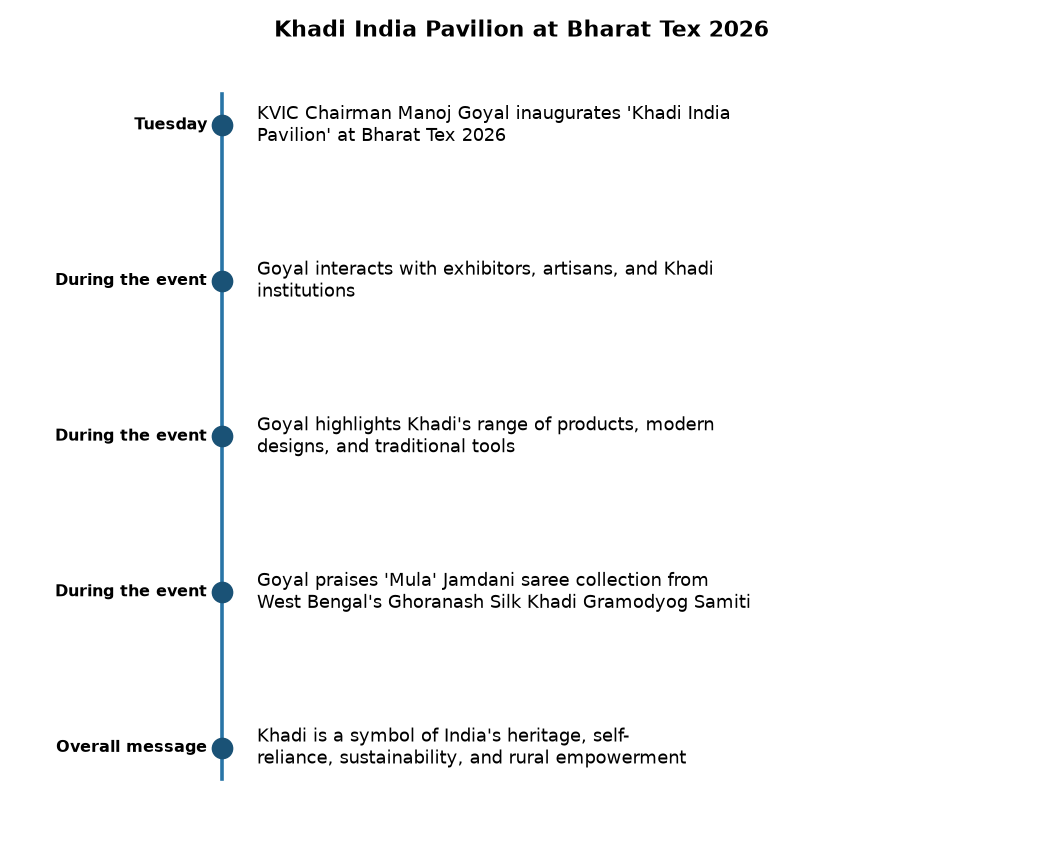
The Khadi India Pavilion was inaugurated at Bharat Tex 2026, India’s largest global textile event, by Shri Manoj Goyal, Chairman of the Khadi and Village Industries Commission (KVIC) under the Ministry of Micro, Small & Medium Enterprises (MSME). The pavilion showcased ‘New India’s New Khadi,’ emphasizing innovation, modern designs, and a diverse range of Khadi and village industry products, highlighting Khadi’s evolution beyond traditional attire into a symbol of India’s rich heritage, self-reliance, sustainable development, and rural empowerment.
Background
- Khadi, a hand-spun and hand-woven fabric, was popularized by Mahatma Gandhi during India’s freedom struggle as a symbol of self-sufficiency and a tool for economic upliftment of rural masses.
- The Khadi and Village Industries Commission (KVIC) was established by the Government of India under the Khadi and Village Industries Commission Act, 1956, to plan, promote, facilitate, organize, and assist in the establishment and development of Khadi and village industries in rural areas.
- In recent years, the Government of India has actively promoted Khadi through initiatives like ‘Vocal for Local’ and ‘Aatmanirbhar Bharat,’ aiming to boost domestic production, create employment, and position Indian products globally.
- Bharat Tex is a premier global textile event, organized to showcase India’s capabilities across the entire textile value chain, from fibre to fashion, and to foster international collaborations.
- The ‘New India’s New Khadi’ initiative reflects a strategic shift to modernize Khadi, making it appealing to younger generations and global markets through design innovation, product diversification (e.g., home decor, lifestyle products), and technological integration.
- The Khadi and Village Industries sector recorded a turnover exceeding ₹1.87 lakh crore and generated employment for over 2.04 crore people in FY 2025-26, demonstrating significant growth and impact on rural livelihoods.
What is Khadi and Village Industries Commission (KVIC)?
- KVIC is a statutory body established by the Government of India under the Khadi and Village Industries Commission Act of 1956.
- It functions under the administrative control of the Ministry of Micro, Small & Medium Enterprises (MSME).
- Its primary objective is to plan, promote, facilitate, organize, and assist in the establishment and development of Khadi and village industries in rural areas.
- KVIC aims to provide employment opportunities in rural areas, thereby strengthening the rural economy and promoting self-reliance.
- It also focuses on promoting the sale and marketing of Khadi and village industry products, both domestically and internationally.
- KVIC is instrumental in preserving traditional crafts, skills, and cultural heritage associated with Khadi and village industries.
- It provides financial assistance, training, and technical support to Khadi institutions and artisans.
- The Commission plays a crucial role in implementing various government schemes aimed at the development of the Khadi and village industries sector.
Key Features
| Feature | Significance |
|---|---|
| Design-based Innovation | Modernizes Khadi’s appeal, making it relevant for contemporary fashion and lifestyle, attracting younger consumers and global markets. |
| Product Diversification | Expands Khadi’s utility beyond apparel to home linen, home decor, and lifestyle products, increasing market reach and revenue streams. |
| Showcasing Traditional Crafts | Highlights unique regional crafts like ‘Mula’ Jamdani sarees, preserving cultural heritage and offering distinct value propositions. |
| Emphasis on Sustainability | Reinforces Khadi’s inherent eco-friendly nature, aligning with global trends towards sustainable consumption and production. |
| Rural Livelihood Empowerment | Directly supports millions of artisans and weavers, providing sustainable employment and contributing to rural economic development. |
| Global Market Integration | Positions Khadi as a high-quality, ethically produced, and fashionable product for international export, embodying ‘Local to Global’. |
Why it Matters
Economic Empowerment and Rural Livelihoods
- Khadi and Village Industries (KVI) sector is a significant employer, particularly in rural and semi-urban areas, providing sustainable livelihoods to millions of artisans, weavers, and farmers.
- It fosters decentralized production, reducing rural-urban migration and promoting equitable wealth distribution.
- The sector’s impressive turnover (₹1.87 lakh crore in FY 2025-26) demonstrates its substantial contribution to the national economy, aligning with the ‘Aatmanirbhar Bharat’ vision.
Cultural Preservation and Heritage Promotion
- Khadi embodies India’s rich cultural heritage and the legacy of Mahatma Gandhi, symbolizing self-reliance and non-violence.
- It preserves traditional weaving techniques and indigenous crafts, preventing the loss of invaluable artisanal skills.
- Promoting Khadi helps in celebrating and showcasing India’s unique textile traditions on a global platform.
Sustainable Development and Environmental Stewardship
- Khadi production is inherently eco-friendly, involving minimal environmental impact compared to large-scale industrial textile manufacturing.
- It promotes the use of natural fibres and traditional, often organic, processes, contributing to sustainable consumption and production patterns.
- The focus on local sourcing and production reduces carbon footprint associated with long supply chains.
National Identity and Global Recognition
- Khadi has transcended its traditional identity to become a powerful symbol of ‘New India’ – representing progress, innovation, and a commitment to indigenous capabilities.
- Its promotion strengthens the ‘Vocal for Local’ movement, encouraging pride in Indian products and fostering a sense of national identity.
- Showcasing Khadi at global events like Bharat Tex elevates its international profile, positioning it as a premium, ethical, and fashionable product in the global market.
Challenges
1. Competition from Machine-Made Textiles
- Khadi faces stiff competition from mass-produced, cheaper, and often more readily available machine-made textiles.
- The perception of Khadi being expensive or less fashionable than synthetic alternatives persists among some consumer segments.
UPSC Link: GS III — Industrial Policy, Competition
2. Lack of Modernization and Design Innovation
- Traditional Khadi products sometimes lack contemporary designs and finishes, limiting their appeal to younger generations and global fashion markets.
- Limited access to modern technology for processing, dyeing, and finishing can hinder quality and consistency.
UPSC Link: GS III — Technology Missions, Industrial Growth
3. Marketing and Distribution Challenges
- Inadequate marketing infrastructure and limited reach, especially in urban and international markets, restrict Khadi’s growth potential.
- Challenges in creating a strong brand identity and effective retail presence compared to established fashion brands.
UPSC Link: GS III — Marketing, Supply Chain Management
4. Skill Development and Artisan Welfare
- Aging artisan population and reluctance of younger generations to adopt traditional weaving skills due to perceived low wages and arduous work.
- Ensuring fair wages, social security, and safe working conditions for artisans remains a persistent challenge.
UPSC Link: GS II — Social Justice; GS III — Inclusive Growth
5. Quality Control and Standardization
- Maintaining consistent quality across diverse Khadi institutions and regions can be challenging, impacting consumer trust.
- Lack of standardized certification and labelling for Khadi products can lead to issues of authenticity and consumer confusion.
UPSC Link: GS III — Industrial Standards, Consumer Protection
Challenges — UPSC Perspective
| Issue | Concern |
|---|---|
| Market Competitiveness | High production costs and manual labor make Khadi less price-competitive against mass-produced textiles. |
| Design & Innovation Gap | Traditional designs may not always align with contemporary fashion trends, limiting market appeal. |
| Supply Chain Inefficiencies | Fragmented production units and logistical challenges hinder efficient raw material procurement and product distribution. |
| Artisan Attrition | Younger generations are less inclined to pursue traditional Khadi crafts due to perceived low income and lack of modern amenities. |
| Branding & Perception | Khadi is sometimes perceived as a niche or ‘ethnic’ product, limiting its mainstream fashion appeal. |
| Technological Upgradation | Limited access to modern spinning, weaving, and finishing technologies affects productivity and product quality. |
Government Initiatives — Must-Memorise for Prelims
- Market Promotion and Development Assistance (MPDA) Scheme
- Scheme of Fund for Regeneration of Traditional Industries (SFURTI)
- Prime Minister’s Employment Generation Programme (PMEGP)
- Khadi Karigar Janashree Bima Yojana
- Khadi Reform and Development Programme (KRDP)
- Interest Subsidy Eligibility Certificate (ISEC) Scheme
- Gramodyog Vikas Yojana
- Rozgar Yukt Gaon (RYG) Scheme
- Khadi Institution’s Facilitation Centre (KIFC)
- Centre of Khadi Excellence
Way Forward
- Invest significantly in design innovation and product diversification, collaborating with fashion designers and design institutes to create contemporary Khadi products.
- Strengthen marketing and branding efforts, leveraging digital platforms and e-commerce to expand Khadi’s reach to urban and international markets.
- Focus on skill upgradation and training for artisans, introducing modern techniques while preserving traditional craftsmanship, and ensuring fair wages and social security.
- Promote technological adoption in Khadi production, including improved charkhas and looms, to enhance productivity, quality, and consistency.
- Establish robust quality control mechanisms and standardization protocols to build consumer trust and ensure authenticity of Khadi products.
- Foster public-private partnerships and collaborations with large retailers and fashion houses to integrate Khadi into mainstream fashion and lifestyle segments.
- Emphasize Khadi’s sustainable and ethical credentials through targeted campaigns, appealing to environmentally conscious consumers globally.
- Expand the network of Khadi outlets and experience centres, offering a diverse range of products and an immersive brand experience.
UPSC Value Addition
Keywords for Mains Answer-Writing
Khadi Renaissance · Aatmanirbhar Bharat · Vocal for Local · Rural Livelihood Empowerment · Sustainable Development · Cultural Heritage Preservation · Design Innovation · Global Textile Market · MSME Sector Growth · Inclusive Growth · Traditional Crafts Revival · Ethical Fashion
Constitutional & Policy Linkages
- Article 43: Promotion of Cottage Industries
- KVIC Act, 1956: Statutory body for Khadi development
- MSME Development Act, 2006: Framework for MSME sector
- National Textile Policy: Vision for textile sector growth
- National Rural Livelihood Mission: Complementary rural development
- Sustainable Development Goals: SDG 8 (Decent Work & Economic Growth), SDG 12 (Responsible Consumption & Production)
Concept Flow
Government Promotion (Vocal for Local, Aatmanirbhar Bharat) → Increased Demand & Market Access (Bharat Tex, E-commerce) → Enhanced Production & Design Innovation (New Khadi, Modern Products) → Greater Rural Employment & Artisan Empowerment (Livelihoods, Fair Wages) → Economic Growth & Cultural Preservation (MSME Turnover, Heritage) → Sustainable Development & Global Recognition (Eco-friendly, Local to Global)
Prelims Practice Questions
Q1. With reference to the Khadi and Village Industries Commission (KVIC), consider the following statements:
1. KVIC is a statutory body established under the Ministry of Culture.
2. It aims to plan, promote, facilitate, organize, and assist in the establishment and development of Khadi and village industries in rural areas.
3. The ‘Mula’ Jamdani saree, showcased at Bharat Tex 2026, is a traditional craft from West Bengal.
- A. 1 and 2 only
- B. 2 and 3 only
- C. 1 and 3 only
- D. 1, 2 and 3
Answer: B. 2 and 3 only — Statement 1 is incorrect: KVIC is a statutory body established under the Ministry of Micro, Small & Medium Enterprises (MSME), not the Ministry of Culture. Statement 2 is correct, as per the KVIC Act, 1956. Statement 3 is correct, as the news mentions the ‘Mula’ Jamdani saree from West Bengal’s Ghoranash Silk Khadi Gramodyog Samiti.
Q2. Which of the following government initiatives are directly associated with the promotion and development of Khadi and village industries in India?
1. Prime Minister’s Employment Generation Programme (PMEGP)
2. Scheme of Fund for Regeneration of Traditional Industries (SFURTI)
3. Interest Subsidy Eligibility Certificate (ISEC) Scheme
4. National Skill Development Mission
- A. 1 and 2 only
- B. 2, 3 and 4 only
- C. 1, 2 and 3 only
- D. 1, 2, 3 and 4
Answer: C. 1, 2 and 3 only — PMEGP, SFURTI, and ISEC Scheme are all directly implemented or designed for the promotion and development of Khadi and village industries, providing financial assistance, infrastructure, and market support. The National Skill Development Mission is a broader initiative for skill development across various sectors, not exclusively for Khadi and village industries, although it may indirectly benefit them.
Mains Practice Question
✍ The ‘New India’s New Khadi’ initiative signifies a paradigm shift in positioning Khadi beyond its traditional identity. Analyze the multi-faceted significance of this transformation for India’s economy, culture, and sustainable development, while also discussing the key challenges that need to be addressed for its sustained growth. (250 words)
Approach: Begin by introducing Khadi’s historical significance and the context of ‘New India’s New Khadi’. In the first part, discuss its multi-faceted significance, covering economic aspects (rural livelihoods, MSME growth, Aatmanirbhar Bharat), cultural aspects (heritage preservation, national identity), and sustainable development (eco-friendly production, ethical consumption). In the second part, delve into challenges such as competition from machine-made textiles, design innovation gaps, marketing issues, artisan welfare, and quality control. Conclude with a forward-looking statement on the potential of Khadi with strategic interventions.
Source: PIB (Press Information Bureau)

- UPSC Alert: India Launches National Action Plan for Inland Small Fisheries - October 24, 2026
- विशेष अभियान 6: कपड़ा आयुक्त कार्यालय ने सफाई और दक्षता में बढ़ाया योगदान - October 24, 2026
- Inter-Caste Marriage Scheme: UPSC Exam Polity & Governance Insight - October 24, 2026

No Comments