


30 Aug डीआरआई ने जब्त किए 18 किलो सिंथेटिक ड्रग्स, चार गिरफ्तार
✎ The NDPS Act, 1985, classifies synthetic drugs like amphetamine and MDMA under Schedule I, making their trafficking punishable with rigorous imprisonment and fines, while enforcement agencies like DRI play a critical role in…
Subject Relevance — Where This Topic Fits
- GS Paper III — Security: Role of Intelligence and Enforcement Agencies | GS Paper III — Economy: Illicit Drug Trade and Economic Impact | GS Paper III — Environment and Ecology: Public Health Consequences of Drug Abuse
- Prelims: NDPS Act, 1985, Directorate of Revenue Intelligence (DRI), Synthetic Drugs: Amphetamine, Methamphetamine, MDMA, Drug trafficking routes in India, Narcotic substances classification, Preventive detention under NDPS Act
- Essay: Public Health and Governance: Balancing Law Enforcement and Harm Reduction in Drug Policy, The Role of Intelligence Agencies in Combating Transnational Crime
Quick Revision: The NDPS Act, 1985, classifies synthetic drugs like amphetamine and MDMA under Schedule I, making their trafficking punishable with rigorous imprisonment and fines, while enforcement agencies like DRI play a critical role in interdiction and intelligence-led operations.
Why is this in the news?
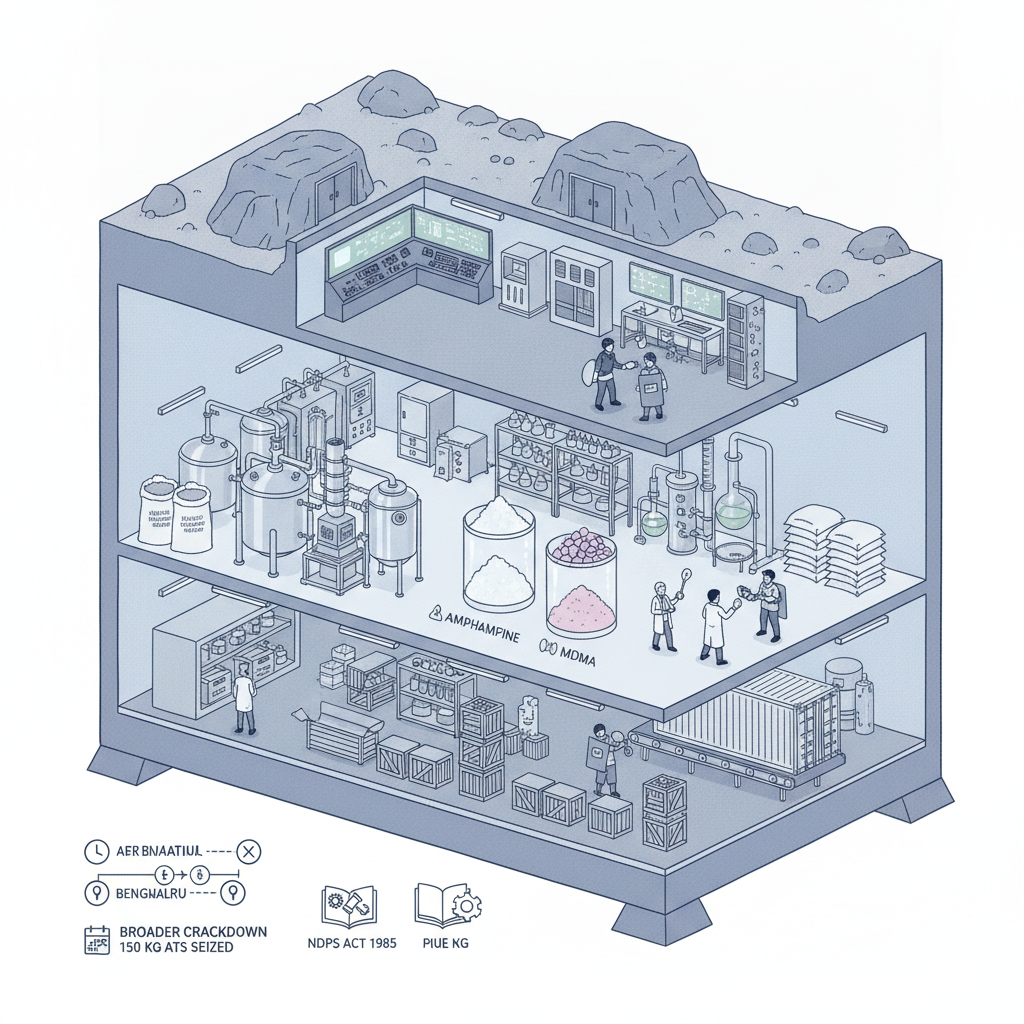
The Directorate of Revenue Intelligence (DRI) recently seized approximately 18 kilograms of synthetic drugs—including amphetamine and MDMA—across two operations in Bengaluru and Pune on 25 August 2026. This action, conducted under the Narcotic Drugs and Psychotropic Substances (NDPS) Act, 1985, resulted in the arrest of four individuals and underscores the intensification of India’s efforts to curb the trafficking of synthetic narcotics, particularly those linked to transnational criminal networks. The seizures follow a broader crackdown over two weeks, during which DRI intercepted nearly 150 kilograms of amphetamine-type stimulants (ATS), highlighting the operational scale and strategic focus of enforcement agencies.
Background
- The Narcotic Drugs and Psychotropic Substances (NDPS) Act, 1985, is the primary legal framework in India for regulating and penalizing the production, possession, sale, and trafficking of narcotic drugs and psychotropic substances.
- Synthetic drugs, including amphetamine, methamphetamine, and MDMA (ecstasy), are chemically manufactured substances that mimic the effects of traditional drugs like cocaine or cannabis but are often more potent and easier to produce illicitly.
- India’s geographical location and extensive rail and road networks make it a transit hub for drug trafficking between South and Southeast Asia, the Middle East, and beyond.
- The Directorate of Revenue Intelligence (DRI), under the aegis of the Central Board of Indirect Taxes and Customs (CBIC), is the premier intelligence and enforcement agency tasked with preventing the smuggling of contraband, including narcotics, across India’s borders and within the country.
- The global synthetic drug market has expanded significantly in recent decades, driven by demand in North America, Europe, and parts of Asia, leading to increased trafficking through India.
- Public health concerns associated with synthetic drug abuse include addiction, mental health disorders, and social destabilization, necessitating a multi-agency response.
What are Synthetic Drugs and the NDPS Act Framework?
- **Synthetic Drugs**: These are chemically engineered substances designed to produce psychoactive effects. Common examples include amphetamine (a central nervous system stimulant), methamphetamine (a highly addictive stimulant), and MDMA (a psychoactive compound with both stimulant and hallucinogenic properties).
- **Classification under NDPS Act, 1985**: The Act categorizes narcotic drugs and psychotropic substances into Schedule I, the most restrictive category, prohibiting their production, sale, or possession except for medical or scientific purposes under strict regulation.
- **Legal Provisions for Trafficking**: Under the NDPS Act, trafficking in Schedule I substances is punishable with rigorous imprisonment ranging from 10 years to life imprisonment, and fines up to ₹1 lakh or more, depending on the quantity involved. Repeat offenses attract enhanced penalties.
- **Enforcement Agencies**: The NDPS Act empowers central and state agencies, including the Narcotics Control Bureau (NCB), DRI, and state police, to investigate, seize, and prosecute drug-related offenses. The DRI focuses on interdiction at ports, airports, and land borders.
- **International Cooperation**: India is a signatory to the United Nations Convention Against Illicit Traffic in Narcotic Drugs and Psychotropic Substances, 1988, which mandates cooperation in combating drug trafficking, including intelligence sharing and joint operations.
- **Public Health Measures**: Beyond enforcement, the NDPS Act and related policies emphasize demand reduction through awareness campaigns and rehabilitation programs.
Key Features
| Feature | Significance |
|---|---|
| Quantity of Drugs Seized (18 kg ATS) | Demonstrates the scale of synthetic drug trafficking operations and the efficacy of interdiction efforts by enforcement agencies. |
| Geographical Spread (Bengaluru & Pune) | Indicates the transnational nature of drug networks, leveraging rail transport corridors across India. |
| Use of Detection Kits | Highlights the deployment of forensic tools in real-time interdiction, enhancing operational efficiency of field units. |
| Arrests under NDPS Act, 1985 | Reflects the legal framework governing drug offences and the punitive measures available to authorities. |
| Multi-Stage Interdiction (Transport & Receipt) | Shows the layered approach in dismantling supply chains, targeting both dispatchers and recipients. |
Why it Matters
Legal & Governance
- The NDPS Act, 1985 provides the statutory basis for prosecution, with stringent penalties for trafficking, including imprisonment and fines.
- Recent seizures align with the Act’s provisions, underscoring the need for robust implementation and judicial follow-up.
- The use of forensic detection kits aligns with Section 27 of the NDPS Act, which permits the use of scientific aids in investigations.
Economic
- Synthetic drug trafficking undermines public health, leading to productivity losses and increased healthcare expenditures.
- Illicit drug markets divert financial resources from legitimate economies, distorting market dynamics.
- Enforcement actions mitigate economic losses by disrupting high-value criminal enterprises.
Public Health & Social
- Synthetic drugs like Amphetamine-Type Stimulants (ATS) pose severe health risks, including addiction, psychosis, and cardiovascular complications.
- Widespread trafficking exacerbates drug abuse, particularly among youth, necessitating preventive and rehabilitative measures.
- Interdiction efforts complement harm-reduction strategies by reducing drug availability in circulation.
Operational & Institutional
- The Directorate of Revenue Intelligence (DRI) plays a pivotal role in cross-border and inter-state drug interdiction, leveraging intelligence and multi-agency coordination.
- Recent operations reflect enhanced inter-agency collaboration, including railway security personnel and forensic laboratories.
- The scale of seizures (150 kg in two weeks) suggests a need for sustained resource allocation and capacity-building in enforcement agencies.
Challenges
1. Cross-Border Drug Trafficking
- Synthetic drugs are often smuggled via international mail, courier services, and porous borders, exploiting gaps in customs and border control.
- The use of concealment methods (e.g., mixing with legal goods) complicates detection and requires advanced screening technologies.
- Transnational criminal networks operate across jurisdictions, necessitating international cooperation under frameworks like the UN Convention Against Illicit Traffic in Narcotic Drugs and Psychotropic Substances (1988).
UPSC Link: GS3: Border Management, GS3: Security Challenges
2. Technological Adaptation by Traffickers
- Traffickers employ sophisticated methods to evade detection, including digital encryption, darknet markets, and mislabeling of consignments.
- The rapid evolution of synthetic drugs (e.g., novel psychoactive substances) outpaces regulatory and enforcement responses.
- Enforcement agencies require continuous training and investment in forensic tools to stay ahead of trafficking tactics.
UPSC Link: GS3: Science & Technology in Policing
3. Judicial and Prosecutorial Bottlenecks
- Delays in trials and low conviction rates under the NDPS Act undermine deterrence and encourage repeat offences.
- The burden of proof in drug cases often requires scientific validation, which may be delayed due to limited forensic infrastructure.
- Specialized courts and fast-track mechanisms are needed to expedite cases involving large-scale drug trafficking.
UPSC Link: GS2: Judiciary & Legal System
4. Public Awareness and Prevention
- Limited public awareness about the dangers of synthetic drugs contributes to their demand and supply.
- Preventive measures, such as school-based education and community outreach, are essential to curb initiation into drug use.
- Collaboration with civil society and NGOs is critical to design targeted interventions for vulnerable populations.
UPSC Link: GS2: Social Sector & Health
5. Resource Constraints in Enforcement
- Limited manpower, training, and equipment in agencies like DRI and state police forces hinder effective interdiction.
- Inadequate funding for forensic laboratories and intelligence units restricts operational capabilities.
- The need for modernized infrastructure, including AI-driven analytics and real-time monitoring systems, is pressing.
UPSC Link: GS3: Internal Security & Policing
Challenges — UPSC Perspective
| Issue | Concern |
|---|---|
| Porous Borders & Smuggling Routes | Exploitation of weak border controls and rail networks for drug trafficking. |
| Evolving Drug Chemistry | Emergence of novel psychoactive substances that bypass existing legal frameworks. |
| Forensic Backlog | Delays in drug testing and analysis due to limited laboratory capacity. |
| Low Conviction Rates | Judicial bottlenecks and procedural delays in NDPS Act cases. |
| Public Health Impact | Rising drug abuse and associated social costs, including healthcare burden. |
| Technological Lag | Traffickers use encrypted communication and darknet markets to evade detection. |
Government Initiatives — Must-Memorise for Prelims
- Narcotic Drugs and Psychotropic Substances (NDPS) Act, 1985
Way Forward
- Strengthen inter-agency coordination between DRI, Narcotics Control Bureau (NCB), state police, and customs to disrupt trafficking networks.
- Invest in advanced forensic tools and AI-driven analytics to enhance real-time detection and interdiction capabilities.
- Establish specialized fast-track courts for NDPS Act cases to expedite trials and improve conviction rates.
- Expand public awareness campaigns, particularly targeting youth, to reduce demand for synthetic drugs.
- Enhance border and port security through capacity-building and deployment of non-intrusive inspection technologies.
- Promote international cooperation under UN conventions to address transnational drug trafficking and money laundering.
- Develop rehabilitation and de-addiction programs in collaboration with NGOs and state health departments to address drug abuse holistically.
UPSC Value Addition
Keywords for Mains Answer-Writing
Narcotic Drugs and Psychotropic Substances (NDPS) Act, 1985 · Directorate of Revenue Intelligence (DRI) · Synthetic drugs · Amphetamine-Type Stimulants (ATS) · Methamphetamine · MDMA (Ecstasy) · Drug trafficking · Illicit drug trade · NDPS Act provisions and penalties · Preventive detention in drug cases · Financial Intelligence Unit (FIU-IND) · UN Conventions on Narcotic Drugs · Drug interdiction operations · Psychotropic substances regulation
Constitutional & Policy Linkages
- Article 21 (Right to Life and Personal Liberty) – Protection from harm caused by drug abuse and trafficking.
Concept Flow
Synthetic drug trafficking networks exploit rail transport corridors and concealment methods. → Intelligence-led operations by DRI lead to interdiction and seizures under NDPS Act, 1985. → Forensic detection and judicial processes determine legal outcomes for arrested traffickers. → Public health and social consequences of drug abuse necessitate preventive and rehabilitative measures. → Systemic challenges (e.g., judicial delays, technological lag) require policy and institutional reforms. → International cooperation and capacity-building are essential to address transnational dimensions of trafficking.
Prelims Practice Questions
Q1. Consider the following statements regarding the Narcotic Drugs and Psychotropic Substances (NDPS) Act, 1985:
1. The Act empowers the Central Government to regulate the cultivation, production, sale, and consumption of narcotic drugs and psychotropic substances.
2. The Act provides for the death penalty for certain offences involving commercial quantities of drugs.
3. The Act does not apply to drugs used for medical or scientific purposes.
How many of the above statements are correct?
- Only one
- Only two
- Only three
- None
Answer: Only three — Statement 1 is correct as the NDPS Act empowers the Central Government to regulate all aspects of narcotic drugs and psychotropic substances. Statement 2 is correct as the Act prescribes the death penalty for certain offences involving commercial quantities of drugs. Statement 3 is incorrect as the Act does apply to drugs used for medical or scientific purposes, subject to regulations.
Q2. Which of the following is NOT a function of the Directorate of Revenue Intelligence (DRI)?
- Investigation of smuggling cases
- Collection of customs duties
- Intelligence gathering on drug trafficking
- Enforcement of the NDPS Act
Answer: Collection of customs duties — The Directorate of Revenue Intelligence (DRI) is primarily responsible for intelligence-based enforcement of laws related to smuggling, drug trafficking, and economic offences. While it may investigate smuggling cases, the collection of customs duties is the function of customs officers under the Central Board of Indirect Taxes and Customs (CBIC).
Q3. Assertion (A): The NDPS Act, 1985, classifies drugs into different categories based on their potential for abuse and medical utility.
Reason (R): The Act mandates the death penalty for all offences involving narcotic drugs, regardless of the quantity involved.
- Both A and R are true, and R is the correct explanation of A
- Both A and R are true, but R is not the correct explanation of A
- A is true, but R is false
- A is false, but R is true
Answer: A is true, but R is false — Assertion (A) is true as the NDPS Act classifies drugs into different schedules based on their potential for abuse and medical utility. Reason (R) is false because the Act does not mandate the death penalty for all offences; it prescribes the death penalty only for certain offences involving commercial quantities of drugs.
Mains Practice Question
✍ Critically examine the efficacy of the Narcotic Drugs and Psychotropic Substances (NDPS) Act, 1985, in addressing the menace of synthetic drugs in India. Substantiate your arguments with reference to recent enforcement actions and judicial interpretations. (15 Marks)
Approach: MODEL-ANSWER SKELETON:
1. Introduction (2 marks): Briefly define synthetic drugs (e.g., Amphetamine-Type Stimulants (ATS), Methamphetamine, MDMA) and their socio-economic impact in India. Mention the NDPS Act, 1985, as the primary legislation governing narcotic drugs and psychotropic substances.
2. Provisions of the NDPS Act relevant to synthetic drugs (3 marks):
– Classification of drugs into schedules (I, II, III, IV) based on abuse potential and medical utility.
– Definition of ‘commercial quantity’ and ‘small quantity’ under the Act.
– Punishments prescribed for possession, trafficking, and consumption of synthetic drugs.
– Role of the Central Government in regulating drug trade and enforcement agencies like DRI and Narcotics Control Bureau (NCB).
3. Enforcement actions and recent trends (4 marks):
– Cite recent enforcement actions by DRI (e.g., seizure of 18 kg of Amphetamine and MDMA in August 2026).
– Highlight the modus operandi of drug traffickers (e.g., concealment in luggage, use of courier services).
– Discuss the role of intelligence-led operations and inter-agency coordination (e.g., DRI, NCB, FIU-IND).
– Mention the seizure of 150 kg of ATS in two weeks as a recent trend.
4. Judicial interpretations and challenges (3 marks):
– Discuss landmark judgments (e.g., Arun Gopal v. State of Kerala, 2017; State of Punjab v. Baldev Singh, 2011) on NDPS Act provisions.
– Highlight judicial activism in reducing sentences for ‘small quantity’ offences and the need for proportionality in punishment.
– Discuss the balance between deterrence and reformative justice in drug cases.
5. Critique and suggestions (3 marks):
– Critique the efficacy of the NDPS Act in addressing synthetic drugs, citing loopholes (e.g., delayed trials, lack of rehabilitation provisions).
– Suggest measures: Strengthening of forensic infrastructure, international cooperation (e.g., UN Conventions), and rehabilitation programs for drug users.
– Discuss the role of awareness campaigns and community policing in prevention.
Source: PIB (Press Information Bureau)
Generated by AanyaAi for educational purpose.
Related guides on our sites
- Anthropology VS PSIR
- Best PSIR optional coaching
- Best PSIR optional coaching online
- Best PSIR optional teacher

- ग्रामीण विकास विभाग ने विशेष अभियान 6 के तहत 76% फाइलों की समीक्षा पूरी की - October 24, 2026
- 2030 तक 250 बिलियन डॉलर इंजीनियरिंग निर्यात: नीति निर्माताओं की रणनीति - October 24, 2026
- बस्तर दशहरा में राष्ट्रपति मुर्मु: जनजातीय समाज और विकास के पथ पर नया अध्याय - October 24, 2026

No Comments