


30 Jul अटल भूजल योजना: भूजल स्तर सुधार में 180 ब्लॉक सफल, जानें पूरा विश्लेषण
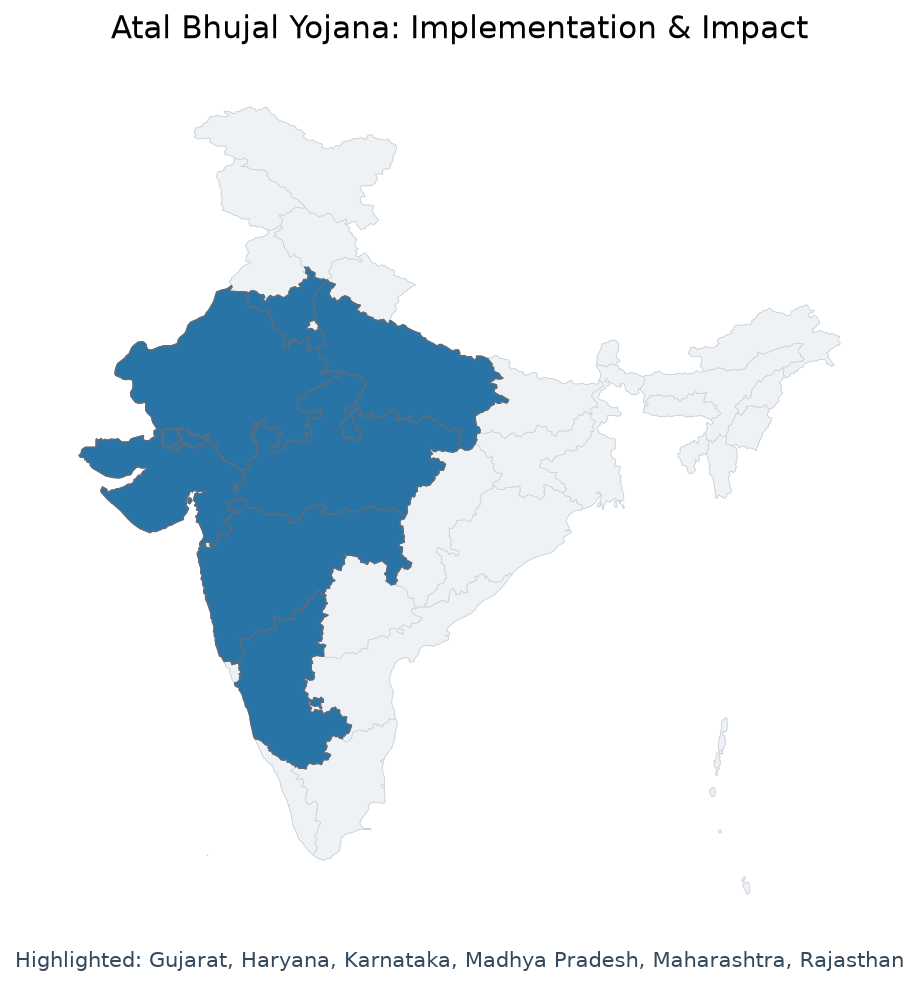
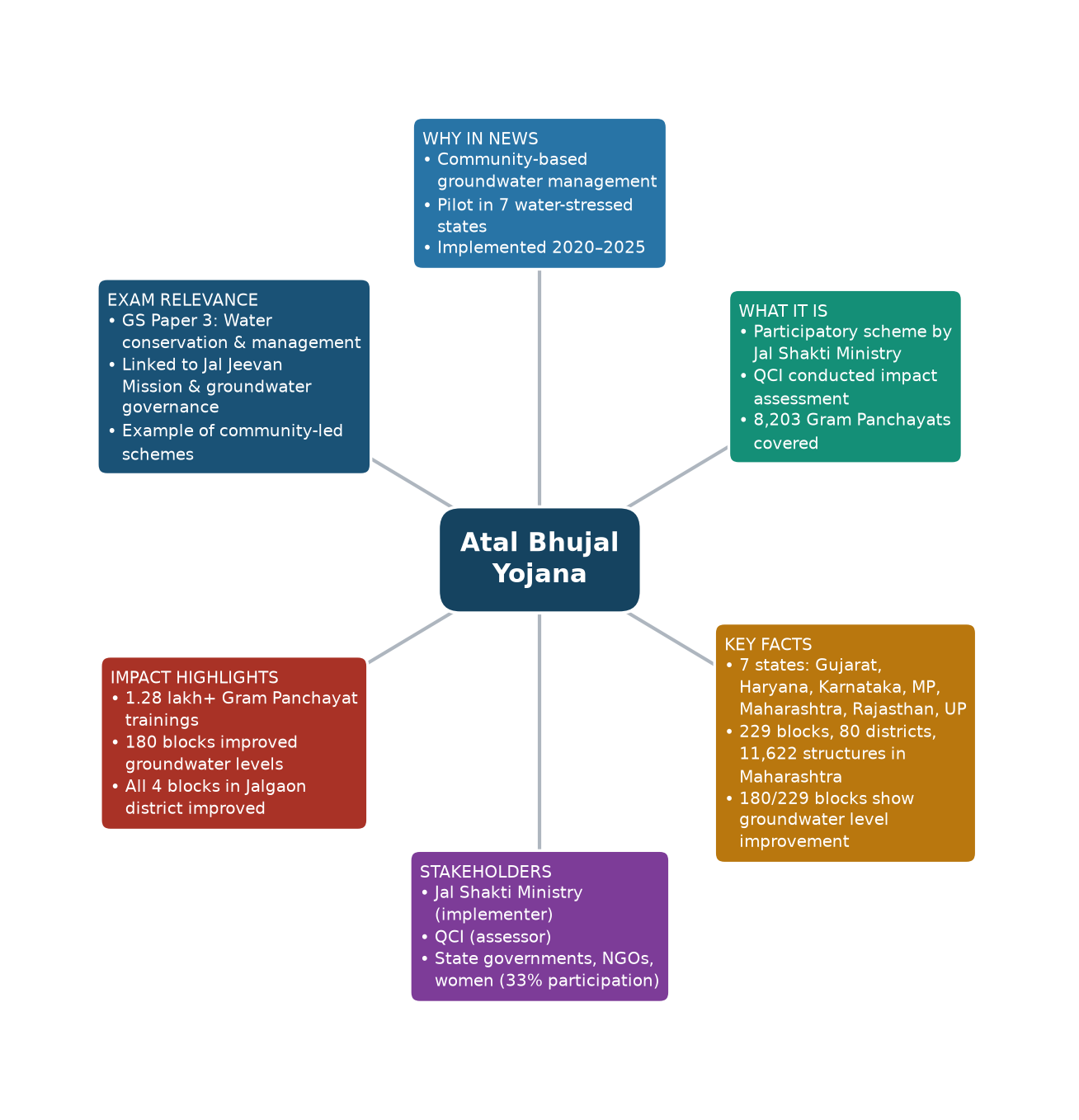
Map & concept mind-map: Atal Bhujal Yojana: Implementation & Impact
Subject Relevance — Where This Topic Fits
- GS Paper II — Governance, Transparency and Citizen Participation | GS Paper III — Water Resources, Conservation and Sustainable Agriculture | GS Paper III — Rural Development and Participatory Planning
- Prelims: Groundwater governance, Community-led natural resource management, Jal Shakti Abhiyan, Water budgeting at GP level, Participatory Irrigation Management (PIM), Aquifer mapping, Rainwater harvesting structures, Women’s participation in water governance, CSR in water conservation, Digital groundwater monitoring
- Essay: Water security as a determinant of rural livelihoods and sustainable development, From policy to practice: The role of community institutions in natural resource management
Quick Revision: Atal Jal Yojana demonstrates that participatory groundwater governance—anchored in community-led water budgeting, digital monitoring, and gender-inclusive decision-making—can reverse depletion trends in water-stressed districts within a five-year pilot period.
Why is this in the news?
The Press Information Bureau (PIB), Ministry of Jal Shakti, released an impact assessment report on 30 July 2026, evaluating the implementation of Atal Jal Yojana (Atal Jal) across seven water-stressed states from 1 April 2020 to 15 October 2025. Conducted by the Quality Council of India (QCI), the study highlights measurable improvements in groundwater levels, community awareness, and institutional capacity, affirming the pilot’s success as a scalable model for participatory groundwater governance.
Background
- Groundwater constitutes approximately 60% of India’s irrigation and 80% of rural drinking water supply, yet overexploitation has led to critical depletion in 17% of assessment units (2023 NITI Aayog report).
- The National Water Policy (2012) and subsequent National Groundwater Management Improvement Programme (NGMIP) emphasised decentralised, participatory approaches to groundwater governance.
- The scheme excluded Chhattisgarh due to its distinct hydro-geological and administrative context.
- The pilot period (2020–2025) coincided with the Jal Shakti Abhiyan and Mission Amrit Sarovar, reinforcing convergence with other water conservation initiatives.
What is Atal Jal Yojana?
- A community-based, participatory groundwater management pilot scheme launched on 1 April 2020 under the aegis of the Ministry of Jal Shakti.
- Implemented in 8,203 gram panchayats across 229 blocks in seven states: Gujarat, Haryana, Karnataka, Madhya Pradesh, Maharashtra, Rajasthan, and Uttar Pradesh.
- Aimed at improving groundwater levels through demand-side and supply-side interventions, including community-led water budgeting, aquifer mapping, and rainwater harvesting.
- Operationalised through a World Bank-funded programme (₹5,000 crore) with a central share of ₹1,000 crore, with a fixed pilot duration of five-and-a-half years (2020–2025).
- Focused on capacity building, gender inclusion, and social audit mechanisms to ensure transparency and accountability in groundwater governance.
- Utilised digital tools such as electronic groundwater data measurement, digital water level recorders, and public disclosure platforms for real-time monitoring.
- Mandated a minimum 33% participation of women in decision-making processes at the gram panchayat level.
- Converged with CSR initiatives, academic institutions, and civil society organisations to amplify community engagement and resource mobilisation.
Key Features
| Feature | Significance |
|---|---|
| Community-based participatory model | Ensures local ownership, transparency, and sustainability in groundwater management through structured Gram Panchayat engagement. |
| Decentralised water budgeting | Empowers local communities to allocate water resources rationally based on annual recharge and demand assessments. |
| Digital groundwater monitoring | Institutionalises real-time data collection via piezometers, rain gauges, and digital water-level recorders for evidence-based policy. |
| Gender-inclusive governance | Mandates minimum 33% women’s participation in decision-making, enhancing equity and effectiveness in water governance. |
| Rainwater harvesting & recharge structures | Promotes artificial recharge of aquifers through community-built or renovated structures, reducing groundwater depletion. |
Why it Matters
Economic
- Enhances agricultural productivity in water-scarce regions by improving groundwater availability, thereby stabilising rural incomes and reducing distress migration.
- Reduces long-term expenditure on groundwater extraction by lowering dependency on energy-intensive deep tube-wells and borewells.
- Leverages CSR funds and academic partnerships for scalable water conservation infrastructure, reducing fiscal burden on public exchequer.
Environmental
- Replenishes aquifers through community-led recharge initiatives, mitigating the adverse effects of over-extraction and climate-induced rainfall variability.
- Promotes eco-friendly irrigation practices (drip/sprinkler systems, mulching) that reduce water wastage and soil degradation.
- Contributes to India’s commitments under the SDG 6 (Clean Water and Sanitation) by ensuring sustainable water resource management.
Social
- Fosters social inclusion by integrating marginalised groups (women, SC/ST communities) into water governance structures, aligning with constitutional principles of equity.
- Builds community resilience against water scarcity through participatory planning and capacity-building, reducing vulnerability in drought-prone areas.
- Strengthens local institutions (Gram Panchayats) by institutionalising data-driven decision-making and transparent resource management.
Governance
- Demonstrates the efficacy of bottom-up governance models in addressing complex environmental challenges, serving as a template for future schemes.
- Institutionalises multi-stakeholder collaboration (NGOs, CSOs, academic institutions, CSR) for holistic water management.
- Enhances accountability through public disclosure of groundwater data and participatory monitoring mechanisms.
Challenges
1. Scalability and Replicability
- Limited to 8,203 Gram Panchayats across 7 states; requires expansion to cover more regions, particularly those with severe groundwater depletion (e.g., Punjab, Rajasthan’s western districts).
- Dependence on community participation may wane post-pilot phase without sustained incentives or institutional support.
- Variability in state-level implementation capacities could lead to uneven outcomes across regions.
UPSC Link: GS-III: Water Resources
2. Sustainability of Infrastructure
- Risk of underutilisation or neglect of recharge structures post-construction due to lack of maintenance mechanisms or community awareness.
- Climate change-induced erratic rainfall patterns may reduce the efficacy of traditional recharge methods, necessitating adaptive strategies.
- High initial capital expenditure for digital monitoring tools (piezometers, rain gauges) may deter replication in fiscally constrained regions.
UPSC Link: GS-III: Climate Change
3. Data Integrity and Monitoring
- Reliance on community-reported data for groundwater levels and water budgets may introduce inaccuracies without robust verification systems.
- Limited technical expertise at the Gram Panchayat level to interpret and utilise digital data for decision-making.
- Lack of standardised protocols for data sharing across states hinders comparative analysis and policy formulation.
UPSC Link: GS-III: Science & Technology
4. Gender and Social Inclusion Gaps
- Despite mandatory 33% women’s participation, patriarchal norms may still marginalise women in decision-making processes.
- SC/ST communities, though included, may face barriers in accessing training and leadership roles due to socio-economic disparities.
- Cultural sensitivities around water rights (e.g., caste-based restrictions on well access) may persist, undermining inclusivity.
UPSC Link: GS-II: Governance
5. Policy and Legal Framework
- Absence of a unified national groundwater law complicates enforcement of participatory management models across states.
- Overlapping jurisdictions between central and state agencies (e.g., Jal Shakti Ministry vs. State Water Resources Departments) may lead to coordination gaps.
- Lack of statutory backing for Gram Panchayat-led water budgets limits their enforceability against competing demands.
UPSC Link: GS-II: Federalism
Challenges — UPSC Perspective
| Issue | Concern |
|---|---|
| Limited coverage | Exclusion of severely water-stressed states like Punjab and Rajasthan’s western districts. |
| Maintenance of infrastructure | Risk of neglect of recharge structures post-construction due to lack of community ownership. |
| Data accuracy | Potential inaccuracies in community-reported groundwater data without robust verification mechanisms. |
| Gender parity | Persistent patriarchal norms may undermine women’s participation despite mandatory quotas. |
| Policy harmonisation | Absence of a unified national groundwater law complicates enforcement across states. |
Way Forward
- Expand the scheme to cover all groundwater-stressed districts, prioritising states with severe depletion (e.g., Punjab, Haryana, Rajasthan).
- Institutionalise a national groundwater law to provide statutory backing for participatory management models and Gram Panchayat-led water budgets.
- Develop a centralised digital platform for real-time groundwater data sharing and analysis, integrating inputs from state agencies and communities.
- Strengthen capacity-building programs at the Gram Panchayat level, with a focus on data interpretation, gender sensitization, and conflict resolution.
- Introduce performance-linked incentives for states to ensure timely implementation, maintenance of infrastructure, and achievement of groundwater recharge targets.
- Promote public-private partnerships to mobilise CSR funds and academic research for innovative recharge technologies and adaptive strategies.
- Conduct annual impact assessments with independent audits to identify bottlenecks and refine implementation strategies.
- Integrate the scheme with existing programs like MGNREGA for convergence in water conservation and rural employment generation.
UPSC Value Addition
Keywords for Mains Answer-Writing
Atal Jal Yojana · Community-based groundwater management · Participatory water budgeting · Groundwater level monitoring · Women’s participation in water governance · Jal Shakti Abhiyan · Water conservation structures · Groundwater recharge · Community-led water security plans · Digital groundwater recorders
Constitutional & Policy Linkages
- Article 243G: Empowers Gram Panchayats to prepare plans for economic development and social justice, aligning with participatory water governance.
- Directive Principles of State Policy (Article 39(b), (c)): Ensures equitable distribution of resources and prevention of concentration of wealth, relevant to water rights.
Concept Flow
Groundwater depletion → Community-led participatory planning (Atal Jal Yojana) → Capacity building and gender-inclusive governance → Construction of recharge structures and adoption of efficient irrigation practices → Improvement in groundwater levels → Enhanced agricultural productivity and rural resilience.
Prelims Practice Questions
Q1. Consider the following statements regarding the Atal Jal Yojana:
1. It is a community-based participatory groundwater management scheme.
2. It was implemented in seven states including Chhattisgarh.
3. The scheme mandates at least 33% participation of women in decision-making processes.
4. It includes the installation of digital groundwater recorders in all Gram Panchayats.
How many of the above statements are correct?
- Only one
- Only two
- Only three
- All four
Answer: Only three — Statements 1 and 3 are correct. Statement 2 is incorrect as Chhattisgarh was not included in the scheme. Statement 4 is incorrect as digital groundwater recorders were installed in ‘almost all’ Gram Panchayats, not all.
Q2. Assertion (A): The Atal Jal Yojana primarily focuses on supply-side interventions such as construction of water conservation structures.
Reason (R): The scheme also emphasizes demand-side measures like participatory water budgeting and community-led water security plans.
- Both A and R are true, and R is the correct explanation of A.
- Both A and R are true, but R is not the correct explanation of A.
- A is true, but R is false.
- A is false, but R is true.
Answer: A is true, but R is false. — Assertion (A) is true as the scheme includes construction of water conservation structures. Reason (R) is also true as the scheme emphasizes demand-side measures. However, R does not explain A as it describes a different aspect of the scheme.
Q3. Match the following states with the number of blocks covered under the Atal Jal Yojana:
Column I (State) | Column II (Number of Blocks)
— | —
A. Rajasthan | 1. 29
B. Maharashtra | 2. 43
C. Gujarat | 3. 30
D. Uttar Pradesh | 4. 35
- A-1, B-2, C-3, D-4
- A-2, B-1, C-4, D-3
- A-3, B-2, C-1, D-4
- A-4, B-3, C-2, D-1
Answer: A-1, B-2, C-3, D-4 — Rajasthan had 29 blocks, Maharashtra had 43 blocks, Gujarat had 30 blocks, and Uttar Pradesh had 35 blocks under the Atal Jal Yojana.
Mains Practice Question
✍ The Atal Jal Yojana represents a paradigm shift from government-led to community-led groundwater management in India. Critically examine this proposition with reference to the scheme’s design, implementation, and outcomes. Also, assess the role of women’s participation in enhancing the scheme’s effectiveness. (15 Marks)
Approach: MODEL-ANSWER SKELETON:
1. **Introduction (2 marks)**: Define Atal Jal Yojana as a community-based participatory groundwater management scheme launched in 2020 under the Jal Shakti Mission. Highlight its pilot nature and coverage in seven water-stressed states.
2. **Design and Features (4 marks)**:
– Community participation: Formation of Water User Associations (WUAs) and Gram Panchayat-level water budgeting.
– Institutional mechanisms: Involvement of NGOs as District Implementation Partners and mandatory 33% women’s participation in decision-making.
– Technological integration: Installation of digital groundwater recorders, rain gauges, and piezometers in Gram Panchayats.
– Supply-side interventions: Construction/renovation of 99,000+ water conservation and recharge structures.
– Demand-side measures: Adoption of efficient irrigation practices (drip/sprinkler irrigation) across 9.7 lakh hectares.
3. **Implementation and Outcomes (5 marks)**:
– **Groundwater level improvement**: Cite data showing improvement in 180 out of 229 blocks, with Maharashtra’s Jalgaon district showing improvement in all four blocks.
– **Capacity building**: 1.28 lakh Gram Panchayat-level training sessions conducted.
– **Social inclusion**: Enhanced community awareness, leadership by women, and social inclusivity.
– **Monitoring and transparency**: Public disclosure of groundwater data and real-time monitoring of 70,000 wells.
4. **Role of Women’s Participation (2 marks)**:
– Mandatory 33% participation in decision-making ensured gender-inclusive governance.
– Women-led initiatives in water budgeting and security planning enhanced local ownership and sustainability.
– Case evidence: Improved groundwater management in Maharashtra’s Jalgaon district linked to women’s leadership.
5. **Critique and Challenges (2 marks)**:
– **Limited scope**: Pilot nature restricts scalability; requires expansion to more states/districts.
– **Sustainability**: Long-term viability depends on continued community engagement and funding.
– **Data gaps**: Need for more granular, real-time data for adaptive management.
6. **Conclusion (2 marks)**:
– Atal Jal Yojana successfully demonstrates the efficacy of community-led groundwater management.
– Women’s participation is a critical enabler, but sustained institutional support and scaling up are essential for national impact.
Source: PIB (Press Information Bureau)
Generated by AanyaAi for educational purpose.

- UPSC Civil Services (Main) Examination 2026 — Public Administration Optional Paper I: Questions with Model Answers | Plutus IAS - September 24, 2026
- Madras HC Ruling: Resigned MLAs Can Recontest in By-Elections - September 24, 2026
- विदेश मंत्री जयशंकर की यूरोप के चार विदेश मंत्रियों से द्विपक्षीय वार्ता, भारत-ईयू एफटीए पर चर्चा - September 24, 2026

No Comments