


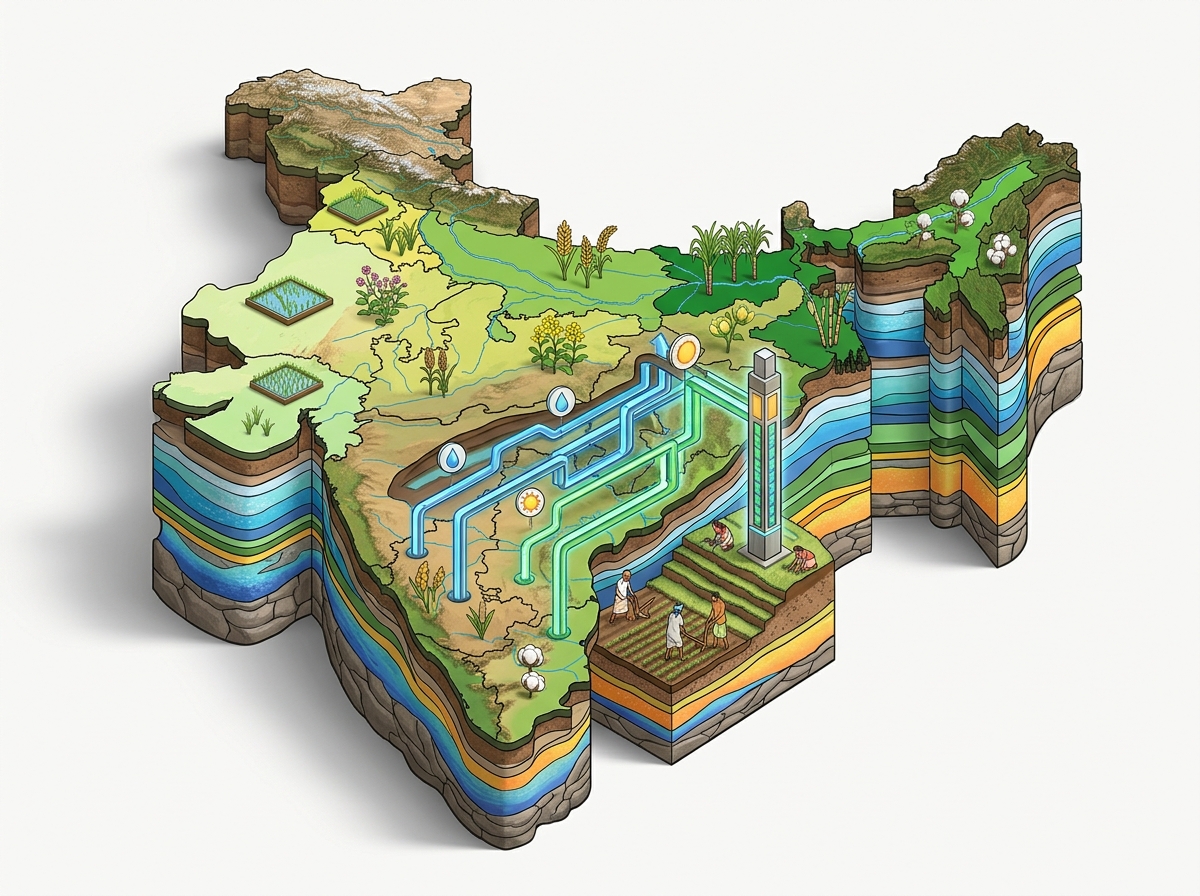
01 Sep खरीफ 2026: धान-उत्पादन क्षेत्र में 14.36 लाख हेक्टेयर की गिरावट
✎ The Progressive Report on Kharif Crop Sowing Area is a weekly government publication that tracks real-time sown area data for key kharif crops, enabling early assessment of production trends and policy responses to ensure food…
Subject Relevance — Where This Topic Fits
- GS Paper III — Agriculture | GS Paper III — Food Security and Subsidies | GS Paper III — Land Reforms and Agricultural Productivity | GS Paper III — Government Policies and Interventions for Development in Various Sectors | GS Paper II — Regional and State-Specific Development
- Prelims: Kharif crops, Sowing area coverage, Pulses, Coarse cereals (Shri Anna), Oilseeds, Agricultural Census, Minimum Support Price (MSP), National Food Security Mission (NFSM), Pradhan Mantri Fasal Bima Yojana (PMFBY), Soil Health Card Scheme
- Essay: Agricultural productivity and food security in India: Challenges and pathways, Balancing ecological sustainability with agricultural growth: The case of India’s kharif season
Quick Revision: The Progressive Report on Kharif Crop Sowing Area is a weekly government publication that tracks real-time sown area data for key kharif crops, enabling early assessment of production trends and policy responses to ensure food security and agricultural resilience.
Why is this in the news?
The Ministry of Agriculture and Farmers’ Welfare, Government of India, released the Progressive Report on Area Coverage under Kharif Crops for the week ending 28 August 2026. This report provides a comparative assessment of the sown area for key kharif crops—rice, pulses, coarse cereals (Shri Anna), oilseeds, sugarcane, jute, mesta, and cotton—against the corresponding period of the previous kharif season (2025-26). The data reveals significant inter-state and inter-crop variations, highlighting the need for targeted policy interventions to ensure food security, price stability, and sustainable agricultural practices in the context of climate variability and market dynamics.
Background
- Kharif crops are sown during the southwest monsoon season (June–September), with harvesting occurring from September to December.
- The Government of India monitors the sowing progress through the Crop Weather Watch Group (CWWG).
- Kharif sowing patterns are influenced by monsoon rainfall distribution, soil moisture availability, market prices, and government policies such as Minimum Support Prices (MSP) and input subsidies.
- Climate change-induced erratic rainfall and rising temperatures have exacerbated risks such as droughts, floods, and pest attacks, necessitating adaptive agricultural strategies.
Understanding the Progressive Report on Kharif Crop Sowing Area
- The Progressive Report is a weekly publication by the Ministry of Agriculture and Farmers’ Welfare, providing real-time data on the sown area of kharif crops across India, state-wise and crop-wise.
- The report compares the current season’s (2026-27) sowing area with the corresponding period of the previous kharif season (2025-26) and the final area coverage of the last completed kharif season (2025-26), enabling trend analysis and early warning of potential shortfalls.
- Key crops monitored include rice (paddy), pulses (tur, urad, moong, kulthi, moth bean, and others), coarse cereals (Shri Anna: jowar, bajra, ragi, small millets, maize), oilseeds (groundnut, soybean, sunflower, sesamum, nigerseed, castor, and others), sugarcane, jute, mesta, and cotton.
- The data is compiled using a combination of satellite imagery (e.g., remote sensing from ISRO’s Resourcesat-2), state agricultural department reports, and field-level surveys conducted by agricultural extension officers.
- The report serves as an early warning system for policymakers to address potential deficits in food grain production, price volatility, and supply chain disruptions, particularly for essential commodities like rice and pulses.
- State-wise variations in sowing area reflect differences in agro-climatic conditions, water availability, farmer preferences, and policy incentives (e.g., MSP, irrigation subsidies, and crop insurance schemes).
- The report also highlights the impact of extreme weather events (e.g., delayed monsoon, deficit rainfall in key regions) on sowing patterns and crop diversification trends.
- For UPSC aspirants, this report is a critical tool for understanding the intersection of agricultural policy, climate resilience, and food security in India’s kharif season.
Key Features
| Feature | Significance |
|---|---|
| Decline in Rice Acreage | A 14.36 lakh hectare reduction in kharif rice sowing (from 428.46 to 414.10 lakh hectares) indicates potential supply-side constraints, regional climatic anomalies, or farmer preference shifts toward alternative crops. |
| Pulse Acreage Expansion | A marginal 1.39 lakh hectare increase in pulse cultivation (to 115.05 lakh hectares) reflects policy incentives under schemes like NFSM and rising domestic demand for protein-rich crops. |
| Decline in Millets (Shri Anna) | A 4.21 lakh hectare reduction in millet acreage (to 177.90 lakh hectares) underscores challenges in mainstreaming nutri-cereals despite government promotion under the ‘Millet Mission’. |
| Oilseeds Sector Stability | A minor 1.00 lakh hectare decline in oilseed sowing (to 190.45 lakh hectares) suggests resilience in edible oil production, though gaps persist in achieving self-sufficiency. |
| State-wise Disparities | Significant inter-state variations (e.g., Karnataka’s 7.16 lakh hectare decline in millets, Uttar Pradesh’s 3.97 lakh hectare increase in pulses) highlight the role of agro-climatic conditions, water availability, and policy implementation in crop choices. |
Why it Matters
Agrarian Economy
- Kharif crop acreage directly influences India’s agricultural GDP, food security, and rural employment, given that kharif contributes ~50% of annual foodgrain output.
- Fluctuations in acreage for staple crops (rice, pulses, millets) impact market prices, inflation trends, and farmer incomes, necessitating real-time monitoring by the Ministry of Agriculture.
- Diversification trends (e.g., shift from rice to pulses/millets) may alter cropping patterns, requiring adaptive agricultural policies and market linkages.
Food Security
- Rice, being a staple, sees a notable acreage decline, which could affect buffer stock norms and PDS allocations if monsoon deficits or farmer preferences persist.
- Pulses, a protein source, show marginal expansion, aligning with India’s protein-deficit challenges and the National Food Security Mission’s objectives.
- Millets, promoted under ‘Shri Anna’, face acreage decline despite nutritional benefits, indicating gaps in demand generation and supply chain integration.
Trade and External Sector
- Oilseeds acreage stability is critical for reducing edible oil imports, which cost ~$16 billion annually, and for achieving the government’s self-sufficiency target by 2027.
- Fluctuations in cotton acreage (125.51 lakh hectares) impact textile exports, a key sector for employment and foreign exchange earnings.
- State-wise disparities in acreage may influence regional trade flows, necessitating inter-state coordination for market stabilization.
Climate Resilience
- Regional declines in acreage (e.g., Karnataka for millets, Maharashtra for pulses) may reflect climate-induced stress, underscoring the need for climate-smart agriculture and drought-resistant varieties.
- Increased acreage in states like Rajasthan and Chhattisgarh for millets suggests adaptive cropping in response to changing monsoon patterns.
Challenges
1. CLIMATE VARIABILITY AND MONSOON DEFICITS
- Erratic monsoon patterns in 2026 (e.g., delayed onset, uneven distribution) have led to reduced sowing in key rice-growing states like Karnataka, Telangana, and Jharkhand.
- Prolonged dry spells in Maharashtra and Karnataka have adversely affected pulse and millet cultivation, exacerbating farmer distress.
- Climate change projections indicate increased frequency of extreme weather events, necessitating resilient crop varieties and water-efficient farming practices.
UPSC Link: GS Paper 3: Climate Change and Agriculture
2. INPUT COSTS AND PROFITABILITY GAPS
- Rising costs of seeds, fertilizers, and diesel have eroded profit margins, particularly for small and marginal farmers, discouraging intensive cropping of high-input crops like rice.
- Price volatility in pulses and oilseeds (e.g., tur, soybean) reduces farmer confidence, leading to acreage shifts toward more remunerative or low-risk crops.
- Lack of access to institutional credit and crop insurance in states like Maharashtra and Karnataka exacerbates vulnerability to input cost fluctuations.
UPSC Link: GS Paper 3: Agricultural Marketing and Price Policy
3. MARKET DISTORTIONS AND PRICE SIGNALS
- Distorted price signals (e.g., minimum support prices not aligned with market realities) have led to overproduction of certain crops (e.g., rice) and underproduction of others (e.g., pulses).
- Weak market linkages and post-harvest losses (estimated at 15-20% for perishable crops) discourage farmers from expanding acreage in high-value crops like oilseeds.
- Global price fluctuations (e.g., edible oil imports) influence domestic sowing decisions, creating a feedback loop between international markets and local acreage.
UPSC Link: GS Paper 3: Agricultural Marketing and Supply Chain
4. POLICY IMPLEMENTATION GAPS
- Inconsistent implementation of flagship schemes (e.g., National Food Security Mission, Mission for Integrated Development of Horticulture) has failed to address regional disparities in acreage expansion.
- Lack of convergence between central schemes (e.g., PM-KISAN, PMFBY) and state-level agricultural programs leads to suboptimal resource allocation.
- Delayed disbursal of subsidies (e.g., for seeds, fertilizers) and poor extension services undermine farmer adoption of recommended practices.
UPSC Link: GS Paper 3: Government Policies for Agriculture
5. INFRASTRUCTURE AND TECHNOLOGY LAG
- Inadequate irrigation infrastructure (e.g., dependence on monsoon in states like Telangana and Jharkhand) limits crop diversification and intensification.
- Limited access to modern farm technologies (e.g., precision agriculture, drones) in rainfed regions restricts yield optimization and acreage expansion.
- Poor rural connectivity and storage facilities (e.g., cold chains for perishable crops) increase post-harvest losses and discourage high-value crop cultivation.
UPSC Link: GS Paper 3: Agricultural Technology and Innovation
Challenges — UPSC Perspective
| Issue | Concern |
|---|---|
| Regional Acreage Disparities | Uneven distribution of sowing across states (e.g., Karnataka’s decline vs. Uttar Pradesh’s growth) threatens national food security and complicates logistics. |
| Climate-Induced Crop Shifts | Monsoon variability is altering traditional cropping patterns, risking long-term food system stability and farmer livelihoods. |
| Price Volatility in Pulses/Oilseeds | Fluctuating market prices discourage farmers from expanding acreage in high-protein or oilseed crops, despite policy incentives. |
| Post-Harvest Losses | Inadequate storage and processing infrastructure leads to wastage, reducing the effective supply of key crops like pulses and millets. |
| Policy-Implementation Mismatch | Central schemes often fail to address ground-level constraints (e.g., credit access, extension services), limiting their impact on acreage expansion. |
| Technology Adoption Gaps | Low penetration of modern farm technologies in rainfed regions restricts yield potential and acreage diversification. |
Way Forward
- Strengthen climate-resilient agriculture through the promotion of drought-resistant varieties (e.g., Sahbhagi Dhan for rice, Arka Suryamukhi for sunflower) and water-efficient irrigation methods (e.g., drip irrigation, micro-sprinklers).
- Enhance market linkages for pulses, oilseeds, and millets by expanding procurement under MSP schemes, improving storage infrastructure, and facilitating direct farmer-buyer interactions via e-NAM platforms.
- Rationalize input subsidies (e.g., fertilizers, seeds) and align MSPs with market realities to provide accurate price signals for farmers, particularly in high-cost crops like rice.
- Expand access to institutional credit and crop insurance (e.g., PMFBY) in states with high acreage disparities (e.g., Maharashtra, Karnataka) to mitigate input cost risks.
- Promote agri-startups and FPOs to improve post-harvest management, value addition, and supply chain efficiency for perishable crops like pulses and millets.
- Invest in rural infrastructure (e.g., cold storage, rural roads) and digital extension services to bridge the technology adoption gap in rainfed regions.
- Converge central schemes (e.g., PM-KISAN, NFSM) with state-level programs to ensure uniform implementation and address regional disparities in acreage expansion.
- Conduct real-time monitoring of sowing progress and market trends through satellite-based acreage estimation (e.g., FASAL project) to enable proactive policy interventions.
UPSC Value Addition
Keywords for Mains Answer-Writing
Agricultural Statistics · Kharif Crops Sowing Progress · Crop Diversification · Agricultural Policy · Food Security · Rainfed Agriculture · Agricultural Data · Agricultural Production · Cropping Pattern · Agricultural Output · Agrometeorology · Agricultural Economics · Kharif Season · Agricultural Land Use · Agricultural Productivity · Agricultural Policy Framework
Concept Flow
Monsoon Variability → Reduced Soil Moisture → Delayed/Reduced Sowing (e.g., Rice in Karnataka, Telangana) → Decline in Acreage → Supply Shortage → Price Inflation → Farmer Distress → Policy Intervention (e.g., MSP, Subsidies) → Input Cost Escalation (Fertilizers, Diesel) → Reduced Profit Margins → Shift to Low-Input Crops (e.g., Millets in Maharashtra) → Regional Acreage Disparities → Market Distortions → Policy Recalibration (e.g., Rationalized Subsidies) → Global Edible Oil Prices → Farmer Preference for Oilseeds → Expansion in Soybean/Mustard Acreage → Domestic Supply Surplus → Price Decline → Reduced Incentives → Stagnation in Acreage Growth → Policy Incentives (NFSM, Millet Mission) → Farmer Adoption → Expansion in Pulse/Millet Acreage → Supply Increase → Price Stabilization → Sustained Acreage Growth → Post-Harvest Losses (15-20%) → Reduced Effective Supply → Market Shortages → Price Volatility → Farmer Disincentive → Underinvestment in High-Value Crops → Acreage Stagnation
Prelims Practice Questions
Q1. Consider the following statements regarding the Kharif cropping season in India:
1. The Kharif season typically begins with the onset of the southwest monsoon in June and concludes with the withdrawal of the monsoon in September.
2. Major Kharif crops include rice, maize, soybean, cotton, and jute.
3. The area under Kharif cultivation is reported weekly by the Ministry of Agriculture and Farmers’ Welfare.
4. The Kharif season is primarily dependent on irrigation rather than rainfall.
How many of the above statements are correct?
- Only one
- Only two
- Only three
- All four
Answer: Only three — Statements 1, 2, and 3 are correct. The Kharif season is rainfed and begins with the southwest monsoon. Statement 4 is incorrect as Kharif crops are predominantly dependent on rainfall, not irrigation.
Q2. Assertion (A): The area under rice cultivation in India has shown a decline in the 2026-27 Kharif season compared to the previous year.
Reason (R): This decline is attributed to reduced rainfall in major rice-growing states like Karnataka, Telangana, and Jharkhand.
Options:
A. Both A and R are true, and R is the correct explanation of A.
B. Both A and R are true, but R is NOT the correct explanation of A.
C. A is true, but R is false.
D. A is false, but R is true.
Answer: ? — Both A and R are true, and R correctly explains the decline in rice cultivation area as these states experienced reduced rainfall, impacting sowing.
Q3. Match the following crops with their respective categories in the Kharif season:
Column I (Crop) Column II (Category)
A. Rice 1. Coarse Cereals
B. Jowar 2. Pulses
C. Tur 3. Oilseeds
D. Soyabean 4. Foodgrains
Options:
A. A-4, B-1, C-2, D-3
B. A-4, B-3, C-2, D-1
C. A-2, B-1, C-4, D-3
D. A-3, B-4, C-1, D-2
Answer: ? — Rice and Jowar are foodgrains, Tur is a pulse, and Soyabean is an oilseed. The correct match is A-4, B-1, C-2, D-3.
Mains Practice Question
✍ Critically analyse the trends in Kharif crop sowing area in India as reported for the week ending 28 August 2026. Highlight the key variations in acreage across major crops and states, and discuss the implications for agricultural policy and food security in the country. (15 Marks)
Approach: MODEL-ANSWER SKELETON:
1. **Introduction (2 marks)**: Define the Kharif season, its significance for India’s agricultural output, and the importance of timely sowing data for policy formulation.
2. **Trends in Crop-wise Acreage (5 marks)**:
– Rice: Decline of 14.36 lakh hectares (414.10 lakh ha in 2026-27 vs. 428.46 lakh ha in 2025-26). Key states: Karnataka (-3.61), Telangana (-3.29), Jharkhand (-1.82).
– Pulses: Increase of 1.39 lakh hectares (115.05 lakh ha vs. 113.66 lakh ha). Key states: Uttar Pradesh (+3.97), Jharkhand (+0.93), Telangana (+0.88).
– Coarse Cereals: Decline of 4.21 lakh hectares (177.90 lakh ha vs. 182.11 lakh ha). Key states: Karnataka (-7.16), Maharashtra (-2.41), Rajasthan (+2.75).
– Oilseeds: Decline of 1.00 lakh hectares (190.45 lakh ha vs. 191.45 lakh ha). Key states: Rajasthan (-2.23), Gujarat (-1.90), Uttar Pradesh (+2.91).
3. **State-wise Variations and Causes (4 marks)**:
– Factors contributing to decline: Erratic monsoon, drought conditions in Karnataka, Telangana, and Maharashtra.
– Factors contributing to increase: Policy incentives (e.g., pulses mission), improved seed varieties, and favourable monsoon in Uttar Pradesh, Rajasthan, and Chhattisgarh.
4. **Policy and Food Security Implications (4 marks)**:
– **Agricultural Policy**: Need for targeted interventions in states with declining acreage (e.g., drought-resistant varieties, irrigation support).
– **Food Security**: Impact on rice and coarse cereals output may affect buffer stocks and prices. Pulses and oilseeds growth is positive but needs scaling.
– **Climate Resilience**: Emphasise climate-smart agriculture, crop diversification, and early warning systems for monsoon variability.
5. **Conclusion (2 marks)**: Summarise the need for data-driven policy adjustments, investment in agricultural infrastructure, and long-term strategies to mitigate climate risks.
Source: PIB (Press Information Bureau)
Generated by AanyaAi for educational purpose.
Related guides on our sites
- Best economics services coaching
- Anthropology VS PSIR
- Best PSIR optional coaching
- Best PSIR optional coaching online

- यूपी हाईकोर्ट ने स्कूल बस सुरक्षा पर दिया सख्त आदेश, डीएम को 1 माह में रिपोर्ट देने का निर्देश - September 22, 2026
- UP High Court Directs DM & Chief Secretary on School Vehicle Safety: Key Facts for UPSC/PCS - September 22, 2026
- पेरियार टाइगर रिजर्व में 6 नई प्रजातियाँ खोजी गईं, जानिए क्या हैं विशेषताएँ - September 22, 2026

No Comments