


24 Sep छत्तीसगढ़ में नई रेल लाइन: ताड़ोकी-रावघाट खंड पूरा, परिवहन क्रांति
✎ The Tadoki-Raoghat section of the Dalli Rajhara-Raoghat new rail line—an electrified broad-gauge single line in South Chhattisgarh—has completed CRS inspection and speed trials, marking a critical step toward operationalisation…
Subject Relevance — Where This Topic Fits
- GS Paper II — Governance, Constitution, Polity, Social Justice and International Relations (Sub-national Governance and Infrastructure Development) | GS Paper III — Infrastructure: Energy, Ports, Roads, Railways and Airports; Industrial Policy and Development
- Prelims: CRS inspection, Single line electrified broad gauge, South East Central Railway, Dalli Rajhara-Raoghat new line project, Chhattisgarh mineral corridor
- Essay: Infrastructure as a catalyst for regional development: Balancing economic growth with inclusive access, The role of railways in India’s socio-economic transformation: Lessons from hinterland connectivity
Quick Revision: The Tadoki-Raoghat section of the Dalli Rajhara-Raoghat new rail line—an electrified broad-gauge single line in South Chhattisgarh—has completed CRS inspection and speed trials, marking a critical step toward operationalisation and enhanced mineral logistics for the Bhilai Steel Plant.
Why is this in the news?
The completion of the Tadoki-Raoghat section of the Dalli Rajhara-Raoghat new rail line by Indian Railways represents a critical milestone in enhancing connectivity to remote regions of South Chhattisgarh. This 17.5 km electrified broad-gauge segment, part of a 95 km project, underwent mandatory Commission of Railway Safety (CRS) inspection and speed trials, marking a key procedural step toward operationalisation. The development is strategically significant for facilitating iron ore transport to the Bhilai Steel Plant, strengthening regional economic linkages, and improving access to essential services in hinterland districts.
Background
- Indian Railways operates under the Ministry of Railways and functions as the principal rail transporter in India, governed by the Railway Act, 1989, and administered through zonal railways including the South East Central Railway (SECR).
- Chhattisgarh, a mineral-rich state, is a critical contributor to India’s iron ore production, with deposits primarily located in the Bailadila and Dalli Rajhara regions.
- The Bhilai Steel Plant (BSP), a flagship unit of Steel Authority of India Limited (SAIL), is a key industrial hub in Chhattisgarh, heavily dependent on efficient logistics for raw material supply and finished product distribution.
- Railways are the dominant mode for bulk freight transport in India, accounting for over 60% of freight movement, including minerals and steel, due to their cost-effectiveness and large carrying capacity.
- The Dalli Rajhara-Raoghat project is part of the broader strategy to enhance last-mile connectivity in mineral-rich hinterlands, reducing road dependence and improving logistics efficiency.
- Electrification of rail lines is a national priority under the Mission 100% Electrification initiative, aimed at reducing carbon footprint, lowering operational costs, and enhancing energy security.
What is the Dalli Rajhara-Raoghat New Rail Line Project?
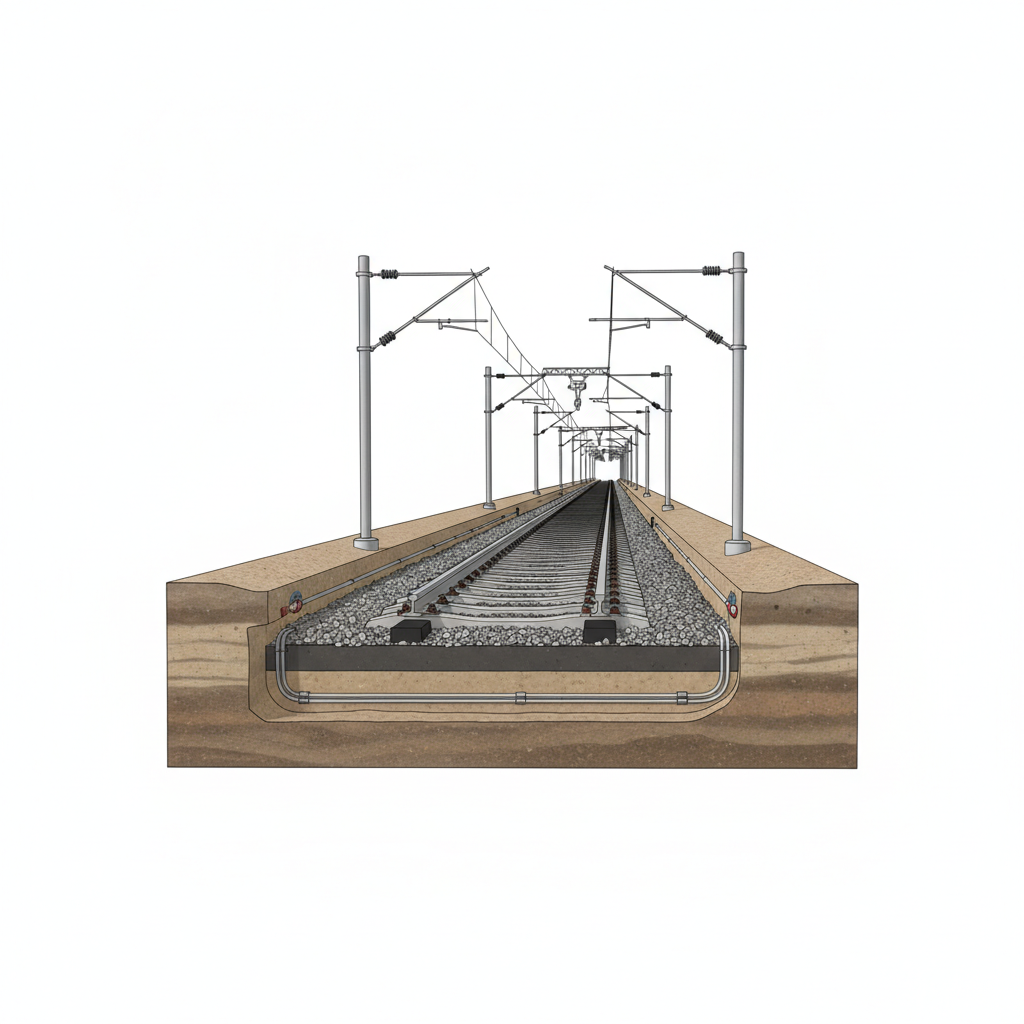
- The Dalli Rajhara-Raoghat new rail line is a 95 km single-line electrified broad-gauge project under the South East Central Railway (SECR), connecting Dalli Rajhara to Raoghat in South Chhattisgarh.
- The project comprises multiple sections, with the Tadoki-Raoghat segment (17.5 km) being the final and most remote stretch, now completed and undergoing CRS inspection and speed trials.
- Electrification of the line enables energy-efficient operations, aligns with India’s decarbonisation goals, and supports the shift from diesel to electric traction in freight transport.
- The project includes modern signalling systems, bridge structures, and safety protocols to ensure operational reliability and compliance with Railway Safety Commission standards.
- Upon completion, the line will integrate remote tribal and rural areas of South Chhattisgarh with major urban centres like Raipur and Bhilai, enhancing access to education, healthcare, and markets.
- The project exemplifies the ‘Hub-and-Spoke’ model of infrastructure development, where a central industrial hub (BSP) is connected to peripheral resource nodes (mines) via dedicated corridors.
- The initiative is aligned with the National Rail Plan (NRP) 2030, which prioritises last-mile connectivity for mineral and agricultural belts to boost industrial output and rural prosperity.
Key Features
| Feature | Significance |
|---|---|
| Single-line electrified broad-gauge section | Ensures higher operational efficiency and reduced carbon footprint compared to diesel traction. |
| 17.5 km Tadoki-Rawaghata segment | Completes the critical last link in the 95 km Dallirajhara-Rawaghata new rail line project. |
| CRS inspection and speed trial | Mandatory safety certification ensuring compliance with Railway Board standards before commercial operations. |
| Connectivity to Bhilai Steel Plant | Facilitates seamless transportation of iron ore, reducing logistics costs for the steel industry. |
| Integration with South East Central Railway | Expands the regional rail network under the Raipur Division, enhancing multi-modal connectivity. |
Why it Matters
Economic
- Reduces transportation costs for iron ore from mines in southern Chhattisgarh to Bhilai Steel Plant, enhancing competitiveness of India’s steel sector.
- Boosts local trade by enabling efficient movement of agricultural and commercial goods to urban markets in Raipur and Bhilai.
- Stimulates ancillary industries such as logistics, warehousing, and small-scale manufacturing along the rail corridor.
Strategic Infrastructure
- Strengthens rail connectivity in remote tribal-dominated districts of southern Chhattisgarh, reducing dependence on road transport.
- Enhances disaster-resilience by providing an alternative transport mode during monsoon disruptions on highways.
- Supports national mineral security by ensuring reliable supply chains for critical raw materials.
Social Development
- Improves access to education and healthcare services in hinterland areas by reducing travel time to Raipur and Bhilai.
- Facilitates labour mobility, enabling workers to commute to industrial and service sector hubs.
- Promotes tourism by linking remote cultural and natural sites to broader rail networks.
Environmental
- Electrified rail reduces greenhouse gas emissions per tonne-km compared to diesel traction.
- Encourages modal shift from road to rail, lowering particulate matter and noise pollution in the region.
Challenges
1. Land Acquisition and Rehabilitation
- Delays in land acquisition for right-of-way and station infrastructure due to fragmented land holdings in tribal areas.
- Need for equitable compensation and resettlement policies compliant with the Right to Fair Compensation and Transparency in Land Acquisition Act, 2013.
UPSC Link: Land Acquisition Act 2013
2. Geological and Engineering Constraints
- Undulating terrain and dense forest cover in southern Chhattisgarh necessitate extensive tunnelling and bridge construction.
- High rainfall and soil erosion risks require robust drainage and slope stabilisation measures.
UPSC Link: Geotechnical challenges in railway projects
3. Operational Readiness
- Ensuring seamless integration with existing rail networks, including signal synchronisation and rolling stock compatibility.
- Training local staff and contractors in modern railway operations and safety protocols.
UPSC Link: Railway operational standards
4. Socio-economic Integration
- Balancing industrial development with preservation of tribal livelihoods and cultural heritage.
- Ensuring equitable access to rail services for marginalised communities through affordable fares and connectivity planning.
UPSC Link: Inclusive infrastructure development
5. Financing and Cost Overruns
- Securing long-term funding for capital-intensive rail projects in low-density corridors.
- Mitigating cost overruns due to inflation, geological surprises, or regulatory delays.
UPSC Link: Infrastructure financing models
Challenges — UPSC Perspective
| Issue | Concern |
|---|---|
| Land fragmentation | Delays in acquisition due to multiple small landholdings in tribal areas. |
| Forest clearances | Need for compliance with Forest Rights Act, 2006 and wildlife protection norms. |
| Monsoon disruptions | Risk of landslides and track washouts during heavy rainfall. |
| Rolling stock availability | Ensuring sufficient locomotives and wagons for iron ore transport. |
| Local employment | Limited skilled workforce in the region necessitates targeted training programs. |
| Cross-subsidisation | Balancing freight and passenger tariffs to ensure economic viability. |
Way Forward
- Conduct phased commercial trials on the Tadoki-Rawaghata segment to validate operational parameters.
- Establish dedicated freight corridors for iron ore to optimise logistics and reduce turnaround time.
- Launch skill development programs in collaboration with ITIs and polytechnics in Raipur and Bhilai.
- Develop last-mile connectivity solutions, including feeder roads and minor bridges, to enhance station accessibility.
- Implement a real-time monitoring system for track maintenance and safety compliance.
- Formulate a regional transport integration plan to synchronise rail with state highways and inland waterways.
- Engage with tribal communities through gram sabhas to address concerns and ensure inclusive project benefits.
- Publish a quarterly performance report on freight volumes, passenger ridership, and socio-economic impact.
UPSC Value Addition
Keywords for Mains Answer-Writing
Indian Railways infrastructure development · Dallirajhara-Raoghat new rail line project · CRS inspection and speed trial · Railway electrification and broad-gauge expansion · Logistics and industrial connectivity · Economic and social development through rail transport · Iron ore transportation and steel industry · Railway safety and operational standards · Regional connectivity in Chhattisgarh · Public infrastructure and governance · Railway Board and Commission of Railway Safety (CRS) · Single-line electrified broad-gauge railway · South East Central Railway (SECR) · Raipur Division · Blast furnace logistics · Multi-modal transport integration
Constitutional & Policy Linkages
- Article 29 (Protection of interests of minorities) – Ensuring tribal communities’ access to infrastructure.
- Article 39(b) (Directive Principles) – Promoting equitable distribution of resources and opportunities.
- Seventh Schedule, List I (Union List) – Entry 24: Railways as a central subject.
Concept Flow
Identification of mineral-rich but logistically constrained regions in southern Chhattisgarh. → Planning and approval of the Dallirajhara-Rawaghata rail line under the National Rail Plan (NRP). → Land acquisition and environmental clearances under the Forest Rights Act and Forest Conservation Act. → Construction of single-line electrified broad-gauge track with safety and signalling systems. → CRS inspection and speed trials to certify operational readiness. → Integration with Bhilai Steel Plant’s logistics chain for iron ore transport. → Enhanced regional connectivity leading to economic diversification and social development.
Prelims Practice Questions
Q1. Consider the following statements regarding the Dallirajhara-Raoghat new rail line project in Chhattisgarh:
1. The project is a single-line electrified broad-gauge railway segment.
2. The CRS inspection and speed trial are mandatory procedures before operationalising a new railway line.
3. The project is part of the South East Central Railway (SECR) and falls under the Raipur Division.
4. The primary objective of the project is to facilitate the transportation of coal from Raipur to Raoghat.
How many of the above statements are correct?
- Only one
- Only two
- Only three
- All
Answer: Only three — Statements 1, 2, and 3 are correct. Statement 4 is incorrect as the project primarily aims to facilitate the transportation of iron ore to the Bhilai Steel Plant, not coal.
Q2. Assertion (A): The Commission of Railway Safety (CRS) is responsible for inspecting and certifying the operational readiness of new railway lines.
Reason (R): The CRS operates under the administrative control of the Ministry of Railways and ensures compliance with safety standards before a railway line is opened for public use.
In the context of the above statements, which of the following is correct?
- Both A and R are true, and R is the correct explanation of A
- Both A and R are true, but R is not the correct explanation of A
- A is true, but R is false
- A is false, but R is true
Answer: Both A and R are true, but R is not the correct explanation of A — Both the Assertion (A) and Reason (R) are correct, and the Reason (R) accurately explains the Assertion (A). The CRS is indeed responsible for inspecting and certifying railway lines, and it functions under the Ministry of Railways.
Q3. Match the following railway infrastructure projects with their respective states:
| Column I (Project) | Column II (State) |
|———————|——————-|
| A. Dallirajhara-Raoghat new rail line | 1. Odisha |
| B. Eastern Dedicated Freight Corridor | 2. Chhattisgarh |
| C. Konkan Railway | 3. Maharashtra |
| D. Chenab Bridge | 4. Jammu & Kashmir |
Select the correct match:
- A-2, B-1, C-3, D-4
- A-1, B-2, C-3, D-4
- A-3, B-1, C-2, D-4
- A-4, B-2, C-1, D-3
Answer: A-2, B-1, C-3, D-4 — The correct matches are: A. Dallirajhara-Raoghat new rail line (Chhattisgarh), B. Eastern Dedicated Freight Corridor (Odisha), C. Konkan Railway (Maharashtra), and D. Chenab Bridge (Jammu & Kashmir).
Mains Practice Question
✍ The expansion of railway infrastructure, such as the completion of the Dallirajhara-Raoghat rail line in Chhattisgarh, is often justified on grounds of economic development, regional connectivity, and industrial growth. Critically examine the role of railway infrastructure in India’s economic transformation, with particular reference to the steel industry and regional development. Also, analyse the institutional mechanisms that ensure the safety and operational readiness of such projects. (15 Marks)
Approach: MODEL-ANSWER SKELETON:
1. **Introduction (2 Marks)**
– Define railway infrastructure and its significance in India’s transport sector.
– Briefly introduce the Dallirajhara-Raoghat project as a case study.
2. **Economic Transformation and the Steel Industry (4 Marks)**
– Explain the role of railways in facilitating the movement of raw materials (e.g., iron ore) and finished goods for the steel industry.
– Discuss how improved logistics reduce costs and enhance competitiveness for industries like Bhilai Steel Plant.
– Cite data or examples of how rail connectivity has boosted industrial output in other regions (e.g., Dedicated Freight Corridors).
3. **Regional Development and Social Impact (4 Marks)**
– Analyse how railway connectivity addresses the ‘last-mile’ problem in remote areas, improving access to education, healthcare, and markets.
– Discuss the concept of ‘regional imbalance’ and how such projects contribute to inclusive growth.
– Reference the role of railways in reducing dependence on road transport and its environmental benefits.
4. **Institutional Mechanisms for Safety and Operational Readiness (3 Marks)**
– Explain the role of the **Commission of Railway Safety (CRS)** in inspecting and certifying new railway lines (e.g., CRS inspection and speed trials).
– Discuss the importance of **electrification** and **broad-gauge expansion** in enhancing safety and efficiency.
– Mention the oversight role of the **Railway Board** and **Ministry of Railways** in project implementation.
5. **Challenges and Way Forward (2 Marks)**
– Highlight challenges such as land acquisition, cost overruns, and environmental concerns.
– Suggest measures like public-private partnerships (PPPs), faster clearances, and technology adoption (e.g., GPS-based monitoring) to address these issues.
**Balanced View Required:** Acknowledge both the benefits (economic growth, connectivity) and limitations (implementation delays, environmental impact) of such projects.
Source: PIB (Press Information Bureau)
Chhattisgarh PCS (CGPSC) — State PCS Practice
Prelims: Recently, the Indian Railways completed the laying of railway tracks up to the Raoghat section in the newly constructed Dallirajhara-Raoghat railway line. This railway line connects which of the following remote regions of South Chhattisgarh?
- A. Korba and Raigarh
- B. Dantewada and Sukma
- C. Raipur and Bilaspur
- D. Jagdalpur and Ambikapur
Answer: B. Dantewada and Sukma — The Dallirajhara-Raoghat railway line connects the remote tribal regions of Dantewada and Sukma in South Chhattisgarh, enhancing connectivity and economic development.
Mains: Explain the significance of the Dallirajhara-Raoghat railway line for the socio-economic development of South Chhattisgarh, with special reference to tribal communities. Also discuss the challenges faced in its construction and the role of central-state coordination in its implementation.
Generated by AanyaAi for educational purpose.
Related guides on our sites
- How to prepare for GS paper 1 for UPSC CSE mains exam
- Best UPSC coaching for IFOS exam
- Best mentorship programme for upsc
- UPSC+BA degree

- यूपीएससी/पीसीएस: 25 सितंबर 2026 को सरकारी प्रतिभूतियों की बोली प्रक्रिया, ₹34,000 करोड़ का पुनर्प्रस्ताव - September 24, 2026
- RBI to Auction ₹34,000 Crore Govt Securities on Sept 25, 2026: Key Details for UPSC & PCS - September 24, 2026
- भारत सेमीकंडक्टर उद्योग में ‘सकारात्मक चक्र’ की ओर: अशोक चंदक - September 24, 2026

No Comments