


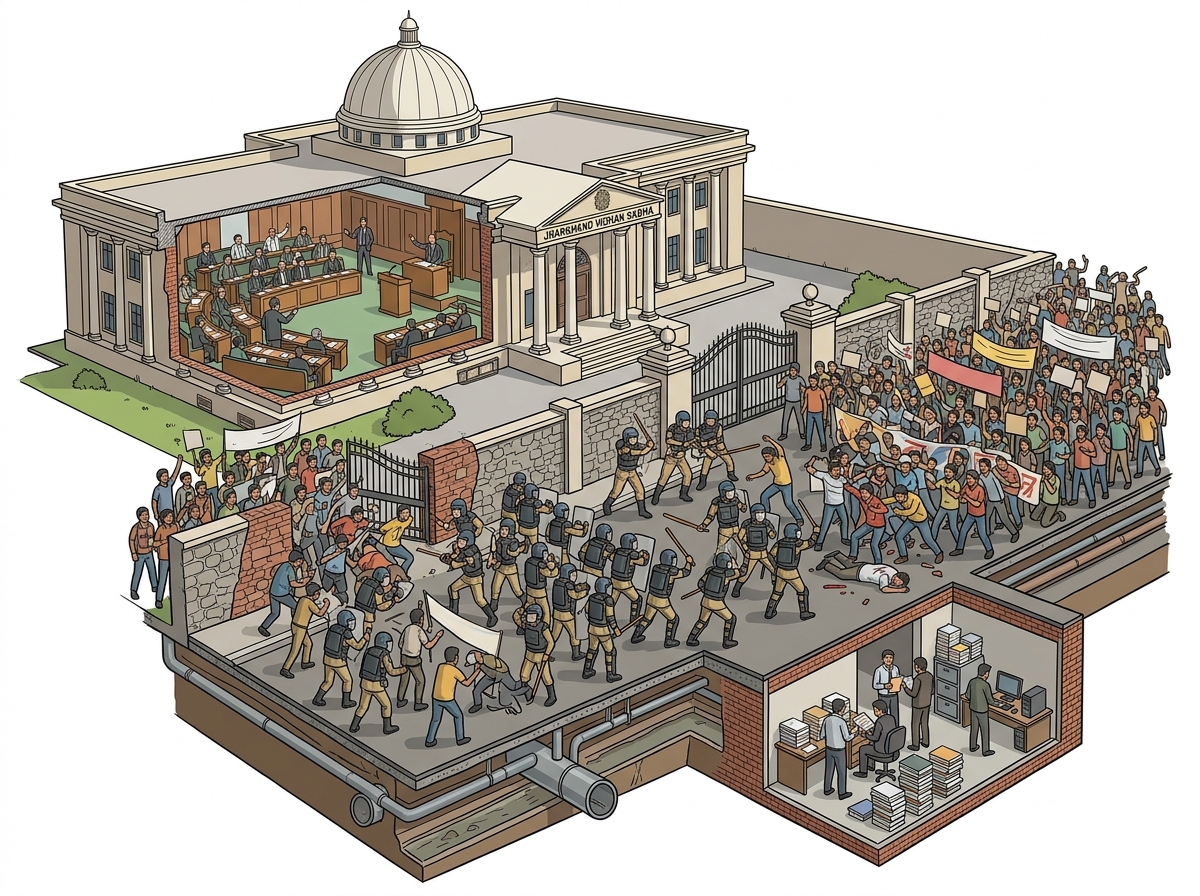
11 Aug झारखंड में छात्र आंदोलन: ईडी जांच, लाठीचार्ज और सरकार-विपक्ष रणनीति
JPSC aspirantsJSSC aspirantsVidhan SabhaLathi-chargeEnforcement Directorate✎ The Enforcement Directorate’s investigation into JPSC/JSSC irregularities is governed by the Prevention of Money Laundering Act, 2002, and must adhere to the twin principles of fairness and transparency enshrined in Articles 14…
Subject Relevance — Where This Topic Fits
- GS Paper II — Polity and Governance: Role of State and Central Agencies | GS Paper III — Issues relating to Transparency in Governance
- Prelims: Enforcement Directorate (ED), Jharkhand Public Service Commission (JPSC), Jharkhand Staff Selection Commission (JSSC), Section 144 CrPC, Right to Protest
- Essay: State response to democratic dissent: balancing order and liberty
Quick Revision: The Enforcement Directorate’s investigation into JPSC/JSSC irregularities is governed by the Prevention of Money Laundering Act, 2002, and must adhere to the twin principles of fairness and transparency enshrined in Articles 14 and 21 of the Constitution.
Why is this in the news?
The protest by thousands of JPSC and JSSC aspirants in Ranchi, now in its third week, has escalated into a governance crisis following police lathi-charge outside the Vidhan Sabha on 11 August 2026. Concurrently, the Enforcement Directorate (ED) initiated a probe into alleged irregularities in recruitment examinations, raising questions about institutional integrity, administrative accountability, and the constitutional guarantee of peaceful assembly. The episode intersects with broader national debates on examination reforms, youth unemployment, and the rule of law in competitive examination governance.
Background
- The JPSC and JSSC conduct recruitment exams for state civil services and Group C/D posts; irregularities in these exams have been a recurring grievance among aspirants.
- In July–August 2026, similar protests erupted in Delhi at Jantar Mantar against alleged NEET paper leaks, highlighting nationwide concerns over transparency in competitive examinations.
- The ED’s jurisdiction under the Prevention of Money Laundering Act, 2002, extends to investigating financial irregularities in public examinations, including alleged malpractices in question paper setting, answer key manipulation, or collusion in recruitment.
- Section 144 of the Code of Criminal Procedure (CrPC) empowers district magistrates to prohibit assemblies likely to disrupt public tranquillity; its invocation during protests is constitutionally reviewable under Articles 19(1)(a) and 21.
What are JPSC and JSSC, and why do their recruitment processes attract controversy?
- The Jharkhand Public Service Commission (JPSC) is a constitutional body established under Article 315 of the Constitution, responsible for conducting civil service examinations for Group A and Group B posts.
- The Jharkhand Staff Selection Commission (JSSC) is a statutory body under the Jharkhand Staff Selection Commission Act, 2008, tasked with recruiting Group C and Group D personnel for state government departments.
- Controversies typically arise from allegations of question paper leaks, answer key discrepancies, delays in result declaration, and perceived political interference in appointments.
- The Right to Information (RTI) Act, 2005, has been instrumental in exposing irregularities; however, delays in RTI responses and non-compliance with disclosure norms exacerbate aspirant grievances.
- The ED’s investigative mandate under the PMLA allows it to probe financial trails linked to recruitment irregularities, including potential kickbacks, benami transactions, or misuse of public funds.
- State governments may refer cases to the Central Bureau of Investigation (CBI) under Section 6 of the Delhi Special Police Establishment Act, 1946, for impartial inquiry into serious malpractices.
- The Supreme Court’s judgments in cases such as *Common Cause v. Union of India* (2018) and *Prakash Singh v. Union of India* (2006) underscore the need for autonomous, accountable, and transparent recruitment agencies.
Key Features
| Feature | Significance |
|---|---|
| Student-led protest in Ranchi | Highlights systemic issues in competitive examination processes (JPSC, JSSC) and raises concerns about transparency and fairness in public employment recruitment. |
| Police lathi charge on protestors | Demonstrates the state’s response to civil disobedience, raising questions about proportionality and adherence to constitutional rights (Article 19(1)(a) and (b)). |
| Enforcement Directorate (ED) investigation initiation | Signals potential scrutiny of financial irregularities or malpractices in recruitment processes, aligning with anti-corruption mechanisms under the Prevention of Corruption Act, 1988. |
| Political polarisation over the issue | Reflects the intersection of governance failures with electoral politics, where opposition and ruling parties frame the narrative around accountability and reform. |
| Health deterioration of protest leader Devendra Nath Mahato | Underscores the human cost of prolonged agitation and the ethical imperative for state intervention to prevent coercive measures affecting public health. |
Why it Matters
Governance and Accountability
- Exposes systemic deficiencies in Jharkhand Public Service Commission (JPSC) and Jharkhand Staff Selection Commission (JSSC) recruitment processes, necessitating institutional reforms to restore public trust.
- Highlights the role of investigative agencies (ED) in probing alleged financial or procedural irregularities, reinforcing the framework of checks and balances in public administration.
- Demonstrates the tension between law enforcement actions and constitutional guarantees of freedom of speech and peaceful assembly (Article 19(1)(a) and (b)).
Social and Political Implications
- Illustrates the mobilisation of youth in demanding accountability, reflecting broader discontent over employment opportunities and governance deficits.
- Showcases the politicisation of a governance issue, where parties leverage public sentiment to advance electoral narratives, potentially overshadowing substantive reforms.
- Raises ethical questions about state response to dissent, particularly when coercive measures (lathi charge) escalate tensions and infringe on democratic norms.
Legal and Institutional Framework
- Reinforces the need for transparent and merit-based recruitment processes in public sector employment, as mandated by Articles 14, 16, and 323A of the Constitution.
- Underscores the importance of judicial oversight in safeguarding civil liberties, particularly when executive actions (police crackdowns) conflict with constitutional rights.
- Emphasises the role of investigative agencies (ED) in addressing corruption allegations, while ensuring due process and fairness in inquiries.
Challenges
1. Ensuring Proportionality in Law Enforcement
- Balancing the maintenance of public order with the protection of constitutional rights to peaceful protest and free expression.
- Avoiding excessive use of force (lathi charge) that escalates tensions and undermines public trust in state institutions.
- Implementing crowd control measures that adhere to the principles of necessity and minimum force, as outlined in police manuals and judicial precedents.
UPSC Link: GS II: Polity – Fundamental Rights
2. Addressing Governance Deficits in Recruitment Processes
- Investigating and rectifying alleged irregularities in JPSC and JSSC examinations to restore credibility in public sector recruitment.
- Implementing transparent and merit-based selection procedures to prevent favouritism, corruption, or procedural lapses.
- Strengthening institutional mechanisms for grievance redressal and accountability in competitive examinations.
UPSC Link: GS II: Governance – Transparency & Accountability
3. Managing Political Polarisation Over Governance Issues
- Preventing the politicisation of governance failures, which can divert attention from substantive reforms to partisan narratives.
- Encouraging bipartisan cooperation to address systemic issues in recruitment processes and public employment.
- Ensuring that political responses to protests do not exacerbate social divisions or undermine democratic institutions.
UPSC Link: GS II: Polity – Political Parties
4. Safeguarding Public Health During Protests
- Preventing coercive measures (e.g., forced removal of protestors) that endanger the health of agitators, particularly those on hunger strikes.
- Ensuring timely medical intervention for protest leaders and participants to mitigate health risks.
- Balancing law enforcement objectives with ethical obligations to preserve human dignity and well-being.
UPSC Link: GS II: Governance – Human Rights
5. Restoring Public Trust in Institutions
- Demonstrating commitment to transparency and accountability in addressing allegations of corruption or malpractice.
- Communicating reforms and corrective actions to the public to rebuild confidence in state institutions.
- Engaging with stakeholders (youth, opposition, civil society) to foster inclusive dialogue and collaborative problem-solving.
UPSC Link: GS IV: Ethics – Probity in Governance
Challenges — UPSC Perspective
| Issue | Concern |
|---|---|
| Proportionality in police response | Risk of excessive force undermining constitutional rights and escalating tensions. |
| Transparency in recruitment processes | Allegations of irregularities eroding public trust in JPSC and JSSC examinations. |
| Political polarisation over the issue | Potential diversion of focus from governance reforms to partisan narratives. |
| Health risks to protestors | Coercive measures exacerbating health vulnerabilities, particularly for hunger strikers. |
| Institutional credibility | Need for reforms to restore faith in public sector recruitment and anti-corruption mechanisms. |
Way Forward
- Constitute an independent judicial commission to investigate allegations of irregularities in JPSC and JSSC examinations, ensuring impartiality and transparency.
- Implement a time-bound action plan to reform recruitment processes, including digitalisation of examination procedures and third-party audits.
- Establish a grievance redressal mechanism for competitive examination aspirants to address complaints and concerns promptly.
- Enhance dialogue between the state government, opposition parties, and student representatives to de-escalate tensions and foster consensus on reforms.
- Review police protocols for crowd control to ensure adherence to the principles of necessity and minimum force, with mandatory training on constitutional rights.
- Direct the Enforcement Directorate to expedite its investigation into financial irregularities, while ensuring due process and fairness for all stakeholders.
- Launch public awareness campaigns to inform aspirants about their rights and the available recourse mechanisms in case of grievances.
- Strengthen institutional oversight by empowering the Jharkhand State Vigilance Commission to monitor recruitment processes and prevent malpractices.
UPSC Value Addition
Keywords for Mains Answer-Writing
Public Order · Right to Protest · Enforcement Directorate (ED) · Federal Structure · Police Powers · Public Service Commission · Recruitment Process · Constitutional Rights · Administrative Accountability · Law and Order Management · Student Agitations · Governance Challenges · Inter-State Coordination · Judicial Review of Executive Actions
Constitutional & Policy Linkages
- Article 14 (Equality before law)
- Article 16 (Equality of opportunity in public employment)
- Article 19(1)(a) (Freedom of speech and expression)
- Article 19(1)(b) (Freedom to assemble peacefully)
- Article 226 (Writs jurisdiction of High Courts)
- Article 323A (Administrative Tribunals)
Concept Flow
Public discontent over JPSC/JSSC recruitment irregularities → Mass student protests in Ranchi → Police crackdown (lathi charge) escalates tensions → Opposition parties frame issue politically → ED initiates investigation → Health crisis of protest leader (Devendra Nath Mahato) → State and opposition strategise responses → Need for institutional reforms and dialogue emerges.
Prelims Practice Questions
Q1. Consider the following statements regarding the powers of the Enforcement Directorate (ED) in India: 1. The ED operates under the administrative control of the Ministry of Home Affairs. 2. The ED can arrest an individual without a warrant under the Prevention of Money Laundering Act (PMLA), 2002. 3. The ED’s powers are subject to judicial review by the High Courts and the Supreme Court. How many of the above statements are correct?
- Only one
- Only two
- All three
- None
Answer: All three — Statement 1 is incorrect: The ED operates under the Department of Revenue, Ministry of Finance. Statements 2 and 3 are correct: The ED can arrest without a warrant under PMLA, and its actions are subject to judicial review.
Q2. Assertion (A): The Right to Protest is a fundamental right under Article 19(1)(a) of the Constitution of India. Reason (R): The State may impose reasonable restrictions on the exercise of this right in the interest of public order, morality, and sovereignty.
- Both A and R are true, and R is the correct explanation of A
- Both A and R are true, but R is not the correct explanation of A
- A is true, but R is false
- A is false, but R is true
Answer: Both A and R are true, but R is not the correct explanation of A — Both A and R are correct, and R correctly explains the limitation on the Right to Protest under Article 19(2).
Q3. Match the following provisions of the Constitution of India with their corresponding articles: Column I (Provision) Column II (Article) A. Power of the President to grant pardons 1. Article 32 B. Right to Constitutional Remedies 2. Article 72 C. Power of the Governor to grant pardons 3. Article 161 D. Power of Parliament to make laws on matters in the State List 4. Article 246
- A-2, B-1, C-3, D-4; A-1, B-2, C-4, D-3; A-3, B-1, C-2, D-4; A-4, B-2, C-3, D-1
- answer_ixs_pairing_ordered_list_indexes_in_q_text_to_options_array_indexes_listed_here_as_0_based: [0, 3, 2, 1]
- explain_json_placeholder_for_explanation:
Answer: A-2, B-1, C-3, D-4; A-1, B-2, C-4, D-3; A-3, B-1, C-2, D-4; A-4, B-2, C-3, D-1 —
Mains Practice Question
✍ Examine the constitutional and administrative dimensions of the management of public order during protests, with particular reference to the recent events in Ranchi, Jharkhand. In your answer, address the following: (i) The legal framework governing the right to protest and the powers of the police to maintain public order. (ii) The role of the Enforcement Directorate (ED) in such scenarios and the implications of its investigative actions on governance. (15 Marks)
Approach: MODEL-ANSWER SKELETON:
1. Legal Framework Governing Right to Protest and Police Powers:
– Article 19(1)(a) of the Constitution guarantees the right to freedom of speech and expression, which includes the right to protest peacefully.
– Article 19(2) empowers the State to impose reasonable restrictions on this right in the interest of public order, morality, and sovereignty.
– The Police Act, 1861, and state-specific police regulations govern the use of force by police during protests.
– Landmark judicial precedents: *Himat Lal K. Shah v. Commissioner of Police, Ahmedabad* (1973) and *Mazdoor Kisan Shakti Sangathan v. Union of India* (2018) on the right to protest and police conduct.
– The Code of Criminal Procedure, 1973, provides for the maintenance of public order and the use of force under Sections 129-131.
2. Role of the Enforcement Directorate (ED) and Governance Implications:
– The ED operates under the Prevention of Money Laundering Act (PMLA), 2002, and the Foreign Exchange Management Act (FEMA), 1999.
– Its investigative actions during protests may raise concerns about the politicization of law enforcement and the chilling effect on dissent.
– Governance implications: erosion of public trust, potential misuse of investigative powers, and the need for judicial oversight.
– Comparative perspective: The role of investigative agencies in other democracies (e.g., FBI in the USA, CBI in India) and the balance between security and civil liberties.
3. Balancing Governance and Civil Liberties:
– The Ranchi incident highlights the tension between maintaining public order and protecting constitutional rights.
– The State’s duty to ensure lawful protests while preventing violence and disruption.
– The role of the judiciary in reviewing executive actions and ensuring accountability.
4. Conclusion:
– The incident underscores the need for transparent, accountable, and rule-based governance in managing protests.
– Emphasize the importance of dialogue between the State and protesting groups to address grievances without recourse to excessive force.
Source: amarujala.com
Generated by AanyaAi for educational purpose.

- संयुक्त राष्ट्र का समुद्र स्तर घोषणा: भारत के लिए क्या है महत्व - September 30, 2026
- ASEAN-India Maritime Exercise (AIME-2026) Begins in Philippines - September 30, 2026
- छत्तीसगढ़ में अतिथि व्याख्याता नीति बदली: मूल निवासियों को मिलेगी वरीयता - September 30, 2026

No Comments