


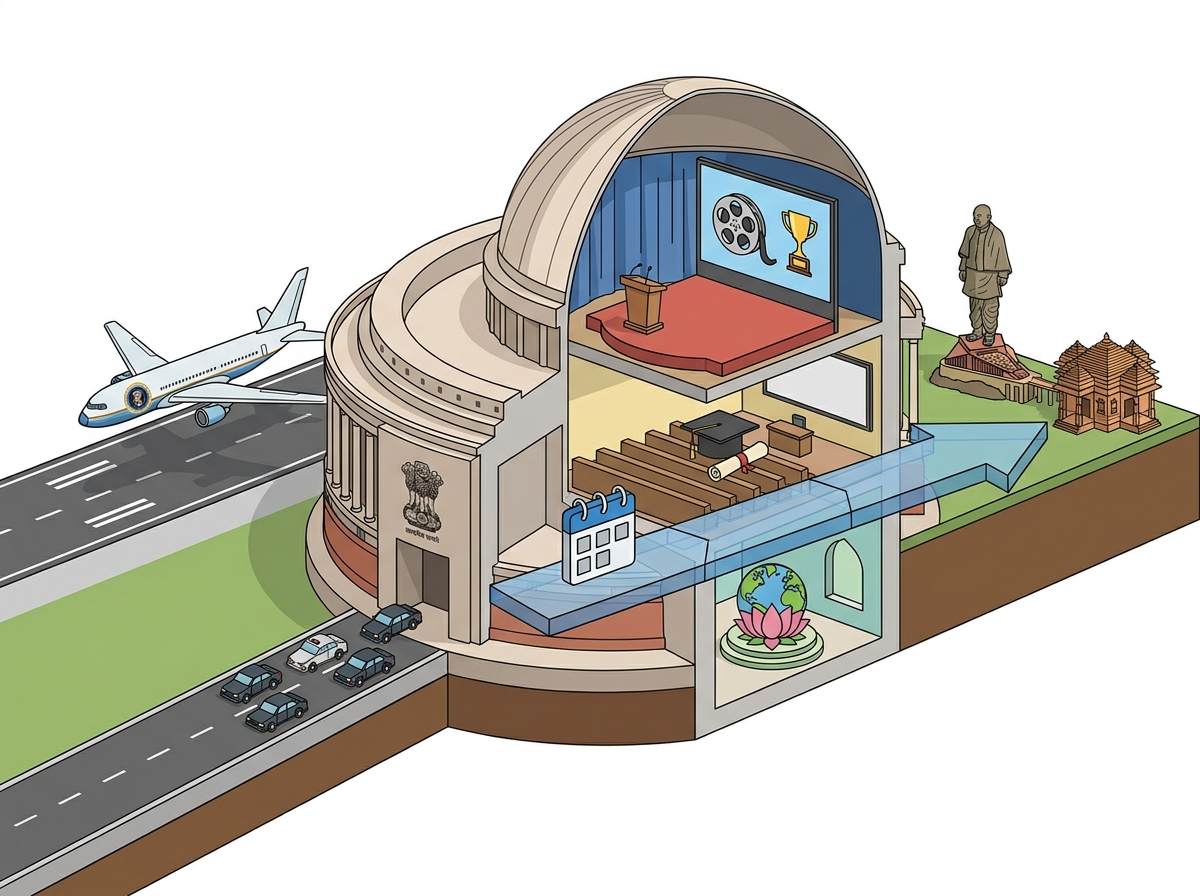
20 Sep द्रौपदी मुर्मु का गुजरात दौरा: 72वें राष्ट्रीय फिल्म पुरस्कार एवं अन्य आयोजन
✎ The President of India performs ceremonial and symbolic functions, including conferring national honours and participating in academic and cultural events, as mandated by the Constitution.
Subject Relevance — Where This Topic Fits
- GS Paper II — Polity and Governance: Constitutional Provisions, Role of President
- Prelims: President of India, National Film Awards, Convocation ceremonies, Constitutional position of the President, State visits
- Essay: The evolving role of constitutional heads in modern democracies, Symbolism and continuity in India’s parliamentary system
Quick Revision: The President of India performs ceremonial and symbolic functions, including conferring national honours and participating in academic and cultural events, as mandated by the Constitution.
Why is this in the news?
The President of India, Smt. Droupadi Murmu, is scheduled to undertake a three-day official visit to Gujarat from 21 to 23 September 2026. During this visit, she will confer the 72nd National Film Awards at Kevadia on 22 September, participate in the 75th convocation of Maharaja Sayajirao University of Baroda on 23 September, and inaugurate initiatives by the Brahma Kumaris, including the ‘Global Spiritual Palace’ retreat centre and a campaign for youth empowerment. The visit exemplifies the President’s constitutional and ceremonial functions, including the conferment of national honours and participation in academic and spiritual events.
Background
- The President of India is the constitutional head of state, with duties primarily ceremonial and symbolic, as outlined in Articles 52 to 78 of the Constitution.
- The National Film Awards, instituted in 1954, recognise excellence in cinematic achievements and are presented annually by the President, typically in a ceremonial context.
- Convocation ceremonies at universities are formal academic events where degrees are conferred upon graduates, often attended by dignitaries to symbolise institutional recognition and continuity.
- Gujarat has been a focal point for national integration initiatives, including the Sardar Sarovar Project and the Statue of Unity, reflecting its symbolic importance in India’s developmental narrative.
- The Brahma Kumaris, a spiritual organisation, engages in social and developmental initiatives, often collaborating with government programmes to promote values-based education and youth empowerment.
- The President’s state visits serve to strengthen federal relations, promote national integration, and symbolise the unity of the Republic.
Constitutional and Ceremonial Role of the President of India
- The President of India is the ceremonial head of state, with powers exercised on the aid and advice of the Council of Ministers under Article 74 of the Constitution.
- The President’s role includes conferring national honours such as the National Film Awards, Padma Awards, and Bharat Ratna, which are symbolic recognitions of excellence and contribution.
- Participation in convocation ceremonies at universities, such as Maharaja Sayajirao University of Baroda, underscores the President’s role in promoting educational excellence and institutional recognition.
- State visits by the President serve to strengthen inter-state relations, promote national integration, and symbolise the constitutional unity of the Republic.
- The President’s engagement with spiritual and social organisations, such as the Brahma Kumaris, reflects the constitutional principle of secularism and the promotion of values-based governance.
- The National Film Awards, instituted by the Directorate of Film Festivals under the Ministry of Information and Broadcasting, celebrate cinematic achievements and cultural heritage.
- The President’s presence at such events reinforces the symbolic and unifying role of the constitutional head in a parliamentary democracy.
- The visit to Gujarat, including the Statue of Unity area, highlights the state’s significance in India’s developmental and cultural narrative.
Key Features
| Feature | Significance |
|---|---|
| Visit Duration and Locations | Demonstrates the constitutional role of the President as the ceremonial head of state in engaging with states, promoting cultural and educational exchanges, and reinforcing national integration. |
| 72nd National Film Awards | Highlights the constitutional mandate of the President to confer national honours, symbolising recognition of excellence in cinematic arts and cultural heritage. |
| 75th Convocation of Maharaja Sayajirao University, Vadodara | Reinforces the President’s role in fostering higher education, academic excellence, and youth empowerment as pillars of national development. |
| Inauguration of ‘Global Spiritual Palace’ Retreat Centre | Reflects the President’s engagement with spiritual and social organisations, underscoring the constitutional emphasis on promoting social harmony and cultural values. |
| Virtual Launch of ‘Youth for Developed India’ Campaign | Demonstrates the President’s outreach to youth, aligning with constitutional directives on fostering national development and citizen participation in governance. |
Why it Matters
Constitutional and Ceremonial
- The President’s visit underscores the constitutional role of the Head of State in symbolising national unity and integrity through state engagements.
- Conferment of national awards (e.g., National Film Awards) aligns with Article 53 of the Constitution, which vests the President with the authority to perform ceremonial functions.
- Participation in university convocations reinforces the constitutional emphasis on education and youth empowerment as enshrined in the Directive Principles of State Policy (Part IV).
Cultural and Educational
- The 72nd National Film Awards highlight the role of cinema as a medium for cultural expression and national identity, aligning with the constitutional mandate to preserve and promote cultural heritage (Article 51A(f)).
- The 75th convocation of Maharaja Sayajirao University, Vadodara, underscores the importance of higher education in nation-building, reflecting the constitutional directive to promote scientific temper and education (Article 51A(h)).
- The inauguration of the ‘Global Spiritual Palace’ Retreat Centre and associated campaigns emphasises the role of spiritual and social organisations in fostering social cohesion and ethical values.
Youth Engagement and National Development
- The virtual launch of the ‘Youth for Developed India’ campaign aligns with the constitutional emphasis on youth empowerment and their role in national development (Article 51A(e)).
- The President’s engagement with youth-centric initiatives reflects the constitutional directive to promote a sense of duty among citizens towards the nation (Article 51A).
State-Level Governance and Public Participation
- The visit to Gujarat demonstrates the President’s role in strengthening federalism by engaging with state institutions and promoting grassroots participation in governance.
- The inclusion of spiritual and cultural events highlights the President’s role in fostering social harmony and community engagement, which are essential for inclusive governance.
Way Forward
- Examine the constitutional provisions governing the President’s role in ceremonial and educational engagements to understand the institutional framework of such visits.
- Study the significance of national awards (e.g., National Film Awards) in promoting cultural heritage and national identity as part of the broader constitutional mandate.
- Analyse the role of higher education institutions (e.g., Maharaja Sayajirao University) in nation-building, particularly in the context of the Directive Principles of State Policy.
- Assess the impact of spiritual and cultural organisations in fostering social cohesion and ethical values, and their alignment with constitutional directives on cultural preservation.
- Evaluate the role of youth engagement initiatives in promoting national development and civic responsibility, as enshrined in the Constitution.
UPSC Value Addition
Keywords for Mains Answer-Writing
Constitutional role of the President of India · National Film Awards · Convocation ceremonies in Indian universities · Spiritual and cultural diplomacy · Institutional visits by constitutional authorities · Public functions and national awards · University convocation as a constitutional engagement · Spiritual and social outreach by constitutional offices · Gujarat as a cultural and educational hub · Institutional outreach and public engagement · Constitutional symbolism and national integration
Constitutional & Policy Linkages
- {‘Articles/Schedules’: ‘Article 53: Executive Power of the President’, ‘note’: ‘Ceremonial and executive roles’}
- {‘Articles/Schedules’: ‘Article 51A(f): Fundamental Duties’, ‘note’: ‘Cultural heritage preservation’}
- {‘Articles/Schedules’: ‘Article 51A(h): Fundamental Duties’, ‘note’: ‘Scientific temper and education’}
- {‘Articles/Schedules’: ‘Article 51A(e): Fundamental Duties’, ‘note’: ‘Youth empowerment’}
Concept Flow
Presidential visit to Gujarat → Constitutional role of Head of State in state engagements → Symbolises national unity and federalism → Conferment of National Film Awards → Recognition of cultural excellence → Aligns with constitutional mandate for cultural preservation (Article 51A(f)) → Participation in university convocation → Emphasis on higher education → Reflects Directive Principles of State Policy (Part IV) → Inauguration of spiritual retreat centre → Promotion of social harmony → Aligns with constitutional directives on ethical values → Virtual launch of youth campaign → Engagement with youth → Reinforces constitutional emphasis on civic responsibility (Article 51A(e))
Prelims Practice Questions
Q1. Consider the following statements regarding the President of India:
1. The President of India is the constitutional head of the state and the supreme commander of the armed forces.
2. The President can award national honours such as the National Film Awards.
3. The President is empowered to inaugurate spiritual and cultural institutions like the ‘Global Spiritual Palace’ in Vadodara.
4. The President can initiate virtual campaigns for social and spiritual awakening.
How many of the above statements are correct?
- Only one
- Only two
- Only three
- All
Answer: All — Statements 1, 2, and 4 are correct. The President is the constitutional head and supreme commander of the armed forces (Art. 53). The President can award national honours (Art. 18(1)(b)). Statements 3 is incorrect as the President can inaugurate or participate in such events but does not initiate them independently.
Q2. Assertion (A): The President of India can participate in the convocation ceremony of a state university.
Reason (R): The President, as the constitutional head, is expected to engage in public functions that promote educational and cultural development.
Options:
A. Both A and R are true, and R is the correct explanation of A.
B. Both A and R are true, but R is not the correct explanation of A.
C. A is true, but R is false.
D. A is false, but R is true.
Answer: ? — Assertion (A) is true as the President can participate in convocation ceremonies of universities under Article 78 and the constitutional convention of public engagement. Reason (R) is also true and correctly explains (A) as the President’s participation aligns with promoting educational and cultural development.
Q3. Match the following events with their respective locations as announced in the President’s recent visit to Gujarat:
Column I (Event) | Column II (Location)
——————————————|—————————————-
1. 72nd National Film Awards | A. Vadodara
2. 75th Annual Convocation of MSU Baroda | B. Kevadia (Ekta Nagar)
3. Inauguration of ‘Global Spiritual Palace’ | C. Nadiad
4. Virtual launch of ‘Yuva Shakti Abhiyan’ | D. Kevadia (Ekta Nagar)
Options:
A. 1-B, 2-A, 3-A, 4-C
B. 1-D, 2-A, 3-B, 4-C
C. 1-B, 2-A, 3-A, 4-D
D. 1-A, 2-B, 3-C, 4-D
Answer: ? — Correct matching: 1-B (72nd National Film Awards in Kevadia), 2-A (75th Annual Convocation of MSU Baroda in Vadodara), 3-A (Inauguration of ‘Global Spiritual Palace’ in Vadodara), 4-C (Virtual launch of ‘Yuva Shakti Abhiyan’ from Nadiad).
Mains Practice Question
✍ The President of India, as the constitutional head of state, engages in multifaceted public functions that transcend ceremonial roles. In this context, critically examine the constitutional and symbolic significance of the President’s participation in events such as the National Film Awards, university convocations, and spiritual initiatives. (15 Marks)
Approach: MODEL-ANSWER SKELETON:
1. Constitutional Position of the President (Art. 53, 78):
– Head of state vs. Head of government (PM under Art. 75).
– Role in public engagement as a symbol of national unity and constitutional continuity.
2. National Film Awards and Cultural Diplomacy:
– Art. 18(1)(b) and the conferment of national honours.
– Promotion of cultural heritage and soft power diplomacy.
– Contrast with the role of the Ministry of Information and Broadcasting.
3. University Convocations and Educational Outreach:
– Art. 78 and the President’s role in promoting higher education.
– Symbolic significance of convocation ceremonies as rites of passage for graduates.
– Comparison with the Governor’s role in state universities (Art. 153-167).
4. Spiritual Initiatives and Public Engagement:
– Constitutional permissibility of the President’s participation in non-state initiatives (Art. 53(1) and the doctrine of constitutional silence).
– Symbolism of spiritual and cultural outreach in nation-building.
– Contrast with the secular principles enshrined in the Preamble and Fundamental Rights (Art. 25-28).
5. Balancing Constitutional Roles and Symbolic Functions:
– Critique: Does such engagement dilute the President’s constitutional neutrality?
– Counter-argument: Enhances the President’s role as a unifying figure in a pluralistic society.
– Judicial perspective: Relevant Supreme Court observations on the President’s discretionary powers (e.g., Art. 72, 161).
6. Contemporary Relevance:
– The President’s visit to Gujarat as a case study in multi-dimensional public engagement.
– Broader implications for constitutional symbolism in a diverse democracy.
Source: PIB (Press Information Bureau)
Gujarat PCS (GPSC) — State PCS Practice
Prelims: Which of the following is a key focus area of the President of India’s visit to Gujarat from 21 to 23 September 2024?
- Inauguration of the Sardar Sarovar Dam’s final phase
- Review of Gujarat’s progress under the ‘Gujarat@2047’ vision
- Launch of a new industrial policy for the state
- Celebration of the 75th anniversary of the Quit India Movement
Answer: Review of Gujarat’s progress under the ‘Gujarat@2047’ vision — The President’s visit is expected to focus on reviewing Gujarat’s developmental progress under the state’s long-term vision, ‘Gujarat@2047’.
Mains: Discuss the significance of the President of India’s visit to Gujarat in the context of the state’s socio-economic development and governance reforms. Highlight how such visits contribute to the implementation of national policies at the grassroots level.
Generated by AanyaAi for educational purpose.
Related guides on our sites
- How to prepare for GS paper 1 for UPSC CSE mains exam
- Best UPSC coaching for IFOS exam
- Best mentorship programme for upsc
- UPSC+BA degree

- NAMASTE Scheme: Enhancing Sanitation Workers’ Livelihoods & Safety - November 14, 2026
- एमएसएमई का विशेष अभियान 6.0: स्वच्छता और लंबित मामलों का निपटारा - November 14, 2026
- Sea Vigil-26: Coastal Defence Drills Off Visakhapatnam - November 14, 2026

No Comments