


15 Jul पीएलएफएस जून 2026: श्रम बल संकेतक, रोजगार और बेरोजगारी दर विश्लेषण
Subject Relevance — Where This Topic Fits
- GS Paper I — Social Issues (Poverty and Developmental issues) | GS Paper II — Government Policies and Interventions for Development in various sectors | GS Paper III — Indian Economy and issues relating to Planning, Mobilization of Resources, Growth, Development and Employment
- Prelims: PLFS, LFPR, WPR, Unemployment Rate, NSO, MoSPI, Current Weekly Status (CWS), Labour Force Indicators, Employment Statistics, Female Labour Force Participation
- Essay: The Paradox of Growth: Employment Generation in India’s Developing Economy, Demographic Dividend or Demographic Disaster: The Imperative of Skilling and Employment
Quick Revision: The PLFS June 2026 data indicates overall stability in India’s labour market indicators (LFPR, WPR, UR) but highlights the imperative for targeted interventions to address urban-rural disparities, enhance female labour force participation, and improve the quality of employment for leveraging the demographic dividend.
Why is this in the news?
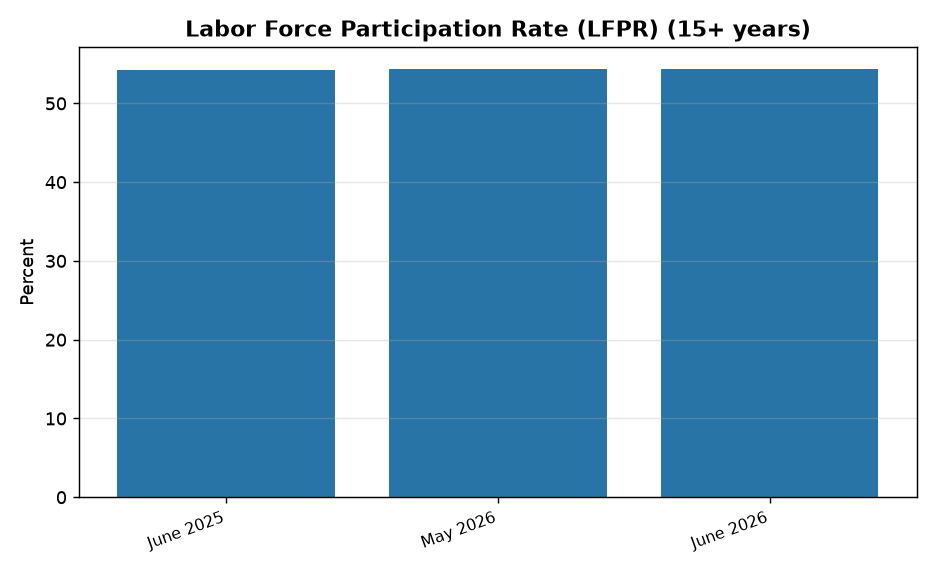
The Ministry of Statistics and Programme Implementation (MoSPI), through its National Statistical Office (NSO), released the Monthly Bulletin for the Periodic Labour Force Survey (PLFS) for June 2026. This fifteenth bulletin in the series provides crucial insights into India’s labour market, detailing trends in Labour Force Participation Rate (LFPR), Worker Population Ratio (WPR), and Unemployment Rate (UR) for persons aged 15 years and above, using the Current Weekly Status (CWS) approach. The data offers a contemporary snapshot of employment and unemployment dynamics, highlighting stability in overall indicators while noting minor shifts in urban and rural segments, particularly concerning female labour force participation.
Background
- The Periodic Labour Force Survey (PLFS) was launched by the NSO in April 2017 to provide quarterly labour force indicators for urban areas and annual indicators for both rural and urban areas.
- From January 2025, the PLFS methodology was revised to provide monthly and quarterly estimates for key labour force indicators, enhancing the timeliness and frequency of data dissemination.
- The survey covers the entire geographical area of India, collecting data from a representative sample of households.
- The ‘Current Weekly Status’ (CWS) approach defines a person’s activity status based on the reference period of the last seven days preceding the date of survey.
- Key indicators derived from PLFS include LFPR, WPR, and UR, which are fundamental for understanding the health and structure of the labour market.
- The monthly bulletins, initiated from April 2025, aim to provide a more dynamic and granular view of labour market trends, facilitating timely policy interventions.
What is the Periodic Labour Force Survey (PLFS)?
- The PLFS is a continuous household survey conducted by the National Statistical Office (NSO), Ministry of Statistics and Programme Implementation (MoSPI).
- Its primary objective is to estimate key employment and unemployment indicators in both urban and rural areas on a more frequent basis.
- It provides estimates of Labour Force Participation Rate (LFPR), Worker Population Ratio (WPR), Unemployment Rate (UR), and other related indicators.
- The survey employs two approaches for measuring employment status: ‘Usual Status’ (principal and subsidiary) and ‘Current Weekly Status’ (CWS).
- The CWS approach captures the activity status of a person during a reference period of seven days preceding the date of survey.
- PLFS data is crucial for policymakers, researchers, and economists to understand labour market dynamics, assess the impact of economic policies, and formulate targeted interventions.
- The survey collects data on various socio-economic characteristics of individuals, including education, industry of work, and type of employment (regular wage/salaried, self-employed, casual labour).
- The monthly bulletins, a recent enhancement, offer a high-frequency perspective on labour market changes, particularly relevant for monitoring short-term economic shifts.
Key Features
| Feature | Significance |
|---|---|
| Monthly Bulletin Release | Provides high-frequency data for timely policy responses and monitoring of short-term labour market fluctuations. |
| Current Weekly Status (CWS) Approach | Captures the most recent activity status, reflecting immediate changes in employment/unemployment over a 7-day reference period. |
| Coverage (15+ years) | Focuses on the economically active population, providing insights into the working-age demographic’s engagement with the labour market. |
| Key Indicators (LFPR, WPR, UR) | Standardised metrics for international comparison and comprehensive assessment of labour force participation, employment generation, and joblessness. |
| Rural-Urban Disaggregation | Highlights distinct labour market characteristics and challenges in different geographical settings, aiding targeted policy formulation. |
| Gender-wise Analysis | Reveals disparities and trends in male and female labour force engagement, crucial for promoting gender equality and women’s economic empowerment. |
Why it Matters
Economic Policy Formulation
- Provides real-time data for the Ministry of Finance and NITI Aayog to assess the health of the economy and formulate fiscal and monetary policies.
- Aids in evaluating the effectiveness of employment generation schemes and making necessary adjustments to achieve desired outcomes.
- Helps in understanding structural shifts in the economy, such as the movement of labour between agriculture, industry, and services.
Social Development and Welfare
- Identifies vulnerable groups and regions with high unemployment, enabling targeted social welfare programs and skill development initiatives.
- Monitors progress on Sustainable Development Goal (SDG) 8: Decent Work and Economic Growth, particularly targets related to full and productive employment.
- Informs policies aimed at enhancing female labour force participation, addressing gender gaps, and promoting inclusive growth.
Academic Research and Analysis
- Serves as a vital data source for economists, sociologists, and demographers to conduct in-depth research on labour market trends, migration, and human capital development.
- Facilitates comparative studies with international labour market statistics, offering insights into India’s position in the global economy.
- Supports the development of predictive models for employment and economic growth, aiding in future planning and forecasting.
Investment and Business Decisions
- Provides insights into labour availability and skill gaps, which are crucial for domestic and foreign investors in making location and expansion decisions.
- Helps businesses understand consumer purchasing power and market demand, influencing production and marketing strategies.
- Assists in identifying emerging sectors with high employment potential, guiding investment towards growth areas.
Challenges
1. Data Comparability and Methodology Shifts
- Frequent methodological revisions (e.g., shift to monthly bulletins from Jan 2025) can pose challenges for long-term trend analysis and comparability with previous PLFS rounds or other surveys.
- The CWS approach, while timely, may not fully capture seasonal employment or underemployment prevalent in the informal sector, potentially understating the true extent of labour market distress.
UPSC Link: GS Paper III — Data Collection and Analysis
2. Informal Sector Dominance
- A significant portion of India’s workforce operates in the informal sector, where employment is often precarious, lacks social security, and is difficult to accurately measure.
- Fluctuations in informal employment can lead to volatility in overall labour market indicators, making it challenging to interpret underlying structural changes.
UPSC Link: GS Paper III — Indian Economy and Employment
3. Quality of Employment
- While WPR may show improvement, the quality of employment (e.g., regular wage vs. casual labour, adequate wages, social security) remains a critical concern.
- Disguised unemployment in agriculture and underemployment in other sectors may not be fully reflected in headline unemployment rates.
UPSC Link: GS Paper III — Inclusive Growth and Employment
4. Skill Mismatch and Employability
- Despite rising educational attainment, a significant skill gap persists between the demands of industries and the skills possessed by the workforce, leading to unemployment among educated youth.
- Rapid technological advancements necessitate continuous upskilling and reskilling, a challenge for a large and diverse workforce.
UPSC Link: GS Paper II — Human Resource Development
5. Female Labour Force Participation
- Despite some improvements, India’s female LFPR remains significantly lower than global averages, influenced by socio-cultural norms, safety concerns, and lack of adequate support infrastructure.
- The ‘U-shaped’ curve hypothesis suggests that female LFPR initially declines with economic development before rising, but India’s trajectory needs careful monitoring and targeted interventions.
UPSC Link: GS Paper I — Social Empowerment; GS Paper II — Women’s Issues
Challenges — UPSC Perspective
| Issue | Concern |
|---|---|
| Data Volatility | Monthly data can show short-term fluctuations that may not represent underlying long-term trends, requiring careful interpretation. |
| Underemployment | PLFS primarily measures unemployment; underemployment (working fewer hours than desired or in jobs below skill level) remains a significant, often uncaptured, challenge. |
| Regional Disparities | All-India averages can mask significant regional variations in employment and unemployment, necessitating more granular state-level analysis. |
| Informal Sector Vulnerability | Workers in the informal sector are highly susceptible to economic shocks, with limited social safety nets, impacting overall labour market stability. |
| Youth Unemployment | Despite overall stability, unemployment among specific demographic groups, particularly educated youth, can remain high, indicating structural issues. |
| Migration and Labour Mobility | Internal migration patterns significantly influence regional labour markets, but their impact on PLFS indicators requires deeper analysis. |
Government Initiatives — Must-Memorise for Prelims
- Mahatma Gandhi National Rural Employment Guarantee Act (MGNREGA)
- Pradhan Mantri Kaushal Vikas Yojana (PMKVY)
- Start-up India
- Stand-up India
- Atmanirbhar Bharat Rojgar Yojana (ABRY)
- National Career Service (NCS) Project
- Pradhan Mantri Mudra Yojana (PMMY)
- Skill India Mission
- Make in India
- Labour Codes (e.g., Code on Wages, Industrial Relations Code)
Way Forward
- Strengthen skill development ecosystems by aligning training programs with industry demands, promoting apprenticeships, and integrating vocational education into mainstream schooling.
- Enhance social security coverage and formalisation incentives to transition informal workers into the formal sector, ensuring decent work conditions.
- Invest in infrastructure development, particularly in rural areas, to create non-farm employment opportunities and reduce disguised unemployment in agriculture.
- Implement targeted policies to boost female labour force participation, including affordable childcare, safer public transport, and flexible work arrangements.
- Leverage technology and data analytics for better labour market intelligence, enabling proactive policy responses to emerging trends and skill requirements.
- Promote entrepreneurship and self-employment through easier access to credit, mentorship, and market linkages, especially for youth and women.
- Foster a robust manufacturing sector through policy support, ease of doing business, and investment in R&D to create large-scale, quality employment.
- Regularly review and refine PLFS methodology to ensure data accuracy, comparability, and relevance, while also exploring additional indicators like underemployment.
UPSC Value Addition
Keywords for Mains Answer-Writing
Labour Market Dynamics · Periodic Labour Force Survey (PLFS) · Employment Generation · Unemployment Rate · Worker Population Ratio (WPR) · Labour Force Participation Rate (LFPR) · Demographic Dividend · Skill Mismatch · Informal Sector · Female Labour Force Participation · Inclusive Growth · Sustainable Development Goals (SDGs)
Constitutional & Policy Linkages
- Article 39: State to secure a living wage and conditions of work
- Article 41: Right to work, to education and to public assistance in certain cases
- Article 42: Provision for just and humane conditions of work and maternity relief
- Article 43: Living wage, etc., for workers
- The Factories Act, 1948: Regulates working conditions in factories
- The Minimum Wages Act, 1948: Provides for fixation of minimum wages
- The Employees’ Provident Funds and Miscellaneous Provisions Act, 1952: Social security for workers
- The Unorganised Workers’ Social Security Act, 2008: Social security for unorganised workers
Concept Flow
Economic Activity & Population Growth → Labour Force Participation (LFPR) → Employment & Unemployment (WPR & UR) → Income Generation & Consumption → Economic Growth & Development → Policy Interventions & Labour Market Reforms
Prelims Practice Questions
Q1. Which of the following statements regarding the Periodic Labour Force Survey (PLFS) are correct?
1. PLFS is conducted by the Ministry of Labour and Employment.
2. The ‘Current Weekly Status’ (CWS) approach considers the activity status of a person during the last 30 days.
3. Labour Force Participation Rate (LFPR) measures the percentage of persons in the labour force (working or seeking work) in the population.
4. The PLFS monthly bulletins were introduced from January 2025.
- 1 and 2 only
- 3 and 4 only
- 1, 2 and 3 only
- All of the above
Answer: 3 and 4 only — Statement 1 is incorrect: PLFS is conducted by the National Statistical Office (NSO) under the Ministry of Statistics and Programme Implementation (MoSPI). Statement 2 is incorrect: The CWS approach considers the activity status during the last seven days. Statement 3 is correct: LFPR is indeed the percentage of the population (15+ years) that is either employed or actively seeking employment. Statement 4 is correct: The PLFS methodology was revised from January 2025 to provide monthly and quarterly estimates.
Q2. Consider the following labour market indicators:
1. Labour Force Participation Rate (LFPR)
2. Worker Population Ratio (WPR)
3. Unemployment Rate (UR)
Which of the above indicators are typically used to assess the health of an economy’s labour market?
- 1 only
- 2 and 3 only
- 1, 2 and 3
- 1 and 2 only
Answer: 1, 2 and 3 — All three indicators—LFPR, WPR, and UR—are crucial for a comprehensive assessment of the labour market. LFPR indicates the proportion of the population willing to work, WPR shows the proportion actually employed, and UR reflects the proportion of the labour force unable to find work. Together, they provide a holistic picture of labour market health.
Mains Practice Question
✍ The recent PLFS data for June 2026 indicates stability in overall labour market indicators but also highlights persistent challenges, particularly concerning female labour force participation and the quality of employment. Critically analyse the implications of these trends for India’s demographic dividend and suggest comprehensive policy measures to foster inclusive and sustainable employment growth. (250 words)
Approach: Begin by briefly introducing the significance of PLFS data and the key findings from the June 2026 report (stability in overall LFPR/WPR/UR, but concerns in rural-urban and gender-specific trends). Then, delve into the implications for India’s demographic dividend, discussing how underutilization of the workforce, especially women, can hinder its realization. Subsequently, identify and elaborate on the challenges such as skill mismatch, informal sector dominance, and quality of employment. Conclude by suggesting a multi-pronged approach encompassing skill development, formalization incentives, infrastructure investment, gender-sensitive policies, and promotion of entrepreneurship to achieve inclusive and sustainable employment growth.
Source: PIB (Press Information Bureau)

- सुप्रीम कोर्ट ने चुनाव आयोग को दिल्ली में ‘यांत्रिक’ SIR नोटिस पर सावधानियां बरतने को कहा - September 22, 2026
- ‘स्वच्छता ही सेवा-2026’ अभियान: सरकारी विभागों में स्वच्छता क्रांति, जानिए मुख्य बिंदु - September 22, 2026
- DFPD Launches ‘Swachhata Hi Seva-2026’ Campaign for Clean India Mission - September 22, 2026

No Comments