


05 Aug पोषण ट्रैकर: मिशन पोषण 2.0 के लिए डिजिटल निगरानी प्रणाली
✎ Poshan Tracker is an ICT-enabled digital platform under Mission Poshan 2.0 and Saksham Anganwadi that ensures real-time monitoring of nutrition outcomes and service delivery in Anganwadi centres through digital dashboards…
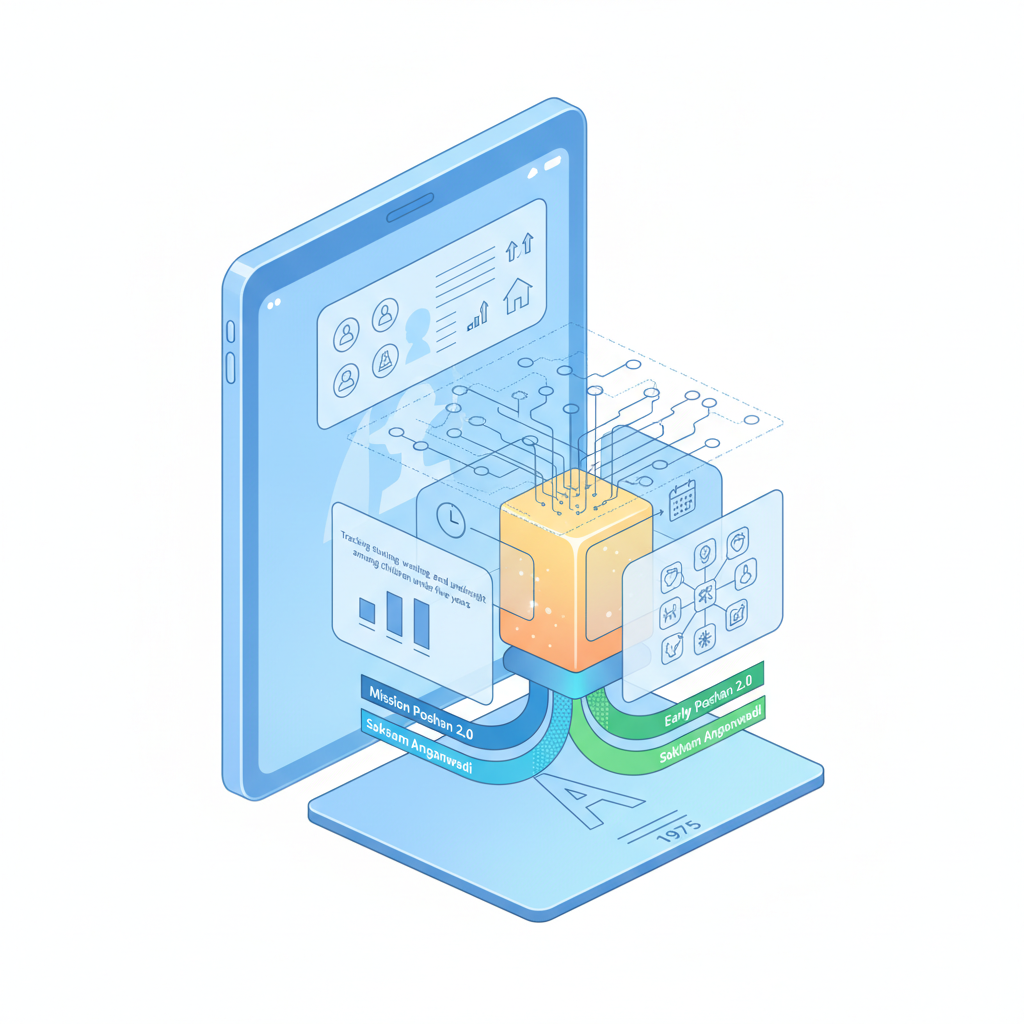 Poshan Tracker appICDS ecosystemNutrition outcomesChild development servicesData-driven interventions
Subject Relevance — Where This Topic Fits
- GS Paper II — Governance, Transparency and Accountability | GS Paper III — Technology Missions and Social Sector Schemes
- Prelims: Poshan Tracker, Mission Poshan 2.0, Saksham Anganwadi and Poshan 2.0, Growth Monitoring Devices (GMD), ICT-based monitoring in ICDS, Stunting, Wasting, Underweight
- Essay: Role of digital governance in achieving Sustainable Development Goals (SDGs) in India, Technology as an enabler for social welfare and public health outcomes
Quick Revision: Poshan Tracker is an ICT-enabled digital platform under Mission Poshan 2.0 and Saksham Anganwadi that ensures real-time monitoring of nutrition outcomes and service delivery in Anganwadi centres through digital dashboards, supportive supervision, and growth monitoring devices.
Why is this in the news?
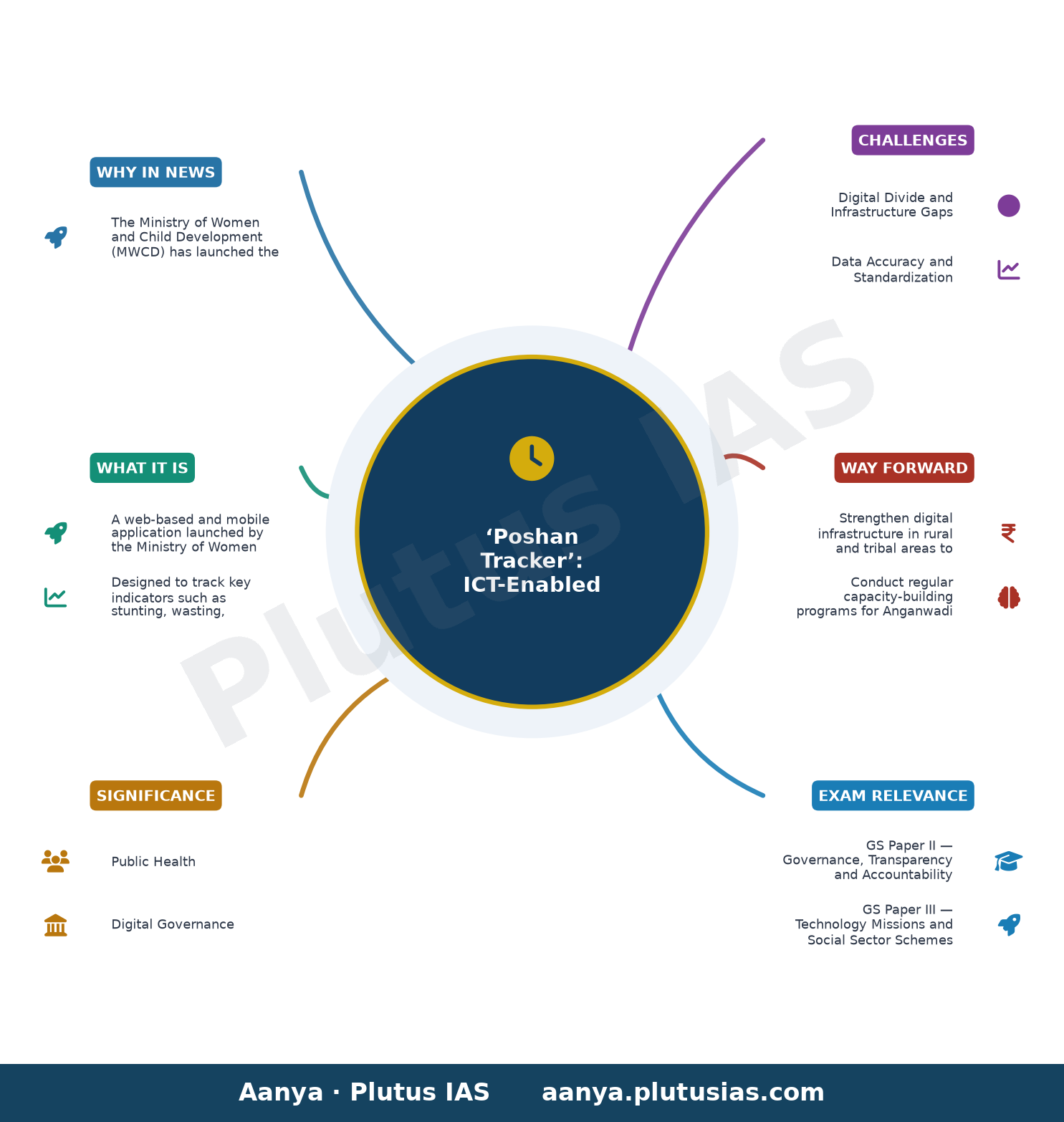
The Ministry of Women and Child Development (MWCD) has launched the ‘Poshan Tracker’, an ICT-based digital application under Mission Poshan 2.0 and Saksham Anganwadi, to enable real-time monitoring, review, and data-driven interventions for nutrition outcomes and early childhood development services. This initiative addresses critical gaps in data accuracy, timeliness, and accountability in the Integrated Child Development Services (ICDS) ecosystem, particularly in tracking stunting, wasting, and underweight among children under five years of age.
Background
- The Integrated Child Development Services (ICDS) scheme, launched in 1975, is India’s flagship programme for early childhood care and development, targeting children below six years, pregnant women, and lactating mothers.
- Mission Poshan 2.0, launched in 2021, is an umbrella convergence mission under the National Nutrition Mission (NNM), aiming to improve nutritional outcomes through targeted interventions, community engagement, and multi-sectoral convergence.
- Saksham Anganwadi and Poshan 2.0 is a sub-mission under Mission Poshan 2.0, focusing on transforming Anganwadi centres into high-functioning, technology-enabled service delivery hubs with improved infrastructure and service quality.
- India’s high burden of malnutrition—with approximately 35% of children under five stunted, 17% wasted, and 33% underweight (NFHS-5, 2019-21)—necessitates robust monitoring mechanisms to track progress and implement timely corrective measures.
- The Poshan Tracker builds on earlier digital initiatives like the Poshan Abhiyaan App and the ICDS-CAS (Common Application Software) but introduces real-time data collection, supportive supervision modules, and growth monitoring devices to enhance accuracy and accountability.
What is the Poshan Tracker?
- A web-based and mobile application launched by the Ministry of Women and Child Development (MWCD) under Mission Poshan 2.0 and Saksham Anganwadi to monitor nutrition outcomes and service delivery in real time.
- Designed to track key indicators such as stunting, wasting, underweight prevalence, and service coverage (e.g., supplementary nutrition, early childhood care and education, growth monitoring) among children under five and pregnant/lactating women.
- Enables near real-time data collection from Anganwadi centres (AWCs) through digital dashboards, reducing delays and improving the accuracy of nutritional assessments and service delivery records.
- Incorporates a dedicated ‘Supportive Supervision Module’ to strengthen monitoring at all administrative levels (supervisors, Child Development Project Officers (CDPOs), and District Programme Officers (DPOs)), ensuring timely feedback and corrective actions.
- Integrates Growth Monitoring Devices (GMDs)—infantometers, stadiometers, and digital weighing scales—to standardise anthropometric measurements and reduce human error in data recording.
- Provides a public dashboard (https://www.poshantracker.in/statistics) for transparent reporting of year-wise coverage and progress under Mission Poshan 2.0, enhancing accountability and citizen engagement.
- Facilitates data-driven decision-making by generating actionable insights for programme managers, enabling targeted interventions and continuous programme evaluation.
- Supports the digitisation of Anganwadi services, including daily attendance tracking, Early Childhood Care and Education (ECCE) activities, and distribution of hot-cooked meals and Take-Home Rations (THR).
Key Features
| Feature | Significance |
|---|---|
| Real-time Data Collection | Enables nearly instantaneous monitoring of Anganwadi services, including attendance, growth monitoring, and service delivery, facilitating timely interventions. |
| Digital Dashboard (poshantracker.in/statistics) | Provides public access to year-wise coverage data of beneficiaries under Mission Poshan 2.0, enhancing transparency and accountability. |
| Supportive Supervision Module | A dedicated digital platform within Poshan Tracker to strengthen real-time monitoring at all administrative levels (supervisors, CDPOs, DPOs), improving data accuracy and program effectiveness. |
| Growth Monitoring Devices (GMDs) | Ensures standardized measurement of child growth parameters (length, height, weight) across all Anganwadi centres, reducing measurement errors and improving data reliability. |
| Data Entry via Smartphones | Empowers Anganwadi workers to record growth metrics and service delivery directly into the Poshan Tracker, supported by data recharge facilities for uninterrupted connectivity. |
Why it Matters
Public Health
- Facilitates evidence-based policy formulation by providing granular data on child nutrition indicators (stunting, wasting, underweight) across districts and demographic groups.
- Enhances the efficiency of targeted interventions by identifying high-risk regions and populations through real-time analytics.
- Supports the achievement of Sustainable Development Goal 2 (Zero Hunger) and Goal 3 (Good Health and Well-being) through improved monitoring of maternal and child health outcomes.
Digital Governance
- Demonstrates India’s commitment to leveraging ICT for social sector governance, aligning with the Digital India initiative and the National Digital Health Mission.
- Promotes interoperability between Anganwadi services and health systems, enabling seamless data exchange for integrated maternal and child health programs.
- Reduces administrative burden by automating data collection and reporting, freeing resources for field-level service delivery.
Administrative Efficiency
- Strengthens the supervisory framework by enabling hierarchical monitoring (from Anganwadi workers to district officials) through the Supportive Supervision Module.
- Improves resource allocation by providing granular data on service gaps, such as underutilized Anganwadi centres or irregular growth monitoring.
- Enhances accountability through transparent data sharing and public dashboards, fostering trust in government programs.
Challenges
1. Digital Divide and Infrastructure Gaps
- Uneven access to smartphones and internet connectivity in rural and tribal areas may hinder real-time data entry by Anganwadi workers.
- Limited digital literacy among frontline workers could impede effective use of the Poshan Tracker platform.
- Dependence on technology risks excluding marginalized communities where digital literacy is low or infrastructure is inadequate.
UPSC Link: GS-III: Science & Technology
2. Data Accuracy and Standardization
- Variations in measurement techniques (e.g., inconsistent use of growth monitoring devices) may lead to inaccurate data, undermining program effectiveness.
- Manual data entry errors or delays in uploading data could compromise the integrity of the Poshan Tracker database.
- Lack of standardized training for Anganwadi workers on data recording may result in inconsistent reporting across regions.
UPSC Link: GS-II: Governance
3. Interdepartmental Coordination
- Fragmented implementation across ministries (e.g., Women and Child Development, Health, Rural Development) may lead to siloed data systems and duplication of efforts.
- Delays in integrating Poshan Tracker with other health and nutrition databases (e.g., HMIS, NFSA) could limit its utility for holistic policy-making.
- Weak coordination between central and state governments may result in uneven adoption and implementation of the platform.
UPSC Link: GS-II: Governance
4. Sustainability and Scalability
- High initial costs for growth monitoring devices and digital infrastructure may pose challenges for long-term maintenance, particularly in resource-constrained states.
- Ensuring continuous funding and technical support for the Poshan Tracker platform is critical to prevent system failures or abandonment.
- Scaling the platform to cover all Anganwadi centres uniformly requires sustained political will and administrative commitment.
UPSC Link: GS-III: Economy
Challenges — UPSC Perspective
| Issue | Concern |
|---|---|
| Digital Literacy | Low digital literacy among Anganwadi workers may hinder effective use of the Poshan Tracker platform. |
| Connectivity Gaps | Poor internet and mobile network coverage in rural areas may disrupt real-time data collection. |
| Measurement Errors | Inconsistent use of growth monitoring devices could lead to inaccurate child growth data. |
| Data Privacy | Risk of unauthorized access or misuse of sensitive child and maternal health data stored in the Poshan Tracker. |
| Interoperability | Lack of seamless integration with other health and nutrition databases may limit the platform’s utility. |
| Funding Sustainability | Dependence on central funding for growth monitoring devices and digital infrastructure may pose long-term sustainability challenges. |
Way Forward
- Strengthen digital infrastructure in rural and tribal areas to ensure uninterrupted connectivity for Anganwadi workers.
- Conduct regular capacity-building programs for Anganwadi workers on data entry, measurement techniques, and digital literacy.
- Establish a robust grievance redressal mechanism to address technical issues and data inaccuracies in real time.
- Integrate Poshan Tracker with other health and nutrition databases (e.g., HMIS, NFSA) to enable holistic policy-making.
- Promote public-private partnerships to develop low-cost growth monitoring devices and digital tools tailored for rural contexts.
- Implement a phased rollout of the Supportive Supervision Module to ensure smooth adoption across all administrative levels.
- Enhance transparency by publishing district-wise progress reports on the Poshan Tracker dashboard to foster community engagement.
- Allocate dedicated funds for the maintenance and upgradation of the Poshan Tracker platform to ensure long-term sustainability.
UPSC Value Addition
Keywords for Mains Answer-Writing
Poshan Tracker · Mission Saksham Anganwadi and Poshan 2.0 · Digital Public Infrastructure for Nutrition · Real-time data collection in ICDS · Stunting, Wasting, Underweight monitoring · Growth Monitoring Devices (GMD) · Supportive Supervision Module · ICDS-CAS (Common Application Software) · Supplementary Nutrition Programme · Early Childhood Care and Education (ECCE) · Take-Home Ration (THR) · Anganwadi Services · Nutrition-sensitive interventions · Poshan Abhiyaan · UNICEF framework on child nutrition · Data-driven governance in social sector
Concept Flow
Mission Poshan 2.0 aims to address child malnutrition through multi-sectoral interventions. → Poshan Tracker is a digital tool to monitor the implementation and outcomes of Mission Poshan 2.0. → Real-time data collection via Poshan Tracker enables timely identification of gaps in service delivery. → Supportive Supervision Module strengthens monitoring at all administrative levels (Anganwadi to district). → Accurate growth monitoring data informs targeted interventions for children with stunting, wasting, or underweight. → Public dashboards enhance transparency and accountability in the implementation of nutrition programs. → Sustained digital governance ensures evidence-based policy-making and improved child health outcomes.
Prelims Practice Questions
Q1. Consider the following statements regarding the Poshan Tracker digital application:
1. It is an ICT-based tool launched under Mission Saksham Anganwadi and Poshan 2.0.
2. It enables real-time data collection on growth monitoring of children under five years.
3. It includes a Supportive Supervision Module to enhance data accuracy.
4. It is exclusively used for monitoring the distribution of Take-Home Ration (THR) and does not track service delivery indicators like ECCE activities.
How many of the above statements are correct?
- Only one
- Only two
- Only three
- All four
Answer: Only three — Statements 1, 2, and 3 are correct. Statement 4 is incorrect as Poshan Tracker monitors a wide range of services including ECCE activities, growth monitoring, and THR distribution.
Q2. Assertion (A): The Poshan Tracker application is designed to improve the accuracy of data collected under the Integrated Child Development Services (ICDS) scheme.
Reason (R): It includes a Supportive Supervision Module that enables real-time monitoring and feedback at all administrative levels.
(a) Both A and R are true, and R is the correct explanation of A
(b) Both A and R are true, but R is not the correct explanation of A
(c) A is true but R is false
(d) A is false but R is true
- (a)
- (b)
- (c)
- (d)
Answer: (a) — Both A and R are true, and R correctly explains A. The Supportive Supervision Module in Poshan Tracker directly enhances data accuracy through real-time monitoring and feedback mechanisms.
Q3. Match the following columns related to Poshan Tracker and Mission Saksham Anganwadi and Poshan 2.0:
Column I (Component) Column II (Description)
A. Growth Monitoring Devices (GMD) 1. Used for measuring height and weight of infants and children
B. Supportive Supervision Module 2. Digital platform for real-time data collection and monitoring
C. Take-Home Ration (THR) 3. Supplementary nutrition provided to beneficiaries
D. Early Childhood Care and Education (ECCE) 4. Activities focused on holistic development of children aged 3-6 years
- A-1, B-2, C-3, D-4
- A-2, B-1, C-4, D-3
- A-3, B-4, C-1, D-2
- A-4, B-3, C-2, D-1
Answer: A-1, B-2, C-3, D-4 — Correct matching: A-1 (GMD are tools for measuring height and weight), B-2 (Supportive Supervision Module is a digital platform for monitoring), C-3 (THR is supplementary nutrition), D-4 (ECCE focuses on holistic development of children aged 3-6 years).
Mains Practice Question
✍ The Poshan Tracker application represents a paradigm shift in the monitoring and evaluation of nutrition and early childhood development services under Mission Saksham Anganwadi and Poshan 2.0. In this context, critically examine the role of digital public infrastructure in enhancing the effectiveness of ICDS and achieving the goals of Poshan Abhiyaan. (15 Marks)
Approach: MODEL-ANSWER SKELETON:
1. **Introduction (2 Marks)**
– Briefly define Poshan Tracker and Mission Saksham Anganwadi and Poshan 2.0.
– State the core objectives of Poshan Abhiyaan (reduction in stunting, wasting, and underweight among children under five, and anaemia in women and adolescents).
2. **Role of Digital Public Infrastructure (DPI) in ICDS (5 Marks)**
– **Real-time data collection**: Explain how Poshan Tracker enables real-time monitoring of services such as growth monitoring, ECCE activities, and THR distribution, reducing delays and improving service delivery.
– **Data accuracy and accountability**: Discuss the role of the Supportive Supervision Module in enhancing data accuracy through real-time feedback and monitoring at all administrative levels (supervisors, CDPOs, DPOs).
– **Transparency and accessibility**: Highlight the public dashboard (poshantracker.in/statistics) for tracking progress and ensuring transparency.
3. **Enhancing Effectiveness of ICDS (4 Marks)**
– **Targeted interventions**: Explain how real-time data helps in identifying high-risk areas and beneficiaries for targeted interventions.
– **Resource optimization**: Discuss how data-driven decision-making optimizes resource allocation (e.g., growth monitoring devices, THR distribution).
– **Integration with UNICEF framework**: Link the Poshan Tracker to the UNICEF framework on child nutrition, emphasizing the importance of multi-sectoral convergence (health, education, WASH).
4. **Challenges and Limitations (3 Marks)**
– **Digital divide**: Discuss challenges in ensuring universal access to smartphones and internet connectivity in rural and tribal areas.
– **Data privacy and security**: Highlight concerns related to data privacy and the need for robust cybersecurity measures.
– **Capacity building**: Emphasize the need for continuous training of Anganwadi workers and supervisors to ensure effective use of the application.
5. **Conclusion (1 Mark)**
– Summarize the transformative potential of Poshan Tracker in achieving the goals of Poshan Abhiyaan and ICDS.
– Conclude with a balanced view on the need for complementary offline mechanisms and community participation to ensure inclusivity.
Source: PIB (Press Information Bureau)
Generated by AanyaAi for educational purpose.

- आपातकाल में ‘गायब’ शाह आयोग रिपोर्ट का रहस्यमयी पुनर्प्राप्ति - September 23, 2026
- What happened to the Shah Commission report on Emergency? UPSC analysis - September 23, 2026
- तमिलनाडु के लिए क्या है ‘एल नीनो’ और उत्तर-पूर्वी मानसून का खतरा? - September 23, 2026

No Comments