


16 Jul भारत-यूके सीईटीए और सामाजिक सुरक्षा समझौता: आर्थिक साझेदारी में मील का पत्थर
Subject Relevance — Where This Topic Fits
- GS Paper II — International Relations (Bilateral, Regional, Global Groupings and Agreements involving India and/or affecting India’s interests) | GS Paper III — Economy (Indian Economy and issues relating to planning, mobilization of resources, growth, development and employment; Trade Agreements)
- Prelims: India-UK CETA, Social Security Agreement (SSA), Double Contribution Convention (DCC), Free Trade Agreement (FTA), Rules of Origin (RoO), eCoO 2.0 platform, Preferential Trade Agreement (PTA), Most Favoured Nation (MFN), Trade in Services
- Essay: Economic Diplomacy as a Cornerstone of India’s Foreign Policy in the 21st Century, The Role of Bilateral Trade Agreements in Fostering Sustainable Economic Growth and Global Competitiveness
Quick Revision: The India-UK CETA and SSA, now operational, represent a landmark in bilateral economic ties, offering zero-duty market access for 99% of Indian exports and exempting professionals from dual social security contributions, poised to significantly boost trade, services, and talent mobility while requiring diligent management of implementation challenges.
Why is this in the news?
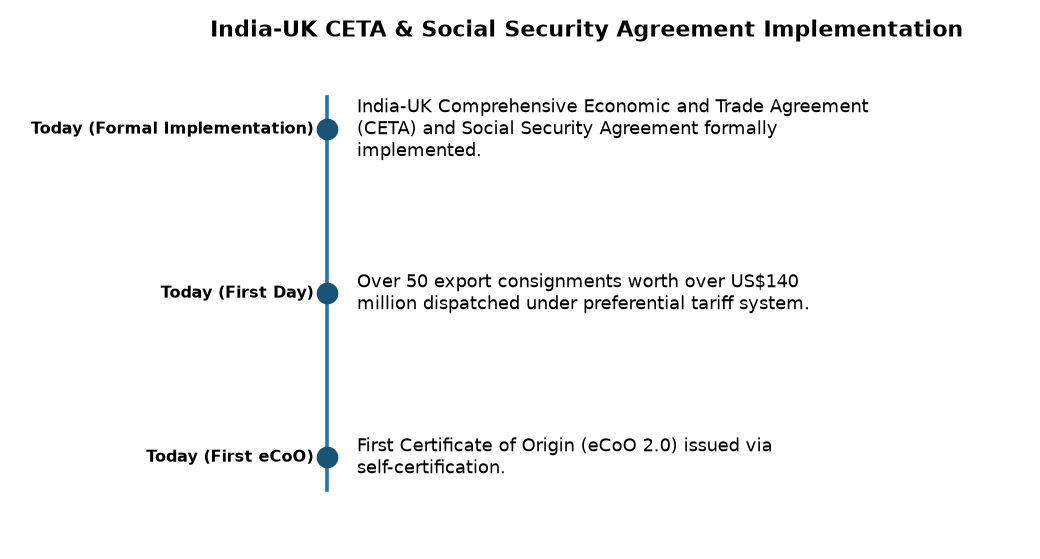
The India-United Kingdom Comprehensive Economic and Trade Agreement (CETA) and the Social Security Agreement (SSA), also known as the Double Contribution Convention (DCC), formally came into effect on July 15, 2026. This significant development, marked by an inaugural ceremony in New Delhi, signifies a pivotal moment in the economic partnership between the two nations, with initial reports indicating over 50 export consignments worth more than US$140 million already dispatched under the preferential duty regime.
Background
- India and the UK share a long-standing historical relationship, evolving into a modern strategic partnership encompassing political, economic, and cultural dimensions.
- Post-Brexit, the UK has actively sought new trade agreements globally, with India identified as a key strategic partner due to its large market and growing economy.
- Negotiations for the India-UK CETA commenced in January 2022, following the ‘Enhanced Trade Partnership’ launched in May 2021, aiming for a comprehensive agreement covering goods, services, investment, and other areas.
- The CETA negotiations involved 14 formal rounds and over 800 technical sessions, highlighting the extensive and complex nature of the discussions.
- The agreement aims to significantly boost bilateral trade, which stood at approximately £36 billion in 2022-23, by reducing tariffs and non-tariff barriers.
- The Social Security Agreement (SSA) was negotiated concurrently to address issues of dual social security contributions for professionals working temporarily in the partner country.
What are the India-UK CETA and Social Security Agreement?
- The India-UK Comprehensive Economic and Trade Agreement (CETA) is a Free Trade Agreement (FTA) designed to liberalize and facilitate trade in goods and services, and foster investment between India and the United Kingdom.
- It aims to provide zero-duty market access for approximately 99% of India’s exports to the UK, covering nearly 100% of trade value, significantly reducing tariff barriers.
- Key sectors poised to benefit include textiles, leather, gems and jewellery, engineering products, marine products, chemicals, and processed food, alongside opportunities for MSMEs, farmers, and manufacturers.
- The CETA also opens new avenues for India’s IT, professional, financial, education, and business service sectors, enhancing the mobility of Indian talent.
- The Social Security Agreement (SSA), or Double Contribution Convention (DCC), is a bilateral accord that exempts Indian professionals temporarily working in the UK (up to five years) from making dual social security contributions.
- This exemption enhances the global competitiveness of India’s workforce by reducing financial burdens and streamlining social security provisions.
- The first Certificate of Origin (CoO) under CETA was issued via the eCoO 2.0 platform on a self-certification basis, demonstrating the digital and streamlined implementation.
- The agreement is described as ‘comprehensive and deep’, surpassing previous FTAs signed by India in its scope and coverage of various economic aspects.
Key Features
| Feature | Significance |
|---|---|
| Zero-Duty Market Access | Provides access for ~99% of Indian exports to the UK, covering ~100% of trade value, boosting export competitiveness across diverse sectors. |
| Social Security Agreement (SSA) | Exempts temporary Indian professionals in the UK from dual social security contributions for up to 5 years, enhancing global talent mobility and reducing costs. |
| Services Sector Liberalization | Creates new opportunities for India’s IT, professional, financial, education, and business services, fostering growth and skill exchange. |
| Digital Implementation (eCoO 2.0) | Facilitates efficient and transparent trade processes through self-certification for Certificates of Origin, reducing bureaucratic hurdles. |
| Comprehensive Scope | Extends beyond traditional goods trade to include services, investment, intellectual property, and sustainable development, reflecting a holistic partnership. |
| MSME and Farmer Benefits | Specific provisions and market access opportunities designed to benefit Micro, Small, and Medium Enterprises and agricultural producers. |
Why it Matters
Economic Significance
- Boosts Bilateral Trade: Expected to significantly increase the current bilateral trade volume, potentially doubling it by 2030, fostering economic growth in both nations.
- Export Diversification and Growth: Provides a substantial fillip to Indian exports across key sectors like textiles, leather, gems, engineering goods, and processed foods, aiding ‘Make in India’ initiatives.
- Investment Promotion: Creates a more predictable and attractive environment for bilateral investments, encouraging capital flows and job creation.
- Services Sector Expansion: Opens new avenues for India’s robust services sector, particularly IT, financial, and professional services, enhancing India’s global service hub status.
- Reduced Business Costs: The SSA reduces the financial burden on Indian professionals working in the UK, making Indian talent more competitive globally and encouraging remittances.
Strategic Significance
- Strengthening Bilateral Ties: Deepens the strategic partnership between India and the UK, reinforcing their commitment to a rules-based international trading system.
- Post-Brexit UK’s Global Strategy: Positions India as a crucial partner in the UK’s ‘Global Britain’ strategy, diversifying its trade relationships beyond the EU.
- India’s Act East Policy & Global Ambitions: Aligns with India’s broader economic diplomacy objectives, enhancing its influence in global trade architecture and fostering partnerships with developed economies.
- Geopolitical Alignment: Reinforces cooperation between two major democracies, contributing to stability and shared values in a complex global environment.
Social and Human Capital Significance
- Enhanced Mobility of Talent: The SSA facilitates easier movement of skilled Indian professionals to the UK, addressing skill gaps and fostering knowledge exchange.
- Protection of Workers’ Rights: Ensures that Indian workers temporarily employed in the UK are not disadvantaged by dual social security contributions, providing financial relief and security.
- Cultural Exchange and People-to-People Ties: Increased trade and professional mobility are likely to strengthen cultural linkages and people-to-people connections, fostering mutual understanding.
Challenges
1. Non-Tariff Barriers (NTBs)
- Despite tariff reductions, NTBs such as complex customs procedures, differing product standards, and regulatory divergences can still impede trade flow.
- Ensuring mutual recognition of standards and certifications will be crucial for the agreement’s full potential.
UPSC Link: GS Paper III — Economy (Trade Policy)
2. Rules of Origin (RoO) Compliance
- Strict RoO requirements can be challenging for exporters, particularly MSMEs, to comply with, potentially limiting access to preferential tariffs.
- Need for robust verification mechanisms to prevent circumvention while ensuring ease of compliance.
UPSC Link: GS Paper III — Economy (International Trade)
3. Impact on Domestic Industries
- While beneficial overall, certain domestic sectors in both countries might face increased competition, necessitating adjustment mechanisms and support.
- Careful monitoring of import surges and their impact on vulnerable industries is essential.
UPSC Link: GS Paper III — Economy (Industrial Policy)
4. Services Mobility and Visa Regimes
- While the CETA aims to enhance services mobility, specific visa policies and immigration regulations in the UK can still pose barriers for Indian professionals.
- Continuous dialogue is required to ensure smooth implementation of mobility provisions.
UPSC Link: GS Paper II — International Relations (Diaspora Issues)
5. Geopolitical and Economic Volatility
- Global economic slowdowns, geopolitical tensions, and unforeseen events can impact trade volumes and the overall effectiveness of the agreement.
- The agreement’s resilience to external shocks will be tested over time.
UPSC Link: GS Paper II — International Relations (Global Economy)
Challenges — UPSC Perspective
| Issue | Concern |
|---|---|
| Non-Tariff Barriers (NTBs) | Regulatory divergences, product standards, and complex customs procedures can still hinder trade despite tariff cuts. |
| Rules of Origin (RoO) | Ensuring compliance for complex supply chains, especially for MSMEs, can be challenging and may limit preferential access. |
| Services Mobility Implementation | Translating CETA’s services commitments into practical, streamlined visa and immigration processes for professionals remains a key challenge. |
| Domestic Industry Adjustment | Potential for increased competition in specific sectors, requiring government support and adaptation strategies for domestic firms. |
| Dispute Resolution Mechanisms | Effectiveness and efficiency of dispute resolution under CETA will be crucial for addressing trade frictions and ensuring fair play. |
| Global Economic Headwinds | External economic shocks, inflation, and geopolitical instability could impact the projected benefits and trade volumes. |
Government Initiatives — Must-Memorise for Prelims
- Make in India
- Production Linked Incentive (PLI) Scheme
- National Logistics Policy
- Foreign Trade Policy (FTP)
- Startup India
- Skill India Mission
- Ease of Doing Business initiatives
- Remission of Duties and Taxes on Exported Products (RoDTEP)
- Market Access Initiative (MAI) Scheme
- Special Economic Zones (SEZ) Policy
Way Forward
- Establish a robust joint monitoring mechanism to regularly review the implementation of CETA and SSA, addressing any emerging issues promptly.
- Invest in capacity building and awareness programs for Indian exporters, especially MSMEs, to navigate the complexities of RoO and other regulatory requirements.
- Continuously engage in dialogue with the UK to streamline visa processes and enhance the mobility of Indian professionals, ensuring the full realization of services trade potential.
- Promote greater collaboration in areas like digital trade, green technologies, and research & development, leveraging the complementary strengths of both economies.
- Diversify export baskets and explore new market niches within the UK, moving beyond traditional goods to high-value and innovative products.
- Strengthen India’s domestic manufacturing capabilities and infrastructure to maximize the benefits of increased market access and attract UK investments.
- Develop effective dispute resolution mechanisms to ensure fair and timely resolution of any trade or investment-related disagreements.
- Utilize the CETA as a template for future comprehensive trade agreements with other developed economies, refining India’s negotiation strategies.
UPSC Value Addition
Keywords for Mains Answer-Writing
Comprehensive Economic and Trade Agreement (CETA) · Social Security Agreement (SSA) · Bilateral Economic Partnership · Trade Liberalization · Services Trade · Market Access · Rules of Origin (RoO) · Non-Tariff Barriers (NTBs) · Economic Diplomacy · Global Britain · Make in India · Skill Mobility
Constitutional & Policy Linkages
- Article 253: Legislation for giving effect to international agreements.
- Seventh Schedule (Union List – Entry 14): Entering into treaties and agreements with foreign countries and implementing treaties, agreements and conventions with foreign countries.
- Foreign Trade (Development and Regulation) Act, 1992: Governs India’s foreign trade policy.
- Customs Act, 1962: Provides for the levy and collection of customs duties.
- Ministry of Commerce and Industry: Nodal ministry for trade agreements.
Concept Flow
India-UK CETA & SSA Signed → Formal Implementation Commences → Tariff Reduction & Services Liberalization → Increased Bilateral Trade & Investment → Economic Growth & Job Creation → Enhanced Strategic Partnership & Global Competitiveness
Prelims Practice Questions
Q1. With reference to the India-UK Comprehensive Economic and Trade Agreement (CETA) and Social Security Agreement (SSA), consider the following statements:
1. The CETA provides zero-duty market access for approximately 99% of India’s exports to the UK.
2. The Social Security Agreement (SSA) is also known as the Double Contribution Convention (DCC).
3. The first Certificate of Origin (CoO) under CETA was issued manually to ensure authenticity.
Which of the statements given above is/are correct?
- A. 1 only
- B. 2 only
- C. 1 and 2 only
- D. 1, 2 and 3
Answer: C. 1 and 2 only — Statement 1 is correct: The CETA aims to provide zero-duty market access for approximately 99% of India’s exports to the UK. Statement 2 is correct: The Social Security Agreement (SSA) is indeed also referred to as the Double Contribution Convention (DCC). Statement 3 is incorrect: The first Certificate of Origin (CoO) under CETA was issued via the eCoO 2.0 platform on a self-certification basis, not manually.
Q2. Which of the following sectors are expected to benefit significantly from the India-UK CETA, as per the recent news?
1. Textiles
2. Leather
3. Gems and Jewellery
4. Information Technology
5. Marine Products
Select the correct answer using the code given below:
- A. 1, 2 and 3 only
- B. 4 and 5 only
- C. 1, 2, 3, 4 and 5
- D. 1, 3 and 5 only
Answer: C. 1, 2, 3, 4 and 5 — All the listed sectors—Textiles, Leather, Gems and Jewellery, Information Technology, and Marine Products—are explicitly mentioned in the news as areas expected to generate unprecedented opportunities and benefit from the India-UK CETA. The agreement covers both goods and services, including IT and other professional services.
Mains Practice Question
✍ The operationalization of the India-UK Comprehensive Economic and Trade Agreement (CETA) and Social Security Agreement (SSA) marks a significant milestone in bilateral relations. Analyze the key features and potential benefits of these agreements for India, while also discussing the challenges that need to be addressed for their successful implementation. (250 words)
Approach: Begin by briefly introducing the CETA and SSA and their recent implementation. In the first part, elaborate on the key features of both agreements, such as zero-duty access, services liberalization, and the SSA’s provisions for professionals. Subsequently, discuss the potential benefits for India, focusing on economic growth, export diversification, investment promotion, and enhanced talent mobility. In the second part, critically analyze the challenges, including non-tariff barriers, rules of origin compliance, and potential impacts on domestic industries. Conclude with a forward-looking statement on the need for effective implementation and continuous dialogue to fully harness the potential of this strategic partnership.
Source: PIB (Press Information Bureau)

- पेरियार टाइगर रिजर्व में 6 नई प्रजातियाँ खोजी गईं, जानिए क्या हैं विशेषताएँ - September 22, 2026
- Six New Species Discovered in Periyar Tiger Reserve: UPSC & PCS Key Biodiversity Insights - September 22, 2026
- तमिलनाडु में बस किराए में संशोधन: सरकार को चार सप्ताह और समय मिला, उच्च न्यायालय का फैसला - September 22, 2026

No Comments