


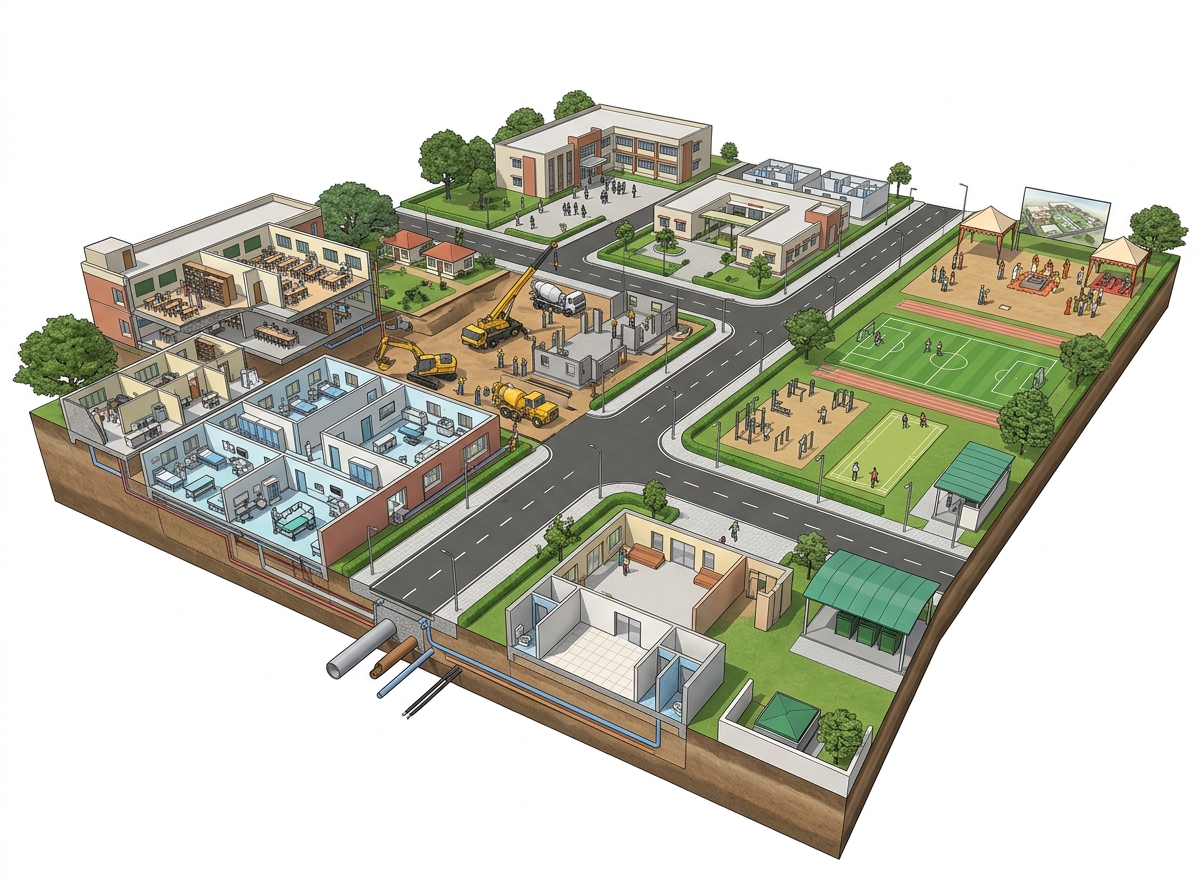
30 Aug लखनऊ छावनी में 14 विकास परियोजनाओं का भूमि पूजन: राजनाथ सिंह
✎ Cantonments are urban areas managed under the Cantonments Act, 2006, with development projects executed through civil-military collaboration to ensure parity with civilian urban centres, integrating infrastructure, education…
Subject Relevance — Where This Topic Fits
- GS Paper II — Governance, Constitution, Polity, Social Justice and International relations (Local Governance and Urban Development) | GS Paper III — Infrastructure, Environment and Urbanisation
- Prelims: Cantonments Act, 2006, Defence Estates Organisation, Swachh Bharat Mission, Atal Mission for Rejuvenation and Urban Transformation (AMRUT), SCADA systems in water supply, Artificial Intelligence in solid waste management, Bio-mining and bio-remediation of legacy waste
- Essay: The role of civil-military synergy in nation-building, Sustainable urban development: Balancing heritage and modernity
Quick Revision: Cantonments are urban areas managed under the Cantonments Act, 2006, with development projects executed through civil-military collaboration to ensure parity with civilian urban centres, integrating infrastructure, education, healthcare, and environmental sustainability.
Why is this in the news?
On 30 August 2026, the Union Defence Minister and the Chief Minister of Uttar Pradesh jointly performed the ground-breaking ceremony for 14 development projects worth over ₹100 crore in the Lucknow Cantonment. These projects, implemented with the collaboration of the state government, focus on enhancing civic infrastructure, education, healthcare, sanitation, and sports facilities, aligning with the broader national agenda of inclusive and sustainable urban development.
Background
- Cantonments in India are administered under the Cantonments Act, 2006, which mandates the development of civilian infrastructure within cantonment areas while ensuring military operational readiness.
- The Defence Estates Organisation (DEO), under the Ministry of Defence, is responsible for the management of defence lands and cantonments, including the execution of development projects in coordination with state governments.
- Uttar Pradesh, with its significant urban population and strategic location, has been a focus area for integrated civil-military development initiatives, particularly in cantonments like Lucknow.
- The Union Government’s emphasis on ‘Viksit Bharat 2047’ underscores the need for holistic urban development, integrating infrastructure, education, healthcare, and environmental sustainability.
- The Swachh Bharat Mission and AMRUT 2.0 have laid the groundwork for sustainable urban infrastructure, which is being extended to cantonment areas to ensure parity with civilian urban centres.
- The collaboration between the central and state governments in cantonment development reflects the principle of cooperative federalism, as enshrined in the Constitution of India.
What are Cantonments and their Development Framework?
- Cantonments are designated areas for the residence and training of military personnel, established during the colonial era and now governed by the Cantonments Act, 2006, which replaced the Cantonments Act, 1924.
- The Cantonments Act, 2006, provides the legal and administrative framework for the management of cantonments, including the development of civilian infrastructure such as schools, hospitals, markets, and recreational facilities.
- The Defence Estates Organisation (DEO), under the Ministry of Defence, is the nodal agency responsible for the administration of cantonments, including land management, development projects, and coordination with state and local authorities.
- Cantonment Boards, established under the Act, function as local self-government bodies, comprising elected representatives, nominated members, and ex-officio members from the military and civil administration.
- Development projects in cantonments are executed through a collaborative model involving the DEO, state governments, and local bodies, ensuring alignment with national and state-level urban development policies.
- The integration of modern technologies such as SCADA (Supervisory Control and Data Acquisition) in water supply systems and AI-based solid waste management plants reflects the adoption of smart urban solutions in cantonment areas.
- Heritage conservation and the renaming of markets in Lucknow Cantonment to honour national icons and freedom fighters underscore the government’s commitment to preserving cultural identity while promoting inclusive development.
- The development of multi-level robotic car parking and commercial complexes in cantonments aligns with the broader urbanisation trends and the need for efficient land use in densely populated areas.
Key Features
| Feature | Significance |
|---|---|
| Artificial Intelligence-based Solid Waste Management Plant | Introduces AI-driven waste segregation and processing, enhancing urban sanitation and reducing landfill dependency under Swachh Bharat Mission 2.0. |
| Multi-purpose Sports Complex | Provides integrated recreational infrastructure for youth, aligning with Khelo India and Fit India Movement objectives for grassroots sports development. |
| Modern Crematorium with SCADA Automation | Ensures efficient and dignified last rites with automated monitoring, reducing operational delays and improving hygiene standards. |
| Underground Water Reservoir (1500 KL capacity) | Strengthens water security in peri-urban areas, mitigating groundwater depletion and aligning with Jal Jeevan Mission’s piped water supply goals. |
| Rainbow Model School Expansion | Expands inclusive education infrastructure for marginalised communities, supporting Right to Education Act (RTE) provisions. |
Why it Matters
Infrastructure Development
- Accelerates urban renewal in cantonment areas through integrated civil-military cooperation, leveraging Defence Estates Organisation’s mandate under the Cantonments Act, 2006.
- Demonstrates Centre-State convergence in project execution, exemplified by joint funding for the polyclinic and coaching centre under UP government’s Abhyudaya Yojana.
- Enhances livability indices in cantonment towns by addressing multi-sectoral deficits in water supply, sanitation, and public health.
Governance & Inclusivity
- Promotes inclusive urban governance by prioritising facilities for Persons with Disabilities (PwDs) via the Rights of Persons with Disabilities Act, 2016.
- Reinforces civic identity through renaming of markets to honour national icons (e.g., Udadevi Bazaar, Mangal Pandey Bazaar), aligning with decolonisation efforts in public spaces.
- Strengthens participatory planning through community engagement in project selection, as evidenced by the inclusion of local stakeholders in the inauguration.
Technological Integration
- Adopts SCADA (Supervisory Control and Data Acquisition) systems for water distribution and crematorium operations, enhancing real-time monitoring and efficiency.
- Deploys AI in solid waste management to optimise resource utilisation and reduce environmental footprint, consistent with Smart Cities Mission guidelines.
- Introduces robotic multi-level parking to address urban congestion, reflecting adoption of smart mobility solutions in cantonment areas.
Strategic & Social Impact
- Bolsters cantonment infrastructure as a model for peri-urban development, potentially replicable in other cantonment boards nationwide.
- Supports youth empowerment through sports and skill development facilities, contributing to demographic dividend utilisation.
- Ensures equitable access to basic services (water, education, healthcare) in line with Sustainable Development Goals (SDG 6, SDG 4, SDG 3).
Challenges
1. Multi-Stakeholder Coordination
- Ensuring seamless collaboration between Defence Estates Organisation, state agencies, and local bodies to prevent delays in project implementation.
- Balancing cantonment-specific regulations (Cantonments Act, 2006) with state-level urban development policies to avoid jurisdictional conflicts.
UPSC Link: Laxmikant Polity: Local Governance
2. Sustainability of Infrastructure
- Maintaining operational efficiency of AI-based waste management and SCADA systems post-commissioning, including capacity-building for local staff.
- Preventing underutilisation of facilities (e.g., sports complex, parking) due to low community awareness or lack of maintenance funds.
UPSC Link: Environment & Ecology: Waste Management
3. Equitable Service Delivery
- Mitigating disparities in access to upgraded facilities between affluent and marginalised sections within cantonment areas.
- Addressing language and cultural barriers in service provision for diverse user groups, including PwDs and senior citizens.
UPSC Link: Social Justice: Inclusive Development
4. Financial Sustainability
- Ensuring long-term funding for operation and maintenance of projects post-completion, beyond initial capital expenditure.
- Avoiding over-reliance on state or central funds by exploring public-private partnerships (PPP) for revenue-generating assets (e.g., commercial complexes).
UPSC Link: Economic Survey: PPP Models
5. Urbanisation Pressures
- Managing increased footfall and resource demand in cantonment areas due to improved infrastructure, potentially straining existing civic amenities.
- Integrating cantonment development with broader city planning to prevent haphazard urban sprawl and traffic congestion.
UPSC Link: Geography: Urbanisation
Challenges — UPSC Perspective
| Issue | Concern |
|---|---|
| Regulatory Compliance | Adherence to Cantonments Act, 2006 and state urban development rules without compromising project timelines. |
| Technology Adoption | Training local staff to operate and maintain AI/SCADA systems, ensuring minimal downtime and data privacy. |
| Community Engagement | Sustaining public interest in post-project utilisation to prevent facilities from becoming white elephants. |
| Funding Gaps | Securing additional revenue streams for maintenance, especially for non-revenue-generating assets like schools and crematoriums. |
| Environmental Impact | Assessing long-term ecological effects of underground reservoirs and AI waste plants on local ecosystems. |
Government Initiatives — Must-Memorise for Prelims
- Abhyudaya Yojana (Uttar Pradesh)
Way Forward
- Conduct periodic audits of project utilisation and maintenance to ensure optimal service delivery and prevent decay.
- Establish a dedicated inter-departmental task force to monitor Centre-State coordination and resolve bottlenecks in real time.
- Launch awareness campaigns to educate residents on the benefits and operational aspects of AI-based and automated systems.
- Develop a revenue model for PPP-based commercial projects to generate funds for upkeep of non-revenue assets.
- Integrate cantonment development plans with municipal urban local bodies (ULBs) to ensure holistic city planning.
- Institute a grievance redressal mechanism for citizens to report issues in facility operation or maintenance.
- Document best practices and lessons learned to replicate the model in other cantonment areas across India.
UPSC Value Addition
Keywords for Mains Answer-Writing
Lucknow Cantonment development · Defence Estates Organisation · Integrated Cantonment Development Programme · Public-Private Partnership in defence infrastructure · Cantonment Boards under Cantonments Act, 2006 · Solid Waste Management in cantonments · SCADA-based water supply automation · Inclusive education for children with disabilities · Heritage conservation in cantonments · Urban governance and decentralisation · Swachh Bharat Mission and cantonment areas · Skill development centres in cantonments · Multi-level robotic parking systems · Artificial Intelligence in waste management · Public health infrastructure in cantonments
Concept Flow
Cantonment Act, 2006 → Defines governance structure of cantonment areas → Enables Centre-State collaboration for infrastructure projects. → Swachh Bharat Mission 2.0 → Mandates AI-based solid waste management → Leads to adoption of smart waste processing systems. → Jal Jeevan Mission → Ensures piped water supply → Drives construction of underground reservoirs and pipeline replacements. → Right to Education Act, 2009 → Guarantees inclusive education → Supports expansion of Rainbow Model School and special schools for PwDs. → Smart Cities Mission → Promotes SCADA automation and robotic parking → Enhances urban efficiency and livability. → Convergence of schemes → Integrates funds, technology, and governance → Results in holistic cantonment redevelopment.
Prelims Practice Questions
Q1. Consider the following statements regarding the Cantonments Act, 2006:
1. The Act provides for the establishment of Cantonment Boards to manage civic amenities in cantonment areas.
2. The Act empowers the Central Government to constitute a Cantonment Board for any notified cantonment area.
3. The Cantonment Board is a statutory body under the administrative control of the Ministry of Defence.
4. The Act mandates that all Cantonment Boards must be chaired by an elected representative.
How many of the above statements are correct?
- Only one
- Only two
- Only three
- All four
Answer: Only three — Statements 1, 2, and 3 are correct. Statement 4 is incorrect as the Chairperson of a Cantonment Board may be an elected representative or an officer nominated by the Central Government.
Q2. Assertion (A): The Integrated Cantonment Development Programme (ICDP) is a centrally sponsored scheme aimed at improving infrastructure in cantonment areas.
Reason (R): The ICDP is implemented under the aegis of the Ministry of Defence and involves the participation of state governments and local bodies.
In the context of the above two statements, which one of the following is correct?
- Both A and R are true, and R is the correct explanation of A.
- Both A and R are true, but R is not the correct explanation of A.
- A is true, but R is false.
- A is false, but R is true.
Answer: Both A and R are true, but R is not the correct explanation of A. — Both the assertion and reason are true. The ICDP is indeed a centrally sponsored scheme under the Ministry of Defence, and it involves multi-stakeholder participation including state governments and local bodies.
Q3. Match the following development projects in Lucknow Cantonment with their respective objectives:
Column I (Project) | Column II (Objective)
——————————————–|———————————————
A. AI-based Solid Waste Management Plant | 1. Ensuring 24×7 water supply
B. SCADA-based Water Supply Automation | 2. Providing inclusive education
C. Multi-level Robotic Parking System | 3. Enhancing waste processing efficiency
D. Special School for Children with Disabilities | 4. Optimising urban space utilisation
Choose the correct match:
- A-3, B-1, C-4, D-2
- A-1, B-3, C-2, D-4
- A-4, B-2, C-1, D-3
- A-2, B-4, C-3, D-1
Answer: A-3, B-1, C-4, D-2 — Correct matches are: A-3 (AI-based Solid Waste Management Plant enhances waste processing efficiency), B-1 (SCADA-based Water Supply Automation ensures 24×7 water supply), C-4 (Multi-level Robotic Parking System optimises urban space utilisation), D-2 (Special School for Children with Disabilities provides inclusive education).
Mains Practice Question
✍ The development of cantonment areas in India requires a multi-dimensional approach integrating infrastructure, governance, and inclusivity. In the context of the recent development initiatives in Lucknow Cantonment, critically examine the role of cantonment boards in urban governance. Also, analyse how such initiatives contribute to the broader goals of ‘Sustainable Cities and Communities’ as outlined in the UN Sustainable Development Goals (SDG 11). (15 Marks)
Approach: MODEL-ANSWER SKELETON:
1. **Role of Cantonment Boards in Urban Governance** (6 points):
– Constitutional/legal framework: Cantonment Boards are statutory bodies constituted under the Cantonments Act, 2006, functioning as local self-government institutions in cantonment areas.
– Composition and functions: Boards consist of elected and nominated members, with the Station Commander as ex-officio President. Functions include provision of civic amenities, maintenance of public health, and urban planning.
– Autonomy vs. central control: Discuss the balance between autonomy of cantonment boards and oversight by the Ministry of Defence and Central Government.
– Challenges: Limited financial resources, coordination issues with municipal bodies, and land management constraints.
– Recent reforms: Highlight provisions for public-private partnerships (PPP) and technology adoption (e.g., SCADA, AI) in cantonment development.
– Case reference: Lucknow Cantonment’s integrated development projects as a model for other cantonments.
2. **Contribution to SDG 11 (Sustainable Cities and Communities)** (6 points):
– Infrastructure development: Discuss how projects like AI-based waste management, SCADA water supply, and multi-level parking align with SDG 11 targets on sustainable infrastructure (11.2, 11.3, 11.6).
– Inclusivity: Analyse initiatives like special schools for children with disabilities and heritage conservation (11.7) in promoting social inclusion.
– Environmental sustainability: Evaluate the impact of solid waste management and water conservation projects on reducing carbon footprint and resource efficiency (11.a, 11.b).
– Governance and partnerships: Emphasise the role of multi-stakeholder collaboration (central, state, local bodies) in achieving SDG 11.
3. **Critical Examination and Way Forward** (3 points):
– Critique: Assess whether cantonment boards are adequately equipped to address urban challenges or if structural reforms (e.g., fiscal devolution, legal empowerment) are needed.
– Comparative perspective: Contrast cantonment governance with municipal governance in urban areas.
– Future directions: Suggest measures such as capacity building, technology adoption, and policy integration to enhance sustainability in cantonment areas.
**Balanced conclusion**: Acknowledge the progress while highlighting gaps and proposing actionable recommendations for holistic urban development in cantonment areas.
Source: PIB (Press Information Bureau)
Uttar Pradesh PCS (UPPSC) — State PCS Practice
Prelims: With reference to the recent inauguration of development projects in Lucknow Cantonment by Union Defence Minister Rajnath Singh and Uttar Pradesh Chief Minister Yogi Adityanath, which of the following statements is/are correct? 1. The total investment in the 14 projects exceeds ₹100 crore. 2. The projects were inaugurated in the Lucknow Cantonment area. 3. The projects are primarily focused on rural infrastructure development. 4. The initiative aligns with the Uttar Pradesh government’s ‘One District One Product’ scheme.
- Only 1 and 2
- Only 2 and 3
- Only 1, 2, and 4
- 1, 2, 3, and 4
Answer: Only 1 and 2 — Statements 1 and 2 are correct as the projects total over ₹100 crore and were inaugurated in Lucknow Cantonment. Statements 3 and 4 are incorrect as the projects focus on cantonment infrastructure and do not explicitly align with ‘One District One Product’.
Mains: Discuss the significance of the recent inauguration of 14 development projects worth over ₹100 crore in Lucknow Cantonment from the perspective of Uttar Pradesh’s urban infrastructure development and cantonment governance. Highlight the administrative and economic benefits for the state, with a focus on Lucknow’s role as a key administrative and military hub.
Generated by AanyaAi for educational purpose.
Related guides on our sites
- Best PSIR optional coaching for upsc
- Best PSIR optional teacher for upsc
- Best teacher of PSIR optional for upsc
- Best PSIR optional coaching in delhi for UPSC

- UNEP Report 2026 Warns: Paris 1.5°C Target Slipping Away - October 23, 2026
- पूर्व आईएएस अधिकारी हत्या मामले में आईएएस एसोसिएशन की मुख्यमंत्री से मुलाकात - October 23, 2026
- UPSC Exam: Rare Glimpse of Ritwik Ghatak’s Cinematic Legacy at 4-Day Festival - October 23, 2026

No Comments