


17 Sep सीएक्यूएम inspects industries in Hapur, UP: 16 out of 22 found violating norms, 12 issued SCNs
✎ The Commission for Air Quality Management (CAQM) conducts special inspections to enforce environmental norms in industrial clusters of the NCR, ensuring compliance with the Air (Prevention and and Control of Pollution) Act, 1981…
Subject Relevance — Where This Topic Fits
- GS Paper III — Environment and Disaster Management | GS Paper III — Pollution Control and Industrial Regulation
- Prelims: Commission for Air Quality Management (CAQM), Online Continuous Emission Monitoring System (OCEMS), Consent to Operate (CTO), Air Pollution Control Devices (APCD), Stack Emission Monitoring, Hazardous Waste Management, Pollution Control Board (PCB), National Clean Air Programme (NCAP)
- Essay: Environmental governance and industrial compliance: Balancing economic growth with ecological sustainability, Regulatory mechanisms for pollution control: Effectiveness and challenges in implementation
Quick Revision: The Commission for Air Quality Management (CAQM) conducts special inspections to enforce environmental norms in industrial clusters of the NCR, ensuring compliance with the Air (Prevention and and Control of Pollution) Act, 1981, and other regulations to mitigate air pollution.
Why is this in the news?
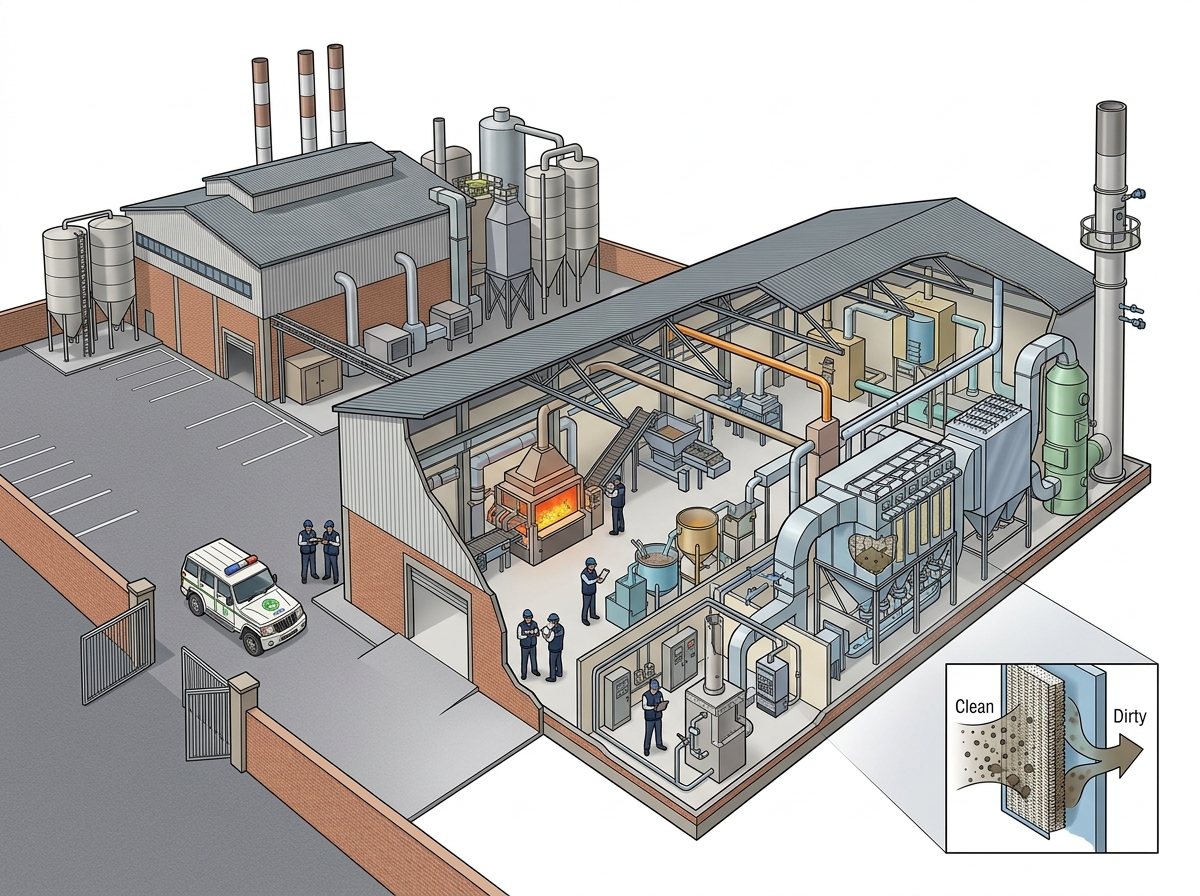
The Commission for Air Quality Management (CAQM) conducted a special inspection of 22 industrial units in Hapur, Uttar Pradesh, on 15 September 2026, under its ongoing enforcement drive across the National Capital Region (NCR). The inspection revealed widespread non-compliance with environmental norms, with 16 units found violating statutory directives. This episode underscores the critical role of the CAQM in ensuring adherence to environmental regulations in industrial clusters to mitigate air pollution in the NCR.
Background
- The National Capital Region (NCR) faces severe air pollution challenges, necessitating robust regulatory oversight to control industrial emissions and other sources of pollution.
- The Commission for Air Quality Management (CAQM) was established under the Commission for Air Quality Management in National Capital Region and Adjoining Areas Act, 2021, to address air pollution in the NCR and surrounding regions through coordinated action among states and central agencies.
- Industrial units in the NCR are required to comply with the Air (Prevention and Control of Pollution) Act, 1981, and other environmental regulations, including the use of Online Continuous Emission Monitoring Systems (OCEMS) and Air Pollution Control Devices (APCD).
- The Uttar Pradesh Pollution Control Board (UPPCB) operates under the Water (Prevention and Control of Pollution) Act, 1974, and the Air (Prevention and Control of Pollution) Act, 1981, to enforce environmental norms in the state.
- The National Clean Air Programme (NCAP), launched in 2019, aims to reduce particulate matter pollution by 20-30% by 2024, with industrial emissions being a key focus area.
- Special inspection drives by the CAQM are part of a broader strategy to identify non-compliant units, issue notices, and ensure strict adherence to environmental norms in critical industrial zones.
What is the Commission for Air Quality Management (CAQM)?
- The CAQM is a statutory body constituted under the Commission for Air Quality Management in National Capital Region and Adjoining Areas Act, 2021, to tackle air pollution in the NCR and adjoining areas.
- It replaces the erstwhile Environment Pollution (Prevention and Control) Authority (EPCA) and is empowered to enforce environmental norms, coordinate with state pollution control boards, and issue directives to industries and local authorities.
- The CAQM operates through specialized units, including Flying Squads, to conduct surprise inspections and ensure compliance with environmental regulations in industrial clusters.
- The Commission is mandated to develop action plans, monitor air quality, and recommend measures to mitigate pollution from various sources, including industries, vehicles, and construction activities.
- The CAQM works in collaboration with state pollution control boards, district administrations, and other stakeholders to enforce environmental norms and ensure accountability among polluters.
- The Commission has the authority to issue notices, impose penalties, and recommend closure or sealing of non-compliant industrial units to prevent environmental degradation.
- The CAQM also promotes the adoption of cleaner technologies, retrofitting of emission control devices, and the use of OCEMS to monitor real-time emissions from industries.
Key Features
| Feature | Significance |
|---|---|
| Special Inspection by CAQM | Conducted by the Commission for Air Quality Management in NCR and Adjoining Areas to enforce environmental norms and curb industrial pollution. |
| Flying Squad Mechanism | Rapid-response teams deployed for surprise inspections to detect non-compliance with environmental regulations. |
| Online Continuous Emission Monitoring System (OCEMS) | Mandatory digital monitoring of industrial emissions to ensure real-time compliance with emission standards. |
| Stack Emission Reports | Documented records of industrial emissions required under statutory guidelines to track compliance. |
| Show Cause Notices (SCNs) | Legal notices issued to industries for non-compliance, initiating penal or corrective action. |
Why it Matters
Environmental Governance
- Enforcement of the Air (Prevention and Control of Pollution) Act, 1981, and the Environment Protection Act, 1986, to mitigate industrial air pollution in NCR.
Public Health
- Reduction of respiratory and cardiovascular diseases linked to industrial emissions, particularly in densely populated industrial clusters like Hapur.
Industrial Accountability
- Strengthening regulatory oversight to ensure industries adhere to statutory emission norms, reducing environmental degradation.
Regulatory Coordination
- Collaboration between CAQM, Uttar Pradesh Pollution Control Board (UPPCB), and district administration to enforce environmental laws uniformly.
Challenges
1. Non-Compliance with Emission Norms
- 16 out of 22 inspected units in Hapur failed to meet statutory emission standards, highlighting systemic gaps in enforcement.
UPSC Link: Air Pollution, NCR
2. Lack of Real-Time Monitoring
- Absence or malfunction of OCEMS in several units, undermining the ability to track emissions continuously.
UPSC Link: Environmental Monitoring
3. Use of Polluting Technologies
- Illegal wood-fired pit furnaces and outdated emission control systems observed, exacerbating air pollution.
UPSC Link: Industrial Pollution
4. Coordination Gaps in Enforcement
- Inadequate inter-agency coordination between CAQM, UPPCB, and local authorities, leading to delayed or ineffective action.
UPSC Link: Environmental Governance
5. Documentation and Reporting Failures
- Missing stack emission reports and discrepancies in operational permits, indicating poor compliance culture.
UPSC Link: Environmental Compliance
Challenges — UPSC Perspective
| Issue | Concern |
|---|---|
| Non-adherence to CTO conditions | Industries operating beyond permitted capacity or fuel specifications, violating statutory permits. |
| Bypass of APCS/Wet Scrubber Systems | Deliberate or negligent bypassing of pollution control devices to reduce operational costs. |
| Absence of OCEMS | Failure to install or maintain mandatory real-time emission monitoring systems. |
| Leakage in Emission Control Systems | Physical defects in pollution control infrastructure leading to unchecked emissions. |
| Non-reporting of Stack Emissions | Industries failing to submit required emission data, hindering regulatory oversight. |
| Use of Obsolete Technologies | Continued use of high-pollution technologies like wood-fired pit furnaces despite bans. |
Way Forward
- Strengthen inter-agency coordination between CAQM, UPPCB, and district authorities to ensure seamless enforcement of environmental norms.
- Mandate the installation and regular auditing of OCEMS in all industrial units to enable real-time compliance monitoring.
- Conduct periodic surprise inspections by flying squads to deter non-compliance and identify violators promptly.
- Impose stringent penalties, including closure and fines, on industries found violating emission norms or using obsolete technologies.
- Promote the adoption of retrofitted emission control devices (RECDs) and cleaner technologies in industries.
- Enhance public awareness campaigns to educate industries and local communities on environmental compliance and health impacts.
- Develop a grievance redressal mechanism for citizens to report industrial pollution violations effectively.
UPSC Value Addition
Keywords for Mains Answer-Writing
Commission for Air Quality Management in National Capital Region and Adjoining Areas (CAQM) · Special inspection of industries · Non-compliance with environmental norms · Causes to show cause notices (SCN) · Air pollution control devices (APCD) · Continuous Emission Monitoring System (CEMS) · Fly ash management · Environmental Protection Act, 1986 · National Green Tribunal (NGT) · Industrial emissions regulations · Retrofitted Emission Control Devices (RECD) · Hapur industrial clusters
Concept Flow
Industrial operations → Emission of pollutants → Non-compliance with environmental norms → Special inspection by CAQM → Detection of violations → Issuance of SCNs → Enforcement action (closure/fines) → Compliance improvement → Reduction in air pollution → Public health protection
Prelims Practice Questions
Q1. Consider the following statements regarding the Commission for Air Quality Management in National Capital Region and Adjoining Areas (CAQM):
1. It is a statutory body established under the Environment (Protection) Act, 1986.
2. It has the power to issue closure directions to non-compliant industries.
3. It is mandated to enforce compliance with the National Ambient Air Quality Standards (NAAQS).
4. It can impose penalties on industries violating environmental norms.
How many of the above statements are correct?
- Only one
- Only two
- Only three
- All
Answer: All — Statements 1, 2, and 3 are correct. Statement 4 is incorrect as the CAQM does not impose penalties directly; it recommends action to the concerned authorities who enforce penalties under applicable laws.
Q2. Assertion (A): The Continuous Emission Monitoring System (CEMS) is mandatory for industries to monitor real-time emissions.
Reason (R): CEMS helps in ensuring compliance with the emission standards prescribed under the Environment (Protection) Act, 1986.
Options:
A. Both A and R are true, and R is the correct explanation of A.
B. Both A and R are true, but R is not the correct explanation of A.
C. A is true, but R is false.
D. A is false, but R is true.
Answer: ? — Both A and R are true. The CEMS is indeed mandatory for industries to monitor emissions in real-time, and this system is prescribed under the Environment (Protection) Act, 1986, to ensure compliance with emission standards.
Q3. Match the following industrial emission control measures with their respective descriptions:
Column I
1. Wet Scrubber System
2. Retrofitted Emission Control Device (RECD)
3. Online Continuous Emission Monitoring System (OCEMS)
4. Stack Emission Report
Column II
A. Installed in existing industries to reduce emissions from stacks.
B. Reports submitted by industries to regulatory authorities detailing stack emissions.
C. A pollution control device that uses liquid to remove pollutants from industrial exhaust gases.
D. Real-time monitoring system installed in stacks to measure emissions continuously.
Options:
1. 1-C, 2-A, 3-D, 4-B
2. 1-A, 2-B, 3-C, 4-D
3. 1-D, 2-C, 3-B, 4-A
4. 1-B, 2-D, 3-A, 4-C
Answer: ? — The correct match is: 1-C (Wet Scrubber System uses liquid to remove pollutants), 2-A (RECD is installed in existing industries to reduce stack emissions), 3-D (OCEMS monitors emissions in real-time), and 4-B (Stack Emission Report is submitted to authorities).
Mains Practice Question
✍ The Commission for Air Quality Management in National Capital Region and Adjoining Areas (CAQM) recently conducted a special inspection of industries in Hapur, Uttar Pradesh, and found widespread non-compliance with environmental norms. Critically examine the legal and institutional framework governing industrial air pollution in India, with particular reference to the role of the CAQM, the Environment (Protection) Act, 1986, and the National Green Tribunal (NGT). Also, discuss the challenges in enforcement and suggest measures to improve compliance. (15 Marks)
Approach: MODEL-ANSWER SKELETON:
1. **Legal Framework**:
– Environment (Protection) Act, 1986: Empowers the central government to take measures to protect and improve the environment; Section 3 provides for the constitution of authorities like the CAQM.
– CAQM: Statutory body constituted under the Environment (Protection) Act, 1986, with jurisdiction over the NCR and adjoining areas; powers include issuing directions, closure orders, and recommending action to state pollution control boards.
– National Green Tribunal (NGT): Established under the National Green Tribunal Act, 2010; adjudicates environmental disputes and provides relief and compensation for damages to persons and property.
2. **Institutional Roles**:
– **CAQM**: Conducts inspections, issues show-cause notices, and recommends action to state authorities (e.g., Uttar Pradesh Pollution Control Board).
– **State Pollution Control Boards (SPCBs)**: Enforce environmental norms at the state level; issue consent to operate (CTO) and take enforcement action.
– **NGT**: Acts as a specialized forum for environmental disputes; can impose penalties and direct remediation.
3. **Challenges in Enforcement**:
– **Regulatory Gaps**: Overlapping jurisdictions between CAQM, SPCBs, and local authorities; lack of uniform enforcement standards.
– **Industry Resistance**: Non-compliance due to cost considerations, lack of technical expertise, or deliberate evasion.
– **Institutional Constraints**: Limited manpower and resources in SPCBs; delays in adjudication by NGT.
– **Technical Challenges**: Absence or malfunctioning of Online Continuous Emission Monitoring Systems (OCEMS), inadequate retrofitting of emission control devices.
4. **Measures to Improve Compliance**:
– Strengthen institutional coordination between CAQM, SPCBs, and local authorities.
– Mandate real-time monitoring (OCEMS) and retrofitting of emission control devices in all industries.
– Enhance penalties and streamline NGT processes for faster adjudication.
– Conduct regular awareness programs for industries and local communities.
– Leverage technology (e.g., drones, satellite monitoring) for better surveillance.
5. **Conclusion**: Balancing industrial growth with environmental protection requires robust enforcement, technological integration, and stakeholder collaboration.
Source: PIB (Press Information Bureau)
Uttar Pradesh PCS (UPPSC) — State PCS Practice
Prelims: As per the recent inspection by the Central Pollution Control Board (CPCB) in Hapur, Uttar Pradesh, what percentage of industrial units were found violating environmental norms?
- A. Approximately 50%
- B. Approximately 60%
- C. Approximately 73%
- D. Approximately 85%
Answer: C. Approximately 73% — Out of 22 industrial units inspected in Hapur, 16 were found violating environmental norms, which is approximately 73%.
Mains: Discuss the role of the Central Pollution Control Board (CPCB) in monitoring industrial compliance with environmental norms in Uttar Pradesh. Suggest measures to strengthen enforcement and reduce violations in the state’s industrial hubs like Hapur.
Generated by AanyaAi for educational purpose.

- बिहार DGP नियुक्ति: कुंदन कृष्णन की राह में सुप्रीम कोर्ट के नियमों से रोड़ा, जानें कौन बन सकता है अगला पुलिस प्रमुख - September 29, 2026
- Union Minister Launches India’s First PRAMAAN Certificates Under Forest Scheme - September 29, 2026
- पशुधन बीमा पोर्टल: किसानों को मिलेगी बीमा सुरक्षा, जानिए पूरी योजना - September 29, 2026

No Comments