


10 Sep झारखंड हाईकोर्ट में तीन नए न्यायाधीश: UPSC के लिए महत्वपूर्ण जानकारी
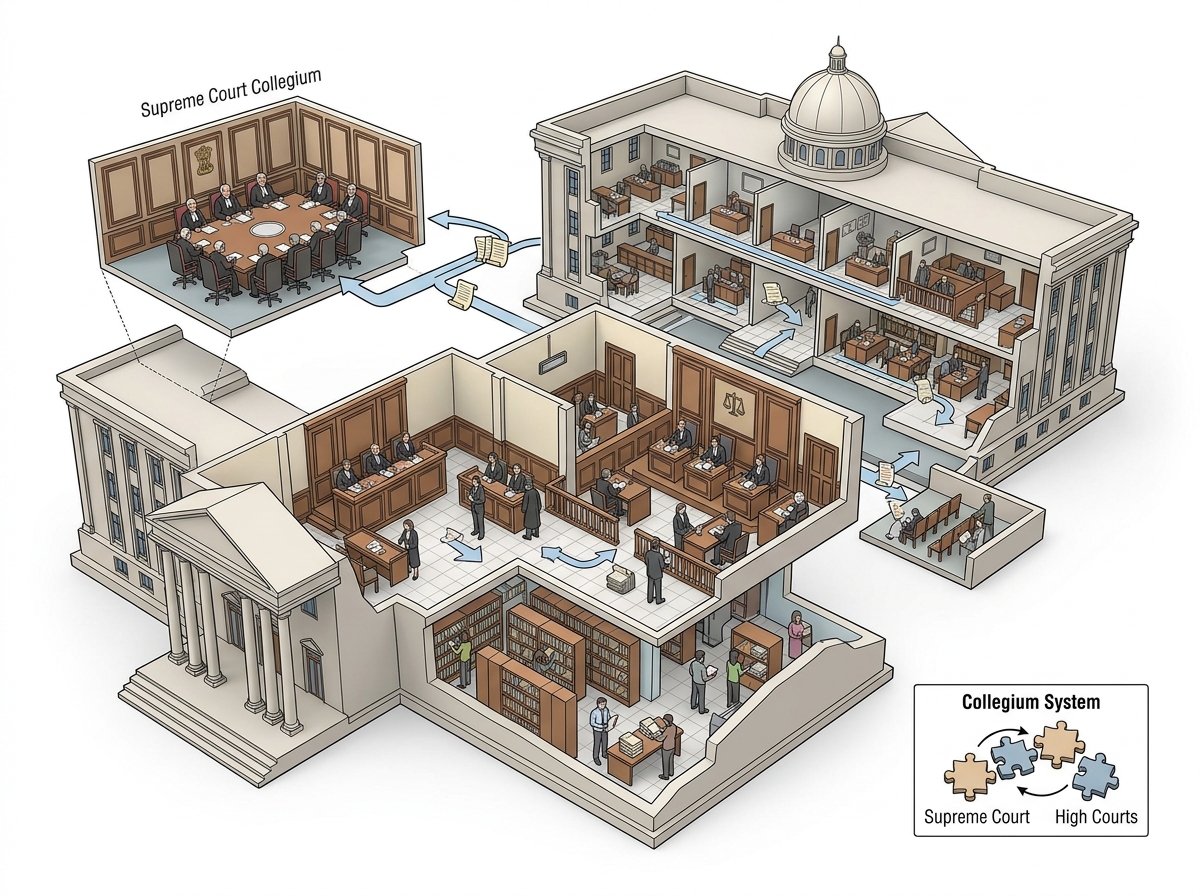
✎ The Collegium System, evolved through judicial precedents, governs the appointment of judges to the higher judiciary in India, ensuring judicial independence but remaining outside the purview of statutory regulation.
Subject Relevance — Where This Topic Fits
- GS Paper II — Polity and Governance — Judiciary | GS Paper IV — Ethics and Integrity in Governance — Judicial Appointments
- Prelims: Judicial Appointments Commission, Collegium System, High Court Judges (Appointments) Act, 1954, Article 217, Judicial Vacancies, Judicial Accountability
- Essay: Judicial Reforms: Balancing Efficiency and Accountability, Role of the Judiciary in Upholding Constitutional Values
Quick Revision: The Collegium System, evolved through judicial precedents, governs the appointment of judges to the higher judiciary in India, ensuring judicial independence but remaining outside the purview of statutory regulation.
Why is this in the news?
The Supreme Court Collegium has approved the appointment of three additional judges to the Jharkhand High Court, a decision that aims to enhance the judicial capacity of the court amid a backlog of cases. This development underscores the procedural framework governing judicial appointments in India, the role of the Collegium, and the broader objective of expediting judicial processes to ensure timely justice delivery.
Background
- The Jharkhand High Court, established in 2000, is the principal judicial authority for the state of Jharkhand.
- Judicial vacancies in High Courts have been a persistent challenge, leading to delays in case disposal and mounting pendency.
- The Collegium System, evolved through judicial pronouncements such as the Second and Third Judges Cases (1993, 1998), is the mechanism for appointing judges to the higher judiciary in India.
- The Supreme Court Collegium, comprising the Chief Justice of India and four senior-most judges, recommends appointments and transfers of judges to High Courts and the Supreme Court.
- The appointment process involves multiple stages, including consultation with the concerned High Court Chief Justice, the Governor of the state, and the Union Ministry of Law and Justice.
- Once the Collegium approves a name, it is forwarded to the President of India for formal appointment, followed by notification in the Gazette of India.
What is the Collegium System and How Does It Govern Judicial Appointments?
- The Collegium System is a judicial innovation that emerged from the interpretation of Articles 124(2) and 217 of the Constitution, which deal with the appointment and transfer of judges.
- It comprises the Chief Justice of India (CJI) and the four senior-most judges of the Supreme Court, collectively responsible for recommending appointments to the Supreme Court and High Courts.
- The system was formalised through the Supreme Court’s judgments in the Second Judges Case (1993) and Third Judges Case (1998), which expanded the role of senior judges in the appointment process.
- The Collegium evaluates candidates based on judicial merit, seniority, integrity, and potential to contribute to the judiciary, though the exact criteria remain largely non-statutory.
- Once the Collegium approves a list of names, it is sent to the Union Ministry of Law and Justice, which processes the appointments in consultation with the concerned state government and the President of India.
- The President’s formal approval and subsequent Gazette notification complete the constitutional process, after which the appointee assumes office as a judge.
- The Collegium System aims to insulate judicial appointments from executive interference, ensuring the independence of the judiciary as mandated by the Constitution.
- Criticisms of the Collegium System include lack of transparency, absence of a formalised selection process, and the potential for subjectivity in evaluations.
Key Features
| Feature | Significance |
|---|---|
| Appointment of three new judges to Jharkhand High Court | Enhances judicial capacity and reduces pendency of cases in the High Court. |
| Supreme Court Collegium’s approval | Ensures adherence to the constitutional process for judicial appointments under Article 217. |
| Constitutional and administrative process post-approval | Involves consultation with the Governor of Jharkhand and the President of India for final notification. |
| Expected acceleration in case disposal | Increased judicial strength is anticipated to expedite hearings and reduce backlog. |
| Focus on judicial infrastructure strengthening | Aligns with the broader objective of improving access to justice in Jharkhand. |
Why it Matters
Judicial Administration
- Strengthens the judicial infrastructure of Jharkhand High Court, addressing the issue of judicial vacancies.
- Enhances the capacity of the High Court to dispose of pending cases, thereby improving judicial efficiency.
- Promotes timely justice delivery, which is critical for maintaining public trust in the judiciary.
- Supports the constitutional mandate of speedy trial under Article 21 of the Constitution.
Constitutional Governance
- Reinforces the role of the Supreme Court Collegium in judicial appointments, ensuring independence of the judiciary.
- Demonstrates the functioning of the constitutional framework for judicial appointments under Article 217.
- Highlights the collaborative process between the judiciary and the executive in appointments.
Judicial Pendency and Access to Justice
- Addresses the challenge of judicial pendency in Jharkhand High Court, a critical issue for litigants.
- Contributes to reducing the backlog of cases, thereby improving access to justice for citizens.
- Supports the principle of ‘justice delayed is justice denied’ by expediting case disposal.
Challenges
1. Judicial Pendency and Backlog
- High pendency of cases in Jharkhand High Court due to limited judicial strength.
- Delays in case disposal affect litigants’ rights and undermine public confidence in the judiciary.
- Inadequate infrastructure and resources in the judiciary exacerbate the problem.
UPSC Link: Judicial Pendency and Case Management
2. Judicial Appointment Process
- Time-consuming and complex process for judicial appointments despite Collegium approval.
- Need for streamlined administrative procedures to ensure timely appointments.
- Coordination challenges between the judiciary and the executive in finalizing appointments.
UPSC Link: Judicial Appointments and Collegium System
3. Judicial Infrastructure and Capacity Building
- Inadequate judicial infrastructure in Jharkhand High Court to support increased judicial strength.
- Requirement for modernized courtrooms, digital infrastructure, and support staff.
- Need for continuous capacity-building programs for judicial officers.
UPSC Link: Judicial Infrastructure and Capacity
Challenges — UPSC Perspective
| Issue | Concern |
|---|---|
| Judicial Pendency | High backlog of cases delays justice delivery. |
| Appointment Delays | Complex process leads to prolonged vacancies in judicial positions. |
| Infrastructure Gaps | Inadequate facilities hinder efficient functioning of the judiciary. |
| Resource Constraints | Limited support staff and digital tools reduce judicial efficiency. |
| Public Trust | Delays and inefficiencies erode confidence in the judiciary. |
Way Forward
- Ensure timely completion of the constitutional and administrative process for the appointment of the three new judges.
- Strengthen judicial infrastructure in Jharkhand High Court, including digital tools and support staff.
- Monitor and evaluate the impact of the new appointments on case disposal rates and pendency.
- Promote alternative dispute resolution mechanisms to reduce the burden on the judiciary.
- Conduct capacity-building programs for judicial officers to enhance efficiency and effectiveness.
- Collaborate with the state government to address infrastructure gaps in the judiciary.
- Ensure transparency and accountability in the judicial appointment process to maintain public trust.
UPSC Value Addition
Keywords for Mains Answer-Writing
Judicial Appointments in India · Supreme Court Collegium System · High Court Judges’ Appointment Process · Article 217 of the Constitution · Judicial Vacancies and Pendency of Cases · Constitutional Provisions for Judicial Appointments · Role of the President in Judicial Appointments · Judicial Reforms and Efficiency · Separation of Powers in Indian Constitution · Judicial Accountability and Transparency
Constitutional & Policy Linkages
- Article 217: Appointment of High Court judges.
- Article 227: Jurisdiction of High Courts.
- Article 233: Appointment of district judges.
Concept Flow
Supreme Court Collegium identifies and approves judicial appointments. → Recommendations forwarded for constitutional and administrative process. → Consultation with Governor and President for final notification. → Appointment of new judges strengthens judicial capacity. → Increased judicial strength accelerates case disposal and reduces pendency. → Improved judicial efficiency enhances access to justice and public trust.
Prelims Practice Questions
Q1. Consider the following statements regarding the appointment of High Court judges in India:
1. The Supreme Court Collegium recommends names for appointment as High Court judges.
2. The President of India appoints judges to the High Courts after the Collegium’s recommendation.
3. The Governor of the respective state is consulted in the appointment process of High Court judges.
4. The appointment process is governed by Article 224 of the Constitution of India.
How many of the above statements are correct?
- Only one
- Only two
- Only three
- All
Answer: Only three — Statements 1 and 2 are correct. Statement 3 is incorrect as the Governor’s role is limited to consultation in the appointment of District Judges under Article 233, not High Court judges. Statement 4 is incorrect as the appointment of High Court judges is governed by Article 217, not Article 224.
Q2. Assertion (A): The Supreme Court Collegium system is a judicial innovation that has evolved through judicial pronouncements.
Reason (R): The Collegium system derives its authority from the Constitution of India, explicitly mentioned under Article 124(2).
Options:
A. Both A and R are true, and R is the correct explanation of A.
B. Both A and R are true, but R is not the correct explanation of A.
C. A is true, but R is false.
D. A is false, but R is true.
Answer: ? — Assertion (A) is true as the Collegium system is a judicial innovation. However, Reason (R) is false because the Collegium system does not derive its authority from Article 124(2), which pertains to the appointment of Supreme Court judges. The Collegium system for High Court judges is not explicitly mentioned in the Constitution but has evolved through judicial pronouncements.
Q3. Match the following constitutional provisions with their respective subjects:
Column I
1. Article 217
2. Article 224
3. Article 124(2)
4. Article 233
Column II
A. Appointment of District Judges
B. Appointment of High Court judges
C. Appointment of Supreme Court judges
D. Appointment of Additional and Acting Judges in High Courts
- 1-B, 2-D, 3-C, 4-A
- 1-D, 2-B, 3-A, 4-C
- 1-C, 2-A, 3-B, 4-D
- 1-B, 2-A, 3-C, 4-D
Answer: 1-B, 2-D, 3-C, 4-A — The correct match is: Article 217 (B) for Appointment of High Court judges, Article 224 (D) for Appointment of Additional and Acting Judges in High Courts, Article 124(2) (C) for Appointment of Supreme Court judges, and Article 233 (A) for Appointment of District Judges.
Mains Practice Question
✍ The Supreme Court Collegium’s approval for the appointment of three new judges to the Jharkhand High Court underscores the evolving dynamics of judicial appointments in India. Examine the constitutional framework governing judicial appointments to High Courts, highlighting the role of the Collegium system, the President, and the Governor. Also, discuss the implications of such appointments on judicial efficiency and the pendency of cases. (15 Marks)
Approach: MODEL-ANSWER SKELETON:
1. **Constitutional Framework**: Cite Article 217 (appointment of High Court judges), Article 224 (appointment of Additional/Acting judges), and Article 216 (establishment of High Courts).
2. **Collegium System**: Explain its origin (Second and Third Judges Cases: S.P. Gupta vs Union of India, 1981 and Supreme Court Advocates-on-Record Association vs Union of India, 1993), composition (Chief Justice of India + four senior-most Supreme Court judges), and its role in recommending appointments.
3. **Role of the President**: Highlight the President’s constitutional duty under Article 74 (aid and advice of the Council of Ministers) and Article 72 (power to grant pardons) in the appointment process.
4. **Role of the Governor**: Clarify the Governor’s limited role, which is consultative and not binding (e.g., consultation under Article 233 for District Judges).
5. **Judicial Efficiency**: Discuss how increasing the number of judges addresses pendency (reference to Law Commission of India reports, e.g., 245th Report on judicial reforms) and ensures timely justice delivery.
6. **Contemporary Context**: Link to the Jharkhand High Court’s pendency (reference to data from the Supreme Court’s e-Courts project) and the need for judicial reforms.
7. **Balanced View**: Acknowledge criticisms of the Collegium system (lack of transparency, absence of legislative backing) and reforms proposed (National Judicial Appointments Commission, NJAC).
8. **Conclusion**: Summarize the importance of judicial appointments in maintaining the independence of the judiciary and ensuring access to justice.
Source: amarujala.com
Jharkhand PCS (JPSC) — State PCS Practice
Prelims: Recently, the Supreme Court Collegium approved the appointment of three new judges to the Jharkhand High Court. This decision aims to primarily address which of the following challenges in the state’s judicial system?
- A. Delay in disposal of cases due to shortage of judges
- B. Lack of specialized tribunals for tribal disputes
- C. Absence of fast-track courts for economic offenses
- D. Inadequate representation of women in judicial appointments
Answer: A. Delay in disposal of cases due to shortage of judges — The appointment of three new judges to the Jharkhand High Court is expected to reduce the backlog of pending cases and expedite judicial proceedings, addressing the challenge of case disposal delays.
Mains: Discuss the significance of increasing the judicial strength in the Jharkhand High Court in the context of the state’s tribal governance systems (e.g., Munda and Nagvanshi systems) and their impact on delivering justice to indigenous communities.
Generated by AanyaAi for educational purpose.
Related guides on our sites
- Best PSIR optional coaching for upsc
- Best PSIR optional teacher for upsc
- Best teacher of PSIR optional for upsc
- Best PSIR optional coaching in delhi for UPSC

- दिव्यांगजन विभाग का विशेष अभियान 6.0 : लंबित मामलों से मुक्ति और स्वच्छ कार्यालयों की ओर - September 24, 2026
- DEPwD Launches Special Campaign 6.0 for Swachh Governance & Pending Cases - September 24, 2026
- यूएनजीए81 में भारत: यूनिवर्सल हेल्थ कवरेज और हेपेटाइटिस उन्मूलन की उपलब्धियां - September 24, 2026

No Comments