


11 Aug टीबी-मुक्त भारत: नड्डा ने कर्नाटक-केरल सांसदों के साथ बैठक कर अभियान तेज किया
Union Health MinisterMembers of ParliamentHigh-burden states✎ The ‘TB-Mukt Bharat Abhiyaan’ is a 100-day campaign under NTEP, operationalised in two phases to intensify TB case detection and treatment adherence, with parliamentary engagement ensuring multi-level governance coordination.
Subject Relevance — Where This Topic Fits
- GS Paper II — Health, Human Resource Development | GS Paper III — Science and Technology in Health, Public Health
- Prelims: National Tuberculosis Elimination Programme (NTEP), Nikshay Poshan Yojana, 100-day TB-Mukt Bharat Campaign, WHO Global TB Report 2025, Nikshay Ecosystem
- Essay: Public health as a determinant of national development, Role of political leadership in achieving Sustainable Development Goals
Quick Revision: The ‘TB-Mukt Bharat Abhiyaan’ is a 100-day campaign under NTEP, operationalised in two phases to intensify TB case detection and treatment adherence, with parliamentary engagement ensuring multi-level governance coordination.
Why is this in the news?
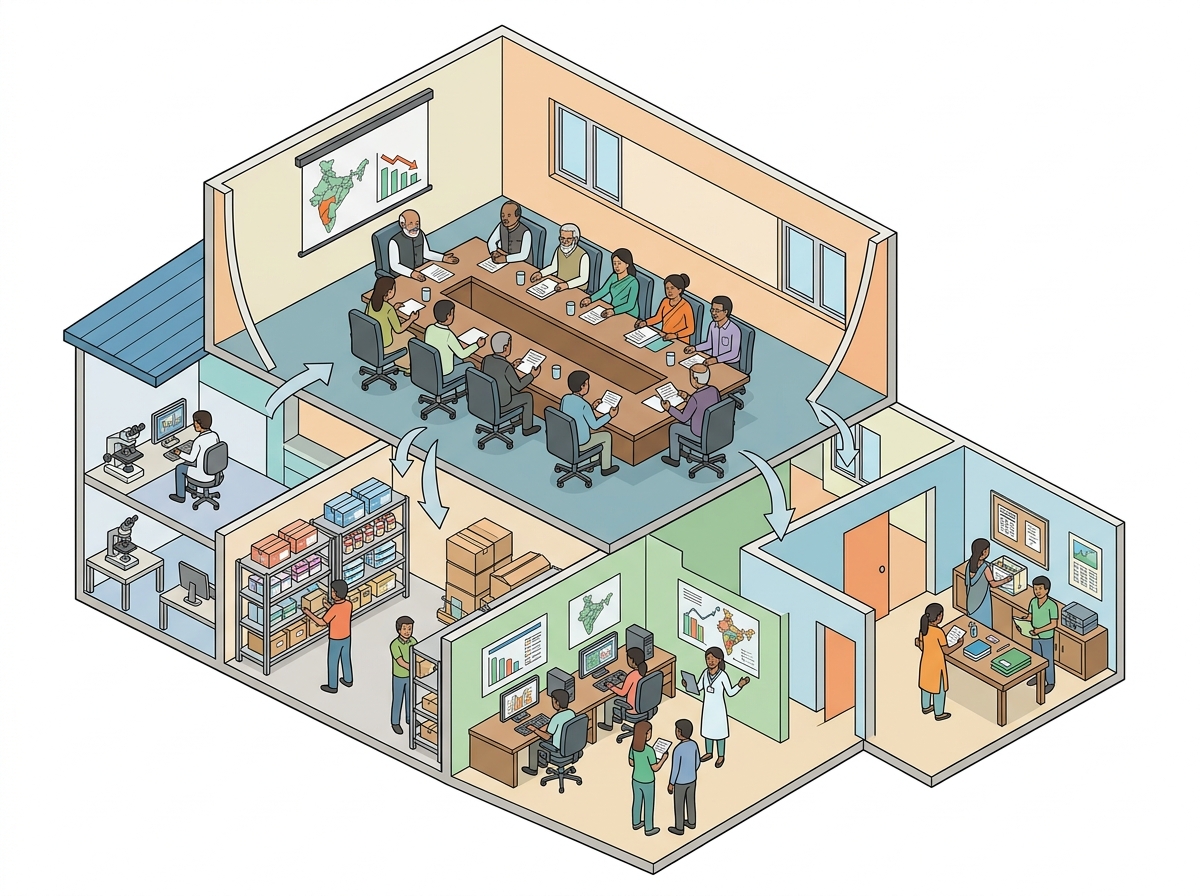
The meeting chaired by the Union Health Minister with Members of Parliament from Karnataka and Kerala underscores the multi-stakeholder approach to tuberculosis elimination, aligning parliamentary representation with ground-level health governance. It highlights the operationalisation of the ‘TB-Mukt Bharat Abhiyaan’ through structured engagement with legislators to review progress, address bottlenecks, and reinforce community participation in high-burden states.
Background
- Tuberculosis (TB) remains a significant public health challenge in India, accounting for approximately 27% of the global TB burden despite being a preventable and treatable disease.
- India’s TB elimination efforts are benchmarked against global standards, with the World Health Organization (WHO) reporting a 21% reduction in TB cases between 2015 and 2024—a rate nearly double the global average.
- The Union Health Minister highlighted India’s achievement of a 92% treatment coverage rate in the WHO Global TB Report 2025, reflecting progress in diagnostic and therapeutic reach.
What is the ‘TB-Mukt Bharat Abhiyaan’?
- The campaign employs a ‘Whole-of-Government’ and ‘Whole-of-Society’ approach, integrating health systems, local governance, and community participation for comprehensive impact.
- Key strategies include active case finding, decentralised diagnostic services, patient-centric care models, and real-time monitoring via the Nikshay Ecosystem—a digital platform for TB case management.
- The initiative prioritises high-risk populations, including marginalised communities, urban slums, and tribal areas, with targeted screening and preventive therapy.
- Parliamentary engagement forms a critical component, leveraging legislators’ reach to mobilise district administrations, health institutions, and local leaders for sustained action.
- Progress is reviewed through district-level dashboards, ensuring accountability and corrective measures in underperforming regions.
- The campaign aligns with India’s commitment to the Sustainable Development Goal (SDG) target 3.3, which aims to end the TB epidemic by 2030.
Key Features
| Feature | Significance |
|---|---|
| 100-दिवसीय टीबी-मुक्त भारत अभियान (24 मार्च–4 जुलाई 2026) | राष्ट्रीय टीबी उन्मूलन प्रयासों को तीव्र गति प्रदान करने वाला द्वितीय चरण; 2.02 करोड़ संवेदनशील व्यक्तियों की जांच और 7 लाख से अधिक नए टीबी मामलों की पहचान सुनिश्चित की गई। |
| राज्य एवं केंद्रशासित प्रदेशों के साथ समन्वित प्रयास | उच्च-जोखिम वाले 1.58 लाख गांवों एवं शहरी वार्डों में टीबी नियंत्रण गतिविधियों का विस्तार; जिला स्तर पर कार्यान्वयन की निगरानी सुनिश्चित की गई। |
| सांसदों की सक्रिय भागीदारी | राजनीतिक स्तर पर जन आंदोलन को प्रोत्साहित करने हेतु सांसदों द्वारा जागरूकता निर्माण, गुणवत्तापूर्ण सेवाओं की निगरानी और सामुदायिक सहभागिता सुनिश्चित की गई। |
| मरीज-केंद्रित देखभाल दृष्टिकोण | टीबी रोगियों की पहचान, उपचार एवं सहायता तक पहुंच बढ़ाने हेतु नवीन रणनीतियों (जैसे रोगी-पहचान अभियान) को अपनाया गया। |
| वैश्विक तुलनात्मक उपलब्धि | वर्ष 2015–2024 के मध्य टीबी मामलों में 21% कमी (वैश्विक औसत से दोगुनी) और 92% उपचार कवरेज दर प्राप्त करने में सफलता। |
Why it Matters
Public Health Impact
- टीबी उन्मूलन के राष्ट्रीय लक्ष्य (2025 तक) की प्राप्ति में महत्वपूर्ण योगदान; रोग बोझ में कमी और सार्वजनिक स्वास्थ्य प्रणाली की सुदृढ़ता।
- समुदाय स्तर पर टीबी नियंत्रण के प्रति जागरूकता एवं सहभागिता में वृद्धि, जिससे रोग के प्रसार में कमी आ सकती है।
- नवाचार एवं तकनीकी हस्तक्षेपों (जैसे डिजिटल निगरानी प्रणाली) के माध्यम से स्वास्थ्य सेवाओं की गुणवत्ता एवं पहुंच में सुधार।
Governance & Institutional Strengthening
- राज्य एवं केंद्र सरकार के बीच समन्वित प्रयासों से नीति कार्यान्वयन में पारदर्शिता एवं जवाबदेही सुनिश्चित हुई है।
- सांसदों एवं स्थानीय प्रशासन के मध्य समन्वय बढ़ाने से नीति निर्माण एवं कार्यान्वयन में सामुदायिक भागीदारी को बल मिला है।
- स्वास्थ्य मंत्रालय द्वारा निर्धारित निगरानी बिंदुओं के माध्यम से टीबी नियंत्रण प्रयासों की प्रभावी ट्रैकिंग सुनिश्चित की गई है।
Economic & Social Dimensions
- टीबी उन्मूलन से श्रम शक्ति की उत्पादकता में वृद्धि एवं स्वास्थ्य व्यय में कमी के माध्यम से आर्थिक लाभ प्राप्त होंगे।
- सामाजिक न्याय के सिद्धांतों के अनुरूप, टीबी से प्रभावित कमजोर वर्गों तक स्वास्थ्य सेवाओं की पहुंच सुनिश्चित करने में सफलता।
- जन आंदोलन के माध्यम से सामाजिक समावेशिता एवं स्वास्थ्य जागरूकता में वृद्धि, जिससे दीर्घकालिक स्वास्थ्य सुधार संभव होगा।
Challenges
1. उच्च जोखिम वाले क्षेत्रों में पहुंच एवं सेवाओं की गुणवत्ता
- ग्रामीण एवं दूरस्थ क्षेत्रों में टीबी नियंत्रण सेवाओं की पहुंच सुनिश्चित करना एक प्रमुख चुनौती है।
- स्वास्थ्य कर्मियों की कमी एवं प्रशिक्षण की कमी के कारण सेवाओं की गुणवत्ता प्रभावित हो सकती है।
- गुणवत्तापूर्ण निदान एवं उपचार सुविधाओं की उपलब्धता सुनिश्चित करने हेतु बुनियादी ढांचे का विकास आवश्यक है।
UPSC Link: GS-II: Health Infrastructure
2. स्टिग्मा एवं सामाजिक जागरूकता की कमी
- टीबी रोगियों के प्रति समाज में व्याप्त स्टिग्मा के कारण रोग की पहचान एवं उपचार में देरी हो सकती है।
- जन आंदोलन के माध्यम से सामाजिक जागरूकता बढ़ाने की आवश्यकता है, विशेष रूप से ग्रामीण एवं आदिवासी क्षेत्रों में।
- मीडिया एवं सोशल मीडिया के माध्यम से सटीक सूचना प्रसारित करने हेतु प्रभावी रणनीतियों की आवश्यकता है।
UPSC Link: GS-II: Social Justice & Health
3. निगरानी एवं मूल्यांकन प्रणाली की प्रभावशीलता
- टीबी नियंत्रण प्रयासों की प्रभावी निगरानी हेतु डेटा संग्रह एवं विश्लेषण प्रणाली को सुदृढ़ करने की आवश्यकता है।
- राज्य एवं केंद्र सरकार के बीच सूचना के आदान-प्रदान एवं समन्वय में सुधार आवश्यक है।
- निजी क्षेत्र एवं गैर-सरकारी संगठनों के साथ सहयोग बढ़ाने से निगरानी प्रणाली को और प्रभावी बनाया जा सकता है।
UPSC Link: GS-II: Governance & Policy Implementation
4. अंतरराष्ट्रीय सहयोग एवं संसाधन जुटाना
- टीबी उन्मूलन हेतु वैश्विक संसाधनों एवं तकनीकी सहायता प्राप्त करने की आवश्यकता है।
- अनुसंधान एवं विकास में निवेश बढ़ाने से नवीन उपचार एवं टीकों के विकास को गति मिल सकती है।
- अंतरराष्ट्रीय संगठनों (WHO, GFF) के साथ सहयोग बढ़ाने से नीति निर्माण एवं कार्यान्वयन में सुधार संभव होगा।
UPSC Link: GS-II: International Relations & Health
5. स्वास्थ्य प्रणाली में बहुआयामी चुनौतियां
- टीबी नियंत्रण के लिए आवश्यक मानव संसाधनों एवं बुनियादी ढांचे की कमी।
- स्वास्थ्य सेवाओं तक पहुंच में असमानताएं, विशेष रूप से कमजोर वर्गों में।
- स्वास्थ्य प्रणाली की क्षमता में वृद्धि हेतु दीर्घकालिक निवेश एवं योजना आवश्यक है।
UPSC Link: GS-II: Health System Strengthening
Challenges — UPSC Perspective
| Issue | Concern |
|---|---|
| ग्रामीण एवं दूरस्थ क्षेत्रों में सेवाओं की पहुंच | स्वास्थ्य सुविधाओं की कमी एवं परिवहन संबंधी चुनौतियां |
| स्टिग्मा एवं सामाजिक जागरूकता | रोगियों द्वारा उपचार लेने में देरी एवं भेदभाव |
| निजी क्षेत्र की भागीदारी | निजी स्वास्थ्य प्रदाताओं द्वारा टीबी मामलों की अधूरी रिपोर्टिंग |
| डेटा गुणवत्ता एवं निगरानी | अपूर्ण रिपोर्टिंग एवं डेटा विश्लेषण में चुनौतियां |
| अंतरराष्ट्रीय संसाधन जुटाना | वैश्विक सहायता एवं तकनीकी सहयोग की कमी |
Government Initiatives — Must-Memorise for Prelims
- टीबी-मुक्त भारत अभियान (2024–2026)
Way Forward
- राज्य एवं केंद्र सरकार के बीच समन्वित प्रयासों को और सुदृढ़ करना, विशेष रूप से उच्च जोखिम वाले क्षेत्रों में।
- टीबी नियंत्रण सेवाओं की गुणवत्ता एवं पहुंच सुनिश्चित करने हेतु स्वास्थ्य अवसंरचना का विकास एवं मानव संसाधनों का प्रशिक्षण।
- जन आंदोलन के माध्यम से सामाजिक जागरूकता बढ़ाना, विशेष रूप से ग्रामीण एवं आदिवासी क्षेत्रों में।
- निजी क्षेत्र एवं गैर-सरकारी संगठनों के साथ सहयोग बढ़ाना, जिससे टीबी मामलों की रिपोर्टिंग एवं निगरानी में सुधार हो सके।
- अंतरराष्ट्रीय संगठनों एवं वैश्विक संसाधनों के माध्यम से तकनीकी सहायता एवं अनुसंधान में निवेश बढ़ाना।
- टीबी उन्मूलन हेतु राष्ट्रीय एवं राज्य स्तरीय निगरानी प्रणाली को सुदृढ़ करना, जिससे डेटा गुणवत्ता एवं विश्लेषण में सुधार हो सके।
- टीबी रोगियों के प्रति स्टिग्मा कम करने हेतु मीडिया एवं सोशल मीडिया अभियानों का संचालन करना।
UPSC Value Addition
Keywords for Mains Answer-Writing
National Tuberculosis Elimination Programme (NTEP) · Sustainable Development Goal 3.3 · Parliamentary engagement in public health · Community-based TB care · Patient-centred TB services · District-level health governance · WHO Global TB Report 2025 · TB case detection and treatment coverage · 100-Day TB-Free India Campaign · Multi-sectoral convergence for TB elimination
Concept Flow
टीबी उन्मूलन हेतु राष्ट्रीय लक्ष्य निर्धारण → 100-दिवसीय टीबी-मुक्त भारत अभियान का द्वितीय चरण (24 मार्च–4 जुलाई 2026) → 2.02 करोड़ संवेदनशील व्यक्तियों की जांच एवं 7 लाख नए मामलों की पहचान। → उच्च-जोखिम वाले 1.58 लाख गांवों एवं शहरी वार्डों में टीबी नियंत्रण गतिविधियों का विस्तार → राज्य एवं केंद्र सरकार के बीच समन्वित प्रयास। → सांसदों द्वारा जन आंदोलन में सक्रिय भागीदारी → सामुदायिक जागरूकता एवं गुणवत्तापूर्ण सेवाओं की निगरानी सुनिश्चित करना। → मरीज-केंद्रित देखभाल दृष्टिकोण अपनाना → नवीन रणनीतियों (जैसे रोगी-पहचान अभियान) के माध्यम से टीबी नियंत्रण में सुधार। → वैश्विक तुलनात्मक उपलब्धि → वर्ष 2015–2024 के मध्य टीबी मामलों में 21% कमी एवं 92% उपचार कवरेज दर प्राप्त करना। → भविष्य की रणनीतियाँ → स्वास्थ्य अवसंरचना का विकास, अंतरराष्ट्रीय सहयोग एवं सामाजिक जागरूकता अभियान।
Prelims Practice Questions
Q1. Consider the following statements regarding the National Tuberculosis Elimination Programme (NTEP) in India:
1. The NTEP is aligned with Sustainable Development Goal 3.3, which aims to end the TB epidemic by 2030.
2. The programme includes a 100-Day TB-Free India Campaign to accelerate case detection and treatment.
3. The NTEP is implemented exclusively through centralised health institutions without involving district-level governance.
4. The programme has achieved a 92% treatment coverage rate, as per the WHO Global TB Report 2025.
How many of the above statements are correct?
- Only one
- Only two
- Only three
- All
Answer: Only three — Statements 1, 2, and 4 are correct. Statement 3 is incorrect as the NTEP involves multi-level governance, including district-level health authorities.
Q2. Assertion (A): The 100-Day TB-Free India Campaign was launched to review progress and accelerate TB elimination efforts nationwide.
Reason (R): The campaign was implemented in two phases, covering high-priority districts and later expanding to high-risk villages and urban wards.
(a) Both A and R are true, and R is the correct explanation of A.
(b) Both A and R are true, but R is not the correct explanation of A.
(c) A is true, but R is false.
(d) A is false, but R is true.
- a
- b
- c
- d
Answer: a — Both the assertion and reason are true, and the reason correctly explains the assertion. The campaign was designed to review progress and accelerate TB elimination through phased implementation.
Q3. Match the following initiatives with their respective objectives under the National Tuberculosis Elimination Programme (NTEP):
Initiative:
1. Patient-centred TB care
2. 100-Day TB-Free India Campaign
3. District-level monitoring
4. Multi-sectoral convergence
Objective:
A. Accelerate case detection and treatment
B. Ensure community engagement and awareness
C. Strengthen local health governance
D. Prioritise individual patient needs in TB management
Select the correct match:
- 1-D, 2-A, 3-C, 4-B
- 1-A, 2-B, 3-C, 4-D
- 1-B, 2-A, 3-D, 4-C
- 1-C, 2-D, 3-A, 4-B
Answer: 1-D, 2-A, 3-C, 4-B — 1-D (Patient-centred TB care prioritises individual patient needs), 2-A (The 100-Day Campaign accelerates case detection and treatment), 3-C (District-level monitoring strengthens local health governance), 4-B (Multi-sectoral convergence ensures community engagement and awareness).
Mains Practice Question
✍ The National Tuberculosis Elimination Programme (NTEP) represents a paradigm shift from a purely biomedical approach to a patient-centred, community-driven strategy for TB elimination in India. Critically examine this assertion with reference to the 100-Day TB-Free India Campaign, parliamentary engagement, and district-level governance mechanisms. (15 Marks)
Approach: MODEL-ANSWER SKELETON:
1. **Introduction**: Define NTEP and its alignment with SDG 3.3; highlight the shift from biomedical to patient-centred care.
2. **Patient-centred TB care**: Explain the principles of patient-centred care (e.g., dignity, autonomy, and support systems) as per WHO guidelines and NTEP’s operational framework. Cite data on treatment coverage (92%) and case detection from WHO Global TB Report 2025.
3. **100-Day TB-Free India Campaign**: Describe the campaign’s objectives, phases (high-priority districts → high-risk villages/urban wards), and outcomes (2.02 crore screenings, 7 lakh new cases detected). Critically assess its impact on accelerating TB elimination.
4. **Parliamentary engagement**: Discuss the role of MPs in TB elimination (e.g., district-level coordination, community awareness, and resource mobilisation) as highlighted in the PIB release. Evaluate the effectiveness of parliamentary involvement in public health governance.
5. **District-level governance**: Explain the role of district collectors and health institutions in implementing NTEP, including monitoring mechanisms and convergence with other sectors (e.g., education, urban development).
6. **Critical analysis**: Weigh the strengths (e.g., multi-sectoral approach, community participation) against challenges (e.g., stigma, healthcare access disparities, and implementation gaps).
7. **Conclusion**: Summarise the paradigm shift and its potential to achieve TB elimination by 2025, while acknowledging the need for sustained political and administrative commitment.
Source: PIB (Press Information Bureau)
Generated by AanyaAi for educational purpose.

- भारत-अमेरिका संबंधों में सीमापार आतंकवाद की चिंता क्यों है महत्वपूर्ण? जानिए क्या बोले एस. जयशंकर - September 29, 2026
- CAG Flags Rs 1,136 Crore Pending E-Challans in Odisha: Key Audit Findings - September 29, 2026
- मुद्रास्फीति लक्ष्यीकरण पर पुनर्विचार का समय: अर्थव्यवस्था के लिए नया दृष्टिकोण - September 29, 2026

No Comments